The ability of AI to produce thousands of protein sequences is no longer the best thing to show for the development of AI biopharmaceuticals. More importantly, the question is whether the molecules that are actually sent to the lab will be small enough and the chances of success high enough.
Molecular Heart recently released the latest AI technology report from the flagship design platform MMDesign, which gives a shocking answer: out of 19 design projects covering 18 thresholds, nanoparticles (VHH) and molecular modeling of two types of molecules, 18 of the experimentally confirmed binding molecules had a project success rate of 94.7%; each project tested only 9 to 50 candidates, with a median score of 21. More significantly, six GPCR thresholds were all successful, and a new round of design was carried out for six thresholds that had previously successfully obtained the target molecule, five of which achieved better results than the previous round.
The signal that this group of results conveys is not AI, yet again, but from the beginning, the design is moving from the prime example of individual villas to a small number of experimental verification, cross-focus, cross-modal repeatable R&D workflows.
Each project measures only a few dozen: AI design begins to compress the scope of experimental screening
Antibodies have long been found to rely heavily on animal immunity and large-scale database screening to find binding molecules in a large number of candidates.
AI attempts to change the starting point from scratch: the researchers specify target proteins and potential binding sites, directly generating new molecular sequences by AI. But the key breakthrough is precisely selecting candidate molecules with binding potential that can be accessed for experimental verification.
MMDesign uses the process of lithium generation, lithium computation, lithium optimization, lithium experimentation, and lithium verification: first exploring a large number of sequences in computational space, then combining criteria such as structural reliability, sequence characteristics, and physical evaluation, to compress the number of candidates to only 9 lithium (50 lithium) per project, much like allowing AI to complete a molecule in a computer.
Of the 19 design projects summarized in the report, 18 received hit candidates, with a 94.7% success rate; of the 453 candidates tested, 139 received confirmed combinations, with a combined candidate hit rate of about 30.7%; and of the 15 projects that received at least two combinations of molecules, with options reserved for further screening optimization.
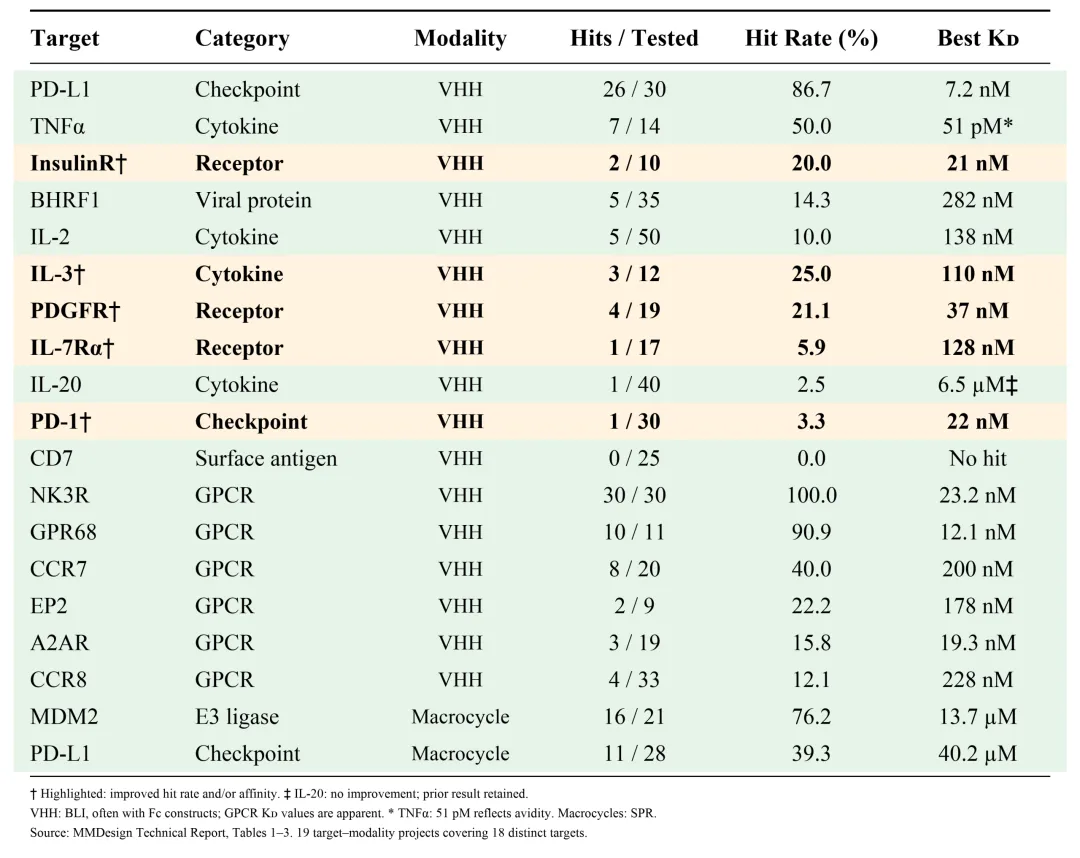
Summary of verification results

There are two different but both important indicators: 94.7% measures whether a project can find at least one binding molecule, and 30.7% measures how many genuine binding molecules there are in the candidate for the test. The two together suggest that MMDesign not only expands the production scale of the computational end, but tries to compress the scope of laboratory verification to dozens of molecules, and that successful binding molecules can be accessed into subsequent R&D processes.
For pharmaceutical research, the potential value is very direct: experimental resources can be more focused on hopeful design if the computing end can rule out a large number of low-value candidates sooner.
Six GPCRs all hit: putting the ability to spot the difficulty in front of the stage
While the 94.7% project success rate demonstrates efficiency, the results of the GPCR series are more reflective of the technical strength of the design from scratch. GPCR is an important family of drug targets, its membrane environment, changes in composition and limited extracellular binding regions, making it difficult to design molecular binding for such targets.
The evaluation included six GPCR focal points for CCR7, CCR8, EP2, GPR68, NK3R and A2AR, all of which received experimentally confirmed binding molecules.
Of these, two groups of results were particularly remarkable: for 30 candidates for the NK3R test, the total success rate was 100%; for 11 candidates for the GPR68 test, there were 10 hits. Both had a combined total of 41 candidates, 40 hits.
It's not just a matter of raising the numbers. In terms of complex membrane protein targeting, finding binding molecules in very few experimental candidates has itself improved the credibility of the design pathway from scratch.
The report also noted that out of the five GPCR hotspots for previously scheduled therapeutic antibodies that were not retrieved from Thera-SAbDab designated version databases, 89 candidates received 53 binding molecules, with a candidate mortality rate of 59.6%.
From a 100% candidate hit rate to successful detection of binding molecules at complex focal points where no known therapeutic antibody precedent exists, the breakthrough of MDDesign not only reflects the superior performance of individual molecules, but also its wide applicability at high-density membrane protein focal points, providing a new technological pathway for the detection of complex focal points such as GPCR, and further validating the application potential of AI from scratch in traditional R&D focal points.
From one hit to widespread success: reusable is the key to an industry-class platform
For pharmaceutical companies, it is important for AI technology to breakthrough at some point, but long-term collaboration is more important than two things: whether the same R&D problem can be addressed and whether the design can be continuously optimized through multiple iterations; and whether the platform can be repeatedly applied to different R&D tasks.
In this evaluation, MMDesign carried out a new round of design focusing on six previously available design outcomes, with five projects achieving further improvements in hit rates, best friendliness, or both.
For example, in the PDGFR project, the candidate hit rate increased from 4.0% to 21.1%, which is 5.2 times higher than before; the best KD37 nM, 150 nM, achieved a four-fold improvement over the previous round.
The range of application of platform capabilities extends to different molecular models. In addition to nanoparticles, the two major ringworms in the report were initially designed to combine molecules: 16 hits from 21 candidates for Project MDM2, 11 hits from 28 candidates for Project PD-L1, and the best report KD at 13.7 μM and 40.2 μM respectively, indicating that the relevant design and verification workflow has expanded to a distinctly different molecular type with VHH properties.
From widespread hits at different points of focus, to improvements in performance in a new round of design at the same point of focus, and to the expansion of large-scale modeling, MMDesign demonstrates not only single design capabilities, but adaptability and continuous optimization potential in the face of different R&D tasks. For pharmaceutical companies that need to advance multiple projects over the long term, this replicability is an important foundation for AI from the main design platform to real R&D applications.
Not just a combination of: molecular quality and model advantages of MMDesign
The discovery of the drug involved more than mercury being unable to bind to mercury. A valuable early-stroke molecule, mercury was also subjected to pre-drug physical examination to investigate developmental problems such as stability of expression, ease of accumulation, and mismatch in binding to unrelated proteins.
According to reports, many MMDesign-designed VHH-Fc candidate molecules are stable in CHO cells, the purified molecules remain single, show fewer signs of clumping, and exhibit lower non-specific responses in alternative testing of insulin and double-stranded DNA.
This is a positive initial developmental signal, meaning that while the platform pursues combined vitality, it further accommodates the critical characteristics required for molecules to enter subsequent drug development.
In terms of sequence novelty, the report emphasizes that from scratch design does not directly retrieve existing antibody sequences or local mutations with known binding molecules as starting points; comparisons with databases such as PDB, OAS and SAbDab show the novelty of some sequences and identifying regions. This is expected to realise the outstanding value of from scratch design.
The underlying model capabilities are determined by AI from the outset, supporting MMDesign's high-efficiency precision design, which is the molecular heart of structural predictive model MMFold, which also exhibits outstanding performance.
The overall success rate of the MMFold Top-1 prediction was 70.9%, the high-quality prediction was 39.0%, and the success rate was about twice that of AlphaFold 3 in all 172 FoldBench antibody and antigen interfaces; in 160 common subset interfaces, the MMFold Top-1 high-quality prediction was 39.4%, up from 33.0% previously published by OpenDDE and 28.2% for Protenix-v2.
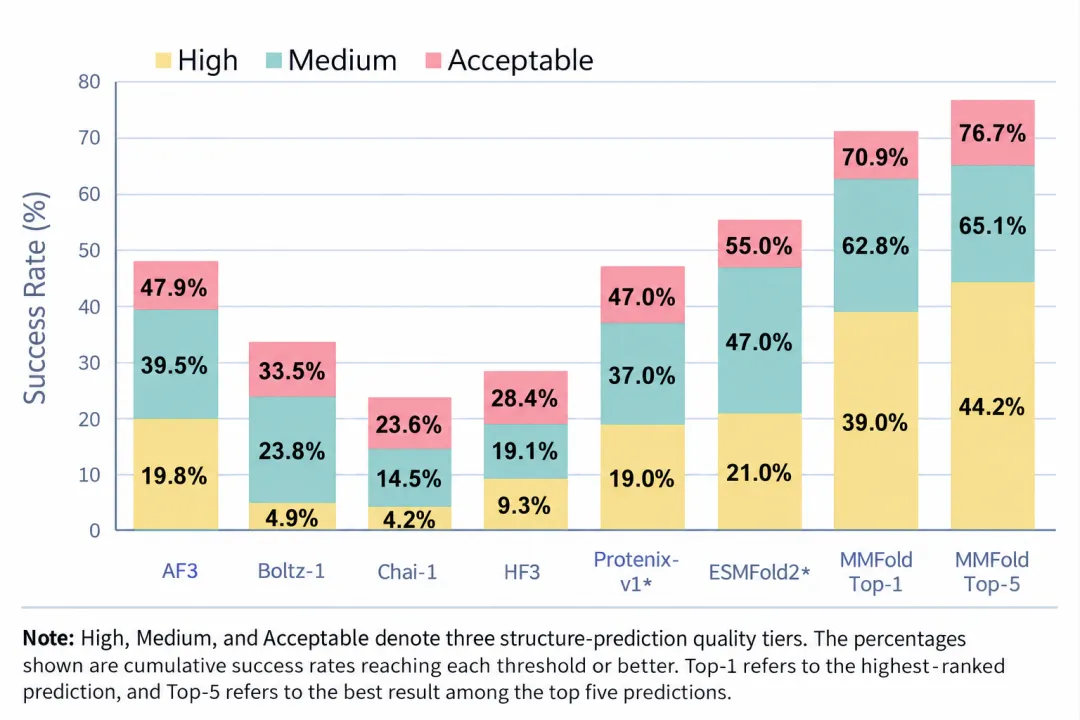
FoldBench All 172 antibodies for the structure of the antigen interface
Structural predictions for FoldBench's 160 common interface subset
For the design process from the outset, structural prediction is not about ranking, but about providing a critical computational basis for the evaluation and preference of candidates. Structural prediction is more accurate and molecular design can more accurately lock candidates in the vast computational space.
From lithium-mass lithium molecule lithium to lithium-precision-designed lithium molecule lithium: upgrades to the paradigm behind the report
From 18 of the 19 successful projects, to six GPCR targets, to the further leap forward and expansion of cross-sectional design results, MMDesign's latest report demonstrates not only whether AI can generate a binding molecule, but a gradual set of molecular discovery workflows that move towards repeatable applications.
This also gives a clearer overall logic to the technical layout at the heart of the molecule: NewOrigin provides the underlying large model, MMDesign assumes the task of generating and selecting candidates from scratch, MMFold focuses on structural predictions, QuantaMind performs dynamic simulations, and MoleculeOS attempts to organize different model tools and R&D tasks into a unified process.
In terms of AI biopharmaceutical research and development, the really worthwhile change may be happening here.
When computational design was able to compress the previously vast exploratory space into a limited, verifiable set of experiments, early discoveries gave rise to the opportunity to move from relying on mass screening to the new paradigm of precise requirements, precise design, limited verification, and continuous optimization.
At the heart of the report is the cross-focus design outcomes, low-volume hit efficiency and underlying modeling capabilities that provide new evidence to support this direction. In this sense, the progress of MDDesign is not just a technological achievement update, but an important step in AI from the ground up to an industry-class R&D tool.
Sources: The heart of the molecule MMDesign's latest technology report
© THE