A Skill can work normally this week, not next week.
The search interface will be restricted, the API will be modified, and the page structure may change abruptly. The developers discovered a bug, fixed the latest version, and handed the files over to the next round of agents.
Why was it modified in the first place? Why did the program fail? What was withdrawn in the last round and what was left? Most of the agents who took the next round don't know.
In its paper SkillHone, Tencent WeChat summed up this problem as an optimization of historical loss, thus proposing a development framework for ongoing Skill evolution.
SkillHone organizes each round of diagnostics, candidate modifications, evaluation evidence and final decisions into a lasting decision history. At the same time, continuous optimization objects extend from a single SKILL.md file to the entire Skill folder and its modification process.
SkillHone: A Harness for Continual Agent Skill Evolution Through Persistent Decision History
One, you can't just optimize your skills.
We also need to model the process of optimizing Skills itself.
The existing Skill methodology is broadly divided into two categories. One is Skill-Creator, which generates new Skill based on task descriptions, examples or data; the other is Hermes-SE(Hermes Agent Self-Evolution), which continuously modifies existing Skill candidates and selects improved versions based on evaluation results.
This type of method can get better Skill in single-wheel optimization, but the optimization process is usually not retained. After running, only the final version files are often left behind. Although file differences can show "what changed", they cannot answer "why". When the environment changes, Agents cannot use past optimization experiences to easily re-explore failed directions.
SkillHone not only optimizes Skill itself, but also models the process of optimizing Skill. Each step of optimization is recorded as a decision history, including problem diagnosis, candidate revision, evidence of clean-up evaluation and final results. By accumulating these multi-round decision records, subsequent Agents can understand the reasons for a change in the targeted problem, the basis for adoption, and the final retention or withdrawal, so that the optimization experience is passed on continuously rather than merely inheriting the final Skill.
Second, how to keep the optimization process going.
SkillHone has two interconnected warehouses. Skill warehouses include SKILL.md, scripts, information, and templates; and Skill-Eval warehouses include practice probes, standard answers, verifiers, run trajectories, and regression tests.
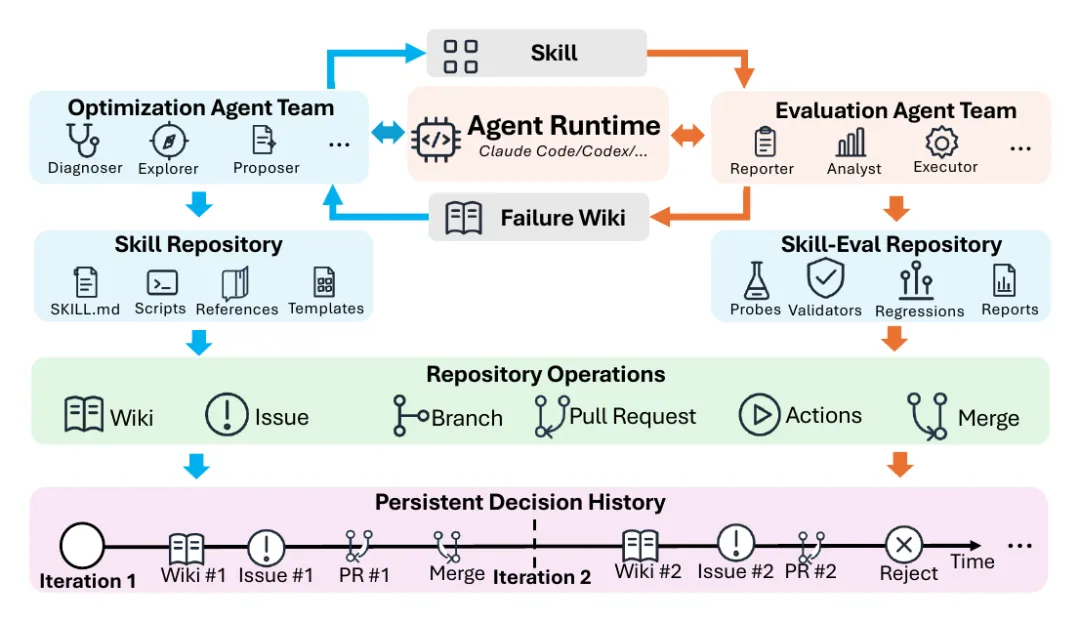
At the start of each round of evolution, the evaluation side first uses the return test on the current Skill Running Verification Set. The optimization side modifies the Skill candidate on the basis of de-sensitivity reports and existing records. The evaluation side then tests the Skill candidate on the benchmark version. The system decides to accept, continue to modify or reject the modified Skill, and will rewrite the evidence into history.
On the optimization side, the Agent can modify Skill, but does not see an unresponsive response. On the evaluation side, the Agent can run verification, view trajectories, but cannot write to the Skill repository. The evaluation results are sorted into failure types, aggregate scores and diagnostic clues, and then returned to the optimization side.
When running, the scheduler generates diagnostic, development, audit, execution, and reporting sub-agents depending on the need, and each character only receives the necessary permissions to complete their own tasks. It does not require the use of a fixed multi-smart body framework, but only that the operating environment can create sub-smart bodies automatically, allowing direct access to Agent Runtime such as Claude Code, Codex, and Hermes.
Three, why do you want to do a Repo-level update?
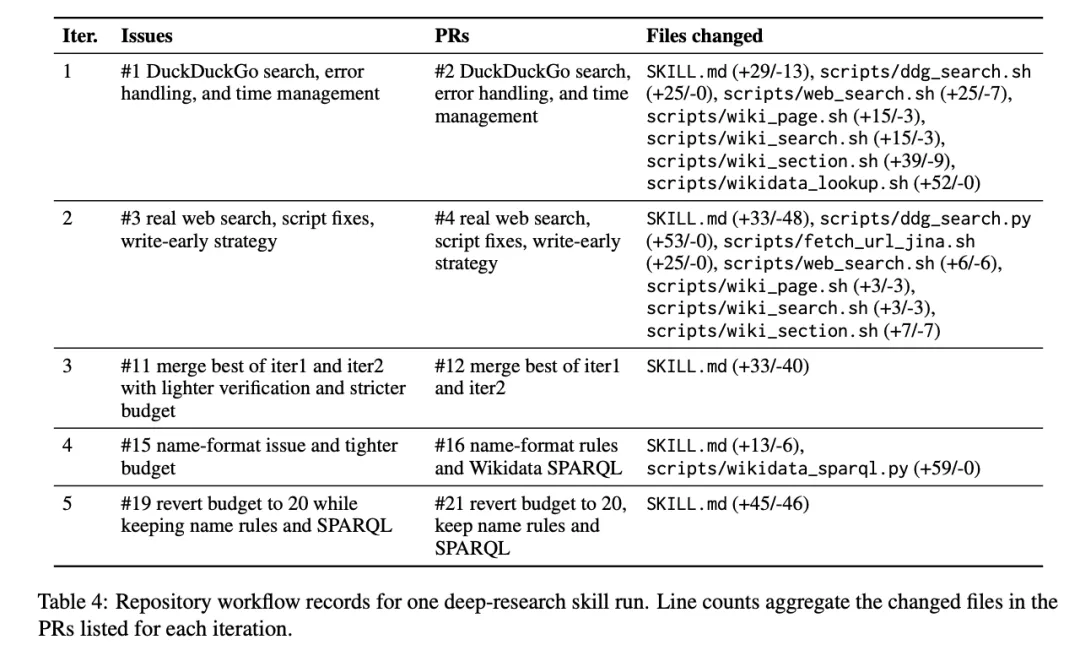
SkillHone allows Repo-level updates to be implemented in the optimization process, rather than just optimizing SKILL.md.
On the other hand, SkillHone also supports Skills updates at the Repo level. SkillOpt and Hermes-SE are both optimized mainly with SKILL.md units, essentially to replace Skill's natural language description, so the optimization scope is limited to individual documents.
In contrast, SkillHone will extend the optimization object to a complete Skill repo, seeing Skill as a complete Repo made up of SKILL.md, executing scripts, references, templates, etc. In the optimization process, not only can the instructional description be modified, but also the contents of auxiliary documents such as script logic can be directly updated.
In four or five rounds of optimization,
How does SkillHone handle back-and-forth?
When the system only looks at the final scores, the entire candidate is often discarded once the candidate version is degraded. However, changes that are already in effect in the candidate version will disappear with it, and the next round will have to be rewritten.
In the paper, the authors wrote that five rounds of in-depth research optimised Skill. After the system joined DuckDuckGo, the probe accuracy increased from 30 percent to 60 percent. Following the next round of early response and strict budget restrictions, accuracy decreased by 10 percentage points.
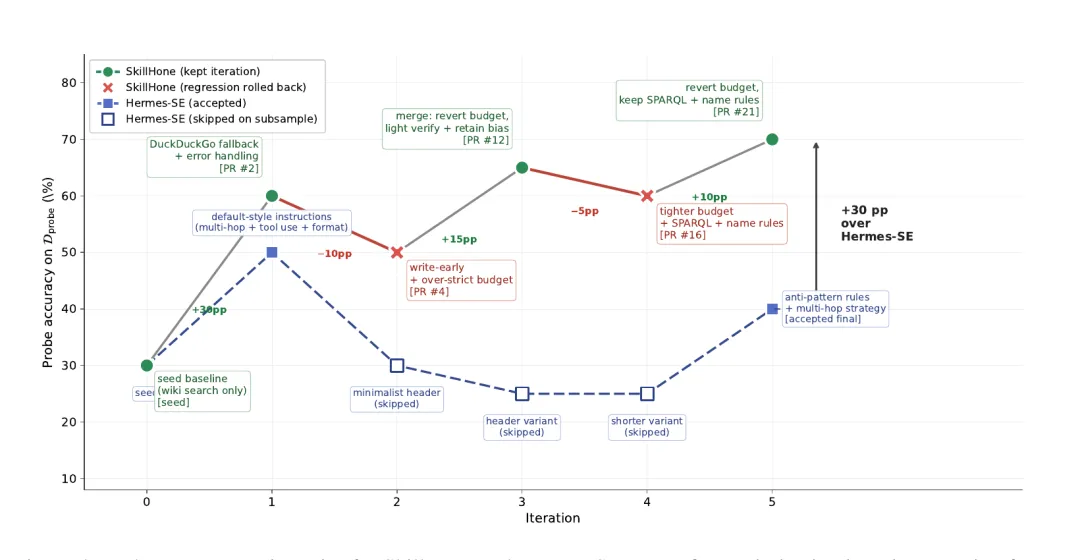
The optimization trajectory of SkillHone and Hermes-SE's five rounds of verification sets (Figure 4)
SkillHone was able to analyze the history of the problem in terms of budgeting strategies, so it only withdrew the part of the problem, retaining the search improvements that had been proven to be effective, and the third round accuracy increased to 65%. After the addition of SPARQL, the naming rules and the stricter budget, the system carried out a further targeted withdrawal, which eventually reached 70% accuracy.
Similarly, starting at 30%, Hermes-SE accepted or rejected a complete candidate based on the rating score, stopping at 40% after five rounds. The difference between the two tracks is clear: SkillHone can see which decisions led to performance degradation and retain the changes already in effect when returning.
Five experiments: performance, migration and melting
The authors tested SkillHone on two in-depth study benchmarks, GAIA and WebWalkerQA-EN. The evaluation was conducted in an open network environment with no pre-integrated search tools. Agents could only access public web pages and then rely on Skill organizations to search, extract, verify and recover from failures.
Using Qwen 3.6-35B-A3B as an execution model, SkillHone reached 64.6% on GAIA and 66.4% on WebWalkerQA-EN. Both results were 15.8 and 3.2 percentage points higher compared to deep-research agents using commercial retrieval services; and 14.2 and 13.4 percentage points higher compared to Hermes-SE respectively.
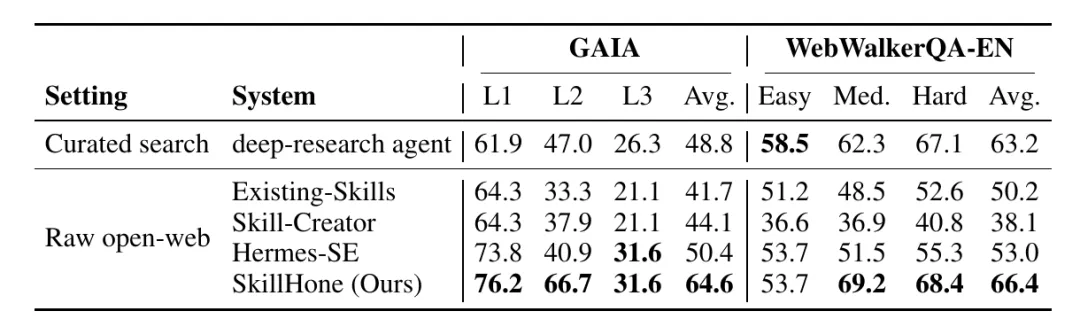
Table 1 SkillHone main results on GAIA and WebWalkerQA-EN
More importantly, the same Skill package continued to rise to 72.4% after the direct migration to Claude Sonnet 4.6 without re-optimization, still higher than Hermes-SE, Existing-Skills and Skill-Creator. After replacing the execution model, users did not need to re-optimize from scratch.
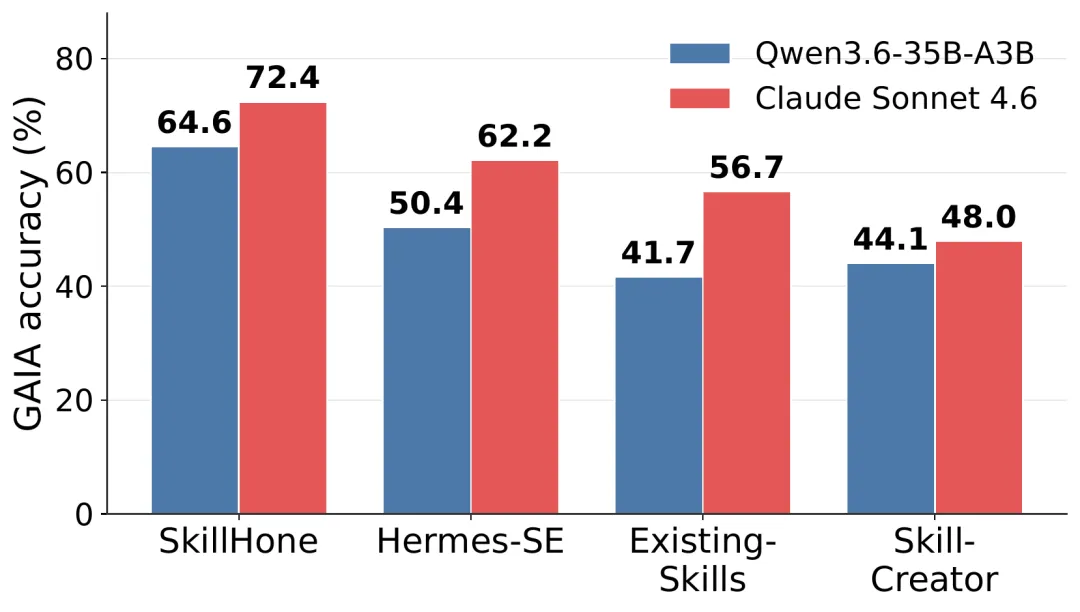
Figure 2 The GAIA results of different methods in Qwen and Claude Sonnet 4.6
After removing the decision history, the GAIA and WebWalkerQA-EN scores fell by 13.4 and 10.9 percentage points respectively. After removing the character isolation, the two scores dropped by 6.4 and 5.3 percentage points respectively.
Table 2 Decision-making history and role-separation dissolution experiments
Six, written at the end.
This is the first time I've read this article.
The answer to the question of how to improve skills documentation in the past has been automated.
SkillHone continues to ask why the changes are being made, how they are being accepted, and which ideas are no longer being adopted.
The optimization process can therefore be retrieved, reused, and handed over to the next round of continued optimization by the Agent;
The Repo-level update allows the model to be adapted to skills projects, including SKILL.md, scripts, references, and templates.
The five-wheeled trajectory in the paper provides direct evidence. When SkillHone encounters a performance regression, it is able to find the changes that have occurred and to withdraw them accurately, while retaining the changes already in effect.
The next round of agents can continue to make decisions based on previous diagnoses and evidence, or directly modify SKILL.md, scripts, references and templates.