Recently, a 3D drama game titled The Little Prince of Bel-Air is on fire on X.
The familiar B-612 planet, the lonely monkey, the mysterious universe... the fairy tale world of Saint-Exupery has become a game to explore in person.
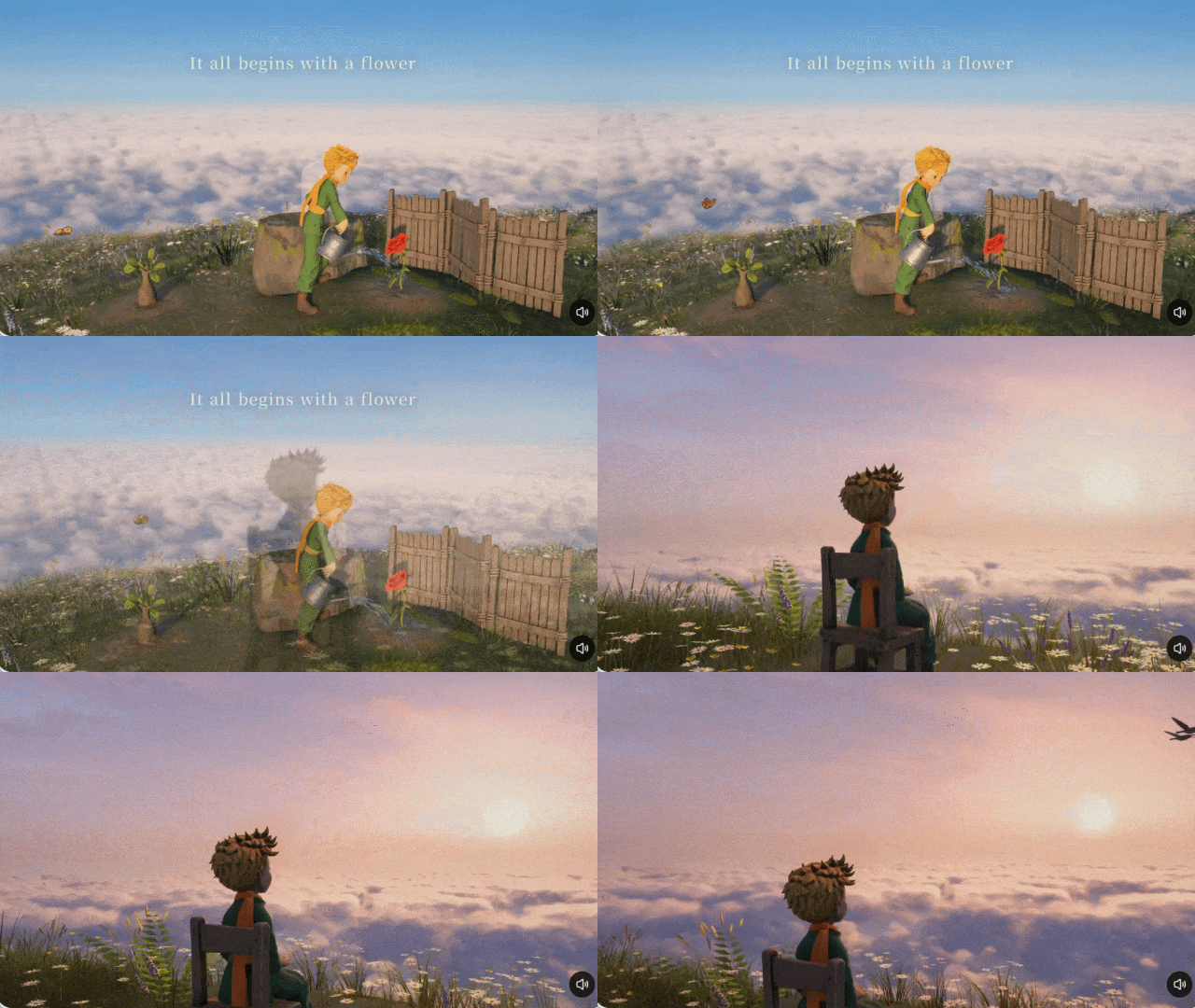
What's even more surprising is that the game was developed by independent developer Sac, who, in just 16 days, used AI to turn Little Prince into a 3D action-adventure game.
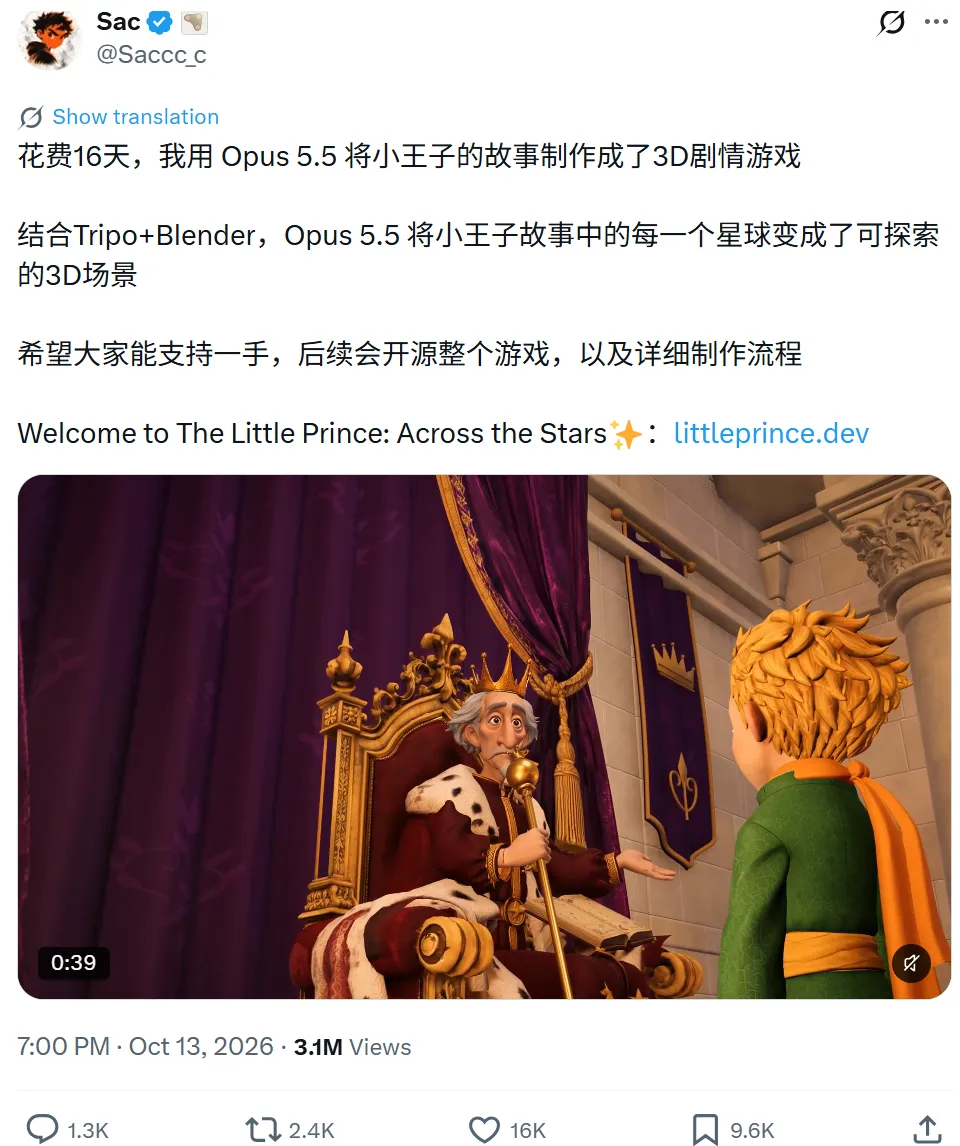
This is the first time this has happened.
One person, in 16 days, can turn classic fairy tales into a playful three-dimensional world.
It is understood that Sac used Opus 5.5 to help write the game code, using Tripo to create 3D models and then to complete the production through Blender.
It's an interesting place.
The company's world-model research has made new strides just as the Little Prince game is going viral.
This time, VAST brought out the latest stage of sexual results, EdenLive.
This is a renderer for "real-time generated rendering" in the Project Eden series of VAST-owned World Model Research projects, using Proxy (simplified reference image) or reference video as the control signal, combining targeted preview images and text cues to continuously generate written, refined, or stylized video images.
Imagine that if you applied EdenLive to a game like Little Prince of Persia, developers could build a game using simplified 3D scenes, then create more fine-grained images in real-time with EdenLive, and even freely switch between different styles of fairy tales, writing, and painting.
In the past, video generation usually required waiting for the model to complete the calculations and then to see the results of the production. EdenLive was able to continue to receive the reference images of the changes and to generate corresponding visual content in real time, allowing users to operate and image changes to form continuous feedback.
In terms of performance, under the configuration of the single Nvidia RTX 5090, 5B parameter model, 720P, the real-time torque of EdenLive exceeds 24 FPS. Continuous generation can last up to the minute level, with output of both 480P and 720P, leaving room for choice between efficiency and image quality.
It's worth noting that VAST also makes EdenLive fully open source, covering model weights for different size specifications, reasoning codes, and technical details and optimization schemes such as model training methods, data, and Tech Report.
At the same time, the team also opened up Game Prototype Turbo, a "Prompt to Proxy Game" Skill. Users can quickly generate directly playable Proxy Games through it; the status data generated during game play can also be synchronized into EdenLive, rendered by the model in real-time as dynamic images, and feedback to the player, forming a complete chain from game logic to real-time visual presentation.
To give developers a more intuitive experience of the process, the team will also open an end-to-end demo, showing the entire process from natural-language game creation, real-world trials, target assignments, to real-time rendering in EdenLive.
In this way, developers can not only directly experience the capabilities of the model, but also further explore its technological realization and access generative rendering in their own games, animation and other interactive applications.
The code is:https://github.com/VAST-AI-Research/EdenLive
The main page of the project:
Technical report:
Open Weight:
With any reference, any drawing, EdenLive uses real-time rendering to play out the flowers.
Next, let's take a look at more demos to get an intuitive feel for the production effects of EdenLive.
EdenLive gives an example. Based on real-life video, the model retains its original rhythm and movement trajectory, while re-interpreting characters and scenes into an anime style.
That is, the action is still the action, but the appearance of the characters, the texture of the image and the overall visual language have been reproduced.
The visual styles of scenes and objects can also be freely switched. The following example is the conversion of real street scenes into high-altitude star-shaped visual styles.
A cartoonist riding a bicycle was rendered via EdenLive, and the picture became a real-life writing scene by the lake.
A cartoon snowmobile is transformed into snow-capped images of snow covered roads, trees along the way and with real-life shadow effects.
These demos are based on the same set of generating logic.
Regardless of whether it's a reference to 2D animation, 3D scenes or real-life video, EdenLive can use the structure and motion information in it to redefine the style of the image using target headers and cues.
A more critical breakthrough is real-time.
Traditional real-time rendering relies on artificial 3D production assets, adjusting materials and shadows, producing high-cycle lengths. While offline video generation models can produce beautiful images, they need to wait for production to be completed, difficult to provide real-time feedback on user operations, and impossible to embed in real-time interaction cycles.
EdenLive offers a new solution between the two. It is possible to continue producing high-quality images in real-time without the need to create complete artistic assets in advance by providing rough scenic structure and movement references.
More importantly, the generation process can be accessed directly by the interactive system. After the user sends an operation, the underlying engine updates the state of the world and continues to output the corresponding reference images.
In this way, circular, generative rendering really enters the real-time interaction process, allowing images to change continuously as users operate.
It is also very suitable for pre-production of video and animation. Directors or animators can use simple images to determine the composition, character movements and paths of the footage, and then try different visual styles through generative rendering. The same reference animation can be generated in real-life, cartoon or other style versions to help the team determine the final art direction more quickly.
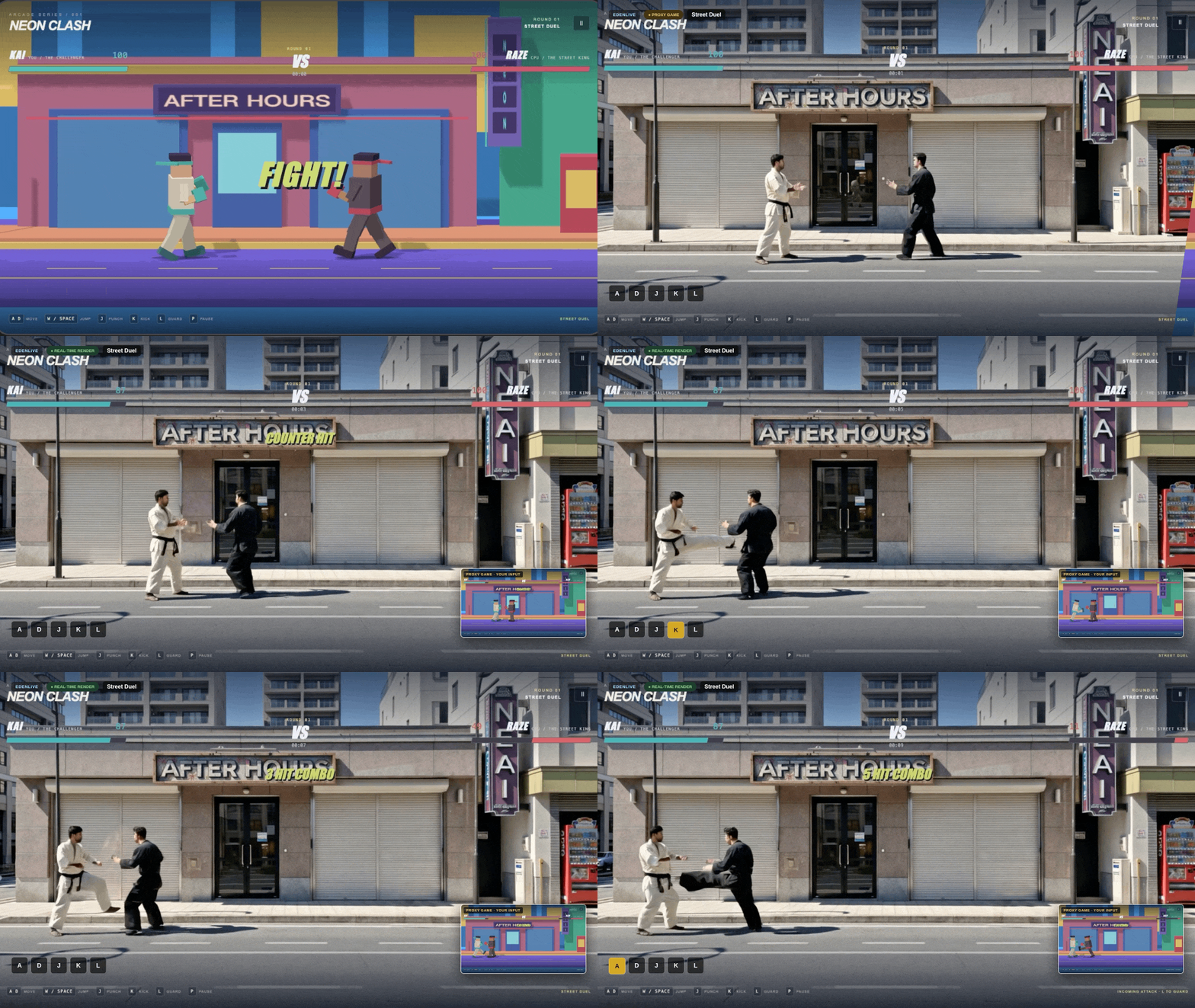
In interactive games, EdenLive's performance can also be rotated, with rendered gameplay graphics with rich environmental details while retaining the game's operating interface and interaction mechanisms.
In another fighting game, the two characters face each other in the scene, and the scene is flashy. The player can still control the player's actions by pressing a button, and the rules of the game at the bottom will not change.
In the field of physically intelligent data, EdenLive also demonstrates application potential. It is able to change the visual appearance of images based on preserving the original data movement trajectory and scene structure, providing more diverse data samples for robot training.
Design philosophy of deconstruction
The world runs independently, images are generated in real time
For a long time, interactive world models have faced a fundamental problem: models need to both generate images and understand and maintain the state of the world.
Creating images requires processing of texture, lighting, motion, shadowing and visual continuity. To maintain the state of the world, it is necessary to accurately record the location of the characters, the properties of objects, collision relationships, and the continuous change in mission progress.
When all information depends on the implicit inference of the video model, errors can easily accumulate gradually.
EdenLive's approach is to reconcile interactive states with visual rendering.
Specifically, the game rules, interaction responses and world status are the responsibility of the upstream interaction system, while EdenLive continues to produce fine or stylized visual content based on the system's output reference images.
Where the characters are, whether they are targeted or attacked, and how the task progresses, are recorded and updated by the interactive system, without the need for video models to be inferred from images alone.
The entire process is mainly driven by three types of inputs.
Input one, proxy or reference video stream. It provides scene layout, camera movement and roughness dynamics. Simplified reference images can be derived from 2D/3D scenes built by a smartphone, output from an existing game engine or creation desktop, or even directly from screen video.
Input 2 is the first image of the target. It determines the overall visual appearance and style of painting.
Input three, text prompts. It adds style and finer detail.
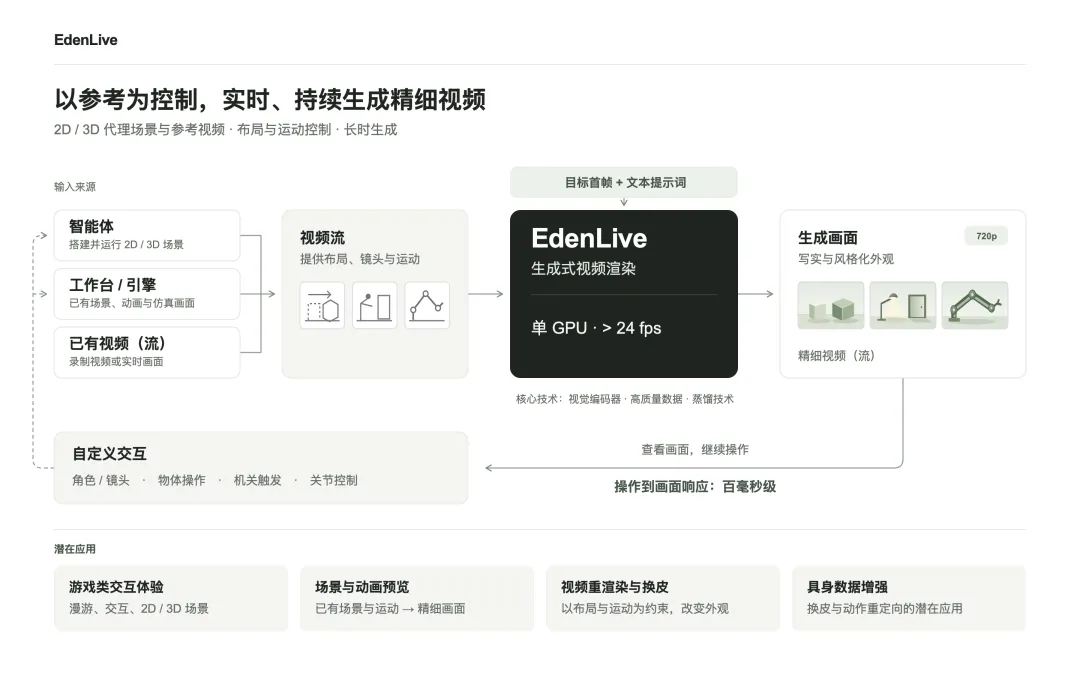
Eventually, EdenLive will output refined video processing or continuously generated video streams.
EdenLive's core generation paradigm can be generalized as Proxy-to-Fine (from simplified reference to fine-tuning images). This paradigm uses the scene structure and motion information provided by Proxy to generate, without the need for the reference image to reach specific geometric detail accuracy, nor does it require it to be generated through a specific rendering pipeline.
For creators, the process does not have to re-create the entire scene asset for each style of painting. The same set of references can generate different visual versions. A simple game prototype also has the opportunity to quickly obtain images closer to the finished product. For teams that need to repeatedly explore game, video and animation styles, this ability has a fairly direct value.
It is worth noting that this route does not mean that 3D technology will be replaced by video generation.
In the technical system of VAST, 3D is responsible for spatial structure, object relations and asset expression, providing the basis for maintaining the state of the world; video generation is responsible for the presentation of fine images and visual styles, which are complementary.
EdenLive is at the intersection of state-of-the-art, 3D rendering and generated video rendering.
EdenLive: Project Eden is a phased achievement
Looking back, we can see that EdenLive is a phased outcome of VAST's World Model Research Project Eden.
As the underlying engine for the next generation of interactive content creation, Project Eden has fundamentally jumped out of the existing technological paradigm to completely unravel the underlying state of the world with surface visual rendering.
The entire project uses a three-tiered deconstruction architecture.
The most basic is the structured state of evolution, which is responsible for describing the information that continues to change in the world.
Intermediate is a state mapping and observation interface that converts internal states into conditions for understanding and presenting models that can be generated.
The top layer is generated rendering, which synthesizes visual content based on state and reference information.
In this architecture, EdenLive is primarily responsible for the work on the third floor.
The long-term goal of Project Eden is to build a generative world that can run continuously, support multiple people simultaneously, and have a sustainable life.
There are still many technical challenges to overcome in this way of creating, but EdenLive has shown the feasibility of the technology.
Of course, there are still some technical challenges with EdenLive. For example, the control stability of small objects and densely interacting scenes still needs to be improved, the consistency of multi-character identities, the appearance of objects when they reappear after leaving the field of view, and longer-lasting state memories need to be further optimized.
Next, the team will focus on reducing end-to-end delays, improving referencing ability to follow and long-term visual consistency, and exploring richer forms of interaction to share world experiences with multiple people.
The VAST River Protectorate
EdenLive is capable of achieving arbitrary reference inputs, arbitrary wind generation and real-time rendering, behind VAST's continued accumulation of technical routes, training data and R&D teams.
The first is a pre-determination of the technological routes.
In today's rapidly evolving world of AI, the judgement of technological paths is particularly important. Different paths determine the direction of model architecture, training data and engineering systems, and once determined, it is necessary to continuously invest a large amount of R&D resources. The sooner we find a viable technological path, the more opportunities we have to accumulate data and engineering experience in advance to form competitive advantage.
As early as May 4 this year, VAST established the "State Maintenance + Video rendering" solution pathway, which was not widely accepted by the industry until September 8, when its layout shifted about three to four months ahead of the industry focus, a path that has been proven to be true to this day.
The second is high-quality, diverse training data.
VAST has a strong data sourcing team, long-term accumulated data pipelines covering a variety of formats such as 2D, 3D Proxy, game engine rendering images and real-time video, and the diversity of this data is an important basis for models to adapt to different reference inputs and achieve lifelong formatting rendering.
And finally, the team and the talent.
VAST's ongoing involvement in the Tripo series of 3D base models, 3D creation tools and Project Eden has accumulated research talent and engineering experience across 3D, video generation and interaction systems, and provided the technical foundation for EdenLive's R&D.
Technical routes and model architectures can be borrowed from cutting-edge areas such as the World Model, but the collaborative capabilities of cross-disciplinary teams, as well as the experience gained through long-term training, optimization and system integration, are difficult to replicate in a short period of time.
V-STAR's Top Talent Program
VAST wants to find more colleagues
To further attract outstanding young researchers from around the world, VAST has also launched the V-STAR Top Talent Program, which focuses on recruiting researchers with innovative potential in 3D-generated basic models, 3D understanding, and three-dimensional models of intelligent agents and world models to explore the frontiers of technology at the forefront.
These directions are also the core research areas of VAST's long-term investment.
In the direction of 3D production and Agentic 3D, based on the self-developed Tripo series of 3D base models, the company launched the AI-powered one-stop 3D workstation Tripo Studio, an attempt to combine base models, ecological plugins with native workstations to reduce the threshold for producing 3D content.
In the world model direction, Project Eden continues to explore a generative world with original durability and multi-player interaction capabilities, while EdenLive is a phased outcome of real-time generative rendering pipelines.
For the 3D base model, VAST builds two types of model systems: the H series and the P series. The H series focuses on high-precision 3D asset generation, emphasizing visual detail and professional production capabilities; the P series focuses on engineering availability, allowing AI to generate assets more directly into production processes such as games and animation.
At the same time, VAST is also continually accumulating a technical base. At present, the company has published more than 60 peer-reviewed papers, more than 35,000 GitHub stars; the Tripo series 3D models have been at the forefront of third-party independent evaluation for six consecutive years; the products and services reach tens of millions of users worldwide and have entered the real production pipeline of the gaming, XR, 3D printing and video team.
These accumulations also form an important basis for VAST's further exploration of the world model.
For researchers who want to explore AI 3D, Agentic 3D and world model directions, VAST provides an opportunity to participate in cutting-edge technology exploration, with the team always focused on the vision of "giving everyone the freedom to create an interactive world", leaving plenty of room for exploration and trial and error on different technological paths.
In terms of talent development, VAST emphasizes an open, flat research environment that encourages young researchers to come up with new ideas and translate them directly into practical research projects. Good technical ideas can be rapidly applied, validated, and even trainees have the opportunity to participate in core model training and deepen model R&D and engineering practices.
In addition to research resources and growth opportunities, V-STAR offers competitive remuneration and long-term incentives. Both full-time and internship students have the opportunity to get more competitive pay than the headquarters, uncluttered excellence, and long-term opportunities to share the real benefits of corporate growth.
From 3D base models to Agentic 3D, to the continuously running generative world, VAST hopes to bring together more young researchers through V-STAR to drive the next generation of technological breakthroughs in the interactive world.
What is the meaning of this verse?
Going back to EdenLive, this release may mean more than making video production faster, and more freedom of choice.
When the underlying states and visual rendering are dismantled, the generated world has the opportunity to gain more stable interactive logic and enable high-quality visual content to change continuously as users operate.
Of course, EdenLive still faces complex challenges such as interaction, long-term consistency and multi-role control.
But as the phased outcomes continue to unfold, VAST's long-standing technological path continues to be validated: 3D as the basis for space and state expression, building and maintaining interactive logic through Agent, and reusing generated video rendering to present the world.
EdenLive is a step-by-step verification of the path to real-time interaction.
VAST's long-term goal is to allow everyone to create and experience an interactive world freely.
© THE