It's the first time in the history of the world.
It's not just Google.AIMathematicians, get to science!
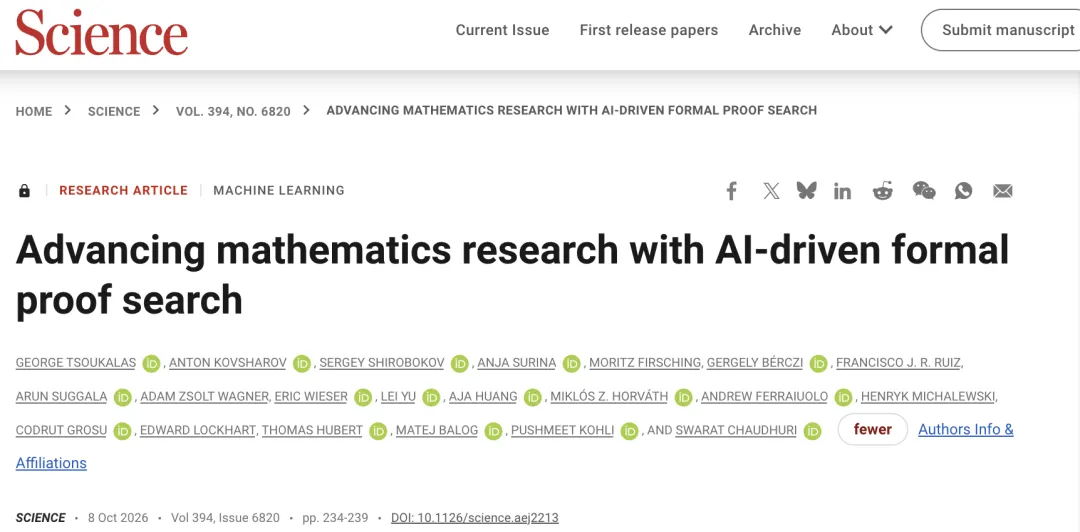
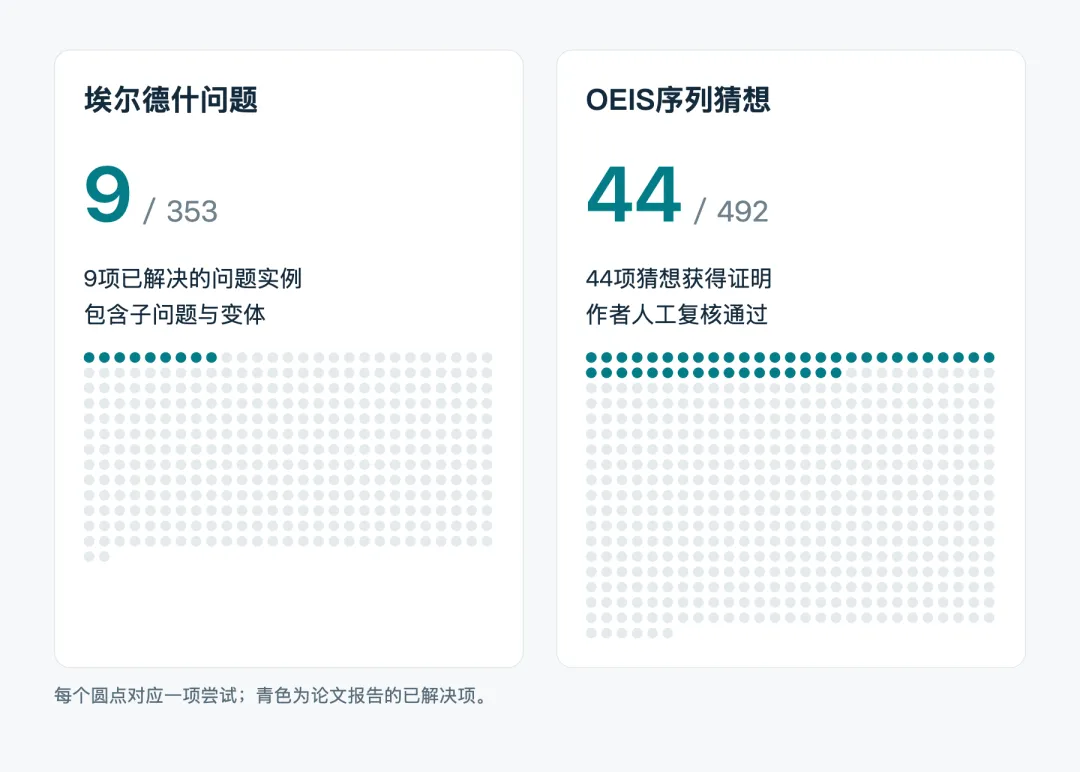
The paper's protagonist is DeepMind's AlphaProof Nexus, which provides evidence for nine Eldash problems and 44 integer sequence conjectures.
Two of the old questions have been hanging for 56 years.
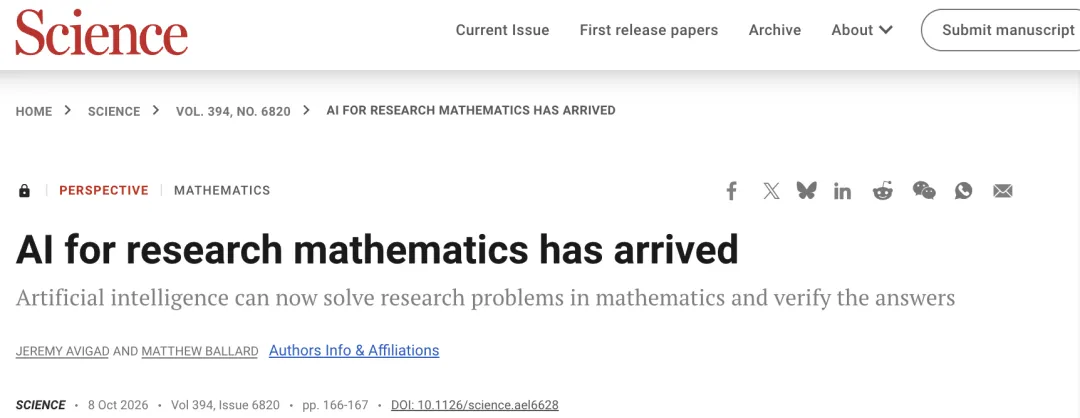
A syndicated commentary by Science simply called it "research-mathematical AI has arrived".
Here, mathematicians speculate that AI itself will come up with ideas and write proofs. It will also be able to find new parametric settings for optimization algorithms and prove why it works.
After these new proofs are made public, mathematicians can then simplify, improve, and continue to do research.
This is what humans are doing with AI to create new knowledge.
The 56-year-old puzzle has finally been solved
Let's take a look at the 56-year-old question.
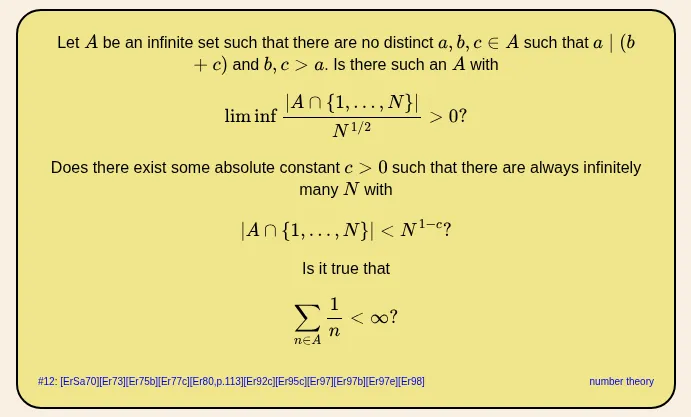
They are two sub-problems in Issue 12 of the Eldersh Resolution, proposed by Eldersh and Sárközy in 1970.
Mathematicians such as Schoen, Baier, Elsholtz and others have made little progress since then, but the complete proof of these two questions has not emerged.
Both questions revolve around the same rule of thumb.
Select some integers, in which any number cannot be subtracted from the sum of the other two larger numbers. For example, 2, 3, 5 cannot be selected simultaneously, because 3 + 5 = 8, and 2 can be subtracted.
The first question requires an infinite number of selected numbers; and, when N is large enough, the number selected from 1 to N must always be no less than √N times the usual number.
The difficulty here is that to avoid solving the relationship, you have to limit the number of options; the more you can limit, the less you have left.
Nexus's practice is to first classify the choices in different numerical ranges and then separate the relationships between the groups and within the groups.
For the number of different groups, it uses the Chinese residual theorem to arrange the residual numbers; within each group, it excludes the three-dimensional structure of 1, 3, and 5.
For example, let the current set of numbers be subtracted by some odd number, and the subsequent number subtracted from it is subtracted by 1. Thus, two larger numbers cannot be subtracted from the current group as long as there is at least one from the subsequent group, and their sum would be subtracted by 1 or subtracted by 2.
The next step is to confirm the number.
For this purpose, Nexus will select the number of the current group in advance according to the number of matches of the next set of starting points.
Thus, even if N enters the empty file between the two groups, no new numbers are added for the time being, and the number that has been selected is enough to start the next group.
Putting these groups together, you get the first infinite set to look for.
The second question is to know the maximum number of people who comply with this rule.
The original conjecture was that a fixed index of less than 1 could be found to assign a maximum number to all such sets, such as 0.9 squares of N or 0.99 squares.
A counter-example of AI suggests that no matter how close the index is to 1, as long as it is smaller than 1, it can eventually construct a set that has always been above this line.
So far, the first two questions of Question 12 have been solved, one by one!
These results resulted in a total of nine wins for Nexus.
After the proof of the 12th problem was made public, Tao Te Ching found that the limitation of "excluding three equal structures" can actually be removed.
Less restrictions could simplify the construction. Other mathematicians also improved the scheme to make more choices for the eligible numbers.
In this way, the proof of AI has become the starting point for colleagues to continue their research.
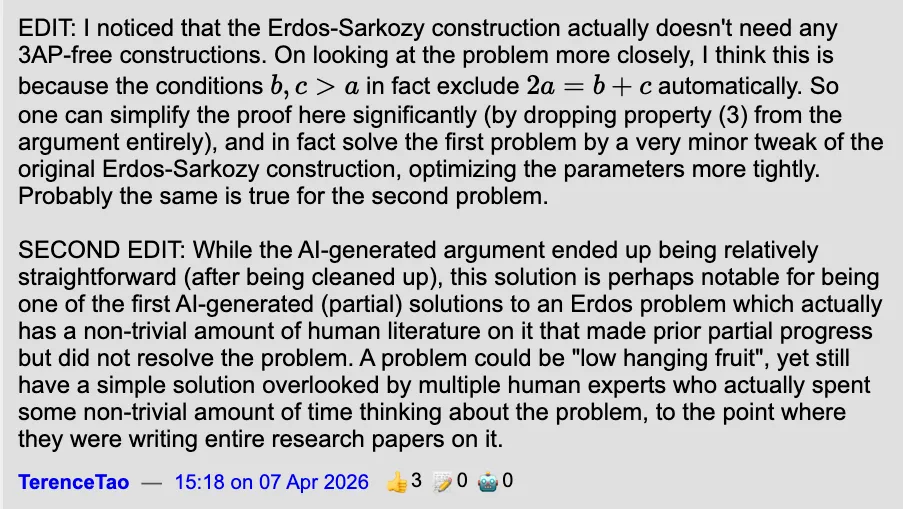 In Question No. 12 discussion area, Tautchen pointed out that the existing conditions of the subject can exclude 2a = b + c, so there is no need to restrict the structure of three equivalents.
The key to solving the problem lies in the cycle.From finding a solution to a problem to delivering a complete proof that mathematicians can then use, Nexus relies on a round-the-clock combination of Gemini and proof tools.
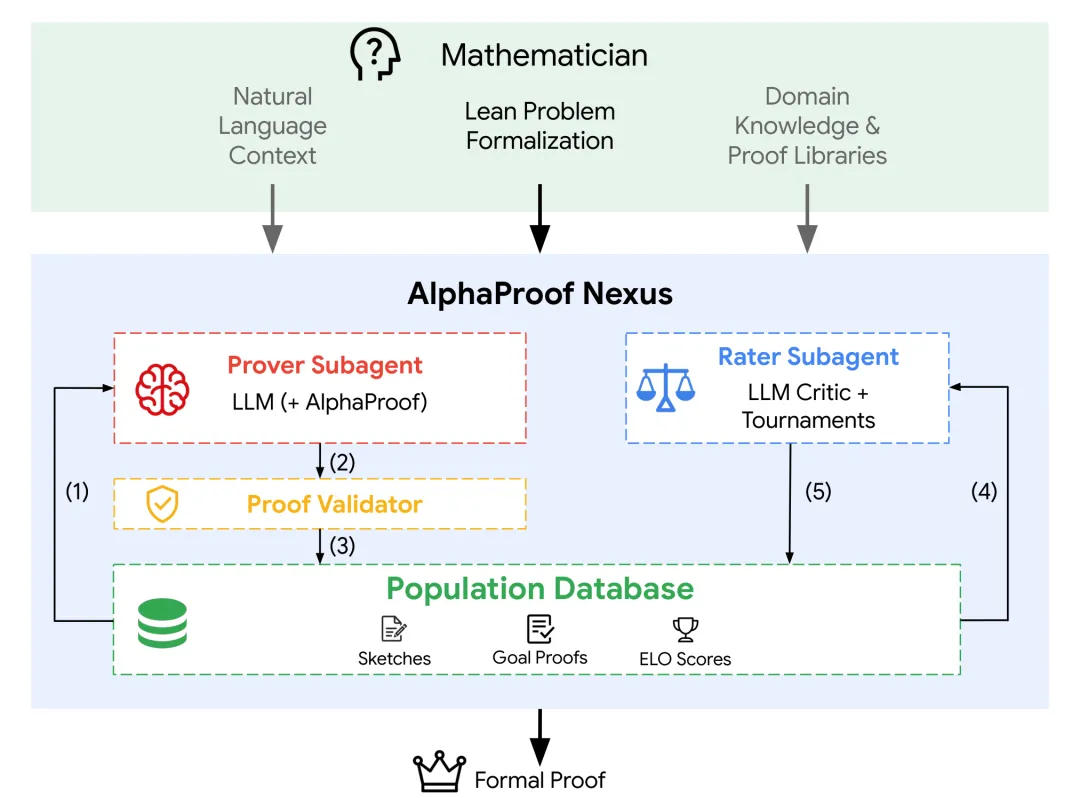 Complete Nexus architecture in the paper: proof of generation, verification, draft evaluation and search
In the full version of the design, the system allows multiple proof agents to share the draft, evaluate which agent is clearer, more reasonable, more innovative, and then decide which path to follow is a priority.
Some of the drafts, though unconfirmed, have found a critical structure, with only the last rationale. So the system can use more computation on this hopeful path and then complete.
To meet specific sub-objectives, Gemini can also call AlphaProof. Large models are responsible for organizing the argument, choosing how to disassemble the problem, and a dedicated proofreader is responsible for solving the disassemble steps.
Sub-targets that have already been solved will also be cached. Therefore, when exactly the same targets appear again, the system can directly retrieve the proof and then do it backwards.
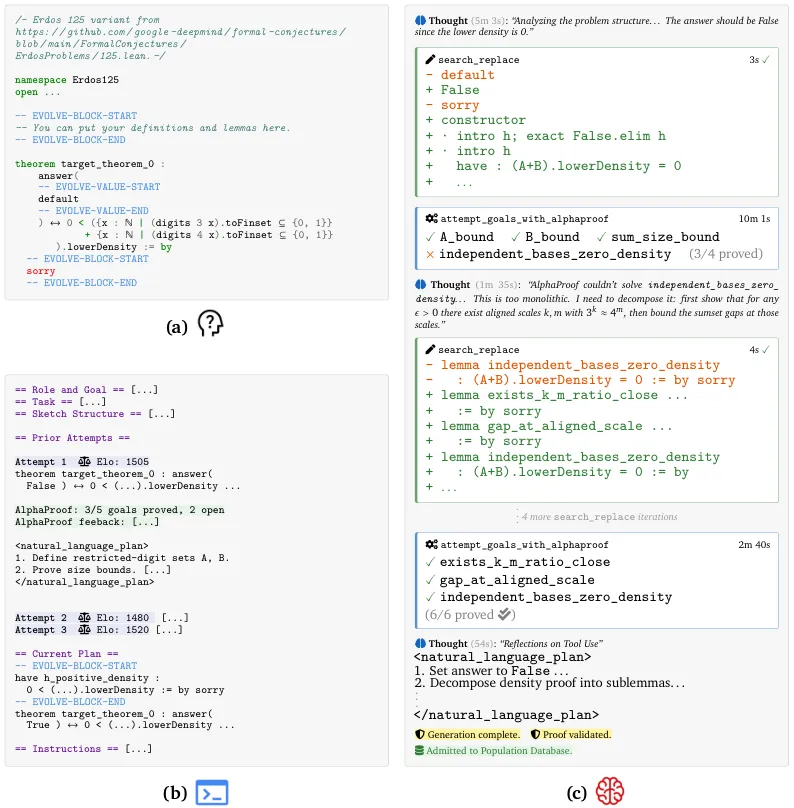 The process of solving the 125th problem in the paper: Gemini breaks down the target and then calls AlphaProof to complete the local proof
So the question arises, to solve these puzzles, how much of this complex process depends on it?
They removed the evolutionary search from the shared draft, and did not call AlphaProof, retaining only the basic compatibility of the Gemini 3.1 Pro with the Lean.
As a result, the Eldersh problem, which had already been solved by the Nano9, was retested, and the basic version, after several independent attempts, found proof.
By contrast, AlphaProof runs separately, and none of the tests in the same group have been solved.
In other words, at least nine of these questions have been proven to be valid by the General Large Model Collaborative Evidence Tool.
From proving guesses to improving algorithms
In addition to the Eldersh problem, Nexus tested 492 hypotheses from the OEIS online encyclopedia of integers, adding proof to 44 of them.
The researchers verified that the code accurately expressed the original question, and the assumptions had not been proven before.
For example, if you select at least one integer from 1 to n, how many ways do you have to choose an average number for an integer? Mathematicians have already guessed what formula this number will grow according to when n is large enough, and Nexus adds a rigorous proof.
In order to minimize the problem's intent when converting, the system first checks whether the number column definition can calculate the correct first few, and then proves the general conclusion.
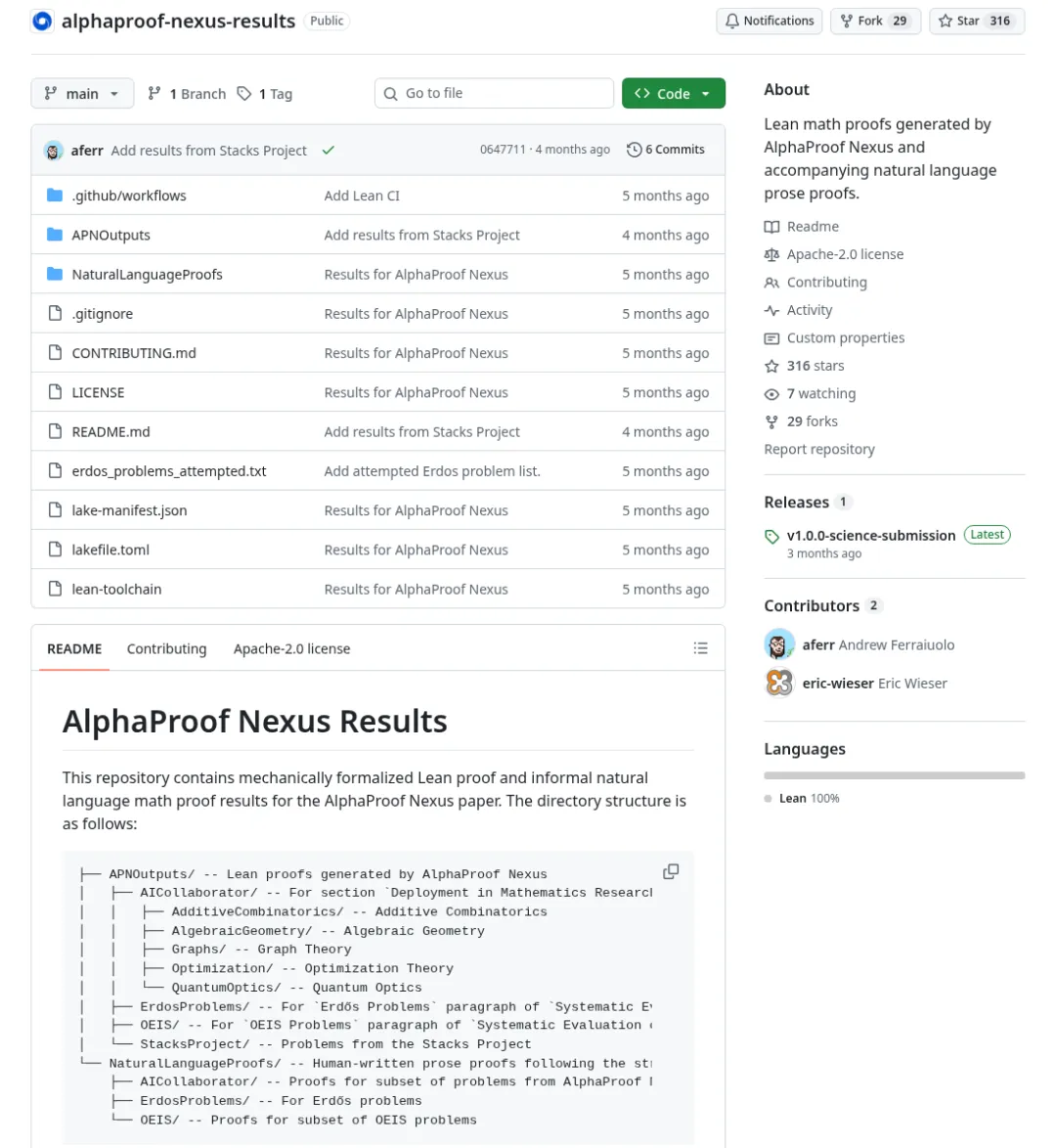
In these numerical problems, AI has to do what it has to do to prove that it has already been hypothesized.
When it comes to optimization theory, the task goes one step further: it has to figure out how to set algorithmic parameters.
Anchored GDA deals with this type of problem. Both sides adjust their own variables, one trying to lower the same target value and the other trying to raise it.
If the two sides are focused on adjusting in their respective directions, there may be a return of tremors, sooner or later there will be no balance.
As a result, the Anchored GDA adds an additional correction to the fixed start-point pullback with each update, helping to stabilize the entire process.
However, the length of each step, the intensity of the correction, affects the convergence rate. So the researchers gave the AI how to set the parameters and let it find out together with the proof.
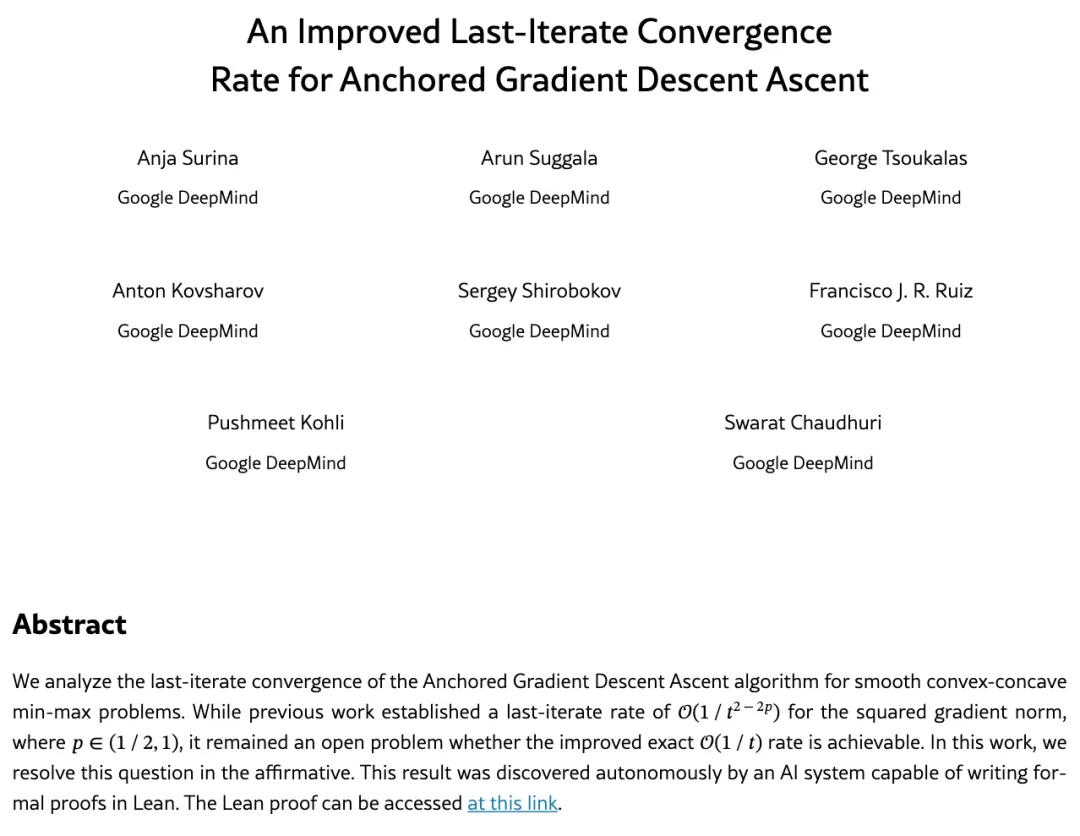 The results of the algorithm were published separately in April, giving new parametric arrangements and proof of convergence.
Finally, AI came up with a new set of parameters and proved that, under the conditions of smoothness, convexity, etc. specified in the paper, measuring the degree of convergence of a "square gradient parameter" can achieve convergence assurance of O (1/t).
T is the number of iterations. Here O (1/t) indicates that the upper bound of this indicator can reduce the number of iterations.
It was previously uncertain whether this algorithm would achieve this convergence rate.
So far, AI isThere's more that can be done: get involved in designing computational methods and prove why they work.
The way people create knowledge is beginning to change.
After the paper's publication, DeepMind's Pushmeet Kohli once again stressed that advancing mathematics should allow mathematicians to do more.
Think about it, if this kind of collaboration became routine, a mathematician would be able to experiment with more ideas at the same time.
The new methods found by AI could also be used to improve research tools. The tools are better, and people and AI have a better chance of finding the next set of answers.
Once such discoveries are made, and humanity explores at an unknown speed, there is an opportunity to accelerate further.