
It's the first time in the history of the world.
In the same year 2026, human reality will be split in half!
In the Anthropic office building in San Francisco,The total duration of the day and night operation of the Agent has been completely anti-human.Some of the staff even wrote a performance review for Claude's team, as if they were a real team.
Beyond one wall, the world is still stuck in the rhythm of another era. Nearly half of Americans still don't believe AI can write a daily email.
Just now, Anthropic has rarely even released two massive internal reports, bringing the two parallel worlds upstairs and outdoors and placing them in front of everyone.
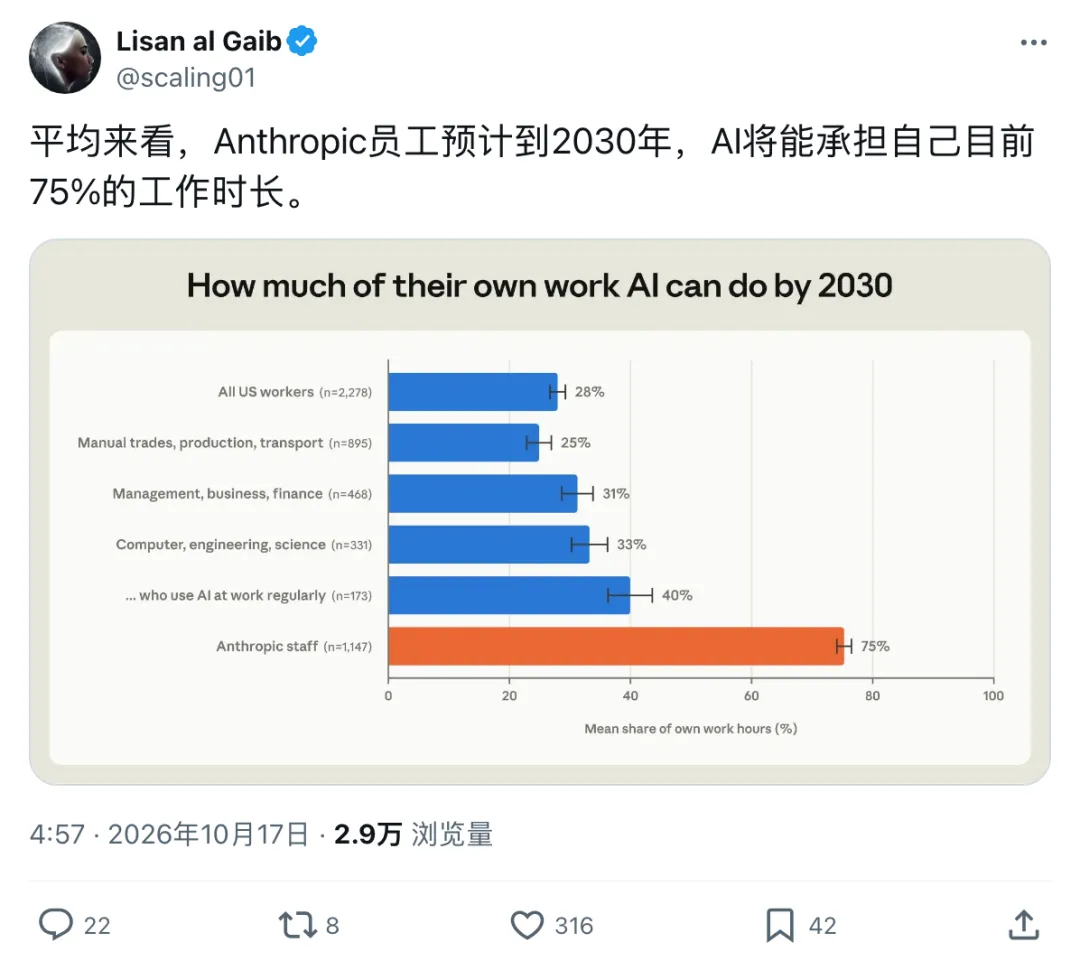
On average, 1,334 people at Anthropic believe that there is a significant increase in the number of people who work at Anthropic.After four years,AIYou can do 75% of the work you do.The same question was asked of U.S. workers from outside the country, and only 28% answered.
More than half of employees believe that AI can cover more than 80% of their lives, and only 5% of American workers dare to think so.
91% of employees believe by 2030AIIt's time to make promising discoveries.In fact, 58 percent of Americans believe they will be able to see through 2027; only 39 percent of American adults do so.
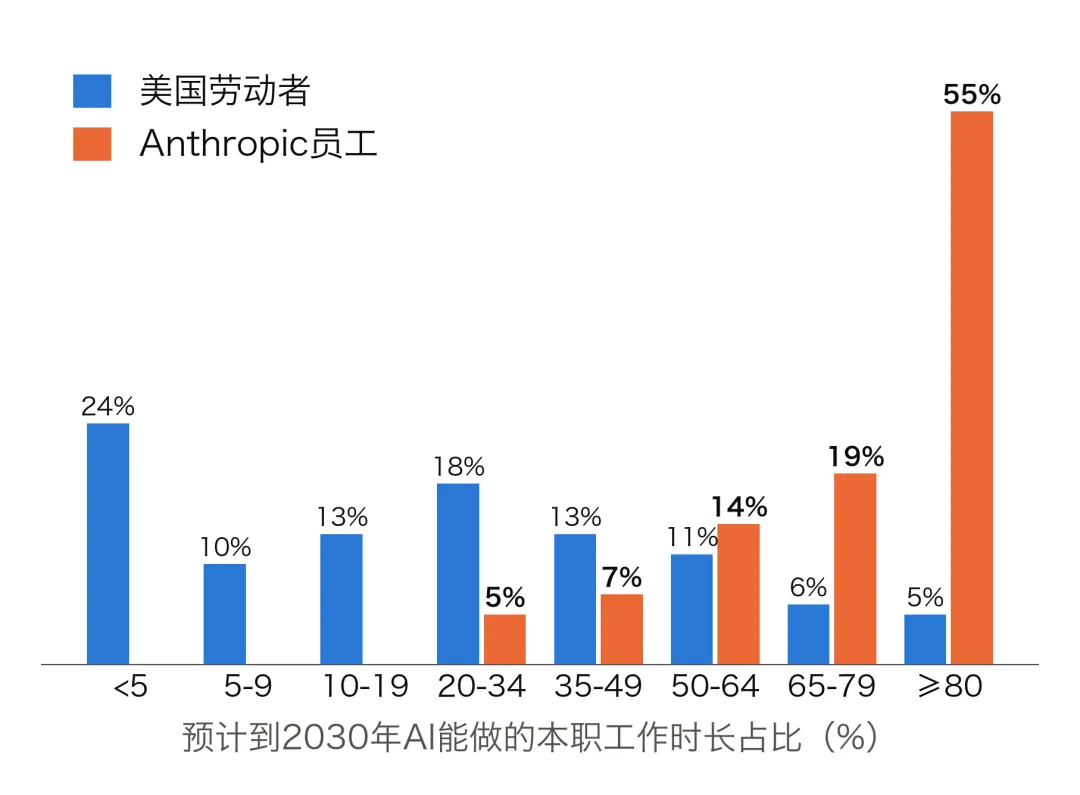
Behind this cognitive divide, it is the strangely recent group of people who are already living in a different kind of everyday life.
At Anthropic, a week and three months outside
They dared to bet so heavily that the bottom line came from another internal report that was released the same day.
Anthropic's internal changes in the workforce have led to the company's personal, product and agent operating records being manipulated and the inside of a top AI lab being turned over to the outside world.
In March of this year, in the wake of the continuous autonomous mission day and night,For the first time ever, the total number of employees employed by the Agency exceeded the total number of human employees.
In just five months, the number of agents sent out by employees alone has grown from less than a fifth of humans in February to more than six times that of humans.
The research department is 19 times behind each researcher, while the 19 tireless Claude is on the run.
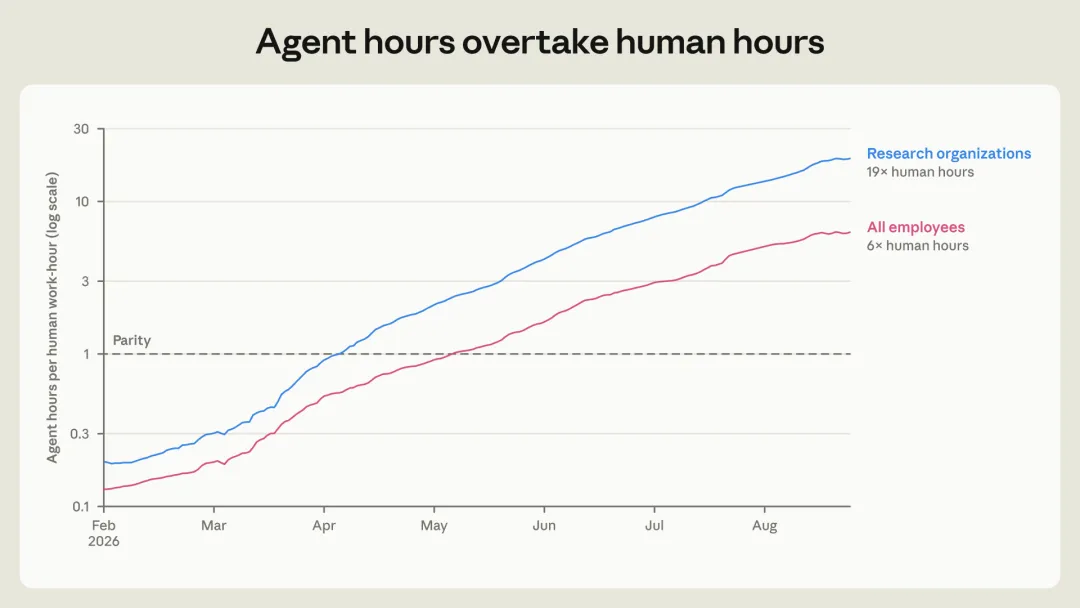 In August, the number of agents sent by employees was six times the number of employees
The report also describes a large-sector Slack public channel network. Initially with 155 employees and 150 Agent sessions, the staff grew to 237 and the Agency sessions swelled to 7,922.
The longer the red dots representing AI are as dense as wildfire, the more the blue dots representing humanity are surrounded.Everyone is surrounded by their own army of AI.
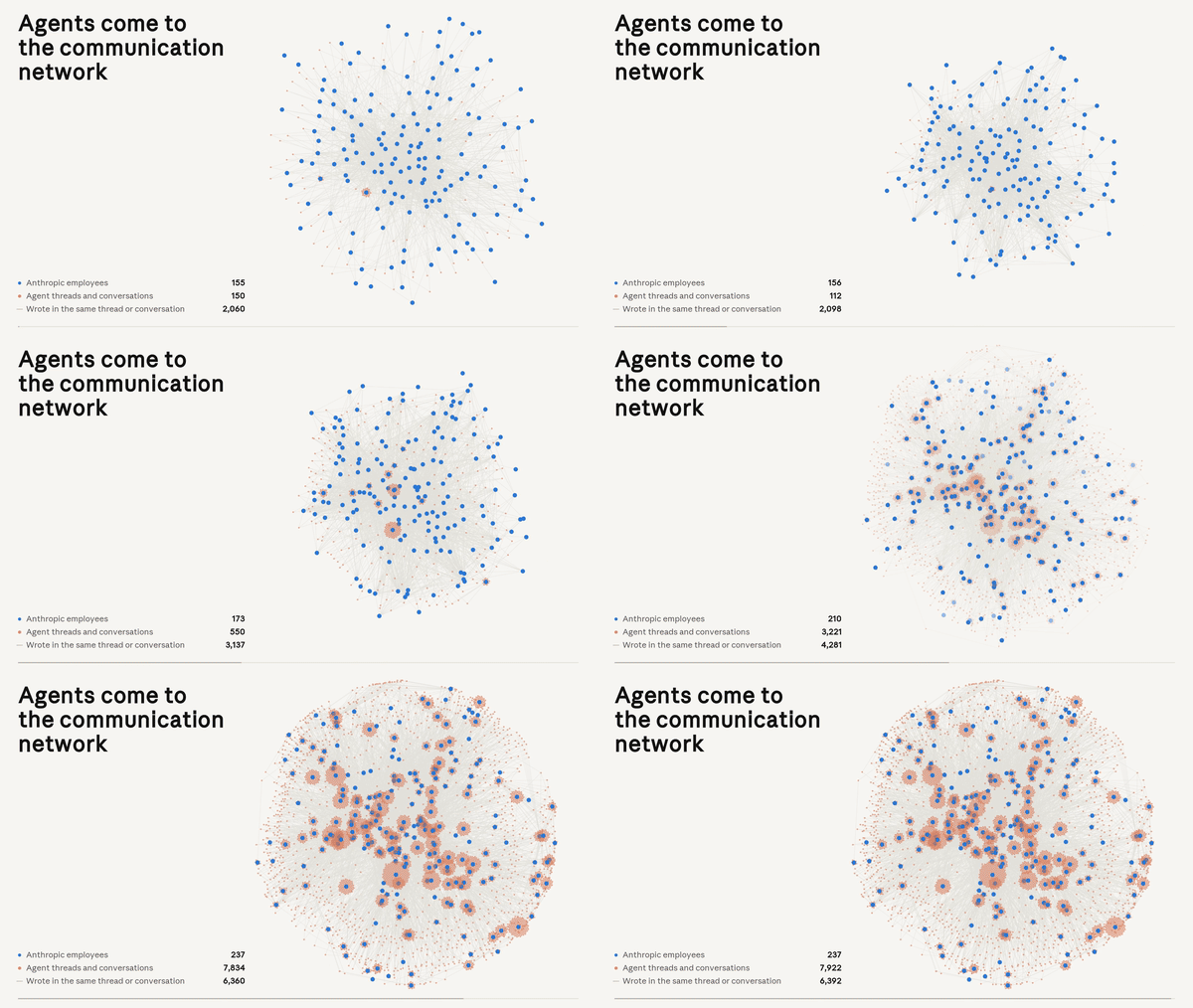 Blue points are employees and red points are Agent meetings.
The air inside the company was described as "eternal pressure" and everyone was driven forward by the legion to do everything with Claude.
One employee said directly:A week's worth of living here, three months' worth of working outside the company, is enough.
As a benchmark in December last year,The number of code submissions per engineer has skyrocketed to 5.1 timesPer capita output in data science, law and sales is also rising.
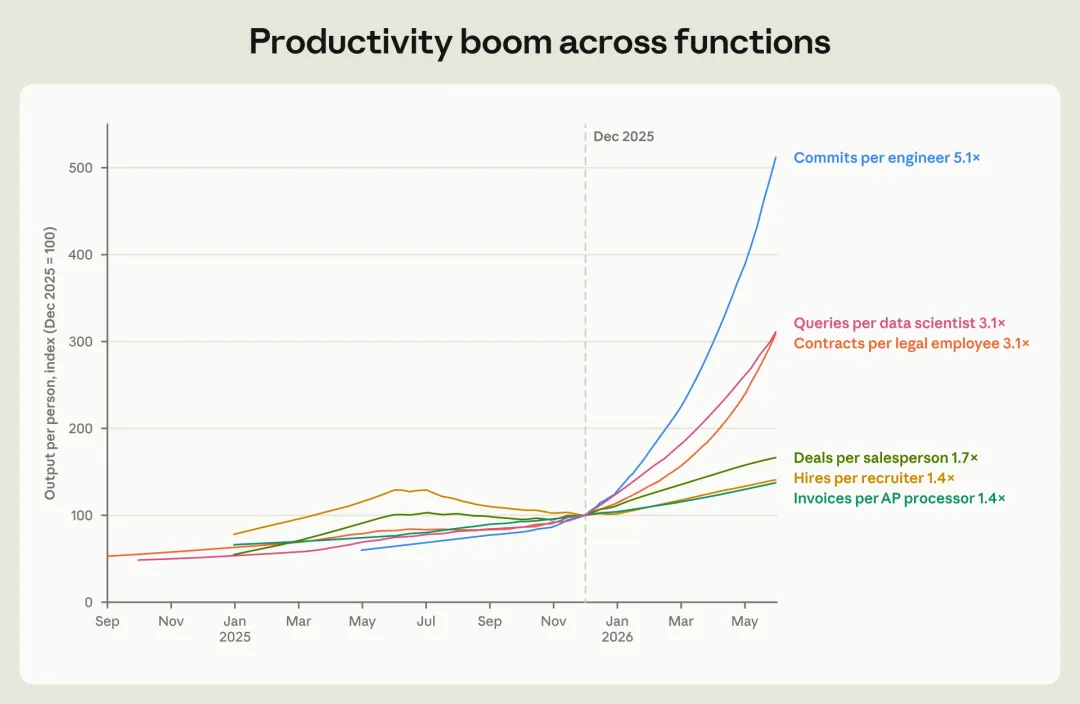 Changes in output per person in different jobs as benchmark for December 2025
In April, Claude solved an unprecedented set of backlog problems, submitted more than 800 repairs, and squeezed an API error to one-thousandth of the original.
According to the engineers in charge,If someone changes their job, they will have to work for four years.
Code-writing has also flooded the boundaries of the technical sector. The monthly Code-Agent sessions initiated by non-technical staff have grown from two in August last year to 90 in May this year.
A sales representative wanted a sign that matched his workflow, and Claude changed the interface, tools and processes for three or four hours.
The team that originally wrote the Claude.ai greeting language, built a set of context diagrams for the Church Agent to write branded texts, and then put together a splendid turn to rewrite model evaluation sets and hints.
One of the engineers said that when he started "Claudation" a year ago, he felt that he could not do anything about it.To date, I haven't written a line of code by hand in almost five months.
You're still running AI, and they're already running AI.
Foreigners have always thought that AI has done everything and people can start drinking tea and watching the newspapers.
But in Anthropic, the reality is the opposite.The human race is the slowest link in the entire flow of water.
The study team calculated the weekly Claude output for each person, divided by the reading time of 250 words per minute.
In engineering and research, a person has to read 424 hours a week, compared to 168 hours a week on Earth.
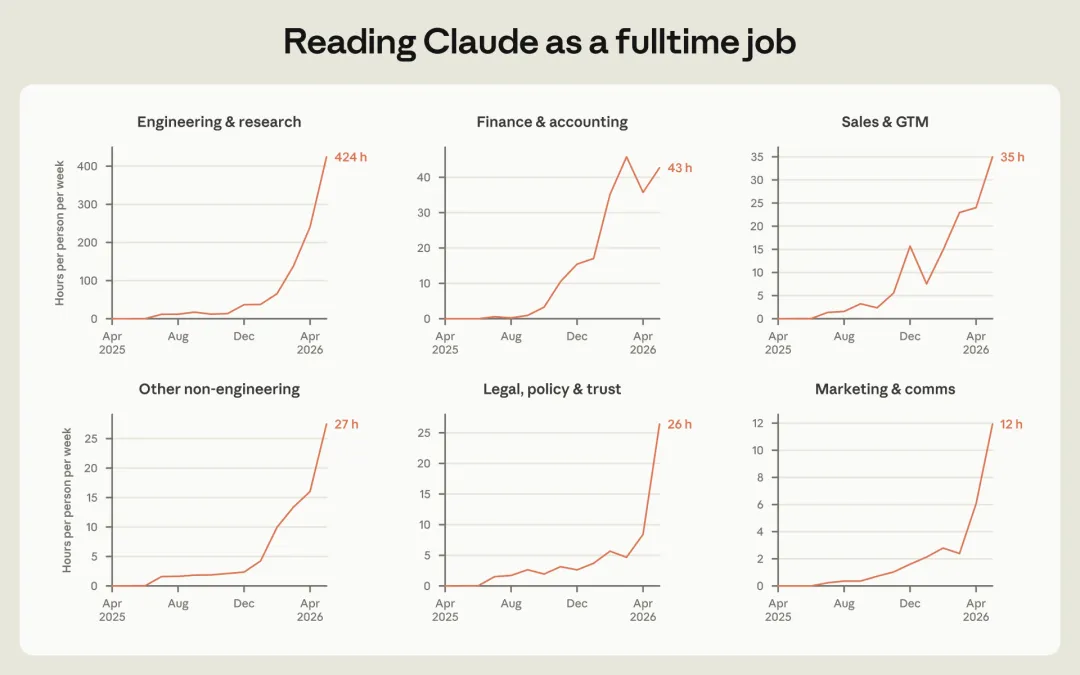 The time it takes for each post to finish reading Claude out every week.
It's just that people can't read and Claude can't do anything.In interactive sessions, it takes about 80% of the time to line up and respond.
For more than two hundred years since the Industrial Revolution, people have never driven machines around; and in this tower, for the first time in history, the turn of the machine is turned around, and so on.
So the people who were pushed to the limit started taking Agent as their manager.
One agent was specially appointed as the "chief of staff" to sort out the requests submitted by the other agents; a permanent residency order was written to the agent, rising from several hundred to 8,500 articles a year.
It's also a scene that makes people cry and laugh.
A few months ago, an employee left his name on a document around the company, and no matter how long it took, Agent came to his door at 3:00 p.m. and asked him for a T-shirt and a Mark Cup.
Even the software infrastructure can't survive under such high intensity of use.
In May this year, Anthropic's main code library combined about 2,500 code changes per day.By September, it had burst 30,000 times, completely crushing programmers with twenty years of Git.
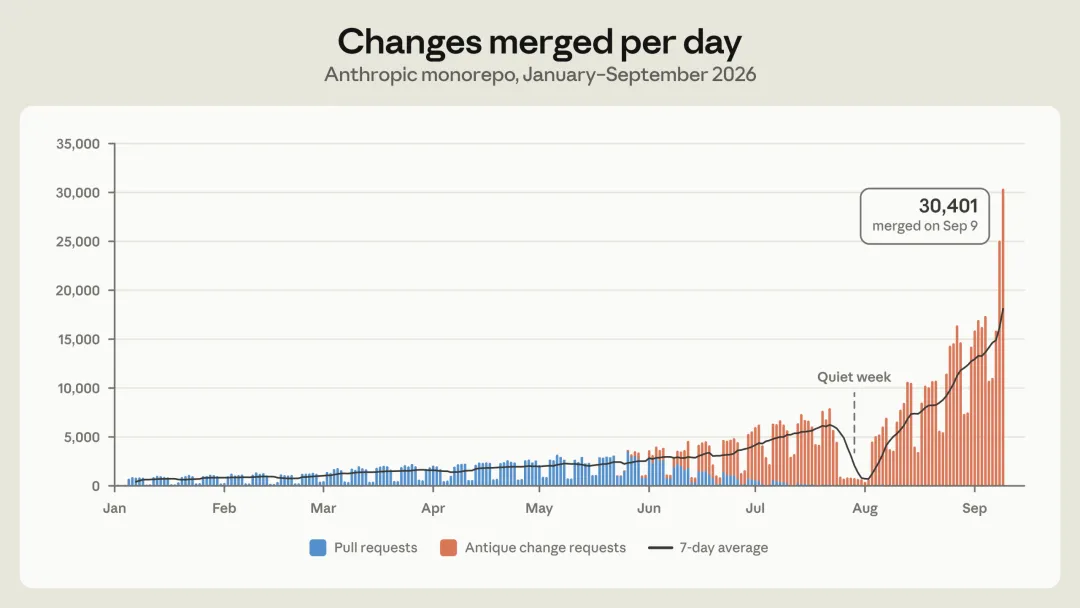 Code changes in the main code library every day
It took seven engineers five months to build the new version control system Scion from scratch and move the entire code library from Git to the past.
The team wrote a handwritten version of the migration code import tool at the beginning of the year, which they were pleased with.
Later, they rewrote it by hand with the intuitive Claude Mythos Preview without adding any additional instructions. As a result, the new version's memory occupancy decreased to a tenth, four times faster!
I hadn't thought that this group of people who created AI themselves would be the first to taste the taste of AI behind them.
The same questionnaire, two by 2030
When I looked up at the top of the tower, it was hard to understand why the tower was so far away.
If only one question were asked about what AI can do today, it would be more or less the same. For example, when designing and publishing a research project, only about a quarter of people on both sides believe that AI can do it now.
But in the years to come, the gap is widening momentarily.By 2027, 90% of employees believe AI can do research independently, compared to only 38% of U.S. adults.
By 2030, more than 9 percent of employees will be confident in eight things, from writing emails, paying taxes to winning awards.On the American side, 19 percent to 40 percent of adults believe AI can never do anything.
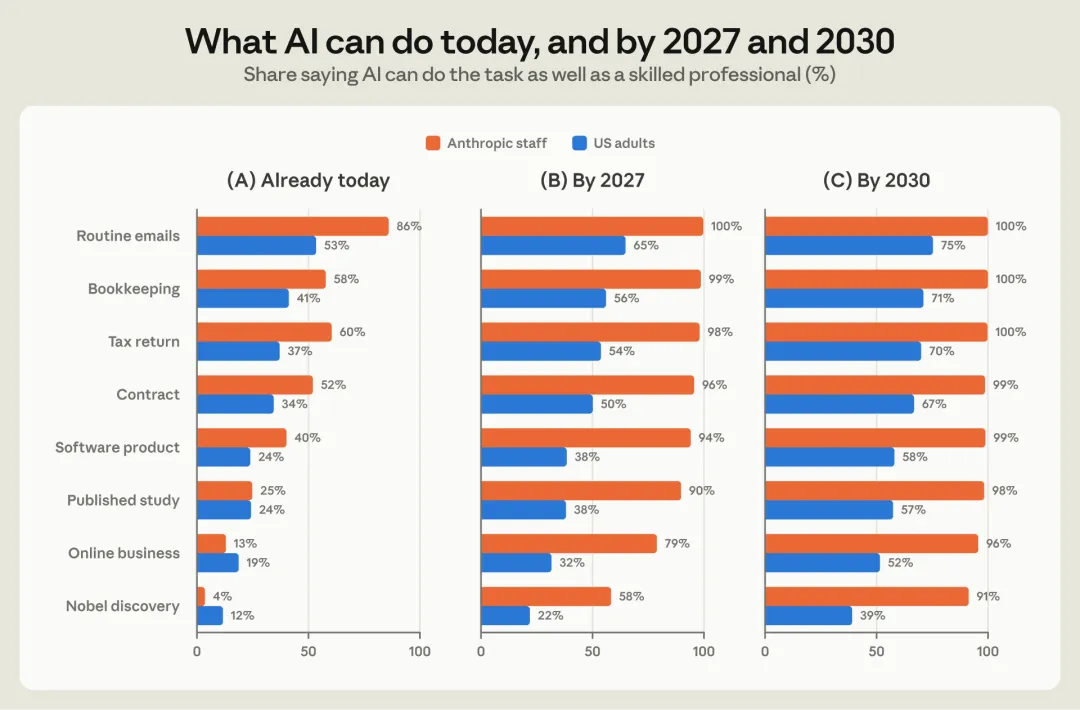 Employees: (Laughs) and U.S. adults: (Blues) Judgments on 8 things
Computer, engineering and science practitioners in the U.S. expect AI to do 33% of its own work by 2030.
Even 40% of those who use AI on a daily basis are still 35 percentage points away from 75% of Anthropic employees.
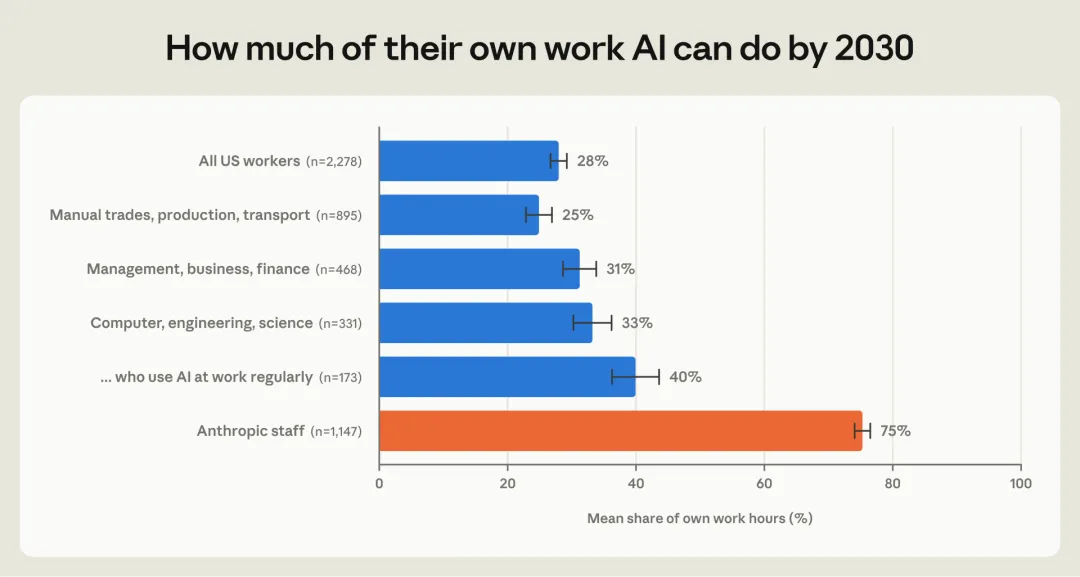 AI is projected to do a proportion of its jobs by 2030
The real difference lies in the feeling of using AI. Choose an AI that is good at living, checking and returning to work.59% of employees say they spend a quarter or less of their time with AI.
Of those Americans who use AI at work, only 26 percent say so, and 29 percent feel that AI is a little slower or slower.
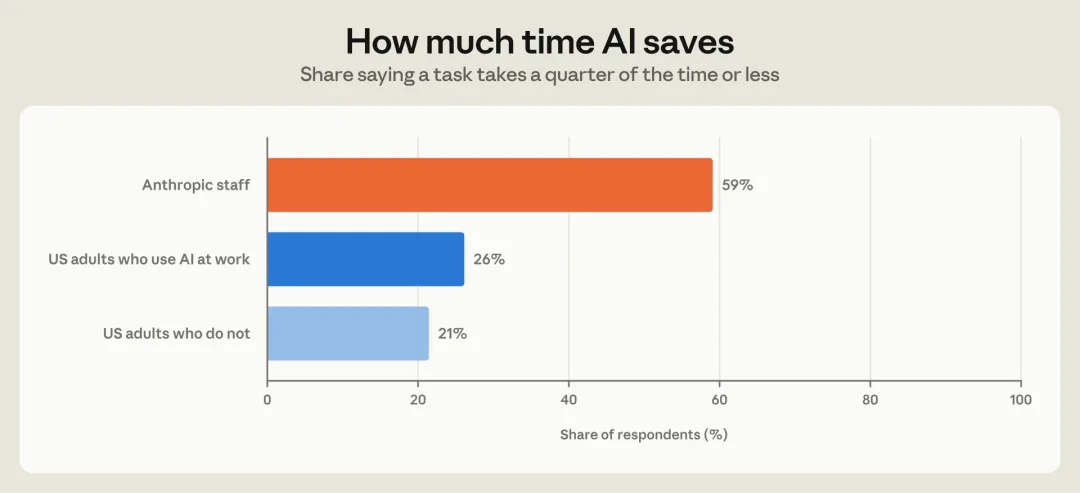 That's about a quarter or less of the time that people spend on AI.
Both of them said, "I'm using AI every day", but it was a completely different day.
Every day we see AI putting three months of life into a week, and in 2030, nature and other people are not in the same world.
The people who created AI started counting down "the last invention".
In the entire survey, the heaviest and most shocking bet the group made was on their old stakes.
The only question on the questionnaire was to ask them, how much work is already being done by AI itself, from orientation, design experiments to evaluation, to building a flagship model at the beginning of 2026.
The average response among employees was 51%, with the most recent study team estimating higher, an average of 60%.They expect this to rise to 80% by the end of 2027, and 95% by the end of 2030.
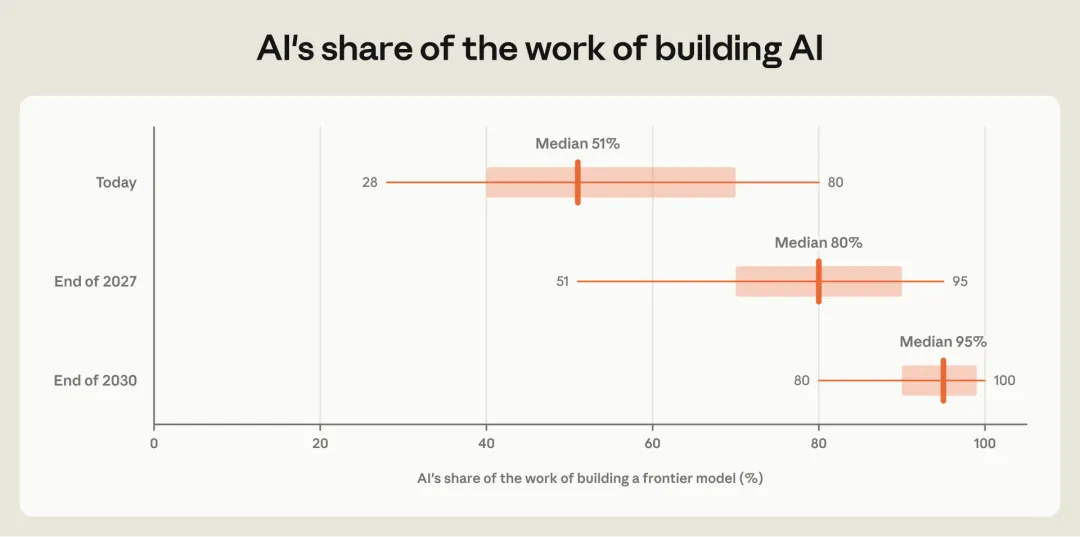 Employees estimate AI's share of front-end model work
Anthropic has previously released an internal test that allowed Claude to speed up the code for a small model of training.
A skilled human researcher can accomplish four times as much in four to eight hours.In April this year, the Claude Mythos Preview went live 52 times.
In an open-source study on AI safety, two human researchers worked for a week, narrowing the performance gap by about 23%.
Claude Agent's team made their own hypothesis, running experiments, with 800 hours of computing and about $180,000, a 97 percent reduction.
Of the 129 real-world research nodes that human researchers have walked through, Claude Mythos Preview gave 64% of the time a better next step.
Even the most important judgments in scientific researchAIIt's also coming to the fore.
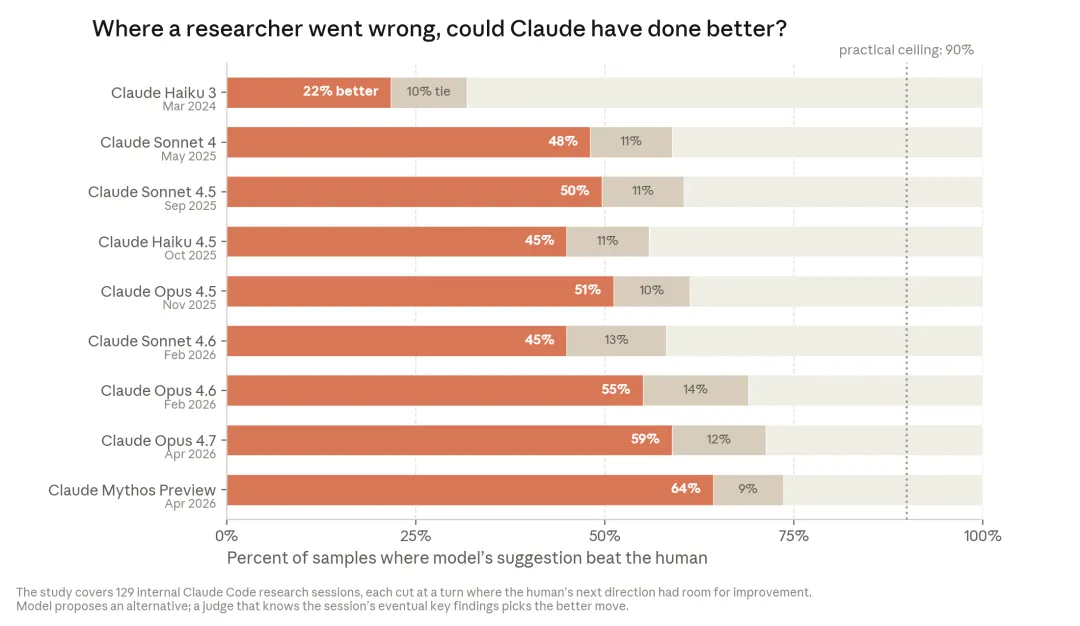 Claude's legacy surpassed that of humans in 129 research nodes.
The Anthropic Institute has envisioned a scenario in which the Earth's magnetic field, the Earth's magnetic field, and the Earth's magnetic field, can be seen as moving downward along this curve.AIAfter major automation of R&D, a company of just 100 people can do the work of 10,000 or even 100,000 organizations in the past.
The idea of "AI making AI itself" has been around for more than 60 years.
In 1965, British mathematician I.J. Goode made the famous prediction that the first super-intelligent machine would be the last invention that humans would need to make.
It's all six.The eleventhYears later, the man who made the machine himself began to give it a countdown. By the end of 2030, he had created a lifelike front-end model, leaving only the last 5% to humans.
The stairs are being pulled up, and after 18 months, the tide has flooded people.
When the future flows into reality in advance, the first person to be photographed on shore is a newcomer who has just entered the workplace.
Over the past year, Anthropic's workforce has more than tripled, and 95% of employees expect the company to continue its massive expansion.
However, in this round of expansion, the first step to the company's staircase is being stealthily pulled out of the cracks of technology.The proportion of primary school students dropped from 27% cliffwise to 9%。
Proportion of junior staff in the technical sector
For hundreds of years, new people have followed the old man's footsteps and tried to hone their judgment a bit.However, today, the entrance is increasingly given to the tireless Agent, and the chances of newcomers even having their first experience are diminishing.
And the new ones are just the first wave of the tidal wave. The crowd outside of a wall is also stepping into the same future.
Replacing the answers of Anthropic employees with an economic model, the future in their eyes corresponds to a staggering 17.1% annual growth rate, equivalent to doubling the U.S. economy every four and a half years.
According to the report, this will be an unprecedented economic transformation in human history.
The answers to the three groups correspond to the US GDP growth rate in 2030.
Peter McCrory, Chief Economist at Anthropic, said on X that in adopting AI, Anthropic was about a year and a half ahead of the entire economy.
In other words, these 1,334 people are 18 months ahead of time, living in the future of the world.
What happened in San Francisco today, 18 months later, will ultimately turn into the tide of the times, sweeping everyone through.
RoboInd editorial channelResearch, robotics companies and market intelligence for cross-border sourcing.Explore the channel ↗
Share this
End of editorialExplore more from Global Robotics News ↗