It's the first time in the history of the world.
Just recently, Anthropic released an explosion study.
Mythos 5 has self-contained circuits designed to be far more efficient than the "best solution" for humans!
And, even in the case of purely linguistic descriptions.
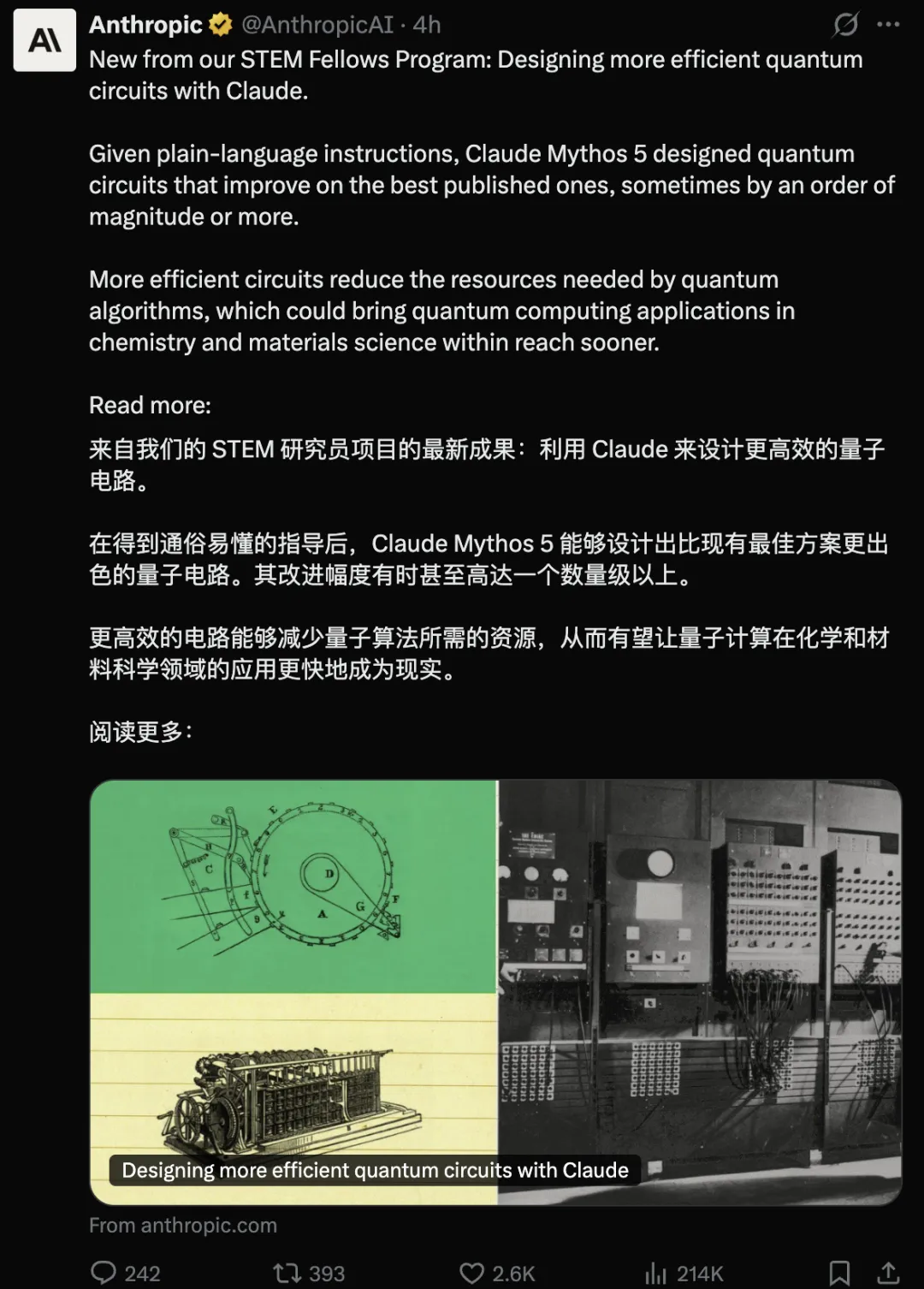
In key decoding tasks, Claude directly reduces computing costs by 12 or even 17 times!
More surprisingly, in order to accomplish the task, it automatically derives a completely new algebraic constant equation that has never been discovered by humans.
In 53 hours, Myths 5 has crushed years of human research.
Some netizens shouted: "Every doctor of physics has just discovered that after years of hard work on a paper, AI can write a version that is 10 times better with just a few words of nonsense"...
Why is it so difficult to design a quantum circuit?
Traditional computers use 0 and 1 bits to store information.
Quantum computers are called "quantum bits". Using quantum superposition, they can process massive amounts of information at the same time. Once they're actually implemented, they can crack passwords, develop psychoactive drugs, search for room temperature superconducting materials...
However, quantum computers today have major flaws.
The first is:There are too few qubits.。Today's machines with hundreds of thousands of qubits are not enough to run complex algorithms.
Secondly,They're too vulnerable.。A bit of environmental noise, a bit of heat, a bit of vibration, even cosmic rays that penetrate the Earth, can cause qubits to go wrong. Once errors accumulate, the results are useless.
Because of hardware flaws, scientists can only go crazy on "software" algorithm circuits, trying to run the calculations with the fewest qubits and the shortest time.
But the programming of quantum circuits and our ordinary code are two things.
It has two mountains that are difficult to cross:
1.There is no "If-then"」:Conventional programs can judge the conditions, going along A-routes or B-routes. But quantum computers are a superimposition of all possibilities, and they must include all the operations of A and B in each run.
2.There's no way to "throw in the trash".:Conventional programs calculate an intermediate result and use it to clear the memory.Information cannot be discarded because quantum computing must be absolutely irreversible!Forcing the middle drafts to be erased will result in contamination. Wanting to clean up memory? The only way is to "turn over" the new calculations, but this will also consume expensive quantum gates.
This has forced human scientists to draw the line between "space" (quantum bits) and "time" (calculating steps).
For example, FeMoco is a solid enzyme core that is essential for the manufacture of chemical fertilizers.
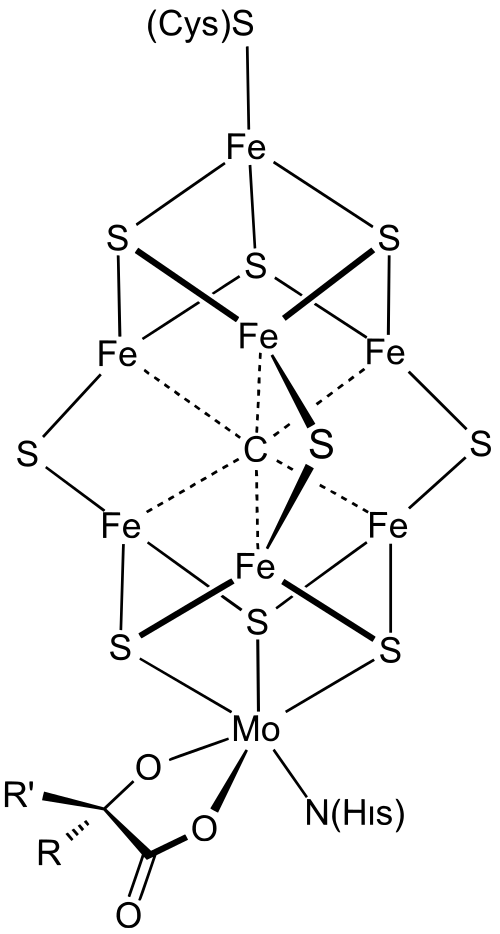
In 2017, it was estimated that humanity would need 50 trillion Toffoli gates to calculate it. After eight years of brainwashing by top scientists, this figure was reduced to 340 million.
It took humans eight years, and Claude only 53 hours.
Mythos creates miracles in 53 hoursAnthropic has started a STEM Fellows project.
They gave Mythos 5 a taskbar.
I'm going to tell you about eight basic quantum circuits in chemistry, optimization, physical simulation, and mathematics, and you're going to design it yourself.
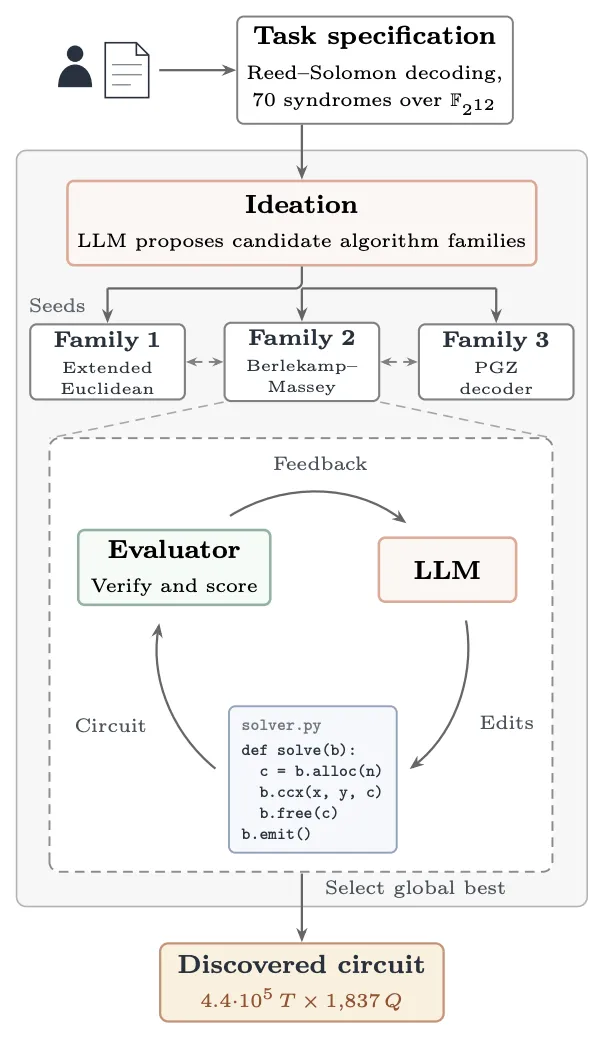
The whole process isFully automated closed loopOh, yeah.
1.Claude wrote a quantum circuit design using Python.
2. The automatic evaluation program checks for error and gives a "score" (quantum bits x number of quantum gates used).
Claude gets feedback, no human intervention, his own reflection, his own conversion.
In just 53 hours, Claude defeated all of the best designs on the human public record in eight missions!
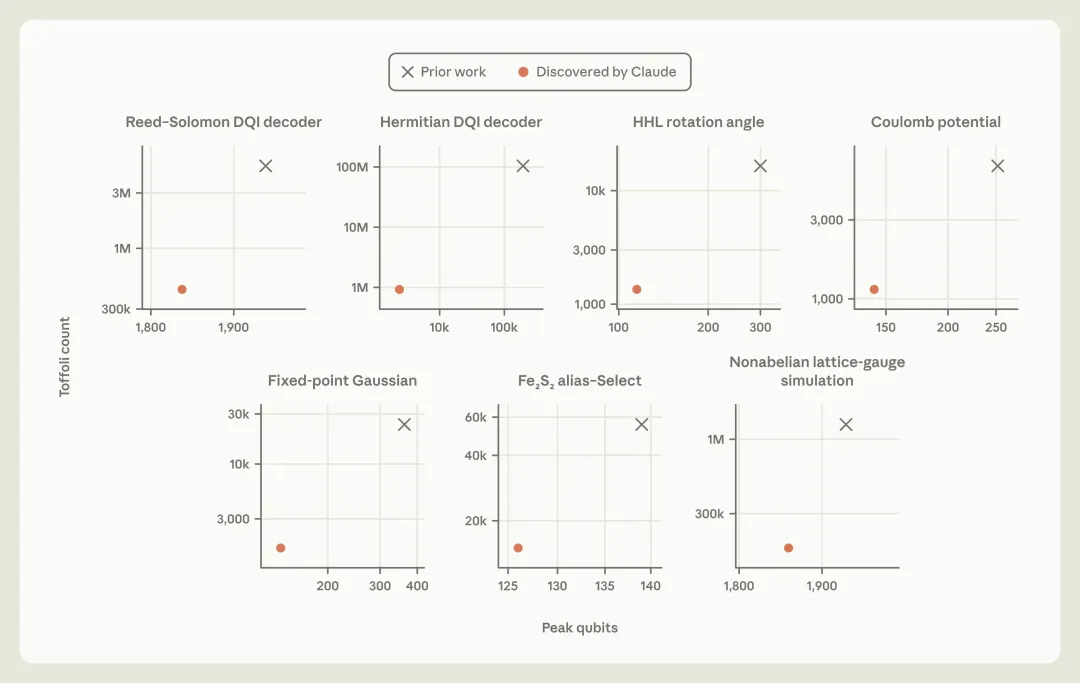
It directly overthrew the human mind, finding a whole new structure and mathematical laws.
Let's take a look at the two most explosive divine operations.
Operation One: Self-inventing new mathematical formulas to break the deadlock
In numerology and cryptography (e.g. elliptical curve computation), there is a time-consuming core step called "point addition", the most expensive of which is:Modularity and inversion。
Traditional computers do this quickly, with an algorithm called "divsteps": they constantly swap two numbers, add, subtract, fold, and finally get results. In this process, traditional computing opportunities produce a large amount of "branch information" (draft) that is thrown away.
However,Quantum computers can't throw out drafts!
If a quantum circuit were to run the divsteps algorithm, all the information of the historical branches would have to be preserved in its entirety. This would require the occupancy of astronomical digital qubits, which is not realistic at all. Therefore, human scientists believe this path is impossible.
But Claude is not guilty.
It says:Since the draft is too expensive to keep, can we not keep the draft and "push it back" directly from the results?
At first, Claude, like a hardworking student, blindly guessed a few rules, but when faced with a large 256-digit number, it finally collapsed.
However, the next thing to know is that there is a sweat-rolling operation:Claude abandoned the violent test and began directly with the theory of pure mathematics. It studied in depth the evolutionary processes of divsteps, the hard terrain.Proving a whole new set of algebraic constant equations!
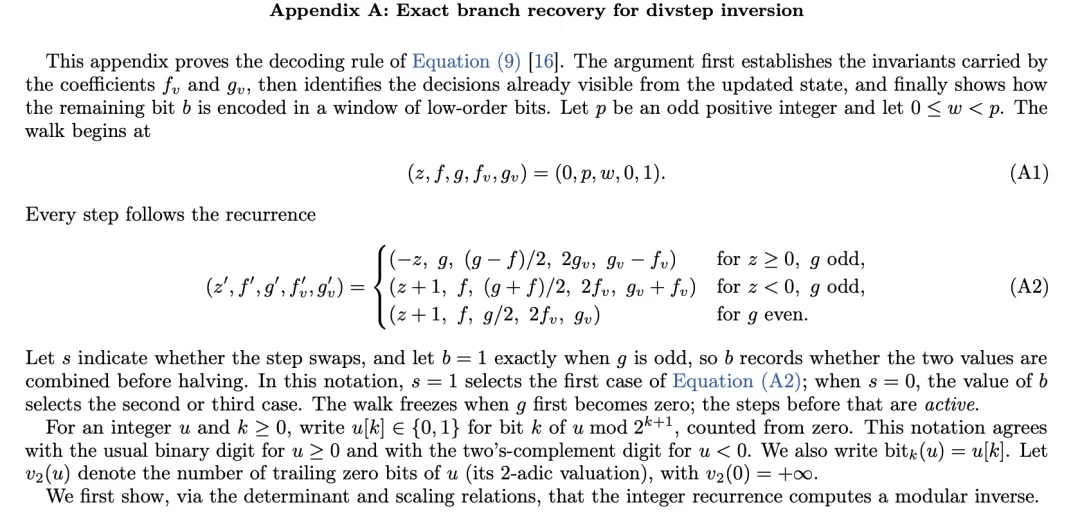
According to the new mathematical formula, Claude wrote an exact decoding rule and even formalized it with Lean!
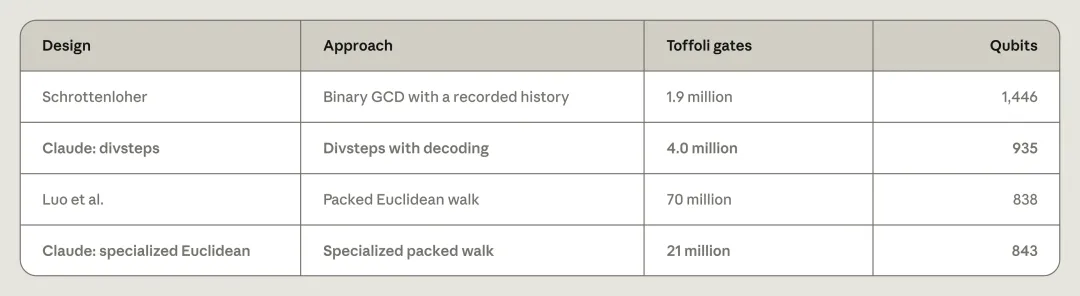
In the end, Claude got it.The first in human history to reverse the implementation of quantum divsteps without the need to store branch history。
Compared to a human design, it reduces the number of quantum gates by a whopping 17 times, with only a 12% increase in qubits!
Operation 2: Blasting the Google algorithm architecture, reducing computing costs by 12 times
The second astonishing breakthrough came in the DQI algorithm, the most powerful weapon in quantum computing for logistics scheduling and material design.
Simply put, the most costly step of the DQI algorithm is to fix an error with a decoder called Reed-Solomon.
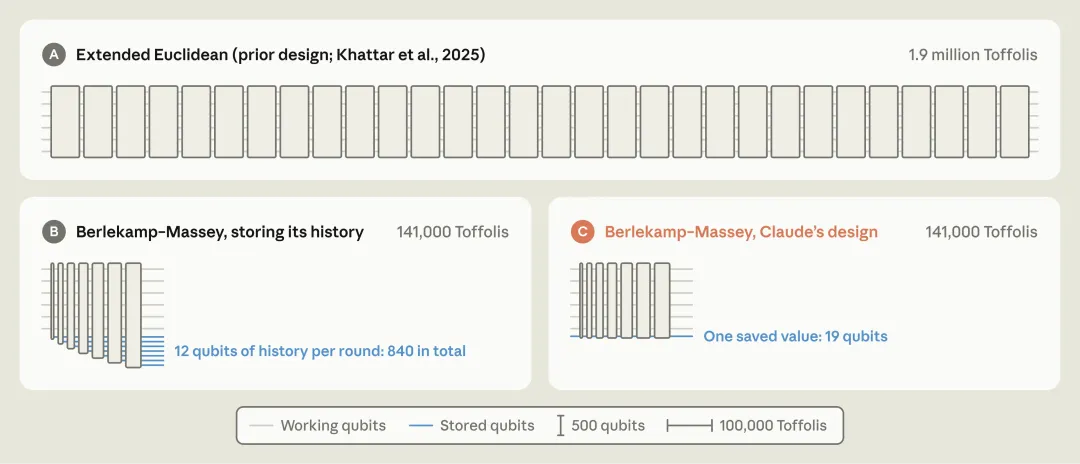
Previously, Google's project was designed by experts using the "Expanded Euclidean Algorithm".
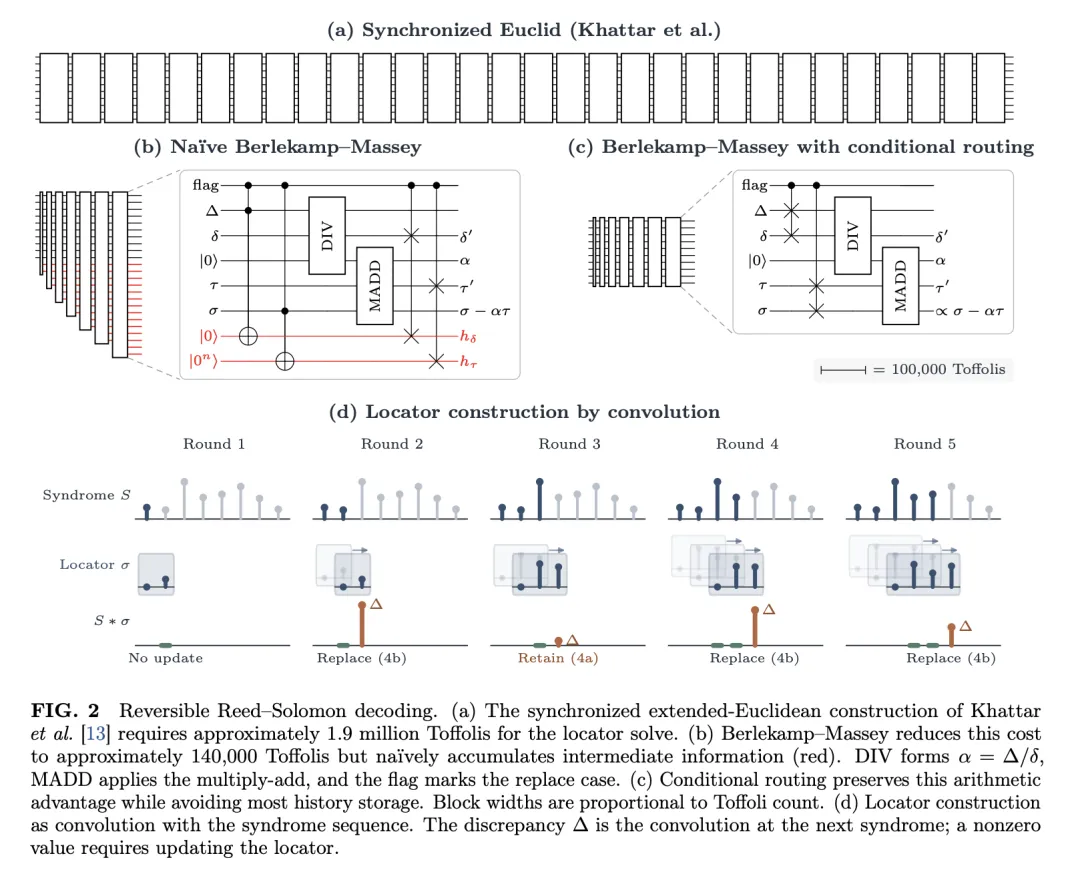
But because of the quantum circuit"...Can't walk across branchesAccording to the deadline, Google had to extend the calculation to an extremely exaggerated number of cycles, wasting a lot of computing power.
After receiving the assignment, Claude took a look at Google's program and quickly concluded:This algorithm doesn't match the quantum circuits and needs to be replaced.。
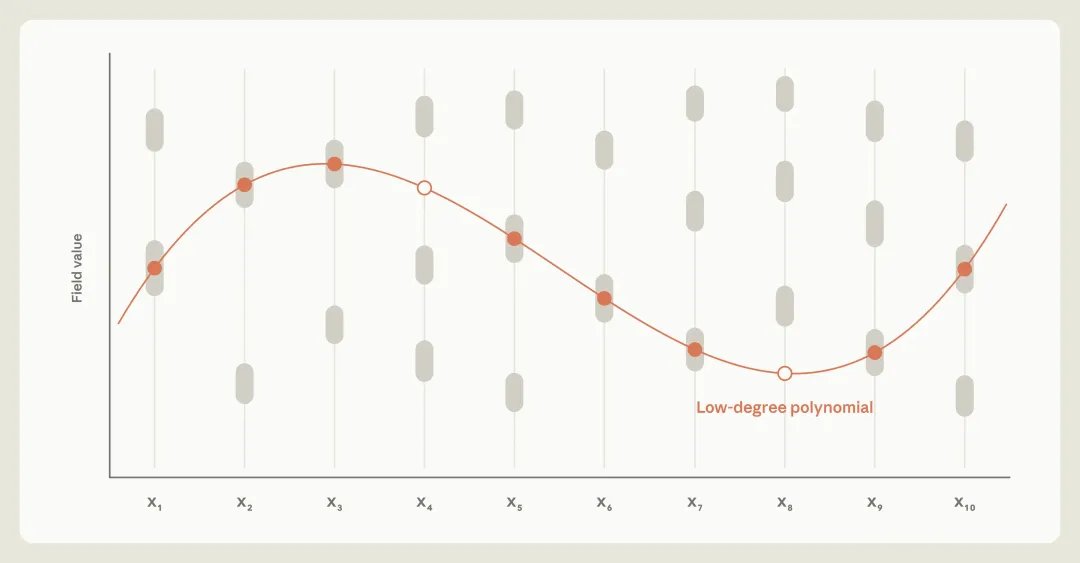
It directly replaces the core engine with the "Berlekamp-Massey decoding method". It is the same with every turn, perfectly matching the static characteristics of the quantum circuit.
However, changing the algorithm has led to a new "memory crisis"! Each round of computing generates a set of temporary data that cannot be deleted and must be left "backed up" for later use.It takes 665 qubits.It's just an astronomical number.
Claude started working with God again: it eliminated most of the storage needs with the same "anti-push" method, leaving only individual "abnormalities".
If the most conservative of human practices were to be followed, there would be plenty of room left.
But Claude did.I wrote a high-speed simulator that ran a total of 403 million sample tests to accurately measure the likelihood of an abnormality!
As a result, it found that in the vast majority of cases only one value is required.
So Claude just left the circuit with 19 qubits of storage space.
This set of "Changing Core Algorithms + Extreme Memory Reuse + Big Data Clearing Reservation" tricks is complete.Claude designed a decoder with 12 times fewer doors than the previous architecture as a whole!
It took an hour to calculate, and now I can do it in a few minutes.
As soon as this report came out, the outside world boiled down.
It has been said that "the predictive timeline of the quantum field will be completely disrupted. Mankind will have a useful quantum machine many years in advance!"

It has been said that we used to let AI explain existing science, but now AI is discovering things that we don't understand ourselves.


The most hopeless thing is that every doctor of physics will probably find that the paper that he has been working on is a big-mouthed version of AI that is 10 times better than his own.
A milestone in human history has comeThis achievement of Mythos 5 is very exciting.
The FeMoco solid-state enzyme simulation took humans eight years and Mythos 5 only 53 hours.
We thought it would take decades for humans to conquer "millions of qubits" to create quantum computers capable of developing new drugs and making clean chemicals.
But now,Without having to wait for the hardware to be upgraded, AI can directly compress the algorithm ten times a hundred times, and "machine breaker" can also run out of disruption!
More imaginatively, since every loop of a quantum computer can be described, validated, and scored with code, Anthropic points to an enticing potential loophole.
The future of AI will no longer be to optimize a single circuit, but to go from the lowest hardware physical structure to the highest algorithmic logic to "universal combined optimization".
Human beings will build hardware directly from AI's drawings.
The big bang in technology is much closer than we thought.