“ In factories with physical intelligence, Foo takes a step forward
At the trade fair, the fusion of physical intelligence and robotics is bringing about a subtle change. The robot on the podium still needs to demonstrate its mobility, but more and more discussions are starting to focus beyond the movement. For example, whether it can recognize unfamiliar workpieces, adjust operations when distorted in position, move between different jobs and operate continuously, and control the force applied to the parts in the moment of contact. These questions sound as if it is not upside down, walking fast as intuitive, but closer to the reality that the robot must face after entering the factory.
An emerging industry consensus is that the industrial landscape will not prepare robots for an ever-accurate world. There are gaps in the workpiece, the feed may be diverted, production tasks are constantly switched, and the spatial layout is limited by equipment and processes. A robot performs a single action in a demonstration environment and can only demonstrate the existence of a certain capability; converting this capability into a stable production efficiency requires the interaction of sensory, operational, motion control endpoints and engineering deployments.
It is no longer a model to be added to traditional robots, but a reworking of the relationship between robots and the real world. This is also an industry signal worthy of attention at this year's trade fair. Competition in the robotics industry is deepening into the mission level, and physical form is still important, but mobility, operational capability, kinetic perception, data closure and on-site adaptability are collectively deciding what a robot can do and whether these capabilities can be copied to the next job.
For traditional industrial automation enterprises, this is both a new technological challenge and an opportunity to extend their capabilities to physical intelligence. Industrial robots' long-term accumulation of motion control, process experience, hardware integration and on-site delivery capabilities will not lose value due to the emergence of large models. On the contrary, these capabilities will become an important foundation for its progress from technical demonstration to reliable operation when robots begin to handle more complex physical tasks.
The exhibition at the Fao Robotics Expo provides an opportunity to observe.
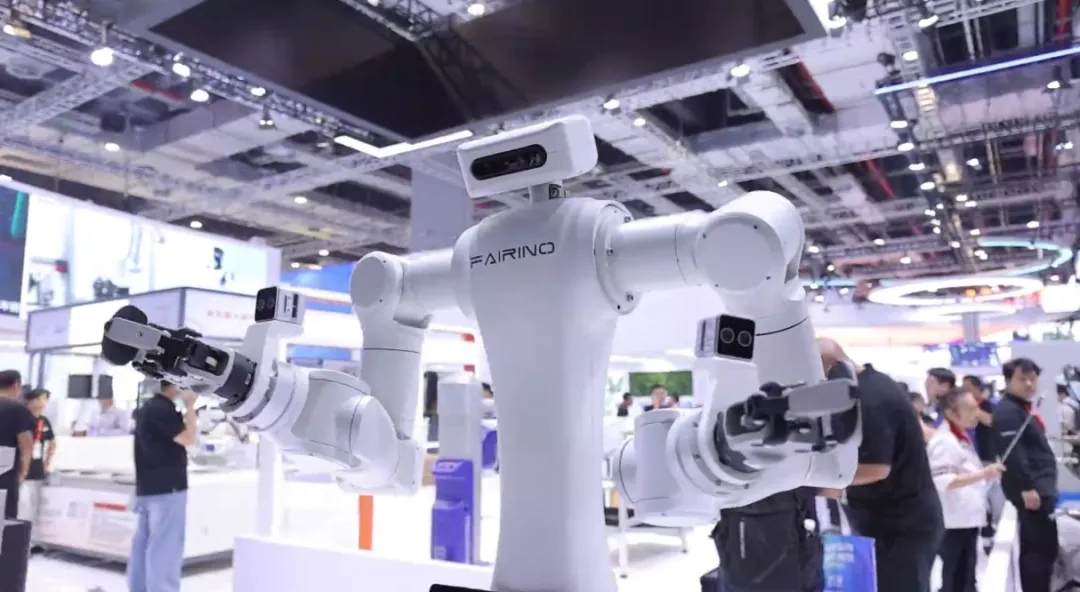
From AIRLab's intelligent welding solutions for ships and large components, to the new ART series' fully articulated controlled human-powered mechanical arms, to industrial-grade body robots with mobile and arm-operating capabilities, Fau demonstrates several interconnected technological paths, with the goal of enabling robots to better understand the field, adapt to the environment and control their movements in contact with objects in order to better complete tasks.
Whether these products can ultimately be transformed into stable industrial production capacity still needs to be verified in real-world scenarios for mission success rates, deployment efficiency and long-term operational performance.
01.
In factories with physical intelligence, mobility and operation must become a set of capabilities
A more strategic view of the Faroe's exhibition focuses on the smartest exhibition space.
What is shown here is a complete chain of capabilities from data collection to precise execution, behind which is a clear strategic vision that enables the scale-up of industrial intelligence (Beyond Massive Industrial Autonomy).
More figuratively, it is an extension of mobility, perception and operational capabilities to more industrial tasks. Wheelchair robots present on-site remote operation and stress, facing industrial field problems: robots must not only complete basic movements, but also adapt to on-site layout, sequential operation processes, dynamic response to changes in working conditions.
Using the remote-operating capabilities of wheelchair robots, the system collects movement, workflow and environmental interaction data, supporting model training iteration. This is the key difference between physical intelligence and traditional automation: traditional automation relies on pre-set programs to perform fixed tasks, while physical intelligence relies on real interaction data, continuously improving the adaptability of robots to new tasks.
Data collection is only a closed loop. The data set covers the coverage of critical operating conditions, the ability of models to migrate robots to entities, and whether on-site failure cases can be reversed, which together determine the landing value of the entire set of programs. The FAROART series of full-junction controlled human arms, covering light agile ART3, general industrial type ART7 and overloaded industrial type ART14, form a complete product matrix ranging from light precision operation to complex overloading operations. The series relies on full-junction control technology, high-junction precision sensing and flexible interaction capabilities, a series that can be flexibly adapted to installation, detection, transport, grinding, multi-type industrial scenarios, and provide robots with more interactive execution platforms from a single runway to intelligent delivery.
BW10-Lite, an industrial-grade intelligent transportation robot, has these capabilities and is designed with two arms, with a maximum load of 20 kg and a maximum operating speed of 1.5 m/s, and is equipped with a self-developed industrial vertical model that supports zero-sample and low-sample adaptation to new working conditions.
The meaning of this type of product is not simply to combine a combination of a mobile chassis and a mechanical arm, but to try to get robots to organize their own capabilities around a task. This also means competing with physical intelligence, not just between models. Who can connect hardware, data, algorithms and real-world tasks has a better chance of shortening the distance from technical verification to stable operation.
02.
With physical intelligence, welding moves to the next step
In areas such as shipbuilding, marine engineering, and large steel structures, welding automation is not just about moving the mechanical arm along its established trajectory. Large components are complex in size and can span longer distances, and the location of the actual workpiece is not necessarily entirely consistent with the ideal model. When changing workpiece types or on-site conditions, re-setting, programming and debugging tend to increase deployment costs.
Robots are not lacking in the ability to repeat movements, and the difficulty lies in how they can still find executable work paths when faced with real-world differences. Fayo AIRLab connects intelligent objects, combining collaborative robots with mobile connectivity circuits, using 3D vision and AI algorithms to identify connectivity positions and shapes, and then generate connectivity paths based on the real-time cloud. The program is also integrated into the connectivity process package, supporting the replication and call of connectivity parameter models.
It is worth noting that the system not only adds to the visual system or mobile device, but also connects field perception, path generation and welding processes. When robots can adjust paths based on actual welding, automation systems have the opportunity to reduce their reliance on fixed workpieces and man-made pre-set trajectories.
This means that automation systems are starting to use more intelligent brains to decide how to operate using on-the-spot information rather than relying entirely on pre-set instructions. Mobile tracks have expanded the range of operations that robots can cover. For large components, mobile organizations can help robots break through the space constraints of a single fixed job; for multi-variety, small-scale production, pathway and process parameters, replication is also expected to reduce the workload of re-deployment. When production patterns shift from large-scale, smaller varieties to more flexible production flows, whether robots can quickly adapt to mixed materials, new locations and new processes will increasingly affect the input of automation projects.
03.
Flexible Manufacturing: Smart from Single to Full Line
The value of physically intelligent robots is no more than the precise work of a single arm. When production moves from large, small varieties to many varieties, small varieties, the real determinant of the ratio of automated input to output is whether the robot can remain flexible in the workpiece gap, material deviation and process switching.
The full-scale collaborative robot program at the Fao Industrial Exhibition demonstrates how to extend physical intelligence features such as force perception and flexible control to the improvement of flexible manufacturing.
The first is the intelligent two-armed folding carton robot, based on two-arms synchronization to complete the folding, unfolding, folding, shaping of the carton, adapting the multi-specification carton to irregular stacking, reducing the dependence on the regular material. Second is the flexible automation of shoe-making graffiti, compressed bottom process, relies on the collaboration of robots with AI visual recognition, end-to-end real-time reasoning, three-dimensional sensing autonomous identification of shoe type, posture and contour, automatically generating graffiti trajectory suitable for different shoe types, supporting multi-size, multi-style seamless switching.
In an AI unordered coding scenario, robots support arbitrary gesture recognition, crawling, right-to-right bi-directional disassembly of each other's codes and 32 types of SKU code mixing, automatically generating the optimum type and path. Subsequently, the screw locks the entire process automatically, through visual dynamic calibration, intelligent tightening and data tracking, completing pinching, positioning, rectification, tightening and data archiving.
They form the same logic as the ART series: intelligent robots not only accomplish individual goals, but also control contact in change, adapt to working conditions, move from fixed positions to flexible production lines, move from single operations to whole line collaboration.
04.
Commercial services: Tier 1 ability to move from industry to life
If flexible manufacturing is a horizontal replication of industrial capabilities within manufacturing, then commercial services are a set of capabilities that flows beyond the real-life scenes. The exhibits of the Faroe Commercial Exhibition continue to be the underlying logic of industrial-level essence, power control and intelligent interaction.
For example, general-purpose intelligent therapy robots based on collaborative robots, modular platforms supporting feature expansion and software upgrades, for scenarios such as urban wellness stores, sports wellness centers, etc. Fully automated two-armed coffee robots with XOS robot operating system, 110 seconds to complete two cups of coffee production, a maximum capacity of 500+ cups per day, equipment covering just 2.5 square meters, supporting 3-hour fast deployment, for coffee shops, large malls, etc. Smart ice cream robots rely on industrial-grade machine arm precision control capabilities, integrated AI interaction technology, tightly adapted to business circles, landscapes, campus, and other multi-traffic scenarios.
From healthcare to catering to retail, the scene has changed, but with physical intelligence driven, reliable identity, precision control, modular deployment and intelligent interaction have remained the same. Cases of physical intelligence in these commercial service scenarios also show that the boundaries of Fao's capabilities are not just core components or industry as a whole, but to export standardization capabilities to more scenarios.
05.
In the end, we're going to get back to the task of being physically intelligent and industrialized.
Of the nearly 300 first-run exhibitions at the exhibition, the focused exhibition of the five-pointed star dimensions (extremely large, very small, very light, very fine, very intelligent) reflects how the robotics industry's emphasis on engineering capabilities is going beyond the pursuit of conceptual innovation.
From the AIRLab smart welding, to the BW10 series of industrial-grade body robots, and to the ART7 all-joint power control mechanical arm, the products on display spanned different technological stages, with the technical concept of AI+FAIRINO=REALITY embedded in the AI deep empowerment product matrix, allowing the robot to move from task-performing to scenic embedding.
This points to a core proposition: AI will remain on the screen forever if it fails to achieve real physical execution. Fau's stand shows that advances in robotics not only enable products to perform more actions, but also allow tasks that originally relied on a large amount of artificial experience, complex programming or highly customized modification, to become deployable, replicable, and maintainable with the addition of intelligent new technologies.
This also explains why the industrialization of physical intelligence cannot rely solely on model breakthroughs. Models affect how robots understand and plan their tasks, sensors and control systems determine how they interact with the physical world, mechanical structures determine their movement and load boundaries, and engineering systems determine whether these capabilities are stable in the long run.
The accumulated process knowledge, control technologies and engineering experience of industrial automation will not be lost to the development of physical intelligence. These accumulation may become an important support for technological development and commercial cooperation when robots begin to process more complex open-environmental tasks.
Fau's booths present several specific cuts along this path, with AIRLab attempting to reduce the complexity of attachment to on-site reprogramming, industrial-grade robotics exploring mobility and operation collaboration, and the ART series bringing mindfulness and agility control into a broader range of operational tasks. They ultimately face challenges not on the stage, but in real production sites.
The dance on the stage is finally over, and every precise task on the production line is perhaps the robot industry's real adult gift.