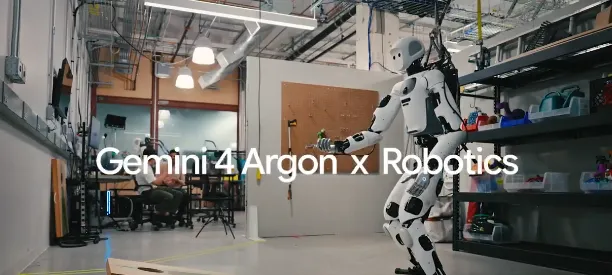
“ Google squeezed the simulation, control and evaluation of robot development into the same model.
On 14 October, Google DeepMind officially launched the General Physical Reasoning Model Gemini 4 Argon. It also released a blog on robotics, which states that the model offers robotic controls, virtual practice environments, training in data quality checks and paper experiments.
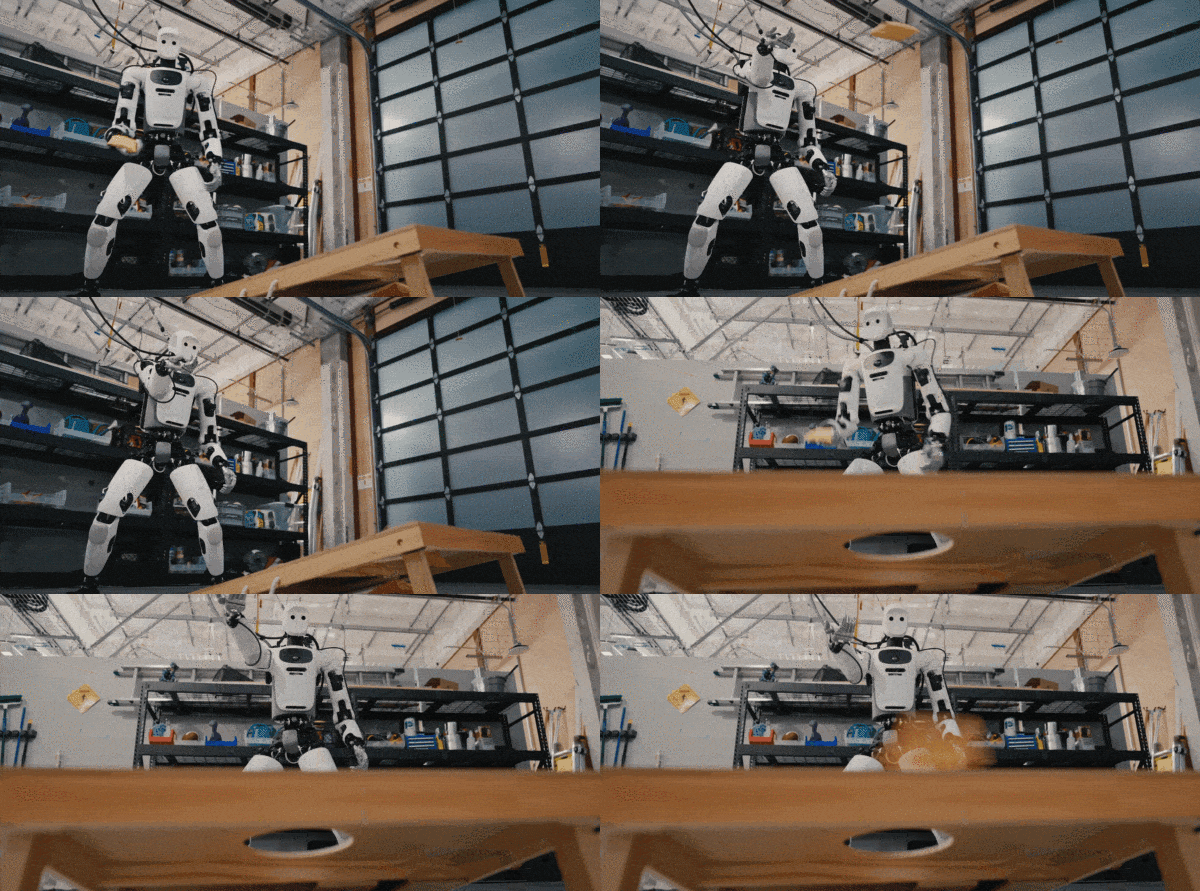
They published a demonstration on the X-Platform in collaboration with the Apptronik Apollo humanoid robot. The team first showed the Gemini 4 Argon a demonstration video of the "sandbag penetration" and then guided the Apollo to repeat and simulate the action. The robot continued to test and adjust its performance, ultimately launching seven consecutive targets.
Demonstration tasks also included having a Boston-powered Spot robot throw a drinking fountain into a trash can. The Gemini 4 Argon builds a virtual copy of the fountain before actually stepping on the trash can and simulates how the robot exercises to maintain balance with its three legs in a simulated environment; it then tries the task on real hardware. Two other AI sensors verify the correct position of the robot's feet and claws before loosening their necks.
Argon's design goals include better understanding spatial relationships, writing control codes, and interpreting video from a physical perspective. Google sees the model as a general tool that extends from the use of single-platform robots to the reproduction of published research, and calls it another step toward "physical AGI", a goal that Google and its AI subsidiary DeepMind have been pursuing for years.
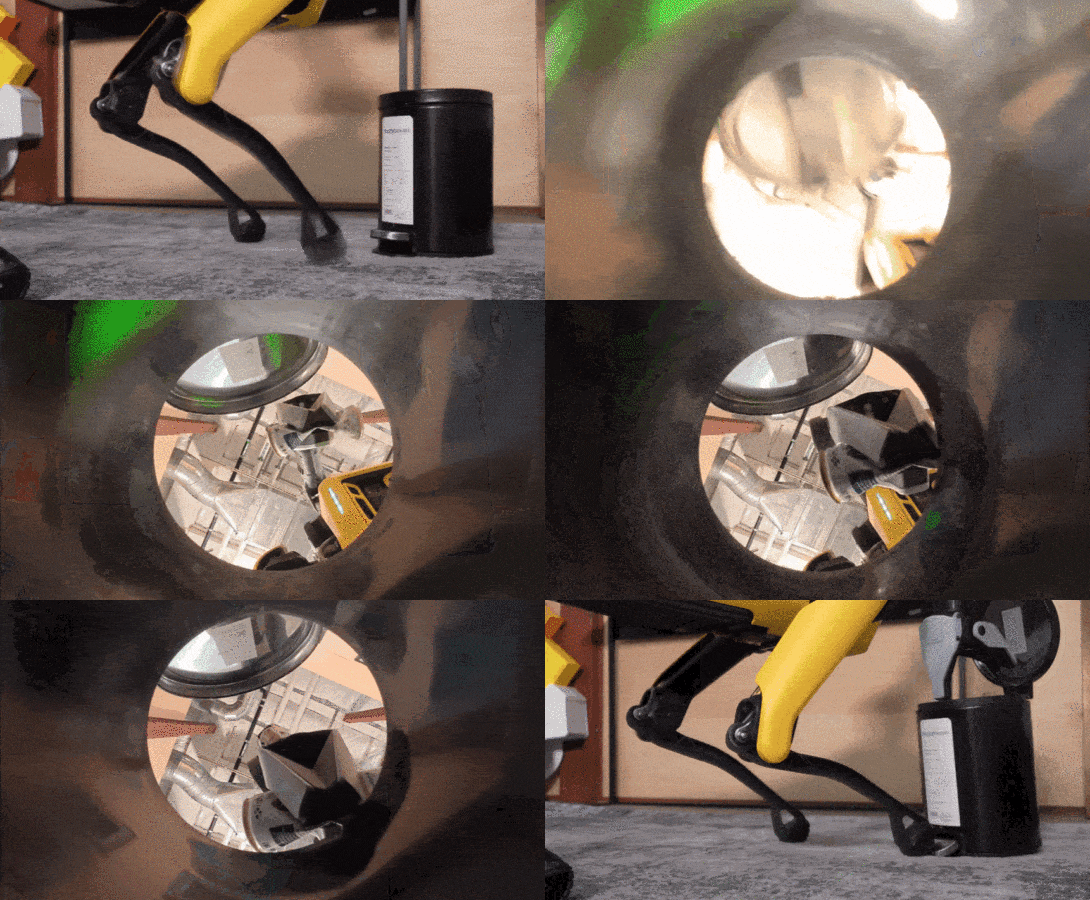
Gemini 4 Argon controls the Spot to lift a drinking fountain and step it into a trash can; the action sequence has previously been practiced in the MuJoCo simulation.
01.
One photo turned into thousands of trainings.
Spot's presentation follows a pattern that has repeatedly appeared in multiple Google cases: Argon uses simulation to prepare tasks, verify tasks, or generate training data. With just one photo of a table with party props, the model builds a virtual copy that includes a soft furry hat. It itself proposes 77 tasks, from supporting downed objects to a blank table, and generates more than 4,500 training episodes for a control model. When tested on a real robot, the success rate increases from 56% to 75%, with execution time decreasing from 35 seconds to 24 seconds.
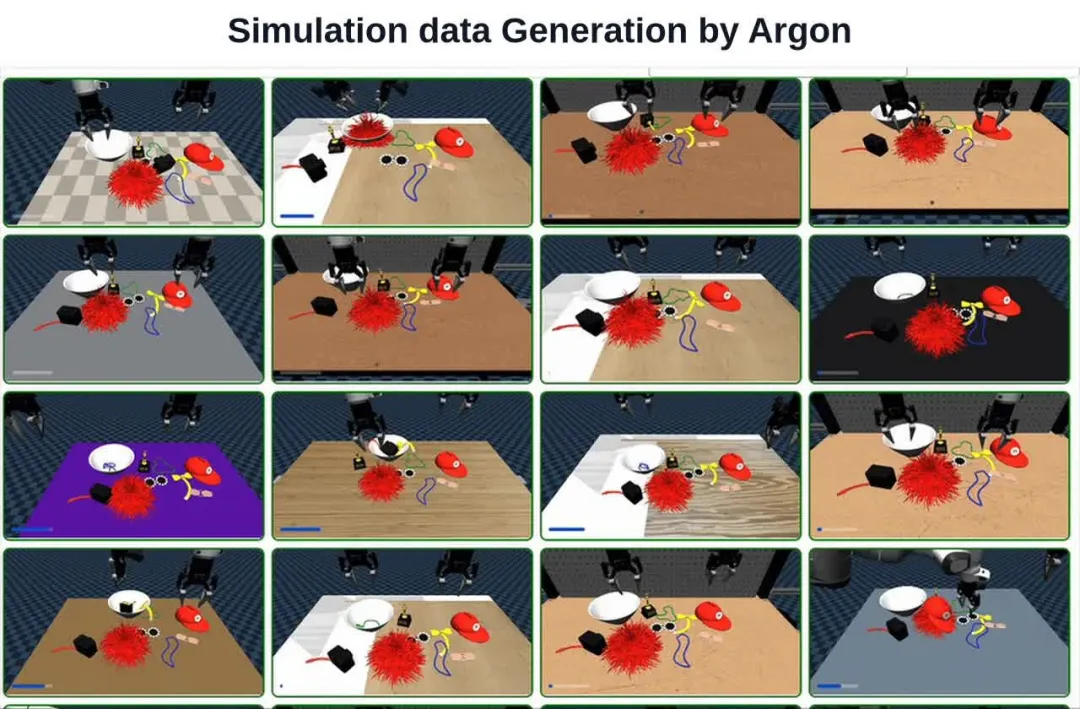
With just one photo, Argon generated more than 4,500 varied simulation clips, increasing the success rate of real robots from 56% to 75%.
Argon can also be obtained from other sources. Based on a video of a remote-operated robot, it can construct a simulation environment that not only strives for consistency in appearance, but also reproduces the same power readings at the fingertips. Based on a first-person video of a human completing a grabbing task, the model can map the movements of the hands and fingers onto a virtual humanoid robot with five fingers.
In the presentation, a painting depicting a man-made robot crashing a box with a ball over a pyramid-shaped stack, Argon generated a simulation and calculated a set of throwing moves to crush all six boxes on the assumption that the robot would not fall.
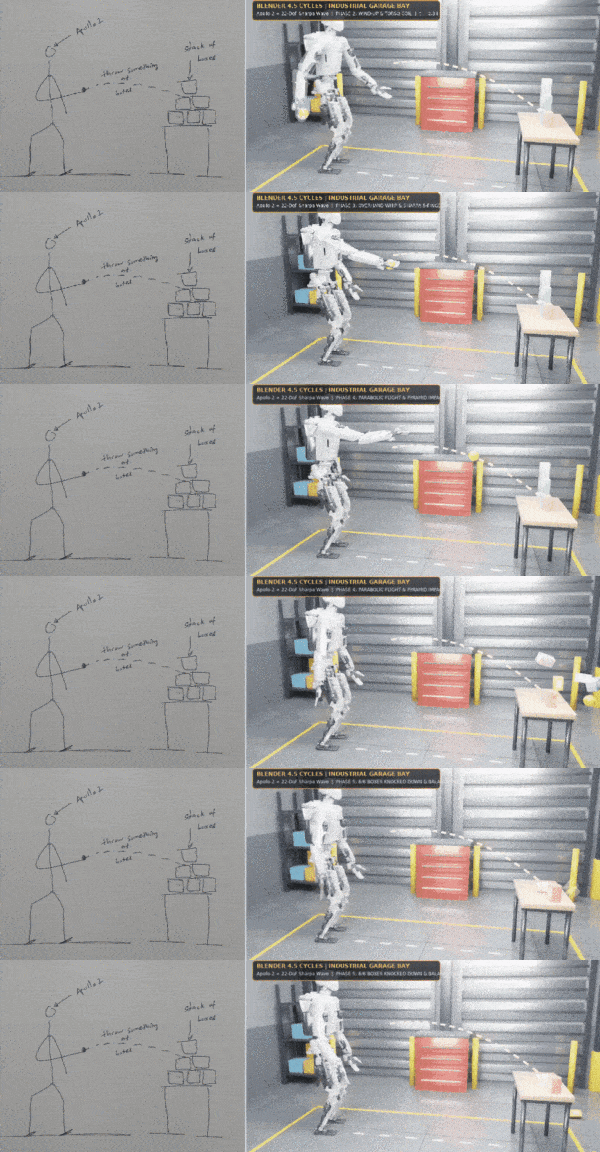
With a simple hand-drawn sketch, Argon created a simulation: a humanoid robot throws down all six boxes at once, while maintaining balance.
02.
Argon commands AI video models to plan robot action
A demonstration takes place entirely in AI-generated video. Gemini Omni is a video world model that can generate clips to show how a scene changes after something happens, and Argon plays the "director" in it. It writes instructions in chronological order indicating what the machine should do at a given moment, such as pushing a piece of Scrabble characters to the center of the table. Gemini Omni uses these instructions to generate a video. Argon then checks the single screenshot and adjusts the next command. The goal is to list the five scattered characters as "ARGON", and after 33 steps, they are in the correct order.
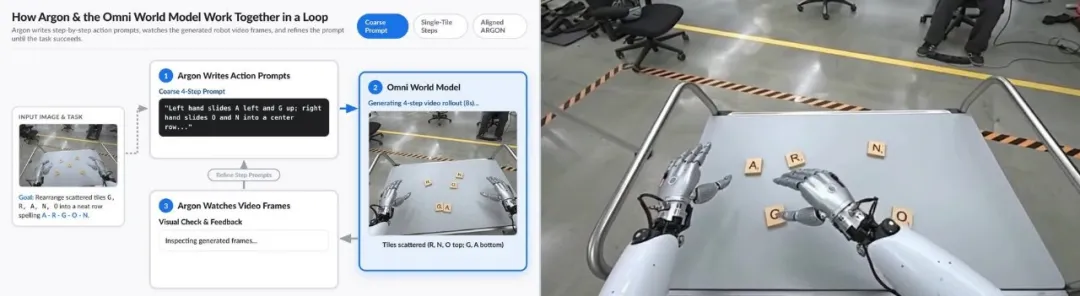
Argon takes a step-by-step direction of the video world model Gemini Omni until the machine hand lines up the characters into ARGON.
Another demonstration used a structurally simple mechanical arm, where Argon needed to put a piece of Lego bricks into a wooden box and improve its performance over time. When the attempt failed, the prompt prompted Argon to look back at his logs and camera images and retry the cause, using a verified correction scheme. The first round took just under 1 minute; the second round was much faster, 23 seconds, but the bricks hit the edge of the box.
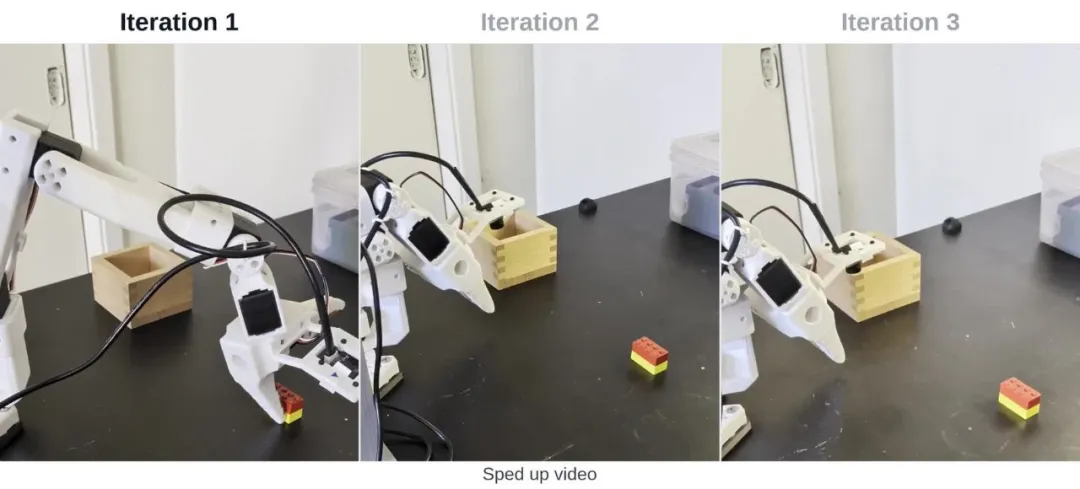
In the three-round conversion, Argon shortened the execution time of the mechanical arm from 58.9 seconds to 17.4 seconds and drove it to the center of the final hit box.
Google also wants Argon to serve as a research tool. Each paper only needs to give a hint to reproduce published robot experiments as interactive simulations that can run in browsers. Google says that 68 such sandbox environments have been built, including robotic football and skateboarding humanoid robots.
Embodied Reasoning Question Answering (ERQA) is used to test the ability of an AI model to understand and solve physical and spatial problems in a 3D environment. The test uses 400 questions, without providing any auxiliary tools, and the model must rely entirely on reasoning. According to data provided by Google, Argon scores 87%, ahead of all other front-end models. Second place Claude Opus 5.5 is 82.3%, about 5 percentage points behind; GPT-6 Astra is 81% behind; Claude Fable 5.1 is 74%, and 13 percentage points behind.
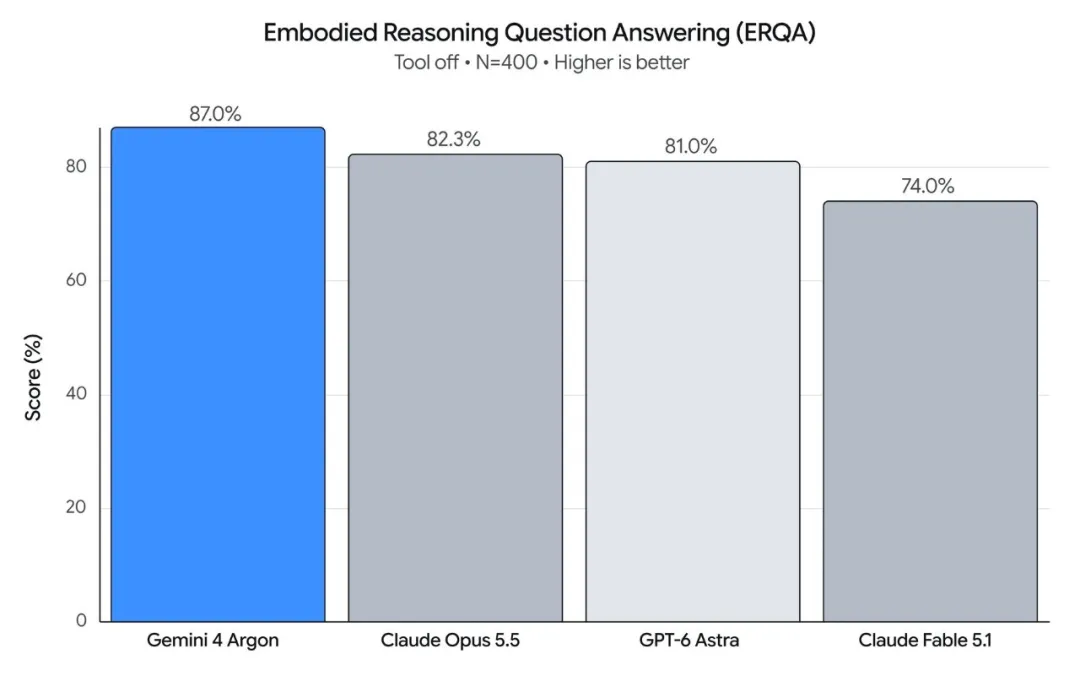
According to Google, on the ERQA benchmark for spatial and physical reasoning, the Gemini 4 Argon leads Claude Opus 5.5 by about 5 percentage points.
However, the AA-Robotics benchmark released a day later by Artificial Analysis yielded a different result. In this test, the language model directly controls an actual mechanical arm to complete eight tasks, with Argon ranked third with 55 points out of 100, behind GPT-6 Astra (69 points) and GPT-6.1 Sol (65 points).
03.
Argon can also review the quality of training data.
In addition to controlling robots and building simulations, Argon is also used to evaluate training data. In a two-minute video showing the two-armed robot folding fox, the model breaks down the entire process into substeps, marking stoppages and unsuccessful crawling movements.
Google also showed a more interesting use case, based on the classic celestial equinox puzzle: one of the twelve balls with the same appearance is heavier or lighter than the rest. Argon constructed a simulation with two mechanical arms and a celestial equinox that read the tilt of the celestial equinox with a camera image and could detect that unusual ball in no more than three dimensions.
04.
The real "scaffold" is hidden in the hint words.
Google disclosed the detailed examples of hints used in these demonstrations, which provide more objective references to some of the larger claims. For example, in the so-called "zero-shot" task of supporting and reversing cups, Argon actually received a camera image overlaid with a centimeter grid, as well as pre-written instructions such as "catch" (grasp) and "drop down to contact" (lower until contact). For simulation tasks, the hints also listed a list of prohibited items in case the model took a shortcut, such as the number of sensors directly copied.
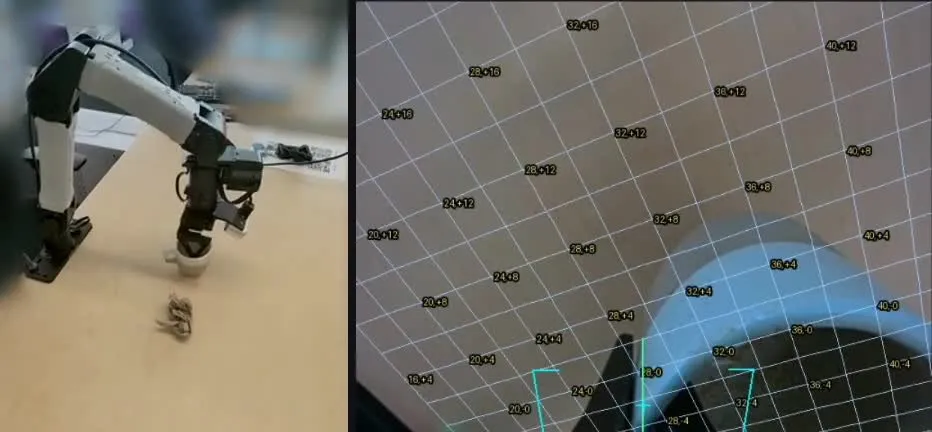
Without any prior training, Argon straightened the downed cup under the guidance of the coordinate grid in the camera image and stuffed a tablecloth into it.
Argon is now available in Google AI Studio and development environment Antigravity, but only for Google AI Ultra subscribers. Developers can also call the model through the Gemini API's paid credentials.
Recently, Google released Gemini 4 Argon globally. In robotic direction, the company has previously launched Gemini Robotics-ER 1.6 for space perception and mission planning. Training in a virtual environment is not new either: the startup World Labs has shown how to transform real-world scenarios into virtual training worlds, while the brilliant DreamDojo simulates robot action in video form.