Over the past few decades, AI's capabilities have been increasingly coded in three directions: bigger computing, better algorithms, more data. This is especially true in the age of big models, with larger clusters, more parameters, and lots of contents, creating a single model with superclusters of capabilities.
When there are enough super-individuals, a larger imaginary space opens up. If these models are allowed to be fully understood and interconnected and cooperate with each other, will they be able to generate intelligence beyond that of any single individual?
This week, the newly founded South Korean startup SinapisAI released its technical report Toward Collective Model Intelligence: Characterizing and Coordinating Models. This is the first time the company's core technology has been made public, with the system introducing its technical framework and initial experimental results built around mass model collaboration: aiming at the ever-expanding model universe, building quantifiable imaging capabilities for the model, and model selection and collaboration by Mio Models in One, combining task needs and resource budgets.
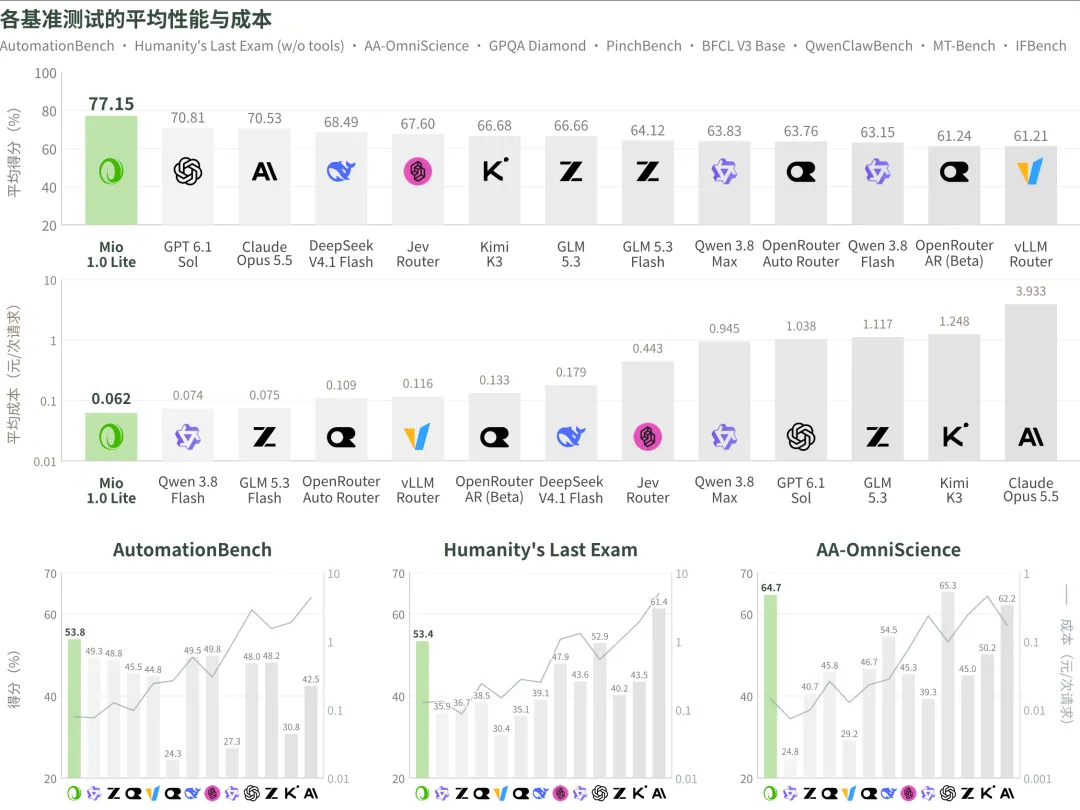
In this comparison of nine benchmarks, Mio 1.0 Lite has the highest average score, the lowest average cost per request.
The report gave the first public ratings: Mio 1.0 Lite was compared with multiple single model routing schemes, taking an average of first place on nine public benchmarks (77.15/100) and the lowest average cost ($0.06 per request) at the same time, scoring the highest score on five of these datasets, with a cost reduction of 73.7% on 97.5% compared to its higher scores.
Nanjing Intelligent is a technology-focused enterprise at Nanjing University's Institute of Artificial Intelligence, the core founding members of the Institute's LAMDA laboratory, including its co-founder, Sun Yang, CEO, CEO, and CTO. On October 8, its product platform, SinapisAI, has just launched a public announcement that 484 models have been acquired.
Model: The Fourth Element of Smart Growth
The model has become a new element of growth, due to two simultaneous changes. One, the model is growing from a one-time technical product to a resource that can be accumulated, replicated, and distributed. New models are being born every week around the world, and even from the same source, models trained by different developers, different skill trees will grow.
In the conclusion section of the report, the value of a model depends on its role in the collective. An average score is not a prominent expert model, but may also complement the lack of capabilities of other models.
In 2016, Zhou Zhihua, academician at the Chinese Academy of Sciences and vice-chancellor of Nanjing University, proposed the "Learnware" paradigm, proposing model regulation, inventory sharing, on-demand replication. Mass model collaboration is an extension of the big model era.
In the report, the idea has a formal name: Collective Model Intelligence. The report focuses on collaboration at the capability level, understanding and coordinating the complementary capabilities of independent development models to improve task performance and resource efficiency.
This path also responds directly to the two deployments of the 15th Five-Year Plan. One is to encourage technological innovation such as group intelligence. In this model universe, system design supports new model registration, capability engraving and candidate pool review, and accordingly updates the available model collection, allowing models to freely access and dynamically exit, providing a basis for the organization of model capabilities and on-demand calls. The other is to promote the consolidation and green development of computational resources.
The core of technology: understanding models, choosing models, moving models
The system consists of four technical subjects, connected in a circle.
Model Eval: Select a model to understand the model, but make a full assessment of each model subject, costly. Model Eval combines query-level response modeling with cross-domain forecasting, using historical assessment information and limited new observations, to build model image capabilities.
In query-level experiments covering 25 models, 18 benchmarks, and more than 250,000 queries, the system estimated the average score of the model on each benchmark, with average scores estimating errors less than comparison methods such as IRT, PSN-IRT. Another experiment covering 35 models and 32 fields separately assessed cross-field predictions to focus on accurate scores in the measured fields and predicted the model's performance in the unmeasured fields.
Option to model (Mio): It combines model capability evidence with the current task state, anticipates candidates that meet constraints such as interfaces, models, and budgets, compares expected task performance, and selects the most cost-effective and delayed options in models that are close to performance.
The candidate pool maintenance mechanism proposed in the report is dynamic and is continually adjusted with new model access, capability evidence and changes in service conditions. When the group pool assesses the directional replacement loss, i.e. after replacing a model, to see if it has a succession of unique advantages on a specific request. Only the remaining models are retained in terms of field coverage, replacement loss and service compatibility, and only one model is moved out of the candidate pool, so that the average score does not have to stand out, but the expert models that can supplement the shortboard are retained.
Modeling Modeling (Mos): After selecting a model, there is a problem that is often overlooked: models of the same model often have multiple sources, and the endpoints of different servers vary greatly in price, limit flow, queue time, generation speed, and availability, and can change at any time.
Modeling Service System Mos Comprehensive endpoint health, availability capacity, costs and expected delays, to arrange the source of execution for the selected model, and to perform conditional retesting and switching to the same model endpoint when failure types and response progress are allowed. Supported model distribution networks have improved the speed of model file reading by up to 23.3 times under pre-heat shared caching (excluding caching, input of parameters into GPUs and logical connections) and improved the efficiency of distributing model files in self-managed deployments.
Install all this (Model Space): A model warehouse at the bottom creates a versioned identity for each model, allowing 484 models to be dynamically accessed, updated and outgoing, and capability images to be updated with versions.
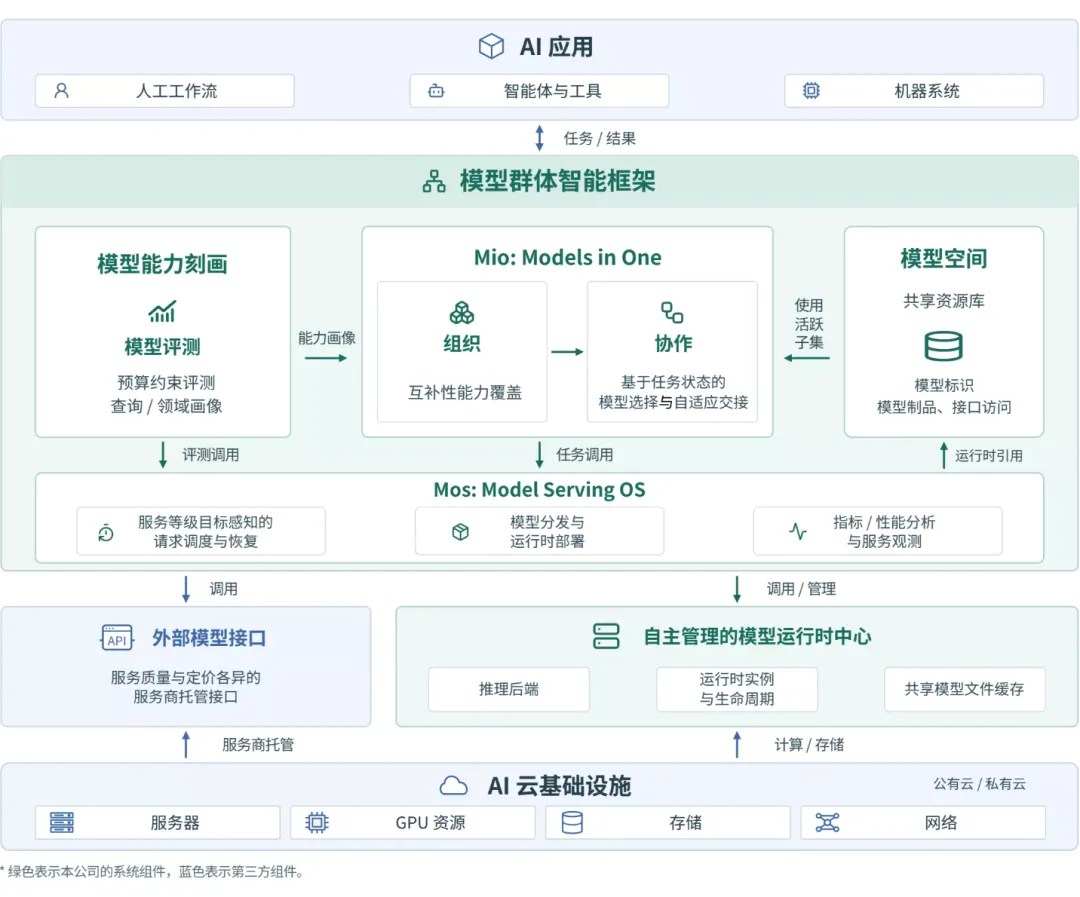
Smart architecture design for model groups
Tests in combat: average first place, lowest cost
According to the report, Mio 1.0 Lite competed with eight top domestic and international models and four routing services on nine public benchmarks, with outstanding results: Mio's nine average scores were 77.15/100, the highest overall; the average cost per request was 0.06, the lowest overall. The highest-rated opponent GPT 6.1 Sol, the highest 6.35 points, the lowest 94.0%; the lowest-cost opponent Qwen 3.8 Flash, the highest 14.00 points, the lowest 16.4%; the specific performance was as follows:
AutomationBench (Agent Execution): 53.83%, first overall, 4.00 percentage points higher than the second Jev Router;
BFCL V3 Base Multi-Turn: 77.50%, first overall, 11.50 percentage points higher than the second Opus 5.5 and costing only 2.7% of the latter;
GPQA Diamond ((Scientific Reasoning): 95.96%, first overall, 2.46 percentage points higher than second place Kimi K3;
Humanity's Last Exam (no-tool reasoning): 53.38%, second place, 7.97 percentage points lower than the first Opus 5.5 and 97.5% lower;
AA-OmniScience ((facts knowledge): 64.67%, second place, 0.67 percentage points lower than the first GPT 6.1 Sol and 85.3% lower cost;
PinchBench (Agent Execution): 96.27%, first overall, 0.23 percentage points higher than second place GLM 5.3;
QwenClawBench ((Agent Execution): 69.38%, second place, 0.43 percentage points lower than the first Qwen 3.8 Max, costing 95.1% less;
IFBench: 92.00%, first place overall, 9.20 percentage points higher than second place Qwen 3.8 Max and 91.6% lower cost;
MT-Bench: 9.138/10, third place, 0.223 points lower than the first GPT 6.1 Sol, 89.7% lower cost;
The report also marks a boundary: In high-difficulty tasks such as HLE, cost-free flagship models still have quality advantages. Mio's positioning is to seek better quality, cost and coverage balance. The team also constructed the RobustRouteBench robustness benchmark, which on 18,982 final test requests in general text, multi-module and Chinese tri-scenario scenarios, evaluates off-line Mio level selectors in fixed model pools to select robustness and avoid developing concurrent requests into final testing.
Compared to single-model/routing algorithms, the Mio 1.0 Lite has both performance and cost advantages.
Commercial Logic: Gold mining, selling watermen's cranes are being priced
The most defining business in the gold rush is often the sale of water. The timing of this report's release is worthwhile: Over the past few months, Stripe has announced its agreement to acquire the AI model gateway and routing platform OpenRouter, and U.N.A. has announced the acquisition of the open model developer community Hugging Face for $12.9 billion.
This business layer is broken down into three progressive nodes. Warehouse solutions are discovered, route solutions are selected, collaborative solutions are combined, and the layout of Nanjing Intelligent is in line with this: Model Square provides model detection inputs, Mio assumes task-based model selection and collaboration, and the underlying system provides the ability to carve and execute support.
In the past, the company has completed close to a billion yuan round of financing involving institutions such as Nanjing City Innovation Investment Group, Shenzhen Capital and others. It is worth noting that Nanchang does not develop its own general model, does not compete with model manufacturers, which is a scarce asset in itself.
The report clearly states that the overall benefits of system integration, as well as the prospect of continuing to evolve with experience, are yet to be further verified. According to the report, this evolutionary pathway is regressive, with the system's ability to collectively diagnose its own weaknesses, correct its mechanisms, and re-verify changes, with the goal of making each cycle simultaneously improve the performance of tasks and the system's self-improvement capabilities. This is not the end of the Scaling Law, but a simpler judgment that when the ability of a single model grows marginally decreases, the organization's ability to have a model is itself a new evolutionary curve.
The vision for collective intelligence is big, but Nanyang Intel has given itself a very specific position. Speaking of what Nanyang Intelligent wants to do in the long run, Nanyang Intelligent CEO Sun Yi used a analogy: the key to changing the world is not just to create larger power plants, but to build a power grid so that electricity can be delivered safely, efficiently and wherever it is needed.
The model universe is still expanding. After arithmetic, algorithms, and data, can't models be the fourth factor in the growth of intelligence?