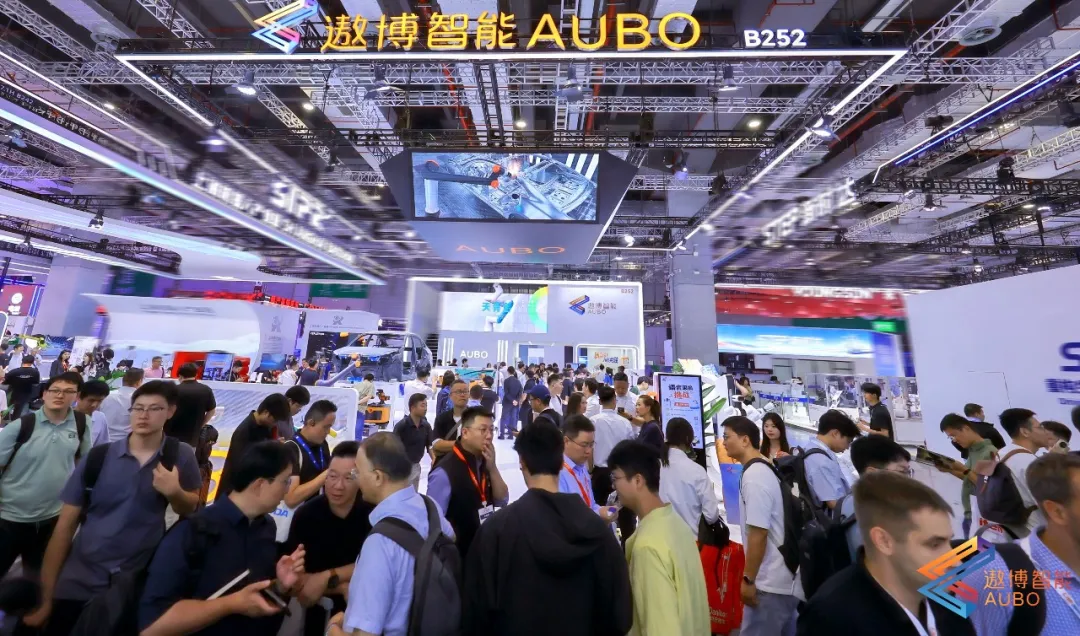
 When flexible AI moves from single automation to smart adaptive collaboration
Automation equipment that operates on fixed tracks is more expensive and difficult to adjust to load biases; the quality of grinding and welding continues to depend on the skill of the workers, and is prone to poor surface consistency, low quality and efficiency bottlenecks.
To break the rigid skeleton of these core jobs, robots would have to go from rigidly performing crystal evolution to flexible perception and process understanding of crystal, which is the core idea behind the G series of intelligent adaptive collaboration robots introduced by Bloomberg: not only allowing robots to make adaptive adjustments based on external changes, but also understanding complex processes and making proactive decisions through intelligent perception, completing the transition from crystal-collaborative robots to crystal-collaborative applications.
In the real industrial grinding scene, the biggest difficulty lies in the stability control of the force under heavy loads, with slight fluctuations in force leading to the workpiece grinding through the grinding or leaking of the grinding. At the core of the automotive production line at the site of the trade fair, the G40 smart adaptive collaboration robot with up to 40 kg of load, coupled with a floating air-mounted grinder, performs continuous dynamic static floating grinding on the parts of the car.
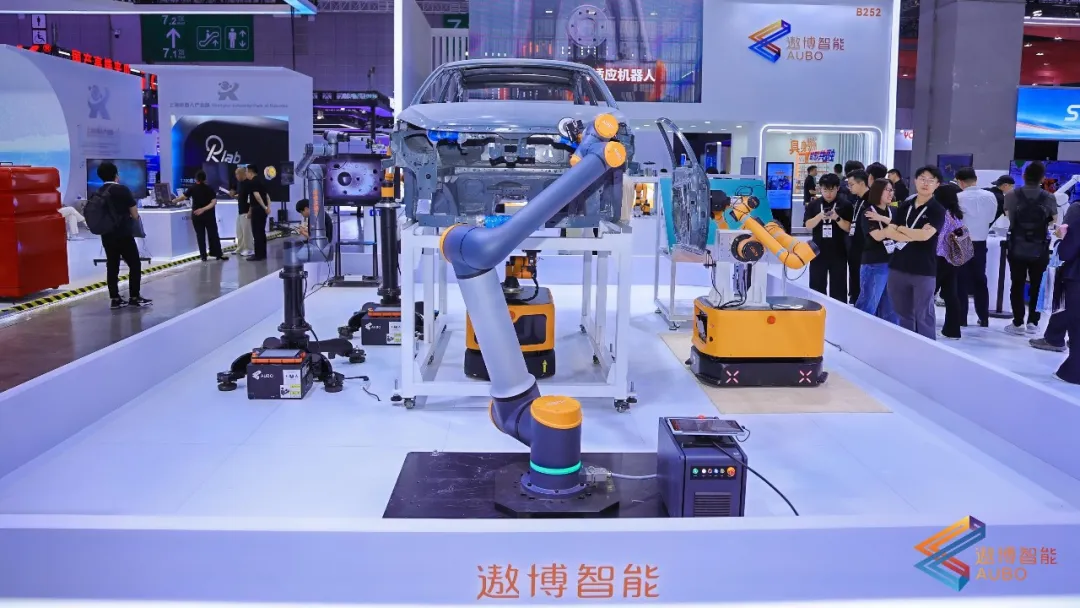
The G40 collaboration robot allows the grinding to be always tightly attached to the workpiece curves, achieving a uniform de-mapping and polishing effect. This is behind the G series built-in high-precision torque sensors and adaptive force control algorithms, so that the mechanical arm can real-time sense the minute changes of contact during grinding and dynamic adjustment of posture and strength.
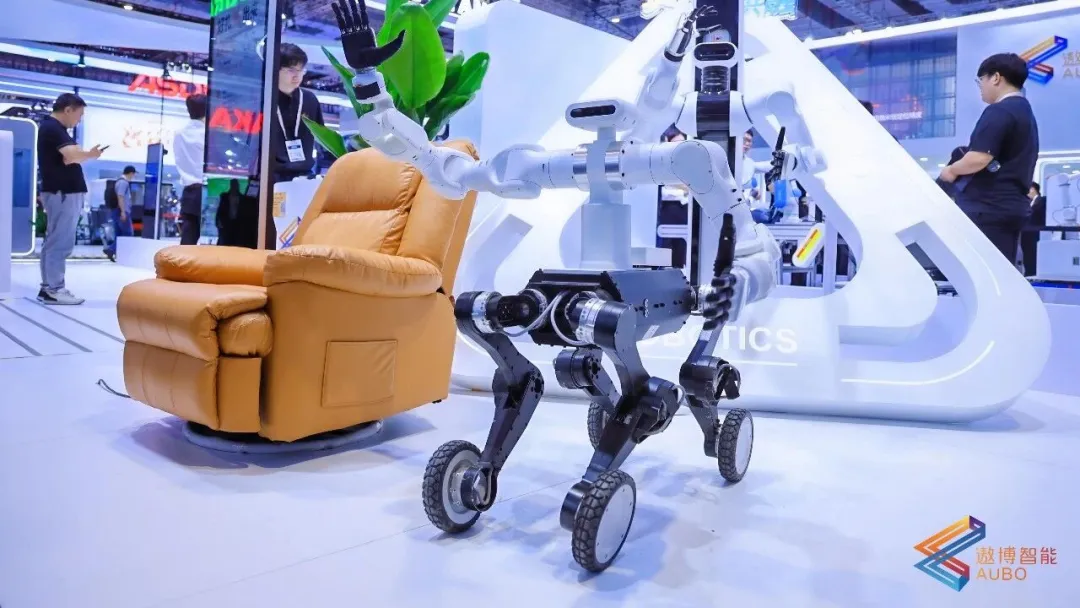
The mobile two-armed robot, which is also operating in this flexible production line, was first shown by Bloomberg Smart. This two-armed robot uses a mobile chassis and two-arms synchronous operation, responsible for completing car door transport, installation work, it solves the problems of small single-arms loads, complex installation space tasks, change of latency, and the real application of Bloomberg smart body smart products in industrial manufacturing.
In addition, for small batches of industries such as ships, bridges, and various types of welding pain points, Bloomberg Smart has also exhibited on site standardized welding workstations consisting of silicon-collaborative robots + ground track pads. The program deep packs hardware, visual perception, power control algorithms with professional welding process packages, free demonstration programs, so that ordinary workers can quickly complete multi-track, multi-material autonomous welding operations without heavy programming, further lowering the ground threshold.
When you're smart enough to live and work in real life, you're smart enough to live and work in real life.
If the automotive flexible AI line demonstrates the profound power of artificial intelligence in vertical industrial processes, then the artificial intelligence panel on the stand is an intuitive answer to the most central question in the industry today: how does artificial intelligence get out of the lab and create value in real life scenarios?
In the face of the boom in investments and research into physical intelligence in the past two years, the thinking of the founder and chairman of Bloomberg Intelligent, Zhang Hongqing, is calm and pragmatic. In an open interview, he said that the shape of humanoid robots is not merely to simulate human beings, but to adapt to the built environment.
In the industrial manufacturing industry, the purpose of developing humanoid or human-like two-armed robots is to be able to directly enter the workplace in a way that converts hydrogen into hydrogen, achieving hydrogenation or hydrogenation.
In express logistics and e-commerce warehousing, the sorting of scattered soft bags has always been a problem: packages vary in size, are easily deformed, overlap when stacked together, poorly handled leak sorting, damage or even card lines.
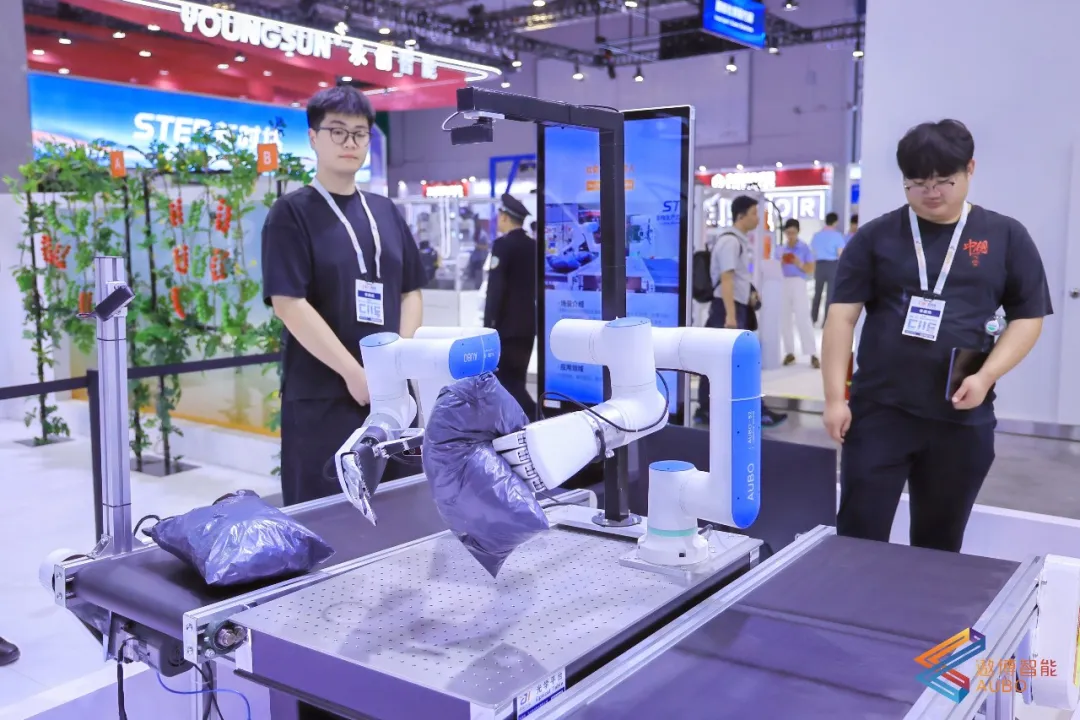
The S-series dual-arm sorting robot, featuring a combination of 3D visual perception and power feedback, faces random stacking of conveyor belts and soft bags of various shapes, capable of identifying, grabbing and tracking conveyor belts autonomously. The two hands work together by placing the packaging upside down, keeping barcode labels uniform, effectively reducing the leakage, breakage and card lines caused by stacking shadows, soft slippage and size differences.
In order to completely break the bottleneck of the hardware industry's weakness, lack of standards and poor performance on its core components, Bloomberg Smart has directly balanced and optimized its standards of reliability in the field of collaborative robotics through over a decade of real-world production lines.
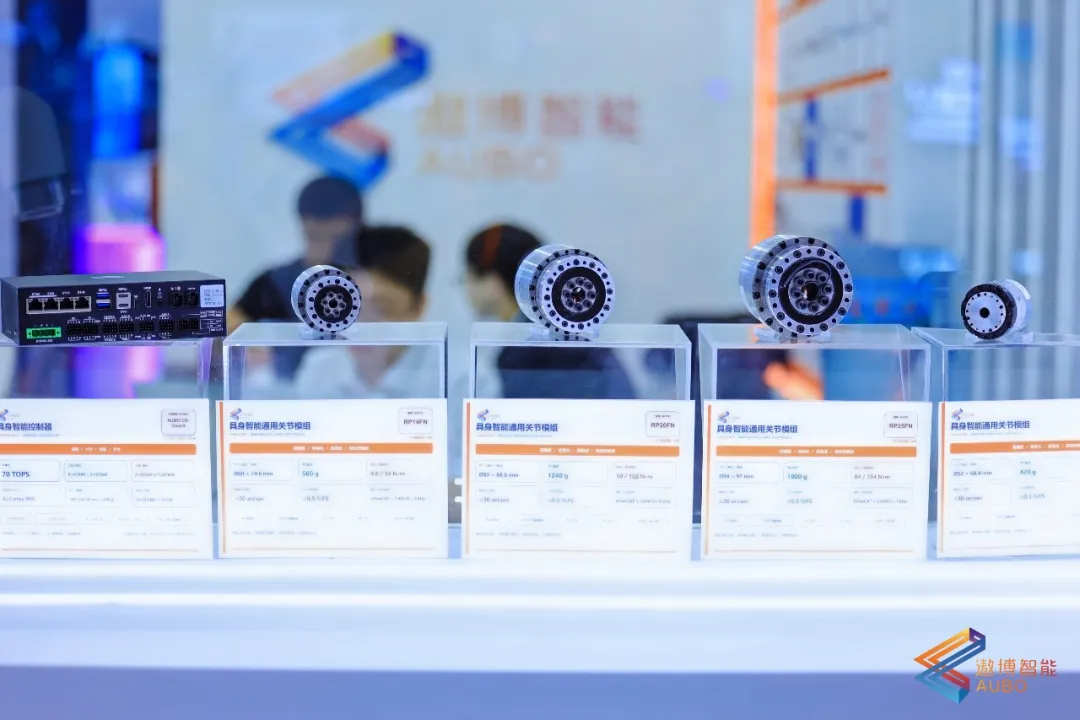
General joint modules of the R-series: R-series: R-series: R-series: R-series: R-series: R-series: R-series: R-series: R-series: R-series: R-series: R-series: R-series: R-series: R-series: R-series: R-series: R-series: R-series: R-series: R-series: R-series: R-series: R-series: R-series: R-series: R-series: R-series: R-series: R-series: R-series: R-series: R-series: R-series: R-series: R-series: R-series: R-series: R-series: R-series: R-series: R-series: R-series: R-series: R-series: R-series: R-series: R-series: R-series: R-series: R-series: R-series: R-series: R-series: R-series: R-series: R-series: R-series: R-series: R-series: R-series: R-series: R-series: R-series: R-series: R-series: R-series: R-series: R-series: R-series: R-series: R-series: R-series: R-series: R-series: R-series: R-series: R-series: R-series: R-series: R-series: R-s: R-series: R-series: R-s: R-series: R-series: R-series: R-series: R-s: R-series: R-s: R-s: R-series: R-s: R-s: R-s: R-s: R-s: R-s: R-s: R-s: R-s
Fully new body controllers: As a core component of the exhibition's debut, Bloomberg's new body controller broke the architectural boundaries of traditional industrial controllers, featuring powerful AI algorithms and high-density communication interfaces that can be widely used as collaborative robots, two-armed robots and complex robots.
General Software and Algorithm Base (ARCS + ARAL): At the core of the software, the ARCS operating system developed autonomously by Bloomberg Intelligent and the ARAL algorithm library are fully compatible with robots that collaborate with humans, arms, and bodies.
Full-scale self-development of the city's rivers with open ecological benefits
Another notable milestone is that the cumulative delivery of collaborative robots by Bloomberg has officially surpassed 50,000 units. For Bloomberg, the 50,000 units is not just a commercial sales figure. The transition from the 1st to the 50,000th units marks the complete run-up of the large scale manufacturing and product control delivery system at its two major modern production bases.
More importantly, these 50,000 robots, deeply rooted in the world's major industrial sites, are constantly being sourced and reabsorbed by the vast quantities of real-world and process data that they have become a valuable asset that drives gaming intelligence to rapidly evolve products.
In the eyes of high-tech robots, the supporting gaming intelligence spans 50,000 units and is able to demonstrate the fundamental logic of dominance on both the industrial production line and the front lines of physical intelligence, in its 11 year-long adherence to the strategic strategy of self-development and open ecology.
Since its inception in 2015, Bloomberg has been steadfastly on the path of self-development, from the underlying servo motors, decelerators, sensors, to the mid-level controllers, joint modules, to the top-level ARCS operating system and ARAL algorithm library, achieving comprehensive nationalisation and autonomous control of core components and software systems.
Not only that, but in the face of the industry's fragmented technological demands, Bloomberg has always maintained an open, win-win platform. For example, at this trade fair, Bloomberg has teamed up with several eco-partners to showcase a series of eco-innovations such as automated three-dimensional measurement schemes, semiconductor reference frame layer schemes, accelerated switching systems, car door vacuum transportation, life simulation machines, and floating gas corner mills.
By building an open system base, Bloomberg Smart is working with downstream partners to build a future-oriented smart grid that moves the Chinese robotics industry from a single hardware breakthrough to an all-encompassing win-win collaboration.
In the second half of the year, people who are physically intelligent and who know the basics of the industrial revolution are among the most influential.
As the initial concept buzz receded, the entire industry became increasingly aware that the ultimate challenge for physical intelligence was not in the spotlight, but in a real-life industry where passports fluctuated and pace demands were stringent.
To make physical intelligence really work in a factory, it is necessary to be able to understand the AI brain of the complex physical world, but it is also impossible to be separated from the joint modules, high-precision power control technologies and deep insights into specific manufacturing processes that can be used for tens of thousands of hours of continuous testing. From this dimension, physical intelligence is not a spacecraft separated from industrial soil, but an inevitable elevation of the evolution of robotics.
The underlying hardware barrier, which has been fully self-developed for 11 years, and the engineering reliability of more than 50,000 industrial sites delivered to the refinery, is undoubtedly one of the most recognizable real-world enterprises in the industry, which also gives it the advantage of not having to re-engineer wheeled tires when it enters the smart track.
Through the real production line, the A-series dual-arms, R-series joints and body controllers are used as an industry infrastructure, and intelligent fusion robots work together in the automotive production line. Not only did Bloomberg Intelligent take the lead in the commercialization of body-intelligent landfills, but it also explored a practical route to industrial deep water for the entire robotics industry.