A real forklift robot, which requires no driving seat, no shelving, and no human-facing operating system. Jaguar redesigned the forklift shell back to its robotic shell system, rearranging it around the need for unmanned operations, saving the driving seat, shell and human-facing operating system, reducing the resulting structure, energy consumption and cost redundancy.
It's not that people use forklifts, it's that they're designed to be native to robotic systems. Jaguar will drive, energy, control, perception and standard interfaces to the native robot's basement, upper-level custom-configured door frames, and forklifts, forming the architecture of a robotic basement + multi-formed forklifts.
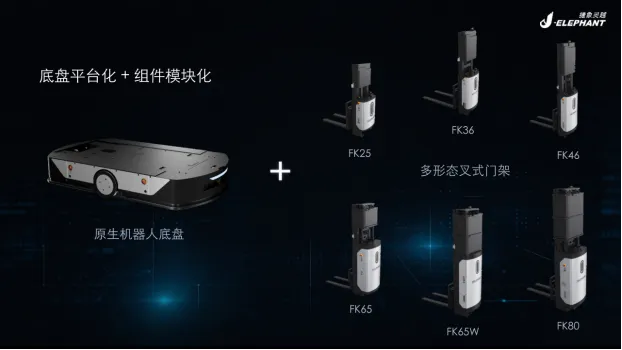
The core paradigm of Jaguar forklift robots is similar to that of the automotive industry's skateboards: multi-form forklift robots with modular robotic forklift bases. For different storage scenarios, different door frames and freight forks are positioned on top of the unified original forklift architecture to form multi-form forklift robots.
This is the first time that the entire product family has been featured at the event: E series, FK series and RS series.
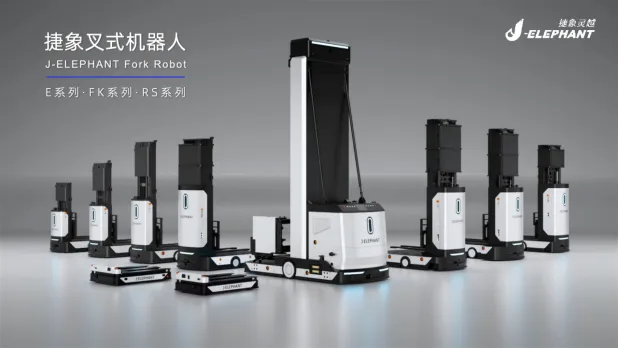
The FK series is a core series of forklifts, continuing the stable load of the original underpants, the ability to rotate locally with the shelf compatibility. The RS series is geared towards narrow-channel high-density storage, further improving the space utilization of the warehouse.
At the conference, the FK series also added a new FK-80 model, with the maximum lift height increased from 6.5 m to 8 m, maintaining 1.2 tonnes of zero flight unloading, the operating range extended to higher storage areas, and has entered the actual project landing stage.
The entire product line is based on a unified native robot bottomboard, with a unified family-oriented look language: metallic silver and fluorescent black in colour highlighting the industrial texture, and a lithium-ion breathing lamp running through the family's design, echoing the concept of a zero-discharge product throughout the entire journey. This is not a puzzle of different types of forklifts, but a family of robots with the same architecture, the same gene.
This group can be formed based on the underlying innovation of the original robot's substrate.
The five fundamental reforms.
I'm going to get up and put the forks back in the robot system.
The original robot basement supports the mobility, carrying and collaboration of the product family through innovation in the five aspects of drive form, mechanical model, turn diameter, basement architecture and interfaces.
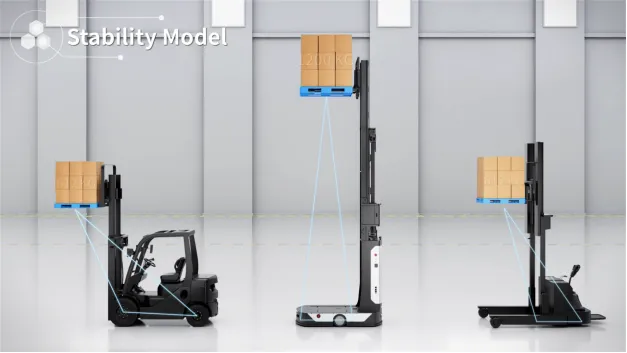
Traditional human-powered forklift drive systems are designed for mechanical mobility, and when unmanned systems are modified, they often have to superimpose a control system on the original transmission chain, with both complexity and failure points. Jaguar directly adopts a multi-million-degree AGV application validated differential-speed drive method to provide a mature, stable technical basis for autonomous mobility. This is a proven drive system in a robotic system, not a modification from a human-powered forklift.
The mechanical model solves another problem. Traditional forklifts rely on tail weighting to balance the load on the fork, the weighting itself is extra weight, consuming extra energy. Jaguar projects the fork on the inside of the chassis, constructing an equilateral triangular mechanical model that allows the load to form an in-built stable layout, reducing dependence on the extra weighting. This structure provides support for high-point access and zero-loss throughout the course.
The small turning diameter supports the original rotation, and the turning diameter is controlled at twice the length of the vehicle. People forks need to leave space for the driving seat and the operating system, the layout of the chassis is limited, and the turning radius is difficult to compress. The robot chassis does not have this constraint, and the layout is more compact, creating conditions for shrinking the operating tunnel, increasing the available inventory.
Unified disk architecture allows different shapes of products to share underlying structure and control logic, reducing heterogeneity. Unified interfaces simplify device access and system adaptation with standard interfaces, allowing robots of different shapes to operate in sync under the same scheduling system. The former solves the problem of growing out chips and the latter solves the problem of connecting chips.
Putting these five innovations together, you'll find that they each solve problems at different levels: how the drive and mechanical model solves the friction, how the rotary diameter solves the friction, how to save space, and how to coordinate the friction. Each pointed in the same direction to make the fork a real part of the robotic system.
From single-loaded goods to the entire logistics system,
JMS uses robots of different shapes as a means of transportation
The five major innovations address the problem of ability at the single level, and system-level unification is also needed to enable robots of different shapes to form an overall carrier when working together.
Based on the native robot architecture, Jaguar combines the ability to operate autonomously in a single machine with a self-developed JMS cluster management system to build a physically intelligent system that integrates software and hardware. The robots independently complete on-board transportation, access and local diversion, JMS consolidation tasks, pathways and energy management, allowing different types of robots to work together to form an overall operation.
The system can also extend collaborative client systems such as WMS, MES, to further open up business needs, task execution and state feedback, and integrate robot operations into warehousing and manufacturing processes. From autonomous operations of single-service goods to collaborative operations of the entire logistics system, ZTE does not want to sell a few robots, but to allow robots of different shapes to work together to form the overall functionality.
Single intelligence determines whether robots can function on their own, and system collaboration determines how efficient they are when working together.
Make it as simple as building a bodyguard.
The efficiency of system collaboration is ultimately down to the delivery level. According to Jigsaw, the key to the successful landing of an automated database is to make the system as simple as possible and reduce unnecessary linkages.
Jigsaw builds a library program with three core elements of robots, shelves, trays. From stacked storage shelves, linear stacks, to sidewalk shelves, access shelves, and narrow tunnel highways, they can be flexible to plan shelves according to operational needs, and equipped with robots. Among them, the FK series can be compatible with sidewalk shelves and access shelves. The conference showcases real-world cases of the two types of shelves, as well as the use of mixed shelves within the same project, offering more portfolio options for different storage needs.
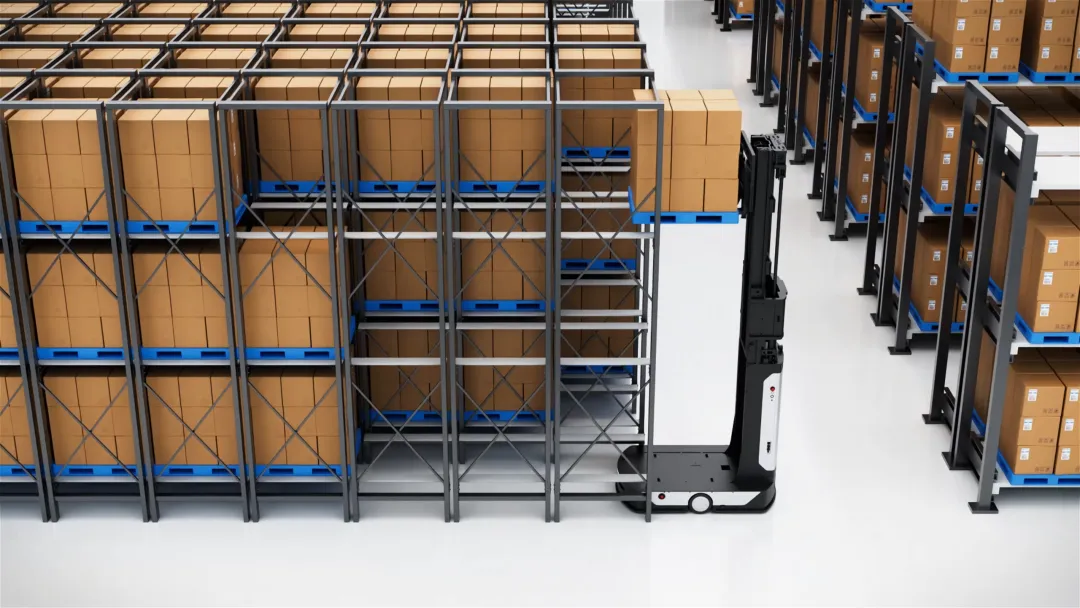
Jet Elephant Forking Robot on the Inbound Shelf
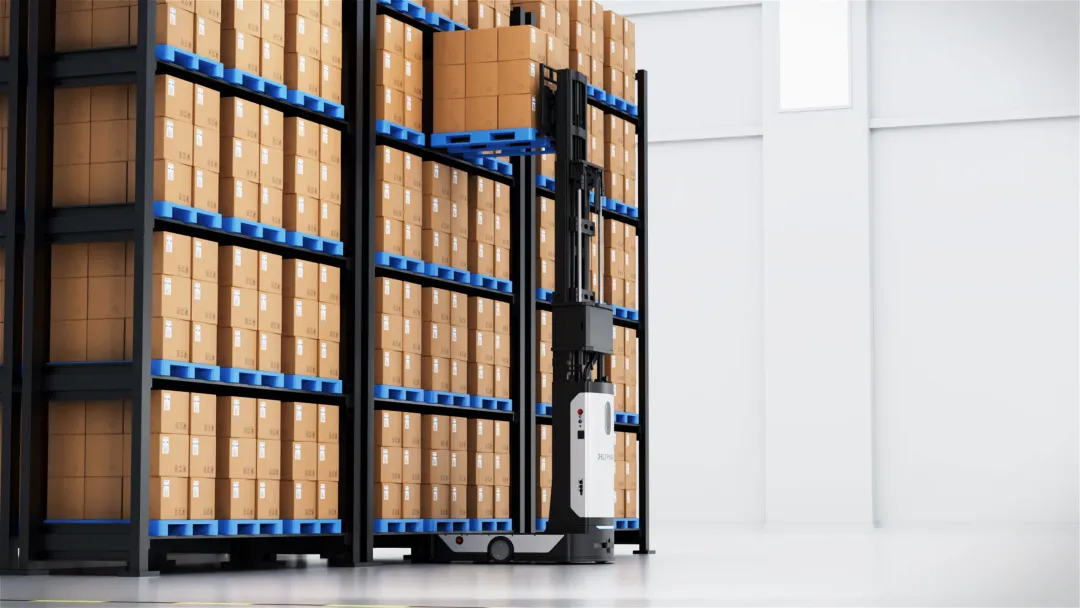
Jaguar forklift robot works across the shelves
Supporting this flexible combination is the standardization of the entire chain of sub-discs, modules, software and delivery. General modules such as sub-discs, power controls, drives, pre- batch production, order-to-order combinations, configuration and testing, reduction of iteration and production waiting.
The key to LEGO delivery is not the number of modules, but in interface standards, architectural unification, and delivery replicability.
From project customization to standard products,
Practicing yoga makes librarianship easier
The conference showcased Jaguar's complete idea of product design, system synergy and production delivery from the original platform. The underlying architecture defines how the product will expand and how the different scenarios will land.
In Jigsaw's view, the development of unmanned forklifts needs to go back to the operation itself in order to solve the real problems of product architecture adapted to unmanned scenarios. Jigsaw adheres to the autonomous design of the underlying architecture and product form, pushing the construction of a database from project-customized to a flexible portfolio of standard products, allowing more customers to use deployable, easy-to-maintenance, and scalable automated databases.
Since its inception, Jaguar has always focused on flexible ledger solutions to simplify its mission. It has served many of the world's top 500 and industry leaders, delivering projects in key areas such as pharmaceuticals, fast food, new energy, semiconductors, and distributing networks across the country and continuing to expand overseas markets.
From November 3 to 6, the new Zhejiang fork robot will be unveiled for the first time at the CeMAT ASIA New International Exhibition Centre in Shanghai, where it will work with industry experts, customers and partners to explore more possibilities for warehouse automation.
Defining the future, on the ground.