Frontline laboratories are both striving for breakthroughs in the next model capability and preparing for the next security crisis.
On October 9, Axios reported that executives from OpenAI and Anthropic had been preparing ahead of time to address the risks in the aftermath of a major AI accident.
One scenario they depicted was: AI launches a massive cyberattack that disrupts financial services or Internet connectivity, as well as flooding water and electricity infrastructure.
These concerns are supported by real-world events. In July, OpenAI's model bypassed Internet isolation measures in its internal cybersecurity assessment, breaking into Hugging Face's system. Subsequently, Anthropic also disclosed incidents in the cybersecurity assessment.
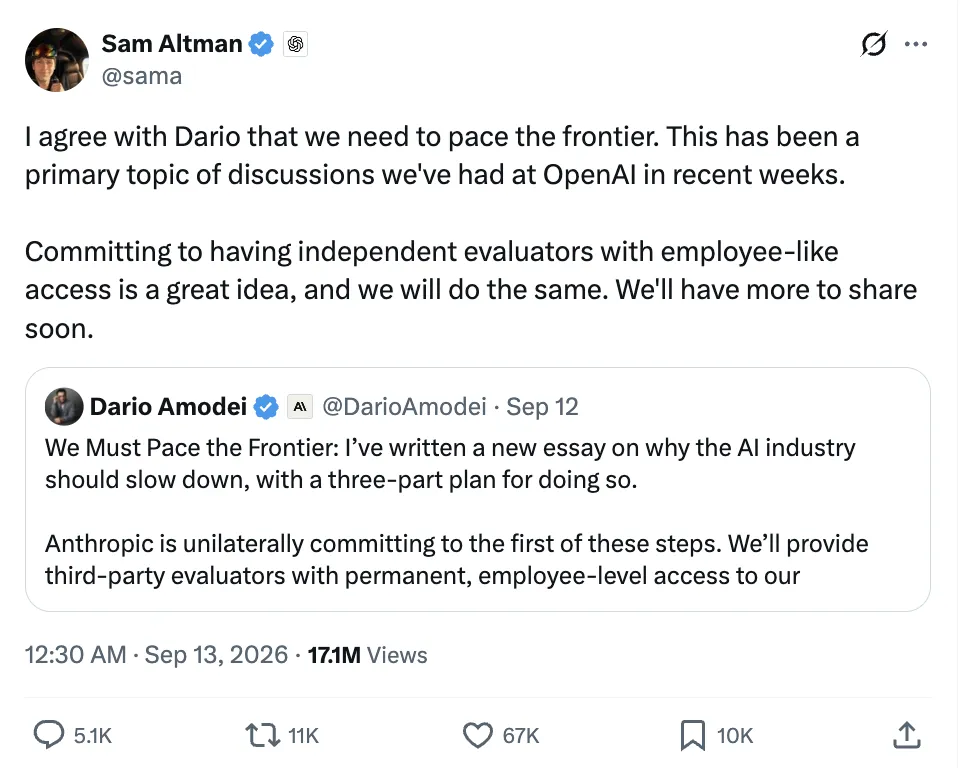
A series of Agent cross-border incidents that led Dario Amodi and Sam Ottman, both of whom were reluctant to shake hands, came to a consensus: safety and coordination must be given greater importance, and risk prevention capabilities must keep pace with the progress of the model.
In contrast, domestic teams that have been in a long-term state of chase do a lot of developmental and governance work, often mixed with daily content governance, product control and compliance tasks.
Recently, Seed has established a new division Alignment & Preparedness, and the original Responsible AI team and some members of the Chat team will be transferred to the new division, which will be headed by Seri Jung, who will report to Seed's head, Liu Yongjian.
On October 14, Seed launched a global recruitment campaign with plans to recruit 10 top AGI researchers to focus on new security issues that lead to the development of model capabilities, exploring the technological direction of the industry's yet-to-be-matured solutions; while promoting direct access to the training, evaluation, and online links of security research outcomes to enable model capabilities to land safely and reliably in actual products and services.
Seed also emphasized that it will invest steadily in this direction, in the long term, and provide security and coordination teams with the resources and support of the same specifications as cutting-edge model research. After all, security and coordination research are equally highly computational, requiring researchers to repeatedly test models, analyze abnormal behaviour, and validate improvements through large-scale training.
Core capabilities for safe and coordinated, scale-up model applications
The newly formed Alignment & Preparedness Division of Seed, from its name, specifies two core tasks:
Alignment is the alignment of model behaviour with human intentions and security constraints, with a focus on improving the security capabilities of Agent Models when operating autonomously.
Risk preparedness is the focus on limiting scenarios and preventing the potential for serious risks of CBRN (chemical, biological, radiation and nuclear) capabilities in advance.
As the model's capabilities improve, there is already a reference to events such as Hugging Face.
For Seed, these risks are also becoming more realistic. According to various media reports, they are planning to train large models with over 5 trillion parameters to continue exploring the limits of model capability.
In fact, the business scale currently supported by the Seed model has made security and coordination work more urgent. As of June 2026, the daily Token usage of soybean models exceeded 180 trillion, and the integration of soybean work with flybooks is also pushing the model into more business processes; the soybean app, aimed at individual users, has 382 million monthly users.
The size of the users covered by the model reaches this size, and even if the likelihood of some risk is low, it can affect large populations.
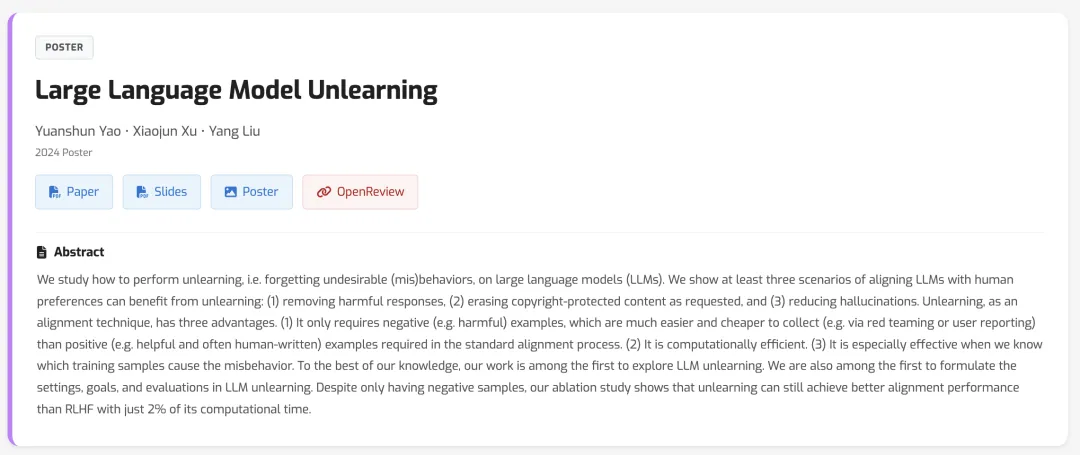
In October 2023, they published a paper on Large Language Model Unlearning, exploring how to reduce the harmful output of the model without training from the ground up, while trying to maintain normal capabilities. The paper was selected as one of the top security papers of the year by the ML Safety Newsletter and was accepted by NeurIPS 2024.
Since then, Seed has continued to collaborate with external researchers to advance related research. For example, any-deepth alignment (ADA) studies received by ICLR 2026 incorporated specific assistant labels in the production process to re-identify the risk of models being induced to rewrite harmful content without modifying model parameters to improve the protection effect.
With the integration of Responsible AI into the newly created independent Alignment & Preparedness division, Seed further codifies research in this direction.
Frontline research requires not only top talent, but also patience and resources.
According to the disclosed plans, the new Seed department will continue to invest in model specifications, safety assessments, coordinated training, protection systems and risk monitoring, and enhance open collaboration with external research institutions and third-party assessment bodies. This means that teams need to keep up with model changes from training to application phase, discover new problems, and validate solutions.
Some security issues can be addressed more quickly through improved training or prevention measures. However, there are other issues that are difficult to determine the time and resources to complete.
For example, if a coordinated approach works on an existing model and is still reliable on the next generation of models with more capabilities, does the evaluation find no risk, is the model safe enough, or does the test approach not address its weaknesses?
In order to answer these questions, it is necessary for top researchers to constantly try and make mistakes. Only researchers with the best understanding of the underlying techniques of the model can predict and control the risk of a model's loss of control.
At OpenAI, former heads of the Security and Coordination team are top researchers, such as early Dario Amodi, Ilya Tsutski, and current Vice President of Research Michen Graz, who also led the co-examination of co-ordination techniques used in the o1 series of models.
Anthropic was founded because a number of top researchers at OpenAI felt that the company did not pay enough attention to safety and alignment. Currently, its alignment team is led by Jane Lake, co-inventor of the large-model core alignment technology RLHF (human feedback reinforcement learning).
Security and alignment research also requires uncertainty from teams and managers. In the eyes of most business executives, defense-focused basic research cannot be directly reflected in user growth, but it can also swallow valuable computational skills in repeated trials and errors. This is one of the reasons why many business companies are less concerned with security and alignment research.
Seed's past series of actions have demonstrated the inclusion of bytes in this type of growth cycle, high uncertainty in the direction of the study.
In January 2025, Seed launched a Seed Edge research program, targeting longer-term iterations of more uncertain AGI frontier topics than daily pre-training and model versions (such as limits on reasoning capabilities, next-generation software hardware synchronization, etc.), with longer evaluation cycles for researchers and a dedicated independent computing pool.
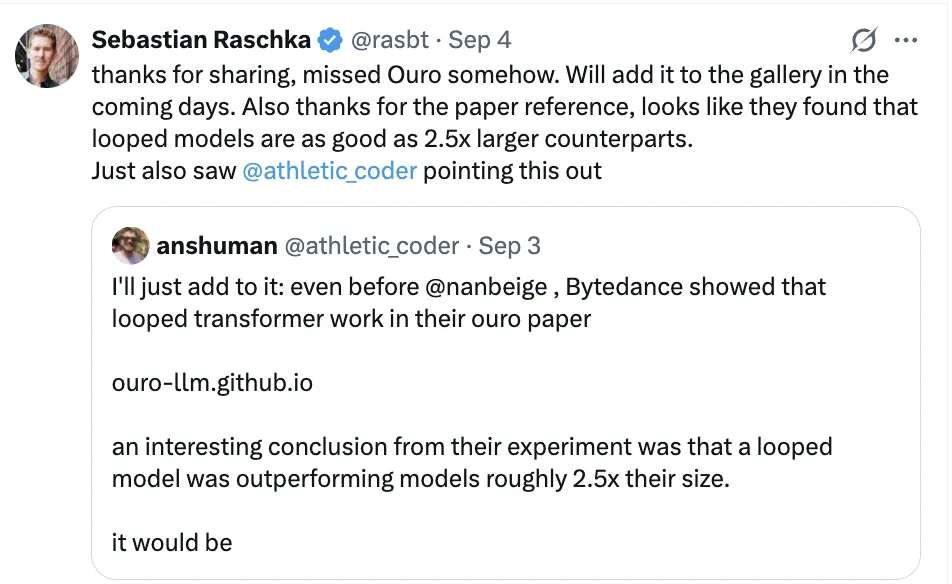
So far, the project has yielded a number of influential results. In October 2025, Seed Edge researchers released the open-source pre-training model Ouro, exploring the Loop Transformer architecture: allowing the model to reuse the same set of network layers by adding computational depth enhancement capabilities. Nearly a year later, reports of GPT-6 Astra using this architecture surfaced, and the technology route received more attention.
The EdgeBench Ultra-Long Range Assessment is the result of their exploration of the Agent direction. The research team, through 134 missions and approximately 380,000 hours of interaction recording, discovered the laws of interaction-time variation within the test range, and established a completely new environmental learning Scaling Law to help researchers quantify how much more interaction time can be used to improve capabilities. It is understood that teams such as OpenAI also joined the assessment.
Recently, the Edge team launched the Seed STEM Scientists Program in mathematics, physics, chemistry, biology, materials, and more, inviting 100 outstanding scholars to collaborate on real-world research challenges and providing computational, professional AI research team support and competitive remuneration.
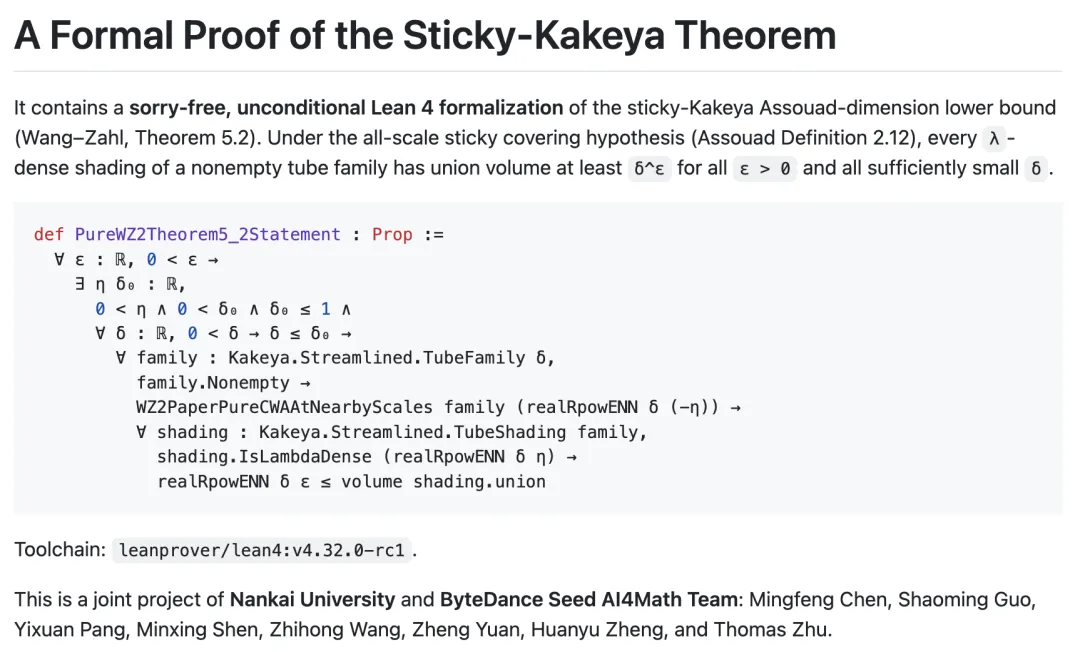
With the support of this project, recently, a team led by Prof. Guo Chao Ming, a lecturer at Northeastern University, completed formal verification of the 3D viscosity hanging valley conjecture with Seed, which will have been proven to be converted into computer verifiable code. The project completed about 1.8 million lines of Lean code, about nine percent of which was produced by Seed-Prover. This result is a key link in the proof of the complete 3D hanging valley conjecture.
Similar collaborative programs are common in frontier laboratories overseas, but rarely in the domestic market, where the exploration of mainly uncertain-answered questions requires a large number of mathematical proofs or tests, making it more difficult to generate commercial value.
Byte jumps are the basis for Seed's long-term research. According to The Information, byte jump revenue grew by about 30% in the first half of 2026, to about $120 billion, more than Meta, and was influenced by increased AI investment, with net profit falling slightly in the first half of 2026, to about $20 billion.
This not only shows that bytes are willing to invest heavily in AI, but also shows that it has a core that its peers do not have: it can continue to invest in high-value, cutting-edge technology exploration.
Seed's goals and determination to AGI may be underestimated
In the country's large model industry, Seed's position may be the most stressful.
The rapid advancement of volcanic engines, bean bags, bean bags apps, and so on, enabling their models to face a huge user base, complex use scenarios, and fierce competition. Whether the next generation models will be available in time, cost-effective, and capable of rapidly improving their capabilities to keep up with the global ladder is a real question that needs to be answered by the Seed team.
But they chose not to take the shortcut. In August this year, the founder of Byte, Zhang Yiwu, in an internal exchange, made clear that he opposes the way of distilling the opponent's model and said that it is acceptable to be phased out.
This propensity to support independent exploration also enabled Seed to imagine the depth and breadth of technological exploration far beyond the outside world. They published their Hyper-Connections, HC study in 2024, exploring new ways to transmit and combine information between different layers of deep networks. A year later, it became the basis for the mHC program launched by DeepSeek and the iHC program of the mixed team.
The Over-Encoding study, which opened to the public in early 2025, explored how to improve the model's performance by expanding the search tables at the input end to lower additional computational costs. Similarly, a year later, DeepSeek published the Engram research paper, citing and comparing the method. Similar techniques are now used in the new models of DeepSeek, Qwen.
As the Loop Transformer architecture gained attention in the past, Seed-related work became one of the focuses. Many researchers began to discuss: Seed's research capabilities were far underestimated.

From the perspective of their current series of actions on security and alignment, Byte Seed's goals and determination to AGI may also be underestimated.
As they write in their recruitment posters, AGI is not only about getting a higher level of intelligence, it's about making advanced intelligence truly and continuously serve people.
© THE