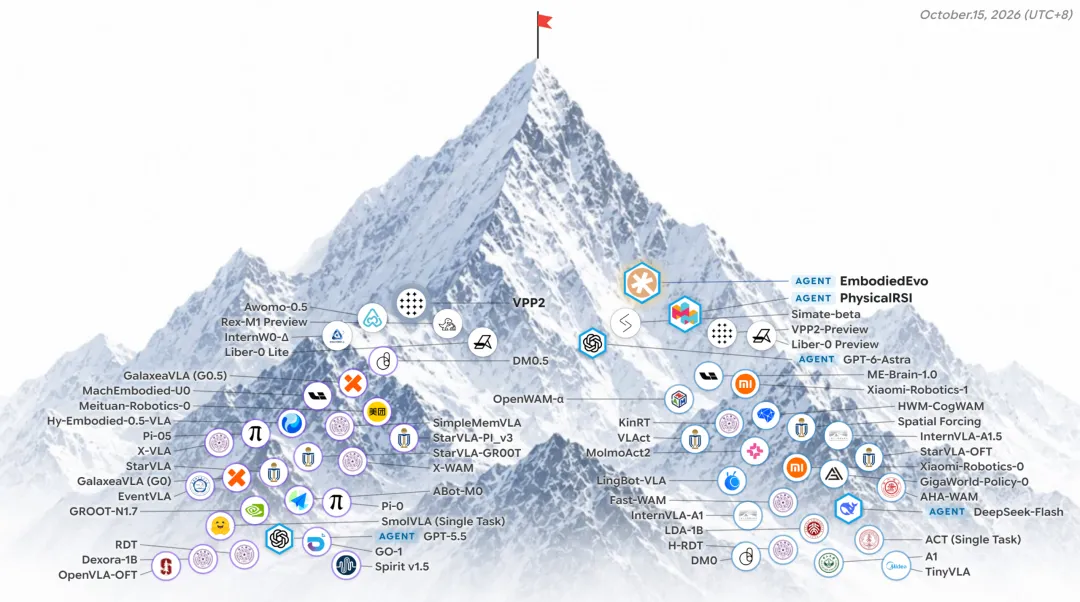
The agent who writes the code is moving into the physical world.
Through robotic interfaces, they can observe scenarios, write control programs, and adjust actions based on feedback. Even without mitigating targets, the Zero-shot success rate of the front-end Coding Agent is comparable to that of VLA and WAM systems trained in similar scenarios.
But the Zero-Shot performance is just the beginning of this path. In the face of unfamiliar robots, from robots that call the interface clutch to clutching the object clutch, Agents still have to perform side-by-side touching. These explorations consume the task budget, but the accumulated experience is not automatically left to the next Agent.
It's like a VLA model that takes a lot of trajectory to train.
"What if you give Agent Monkey the chance to train monkey first, and then let the accumulated experience be the starting point for the next execution?"
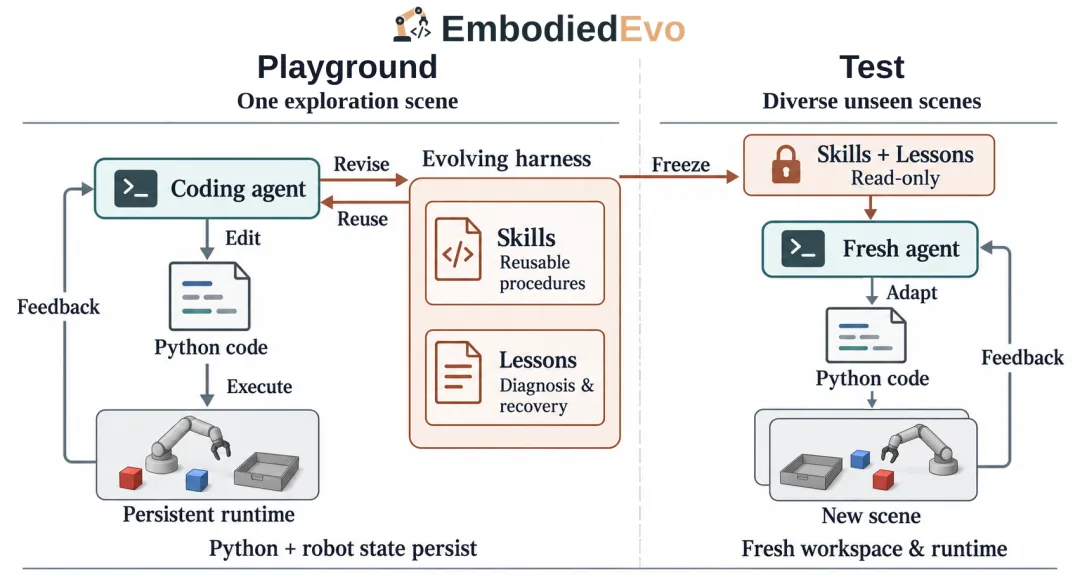
The Navers Lab team at Einsia AI has proposed the EmbodiedEvo: Each task uses only one Playground scene to allow the Agent to accumulate code Skills and text Lessons in interaction. After the exploration, the harness is frozen and handed over to the new Agent, completing the evaluation in unseen scenarios.
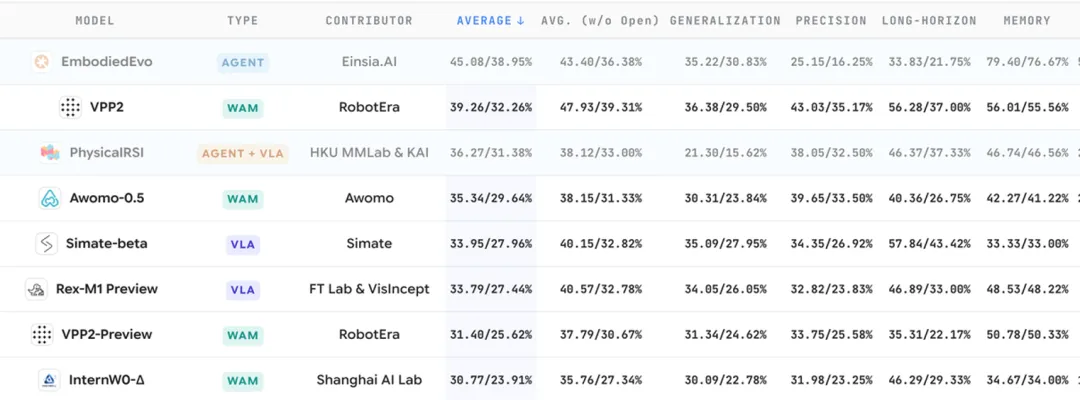
In the RoboDojo assessment, EmbodiedEvo achieved an average score of 45.08 and a success rate of 38.95%, more than any other VLA/WAM, Agent, Agent+VLA method, topping the list of Agent races.
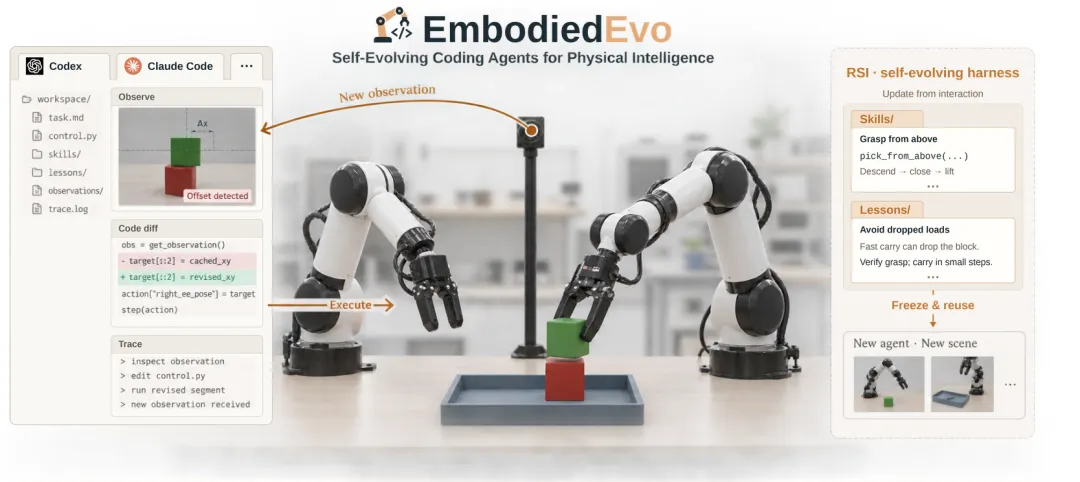
EmbodiedEvo: Self-Evolving Coding Agent for Physical Intelligence
The main page of the project:
arXiv:
GitHub:
From writing code to controlling robots
In EmbodiedEvo, the agent controls the robot with a Python program. It writes the control code in the workspace, submits it to the adaptor to execute, then reviews the camera image, the state of the robot and performs feedback, deciding how to modify the next step. The code can be submitted in phases, and the simulation status, variables and functions in the same round are retained.
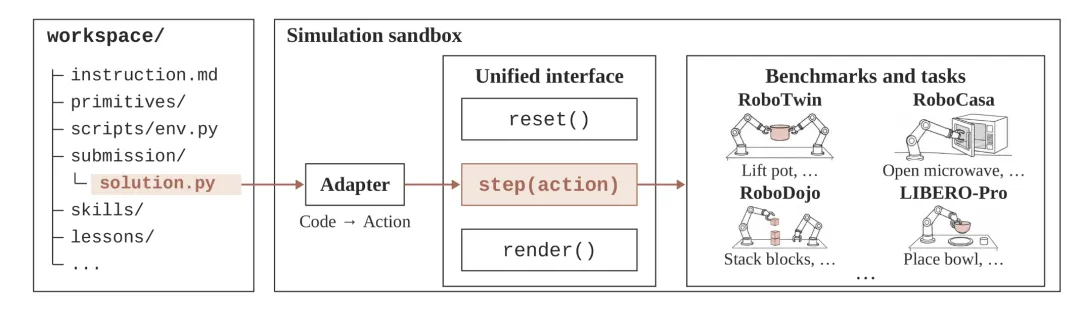
This control interface has only four native languages:
get_instruction (): Read current tasks and objectives.
get_observation (): Obtaining a camera image with a robot status without advancing a simulation.
step (action): execute a joint or endpoint posture goal and claw instruction, return to observation, complete the signal and terminate the state.
Reset (): Reset the same scene for Playground exploration only, disabled during the Test phase.
The underlying controller is responsible for inverse-motion and motion insertion. Agents organize these native languages into close, aligned, closed claws, and elevated operation processes. Interfaces provide advanced skills such as "catching success", how the process is accomplished, when to continue, and need to be combined with feedback to judge.
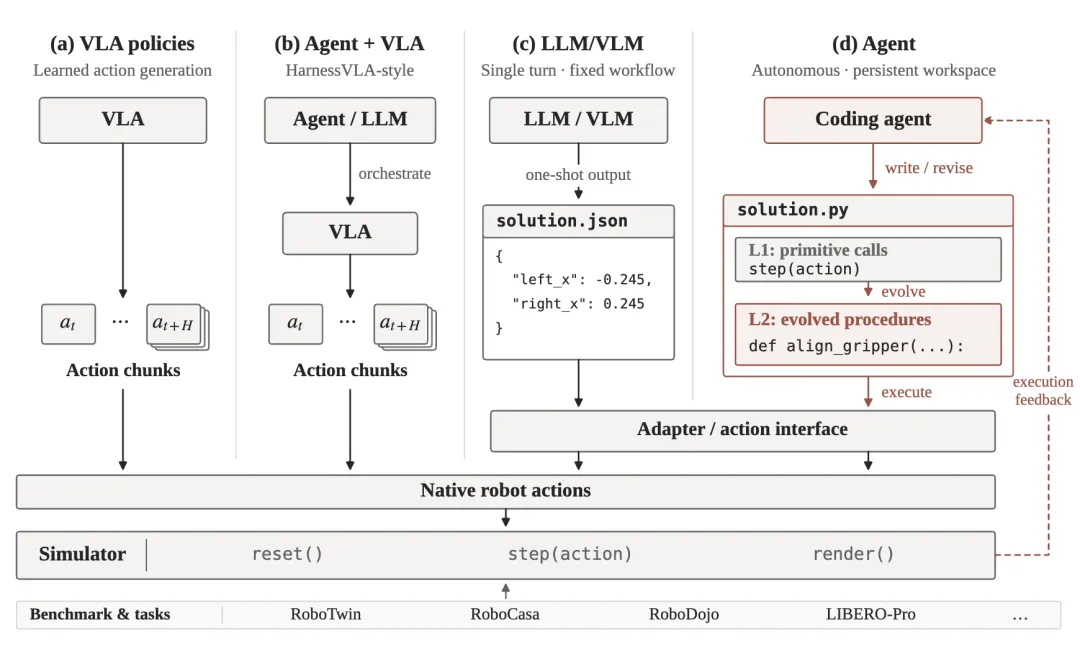
Several control paradigms differ in who generates the action and how it is adjusted based on feedback:
VLA: Learning strategies generate robot actions or sequences of actions.
Agent+VLA: Agent responsible for upper-level planning and scheduling, VLA responsible for generating specific actions.
Single-wheel LLM/VLM: In the fixed workflow shown, the model outputs a structured motion description at a time and is executed by an adapter.
Coding Agent: Autonomously writes executable programs and checks the results, modifies the code, and continues execution in continuous interaction.
The code is both a carrier of action and provides a landing point for experiential replication. Once explored, verified operations can be organized into functions with parameters and verification conditions, for subsequent tasks to execute calls. This also gives the "familiar robot" process the opportunity to leave reproducible results.
EmbodiedEvo: Turning a physical interaction into a repeatable experience
Understanding tasks, reading interfaces, doesn't mean you already know how to operate reliably.
The team analyzed Astra's execution trajectory on Robodojo-sim in detail and found:
In the Tic-tac-toe mission: Astra knows how to grab, but has not yet mastered a reliable grip. Astra's two empty-crawls have consumed about one-third of the motion budget until the 367th live action to first grab the circle.
In the Imitation sorting task: First observe, then execute, is a prerequisite for the task's action. When the demonstration arm is not yet in position, the execution arm deviates significantly from the initial gesture, and is directly doomed to failure. Astra starts moving while the demonstration is still going on, completes 16 moves, and the rotation ends in failure.
Tic-tac-toe tasks require a reliable crawling process, while imitation sorting tasks require a clear operational premise.

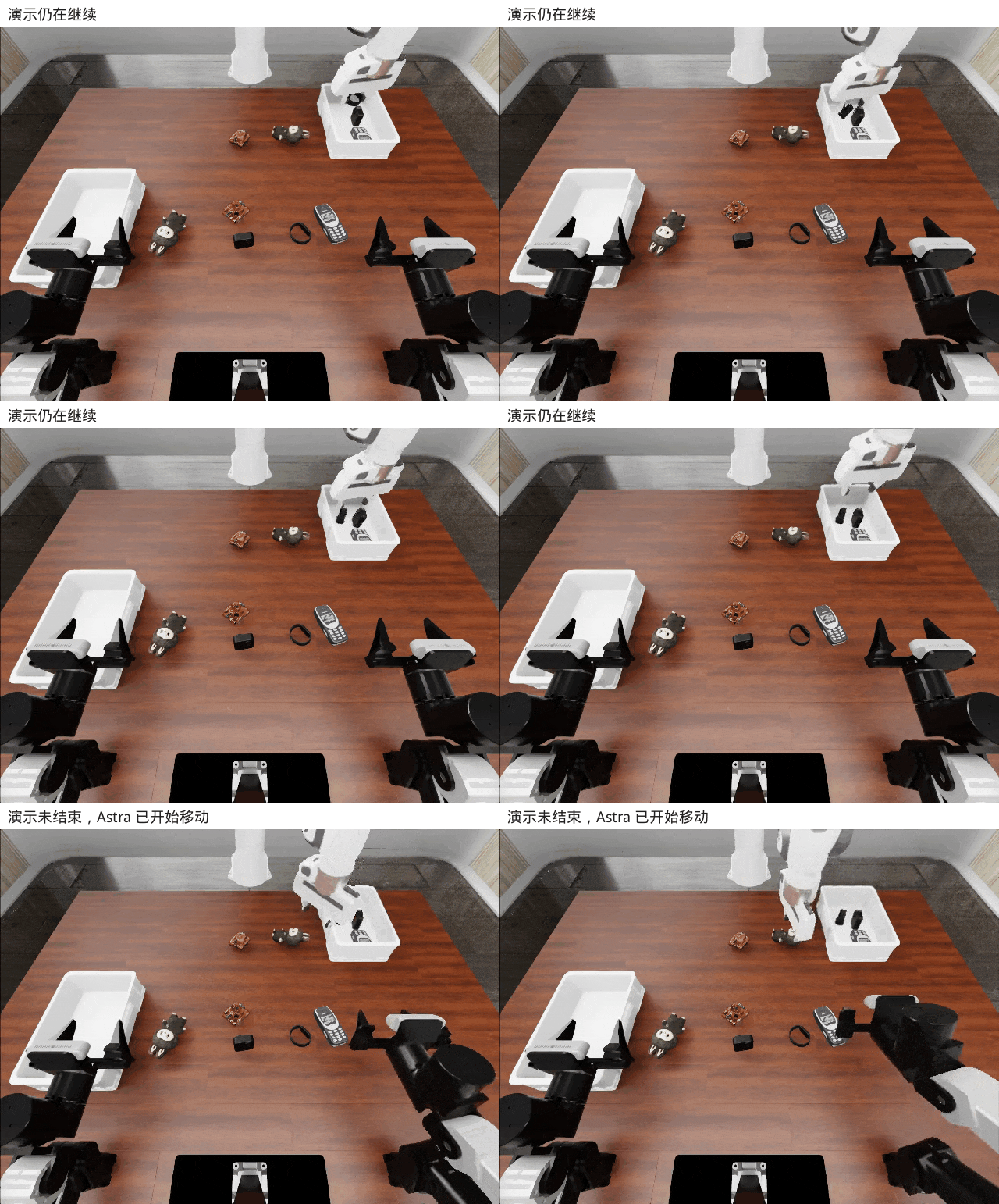
"Reliable operations, including both how to make pumps and under what conditions to make pumps".
EmbodiedEvo therefore sets up the Playground phase: Agents explore, view physical feedback during continuous simulation sessions, and organize the experience into two complementary forms.
Skills: How to code a claw into a claw, such as aligning, grasping, lifting, and checking to see if the object is still in the claw.
Lessons: Write down when to do the drill, where it's easy to make mistakes. For example, before you see the demonstration, or after you move, check the drill again.
The two types of experiences together make up the harness. After exploration, the experience is frozen and replicated by the new agent in an unseen setting. Operating parameters still need to be adjusted according to the current scenario, and the execution results still need to be checked through feedback.
What is the result of the experience in terms of overall performance?
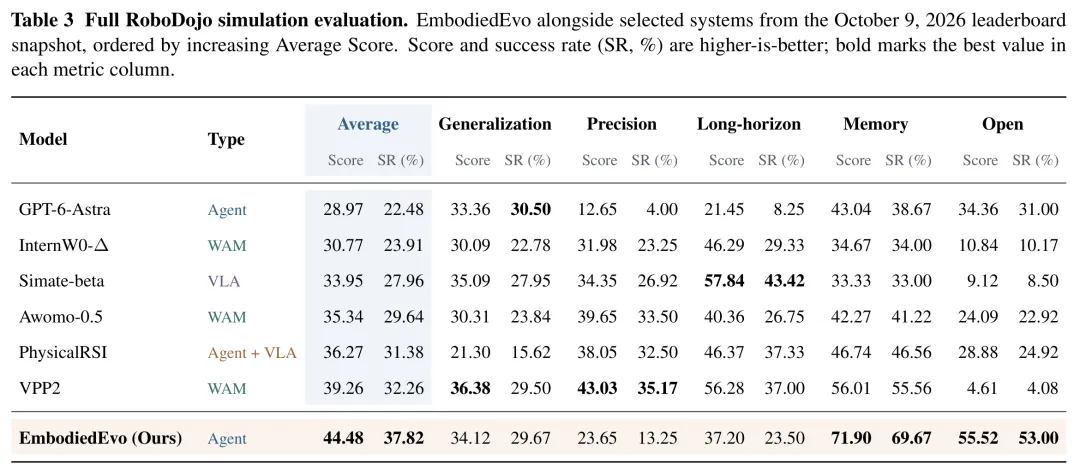
The overall advantage is focused on memory and open tasks. In the local ratings shown in the paper, EmbodiedEvo scored 44.48 points and a 37.82% success rate, surpassing all control methods in the table. Memory and Open scored 69.67% and 53.00%, respectively.
These tasks are both to remember the information of the current scene, but also to capture, move and place together. Repeatable operation processes are combined with sequential recording and phase checking to make "remembering" easier to implement as "doing".
The evolution of processes and times of action has changed.
The team further explored what self-evolving could bring to coding agents.
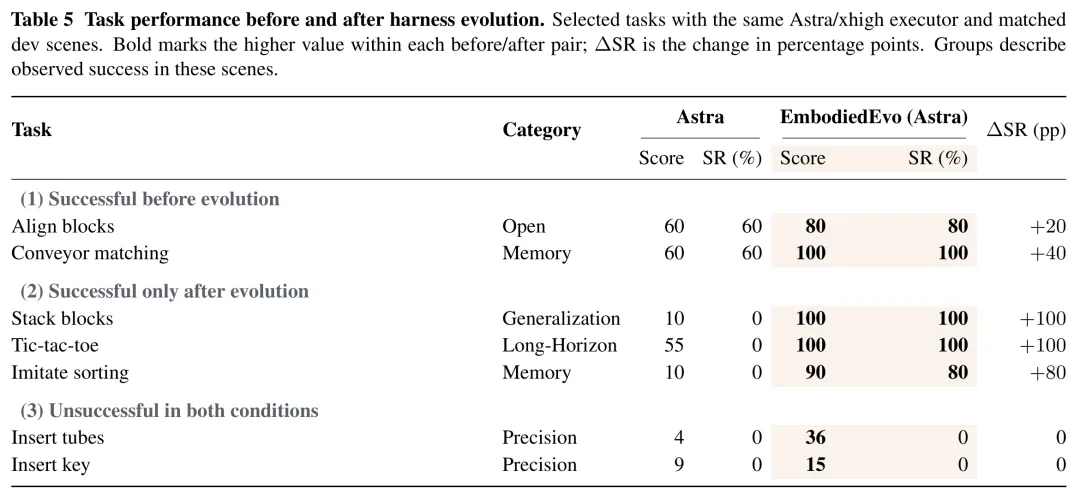
For the same model and configuration, the success rate of tasks can be increased from 13.36% to 35.08% by self-evolving.
Further analysis of the effects of self-evolving can be found in:
The existing capabilities have become more reliable. Coordination blocks and transmission belt matching have a 60% success rate, evolving to 80% and 100% respectively. The objectives of these tasks are visible, and the actions can be corrected locally through feedback; experience further improves operational reliability.
Unfinished tasks can begin to be completed. Success rates for stacking and Tic-tac-toe are increased from 0 to 100%, and imitation sorting is increased from 0 to 80%. These tasks need to be repeated to perform effective operations, or to wait for complete post-action information to be collected, in accordance with the operating processes of Skills and the conditions of use of Lessons.
There are still some tasks that cannot be solved by self-evolving. Plug-in scores range from 4 to 36 and key insertion from 9 to 15, but the success rate is still zero. These results distinguish between improvements in local operation and the success of the complete task, and the difficulty of accurate contact will unfold later.
The following two tracks show how operations and decisions change. Tic-tac-toe Agent uses repeated crawling processes to retain the circle in the 38th live action; Imitation sorting Agent first observes and records the complete presentation and then executes the new order of the current scene.


One exploration, can it help other models and missions?
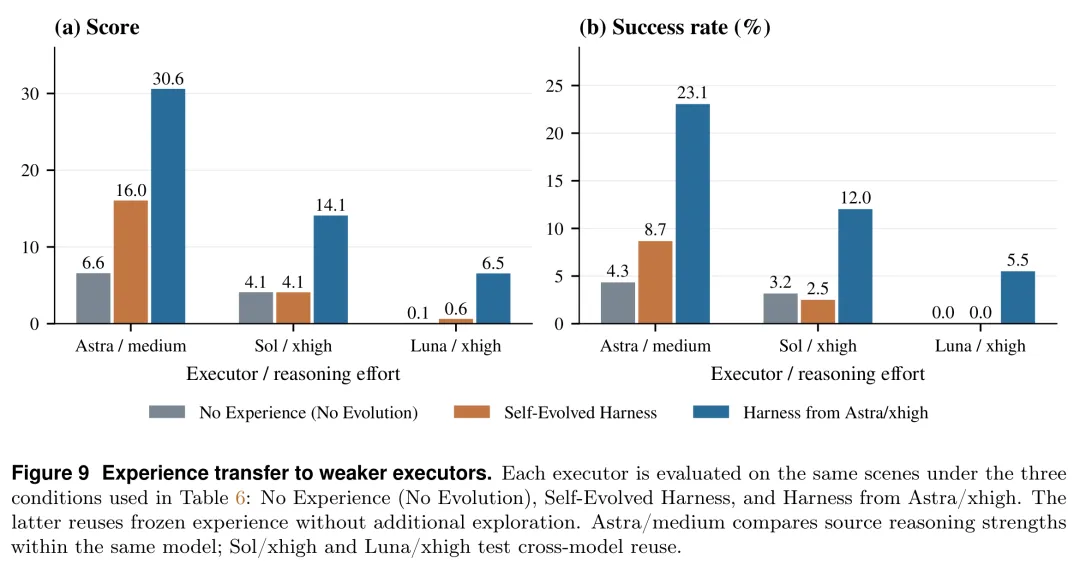
Weaker models are able to use their own hard-to-explore experiences. Following the success of GPT-6-Astra, GPT-5.6-Sol achieved a success rate of 12.03%, 8.86 percentage points higher than inexperienced models; GPT-5.6-Luna improved from 0 to 5.50%.
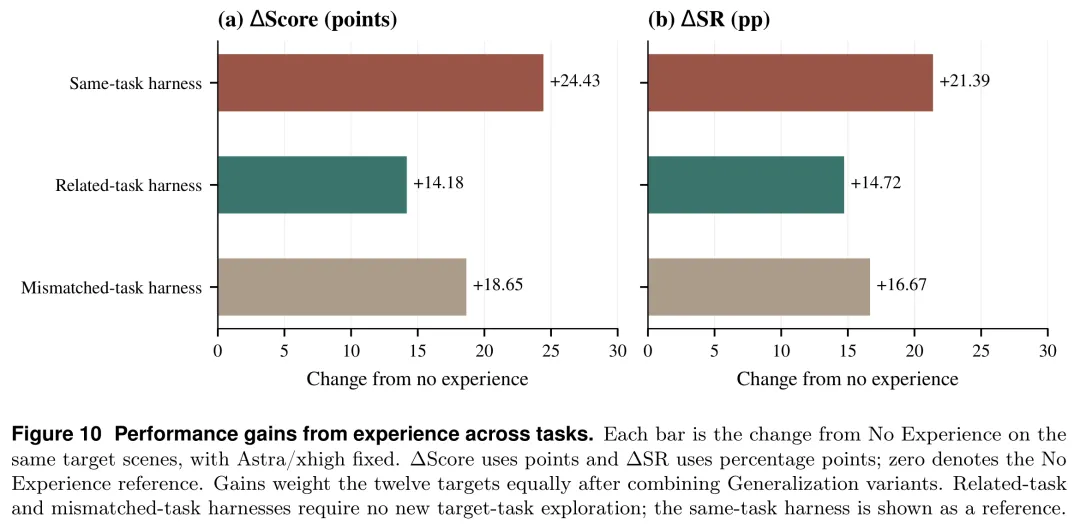
The repetition of the experience can also transcend different task boundaries. Fixed Astra/xhigh accumulated experience, on the same set of targeted tasks, results in a 14.18 point increase in success rate; unmatched mission experience results in an 18.65 point increase and a 16.67 percentage point increase. Both do not require targeted mission exploration.
What experience is worth having?
It is worth noting that "executable methods + applicable conditions + effectiveness checks". After the same exploration is organized into Skills/Lessons, the success rate is close to the full interaction history, with total token usage decreasing by 11.3%.
What is the reason for the failure of sophistication?
It is not enough to ensure the success of accurate contact.
The insert cycle below has completed part of the clutch, transport and position adjustment, but ultimately does not complete the inserting of the three pipes, the official score of 20 was declared a failure.
Difficulties may arise in the reliability of contact geometry, motion switching and local processes: holes and postures need to be more precise, and objects retained in the first step need to remain stable in the next contact.
Experience can provide an operating process, and it remains to be verified whether the process can be reliably completed with each contact.
In future studies, it may be considered to provide gestural references with a small number of demonstrations, which will focus the exploration into difficult contact stages; then, by performing disturbing repetitions, test which processes are worth preserving.

Every interaction is an opportunity to be an accumulation of intelligence.
The success of a mission demonstrates what the Agent can do right now. Once the experience is explored, it may change what it can do the next time.
EmbodiedEvo's meaning is to access the physical world for general programming ability, complementing the cycle of "experience can be inherited".
This allows the body-intelligent training paradigm to grow one more way: the process of grasping from one scene can help operate in another; the conditions of action that an agent summarizes can also be the decision-making basis for another agent.
In the long run, this refers to a type of accumulative, transferable physical knowledge. Along this path, Agent will move towards general intelligence in the physical world.
"How robotic interaction has evolved from a one-time problem solving process to a continuously accumulating ability".
Well, this is exactly the future EmbodiedEvo wants to drive.
© THE