“ Get out of the water.
One investor invested in a global model company at the beginning of the year, valued at $3 billion.
He wanted to sell his stake at $12 billion, which he hasn't lost to this day. The next round of financing of the company, also at $22 billion, is being discussed.
01.
An embarrassing crowd visit
This turning point has a specific time.
In one of the group visits this year, participants were AI-oriented investors from well-known institutions. Self-introduction link, at least three activists expressed that physical intelligence is one of the main investment directions of the institutions.
Then someone asked a question about the recent news that regulators have shut down the listing of smart companies.
The scene was almost awkward for a moment.
On the same morning, an informal window of the regulatory body directed content outflows to be included in the scope of approval of an IPO of humanoid robots that have regular revenue capacity, are on a losing narrow track, or have achieved real technological innovation.
The phrase was later recognized as a watershed moment in the industry. Not because it said something new, but because it brought the ability to change to the stage.
The story that the industry has been telling since last year is that technology will take over, orders will be collected, valuations will come to fruition. The window guidelines are that companies that can be listed must be companies that have already made money or are going to make money on that line.
A business that speaks about the future and is asked to hand over what has already happened. This is the moment when it comes down from the watershed.

02.
12 billion and 22 billion
The 3 billion, 12 billion and 22 billion figures mentioned in the introduction are actually three quotes from the same company in the same year.
Older shareholders want to sell by the middle number, and companies want to make money by the highest number. Those who are willing to enter by 22 billion face a seller who is shipping at 12 billion.
One investor put it more straightforwardly: When there are already 12 billion yuan worth of old stocks on the market, who is going to add capital to the company at a valuation of 22 billion yuan?
There is a mechanism problem in this sentence that is easily overlooked.
Under normal circumstances, the first level should be more optimistic than the second level, because the first level buys the future and the second level sells the past. So you will see that the first level is valued higher than the market value of the second level, which is a reasonable premium.
But when someone starts putting up an offer of 12 billion, the first 22 billion is no longer optimistic, but hanging in the balance. When these two numbers come together, it doesn't matter who's high or low anymore, it's important that they exist at the same time as the fact itself.
The normal value of a reversal is lower than a reversal, because a reversal is an imaginary purchase. This time the reversal direction is different, and the reversal market currently has a gap of 10 billion, and then the reversal is still in its original position. This is not a reversal, it is actually a reversal.
03.
Why aren't the companies pushing for stock changes?
There is a technical move here that old shares are transferred to comply. According to the regulations, shareholders transfer ownership, companies make capital, all require liquidity. One investor told us that in order to limit the transfer of old shares, many smart companies are now reluctant to push for changes in shares.
Putting that phrase together with the $12 billion sale, a causal relationship emerges. A company's reluctance to promote stock changes means that it is actively shutting down a liquidity export. Companies that operate normally will not reject liquidity because shareholders want to go for a reasonable demand, blocking it will trigger disputes and affect subsequent financing.
But if $12 billion of old stock is on the market, and the company's next bid is $22 billion, then any successful transfer of old stock will immediately put the two figures on the same table.
This is not a governance move, but rather a valuation move. A company is actively abandoning liquidity for one reason only: it can't let the market see real exchange rates.
In short, shareholders wanting to sell shares, companies wanting to raise capital to expand shares, all need to complete this compliance process through the company. According to the original ownership structure, share transfer is restricted, and share transfer is the usual channel through this wall.
In normal years, a stock change is a standardized paperwork that runs for months, and now it's become a doorway that companies can close at any time.
The more it is, the more it shows that the seller really wants to go. Old shareholders are not bothered by the fact that the company does not want to export and insist on the listing of 12 billion, which is an expression in itself. A company closing liquid exports costs much more than opening it.
04.
120,000 and 18,000
The reason why the old stock is selling so fast, the company says, is that the withdrawal cycle has been lengthened.
So the real question is how much is the industry's regular income.
There is a set of figures that can be controlled. In January 2026, domestic orders for humanoid robots have already surpassed 120,000 units. While the actual shipment of humanoid robots globally in 2025 was only 18,000 units. In the first half of 2026, Chinese humanoid robots shipped just over 40,000 units, with full-year production expected to exceed 100,000 units, the pace of mass production is indeed accelerating, but there is also a gap in demand.
120,000 versus 18,000. This ratio is 6.7 times. But of the 120,000 units, a significant portion of the flow is from the technical verification and demonstration of the interaction, not the production line.
There are many layers of separation between intended orders and revenue. An intended order means that someone has signed and said that it can be purchased later. It does not represent a prepayment, does not represent a delivery plan, nor does it represent an acceptance standard.
It is not uncommon to hear about the 120,000 units being unveiled in recent years. For example, the construction of a data acquisition center, robotic companies selling equipment to the center and confirming revenue, and data acquisition centers selling data back to the enterprise.
For example, the point of view of Nine Co., Ltd. investment director Liu Fujian is that there is no problem with the number acquisition center model itself, and the question is whether companies should recognize this type of revenue as commercialized order revenue, especially when providing investors with the reference data.
The focus of disagreement should not be on ethics, on quality. A related transaction does not count for revenue, it is a judgment in accounting, and it is a commitment in financing.
Putting these two sets of data together, the revenue structure of the industry is clear. The intended order is 120,000 units, the actual shipment is 180,000 units, while the part that is actually on the production line has no public summary figures.
Some companies put three thresholds to landing: reliability, real-time and cost control.
In fact, more than half of the team is part-time, even paid part-time.
05.
Upstream is taking money, downstream is burning money
Interestingly, the money didn't leave the industry, it just changed direction.
In the first half of this year, more than 70% of the funds were invested in the middle stream of the physical industrial chain, i.e. the body and model layer.
However, the top 30 parts firms attracted nearly US$9.6 billion in financing, with an average of US$320 million in single financing, well above the average of medium-sized enterprises.
This discrepancy illustrates the logic of capital's judgement. When the technical path of this layer of the body is not yet closed, in-flow is the same as betting path. The logic of in-flow is different, flexible hands, sensors, joint modules, whatever the final path wins, which company wins, must be used.
For example, the verdict of Feng Rai Capital's vice-president, Yang Liang, is more straightforward, and he believes that the technology has the fundamental maturity to commercialize.
He used self-driving as a metaphor. When faced with self-driving in 2012, no one could say for sure where it would land, for mining or logistics purposes.
The upstream is the money of bad time, the middle stream is the money of the route judgement.

06.
40 billion and 17 billion
There is a specific example of first- and second-tier decline in the industry.
The first round, valued at around 20 billion yuan, and the next target valued at more than 40 billion yuan, is preparing an IPO in Hong Kong. Optimistic investors expect it to have a post-market value of more than 100 billion yuan.
Another group believes that there is no shortage of companies that are smart in the capital market. For example, Mega Power is considered the most representative manufacturer of smart hands, the latest smart hands have 20 degrees of freedom, but the company has a market value of only about 17 billion yuan.
A valuation of 20 billion, a target of 40 billion, an expected market cap of 100 billion, an actual market value of 17 billion.
It is necessary to clarify here that valuation and market value are not the same thing, valuation can contain the expected premium of the first-tier market, whereas market value is the real-time bid for the second-tier market.
But the gap between the two figures is not a premium, but a direction. The pricing logic of the first-tier market is that the next round will be higher, while 17 billion megawatts is the vote of all second-tier investors on the company's current performance.
So the key here is not the gap between valuation and market value, but how long it will last. A path from technological breakthroughs to bubbling up and down can take a decade, and one that crawls from zero to a market value of 17 billion takes several years, and anything in between is lost, and the valuation is re-established.
The first-tier market gives a runway from zero 40 billion to 100 billion, which is not the company, but the capacity of the runway that actually increases. BAT made the buy-in in 2012, Jindong made the buy-in in 2013, Didi made the buy-in in 2014, and if someone is willing to give them a valuation of 100 billion, the price is right.
07.
One meter cabinet
Another thing that can tell the situation of the mainstream manufacturers more clearly. The FF robot in Jia Yutting tells a new story in the capital market, receiving $70 million in funding in two months, and is now successful in the market. But in the official announcement of FF, 242 units were shipped between March and June, with a target of 2,000 units shipped throughout the year.
One of the questions that FF has not responded to positively is that the integrated system is produced domestically, shipped to the United States and resold with qualified labels. How did its robots come about, OEMs and ODMs, even within the circle, clearly see which domestic company's robot products are.
China's robotic replacement industrial chain is very mature, and almost all parts and replacement plants can be found in North China. Many factories even offer ODM services, supporting small batches, fast sampling and conversion.
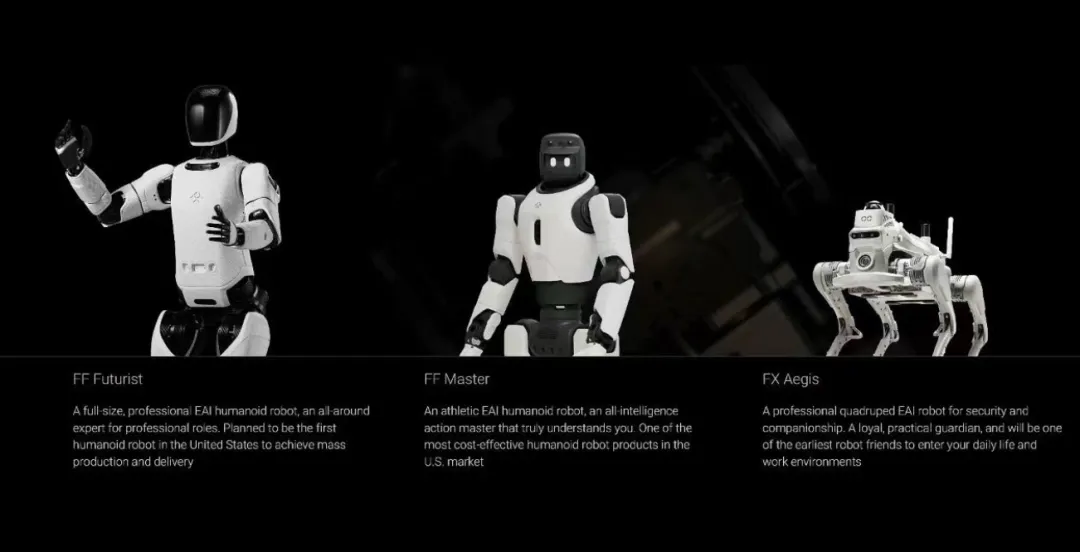
Like traditional PCs, robots have entered a meter cabinet.
At the end of the last century, PC integrator manufacturers were trapped in the Wintel dilemma, with Windows and Intel deeply tied together, defining a unified set of open standards in which downstream automakers could only assemble and look in this set of standards. Most of the profits from the industrial chain were taken away by the Wintel Alliance, with automakers lacking the underlying discourse and only earning very low processing fees.
The situation faced by home manufacturers is more embarrassing than that of PC integrated factories at the time. They are now enjoying the differentiated dividend offered by the Chinese supply chain, but this dividend is based on cost and speed, and both things will be balanced.
When a company that sends rockets into the sky and takes them back is caught in the crossfire, the strongest barrier in the industry - supply chain efficiency - is no longer a barrier.
08.
Two bubbles
There are two types of bubbles. One is the value type, which means that there is a gap between what people expect it to solve in the future and what it ultimately actually solves.
If you can't tell the difference between the two bubbles, you can go back to the Battle of the Bulge in 2014.
Today, the bubble of physical intelligence is the standard model. The industry is well aware that many companies will disappear.
But even knowing this, investors are still willing to continue investing in trying out how to run a big language model.
As the saying goes: "It's better to make mistakes than to be afraid of missing out".
This mentality is the real source of the market's fuel cycle. It doesn't come from judgment, it comes from the absence of anxiety.
This is the most easily overlooked point in the industry. In the rule model bubble, everyone knows that peers will die, but no one is willing to let themselves die. This is not a collective insanity, but rather a structural necessity.
The story of the big language model supports so much high-value because its technical paths are relatively clear, and the gap between winners and losers grows over time. The paths are now unbroken, and any possible path may or may not be right. In this state, the only source of certainty to exit is one round of someone connected to the board.
And when everyone knows that someone is going to buy it, the price of it is going to be pushed down.
So the 12 billion people hanging up for more than a month without anyone taking over, it's not the people taking over who don't understand, but the people taking over aren't in such a hurry.
Those who are entering the country in mid-2026 are in a more difficult situation. They are worth more than 12 billion dollars and are at least two rounds away from the door.

09.
Link to the Future
At this point, it may still be a question of whether the market will see a breakthrough signal.
Window guidance requires constant revenue, and companies that are more than six times between intended orders and actual shipments in this industry are expected to be successful in smoothing this order. Secondly, the technological path of physically intelligent is still unbroken, but the differentiation of this layer will inevitably shrink as the supply chain matures. Third, old stocks are going out at a price of 12 billion, while prices in the first-tier market remain at 22 billion, which may require more time and methods to smooth over.
These three points together point to a judgment that what's missing in this industry is not money or technology. It's the gap between valuation and reality that's being weighed out a little bit by the exchange rate of old stocks.
It's the companies that have a high valuation in the last round, that already have a certain size, that want to invest their wages, that are approaching repurchase terms in their financing contracts.
The recent talk about capital is moderate, and he said that everyone should adjust expectations and remain relatively rational before the industry's turning point arrives.
The phrase translates to "old stocks sell first, valuations fall first, turning points follow". For startups, turning points are much more important than $2 billion.
The first thing that came up was never the company's bankruptcy, but no one was willing to take over. The moment no one took over, it was the real watershed.