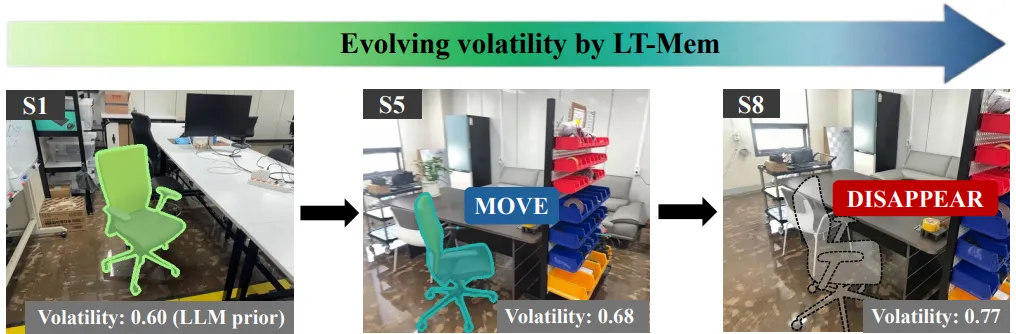
“ It allows the robot to remember not only where the object is, but also where it has moved along the way.
The IROS 2026 award for best paper for a work on long-term memory in robots.
The framework for the study, called LT-Mem, comes from the Department of Robotics and Mechanical Engineering at DGIST, North Korea, and was authored by Yumin Lee, Hyoseok Ju, and communications author Giseop Kim.
The author's APRL laboratory was established in December 2024, and the two lead authors were admitted in July 2025.
01.
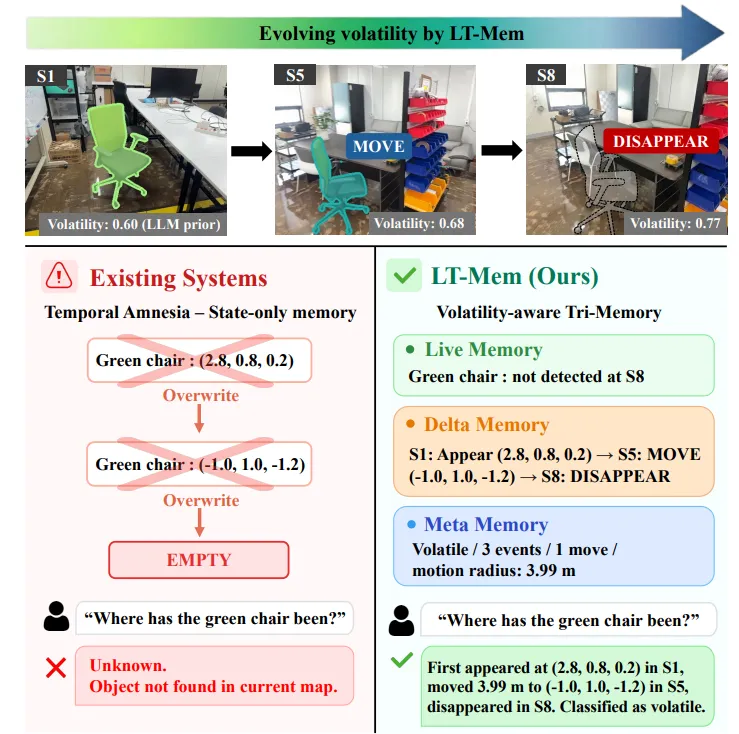
Robots only remember "now" and can't remember "once".
First of all, let's take a premise: this paper calls a session where robots complete a chart independently at different times, and in the context it's called a "rotation".
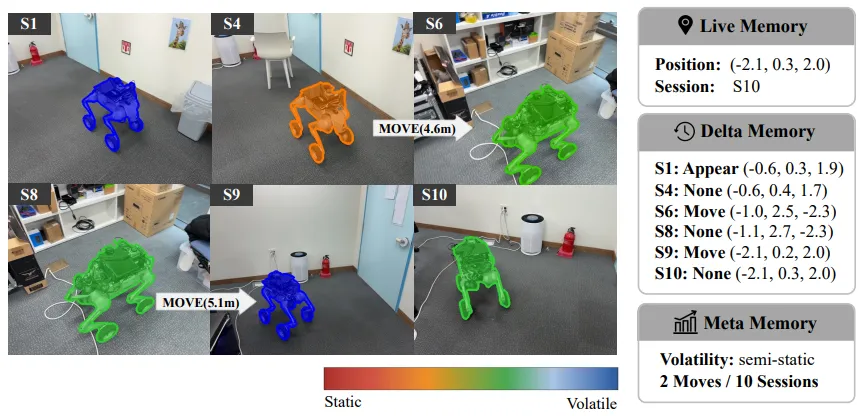
The example given in the paper is based on this setup where the same laboratory is built by the same robot with ten rounds, the third round clock dog next to the white table, then the ninth round, where is it?
Most existing systems fail. Long-term work on geometric routing maps such as LT-mapper, Pomerleau, and others will compare the differences between the maps and new observations, remove or modify the obsolete portion; the work on Chronos further builds a unified short-term dynamics and long-term changes in dense time-space-scale semantic maps. However, they deal with "object displacement" by removing old instances, creating a new record of an object moving from A to B, and leaving no trajectory. Even if given to each object a method of maintaining static probability, they ultimately abandon history to refresh the map.
Another route builds long-term memory on semantic representation, and the difficulty arises at this "recognizer" step. A view level system such as ReMEmbR accumulates characteristic vectors for each observation as a detection enhanced reasoning, while a concept graphs method incorporates basic model characteristics into three-dimensional representations, such as point cloud or scene memory, and builds memory relationships at the object level. The problem is that view level memory does not require the establishment of clear objects between different rounds.
The authors call this systemic loss of the history of the state of an object temporal amnesia (time memory) and foresee the types of queries that need support: the five categories of object-level events APPEAR, DISAPPEAR, MOVE, NONE, RE-APPEAR, on top of which are trajectories, volatility, change time points, and specifying two rounds of state contrast, which must be answered over multiple rounds.
02.
How to update memory using a "volatility score"
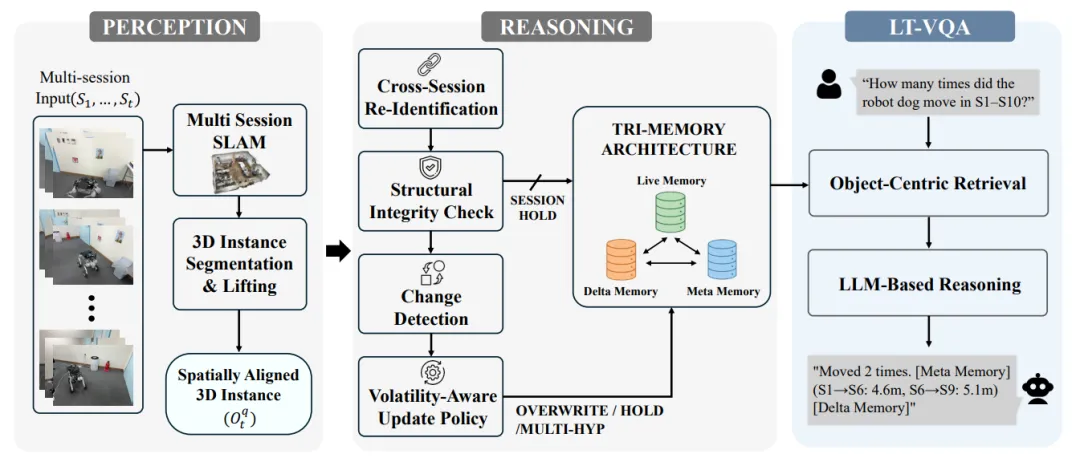
The perception layer is responsible for aligning multiple rounds of graphs to the same coordinate system. The basis is MASt3R-SLAM, a set of three-dimensional reconstruction systems that predict camera position and shutter density from single-shot video. The practice of cross-round alignment follows MR.ScaleMaster, which sets a shutter node for each round, uses scale to estimate the scale and map it to the entire coordinate system.
The reasoning layer deals with identity and updating. Trans-cycle identity light is not far enough because objects would have been moving. The paper gives evidence of a five-way unification: space proximity, time continuity, characteristic similarity, motion consistency as a condition of volatility, and the suppression of mistaken disappearance of shadowing processing.
The weight is 0.05, 0.20, 0.45, 0.15 and 0.15 respectively, and the characteristic similarity is the main signal. The candidate first uses vector searches to extract the five most similar candidates, and if the searches are not confident enough, consider cross-sectional trajectories that are compatible with all semantic labels. The first observations, categories that do not match the simplicity of the situation are determined by hard rules, and the unambiguous output is given to the large model arbiter, can only return to one of the "matching", "reconstructed trajectories", and "interruption", and cannot change the correct scores.
The volatility score alternates between 0 and 1, the event seems to be set as its fixed single-order function, is a non-learning evidence accumulator, the initial value is given once by the large model according to the semantic label; even pre-estimated biases can be crossed in several rounds, without the need for object-to-object dialing.
Three types of movements correspond to triple memory: current state memory storage status, event memory with turn-by-turn index and displacement time logs, statistical memory accumulated fluctuation with change frequency frequencies and anti-breastfeeding movement capacities. For example, in Lab-S machine dogs, the 6th, 9th rounds of 4.6 m and 5.1 m displacement are recorded as moving, the 4th, 8th, and 10th rounds of small drift are recorded as unchanged within the storage, and are eventually classified as semi-static. When users ask, the detection module type of the problem flows into a determination calculation according to the memory, location and frequency directly in the event log, without generating a large model.
03.
Small 3B models can also win, with token spending one level less than the strongest visual baseline.
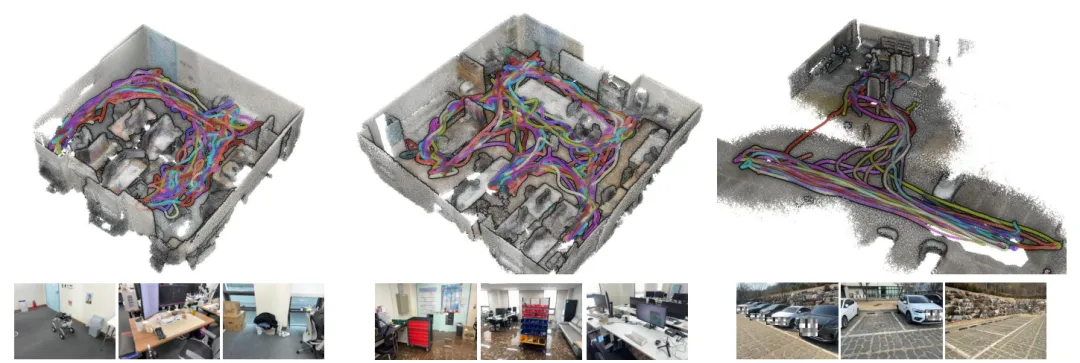
Supporting the LT-VQA dataset, it provides a globally aligned multi-cycle geometry, durable object instance identities, event-level labels, and a sequence of chronologically indexed Q&A. Both indoor environments track 10 objects, each with 10 wheels; outdoor parking lots have the same 10 wheels, distributed on different dates and times.
The three indicators are event detection F1, event query accuracy, frequency query accuracy. The purely geometric baseline detects events at 0.630 from the threshold, but it does not retain an event log, and the two types of questions cannot be answered structurally.
The STAR system with intelligent physical retrieval capacity burned about 45,860,000 tokens, event detection F1 was 0.420, QA-Event was 0.460, and QA-Freq was unable to respond due to its lack of lasting identity and event logs, and the fragmented record of temporary retrieval was inconsistent with the object's history.
LT-Mem with Gemini 2.5 Pro achieved 0.910, 0.820, 0.600 for only about 438,000 tokens; in exchange for the locally operated small model Qwen 2.5-3B, there are still 0.885, 0.800, 0.567, about 35.2 million tokens, still well above all baselines, indicating an improvement in the ability of the structured memory design rather than the large language model itself.
The dilution experiment was simpler: after removing the cross-cycle identity matching, the three collapsed to 0.140, 0.120 and 0.070, and the persistence identity was a prerequisite for all time-order reasoning; replacing the volatility conditions with fixed thresholds returned to 0.615, 0.640 and 0.130.
Parking scene scenes show another class of capabilities: statistical memory rounded up the number of vehicles, the third round (8:00 am) 0 empty vehicles, the eighth round (13:03) 34 full vehicles, the "how many times to find a seat" checklist is the answer.
The main page of the project:https://lt-mem.github.io/