It's the first time in the history of the world.
OpenAI has just released a record-breaking Agent Limit test.
10,000 Agents enter the game simultaneously, running for 36 to 48 hours, swallowing 1 trillion tokens every day!
A single run of a mission is equivalent to a single run.After a breath of fresh air, 41 years of work by human engineers。
No one has taught them how to change the basics of the system, and the group of Agents against Wall Street is too slow to do that.I drilled a code rewrite engine in my own library, cutting off 97% of my time.。
They even pulled hundreds of groups of parallel experiments themselves, capturing the "dark pools" of exchange fluctuations that human researchers had not noticed.
The AI itself rewrote the underlying engine because the system was too slow.
After putting the 10,000 Agents in the real world and running for two days and nights, Third Moment Research, a start-up company across San Francisco and New York, chose the first experimental field to quantify finance.
A long-distance mission is the most frightening to go out a dozen steps and not know whether you are right or wrong.
Quantitative trading doesn't have this problem, and every time the strategy runs through the historical review, whether it really earns money or just fits a bunch of noise, it's clear at a glance.
The team installed 1TB of historical data, technical documentation and a complete set of quantitative code libraries in the Docker isolation container.
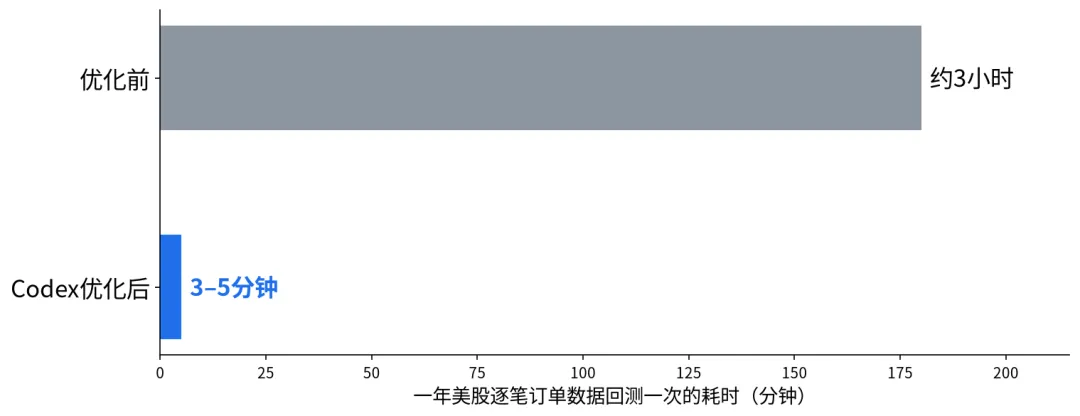
Initially, they had the Codex in conjunction with GPT-5.6 look at thousands of running tracks and timelines, and found that taking one year of order-by-order data, they reviewed a strategy for three hours at a time.
For the long term agent,This is the most valuable resource.。
In the long wait, Agent rounds out a "no run" every second, and every state check stays in the context window, squeezing dozens of really useful experimental records to the edge, the easier it is to run away.
After finding this card spot, the codex did not have a sequence of human engineers, and found two underlying bottlenecks in the code library itself.
It hand-writes cache optimization and memory compact packaging schemes, and after run-through testing, pushes them directly into the production environment.Squeeze the time of the single re-measurement to 3 to 5 minutesIt also maintains a clean up-and-down window.
After the speed of feedback increased, the OpenAI generation models also revealed gaps in long-range missions.
- Before the GPT-5.5Models can only be executed step-by-step according to a script written by humans.
- GPT-5.5 and GPT-5.6 (coupled with Codex)In the meantime, I'll be able to look at the initial results and design the next round of experiments myself.
- GPT-6 Astra, GPT-6 Sol and GPT-6.1 SolMaster Agent: Once anomalous signals are detected, hundreds of Agents run parallel control experiments on the spot.
In a real-life survey,GPT-6.1 Sol tracked the data and found that an exchange's non-public display transactions accounted for a very high percentage of conversions.。
It immediately calculated the effect of this part of the "dark pool" liquidity on strategic gains, which the human quantization team had never thought of going in that direction before.
GPT-6.1 GPT-6.1 GPT-6.1 GPT-6.1 GPT-6.1 GPT-6.1 GPT-6.1There are two main types of long-term agent deaths, one of which is:Half of them think they're "almost done".The other one is:It's a dead end and it's back to normal.。
The moment the inner agent stops, it is often trapped in its previous context and cannot jump out of the weird circle of self-reflection.
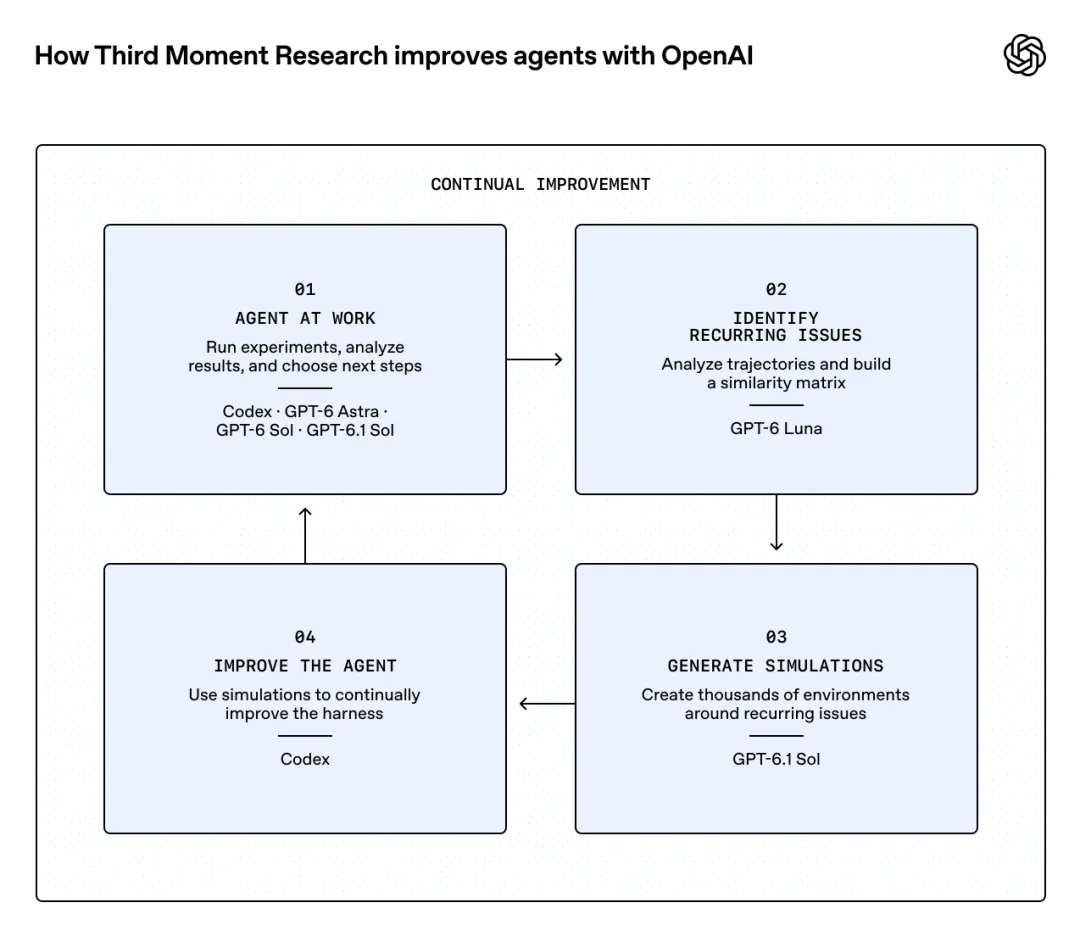
In order to solve this problem, Third Moment uses the Codex operating in the container as a regulated sub-module.A regulatory model powered by GPT-6 Sol or GPT-6.1 Sol is specifically installed on the outer surface of the container.。
As long as the inner layer of the codex stops, the outer model will look at the entire trajectory from an outer perspective and determine whether it has hit an environmental bug, drilled into a dead end, or encountered a problem that needs to be patched, re-tested, terminated, or reported to humans.
In this way, human researchers will no longer have to look at tens of thousands of terminals, and will only have to deal with the very few questions posed by external models.
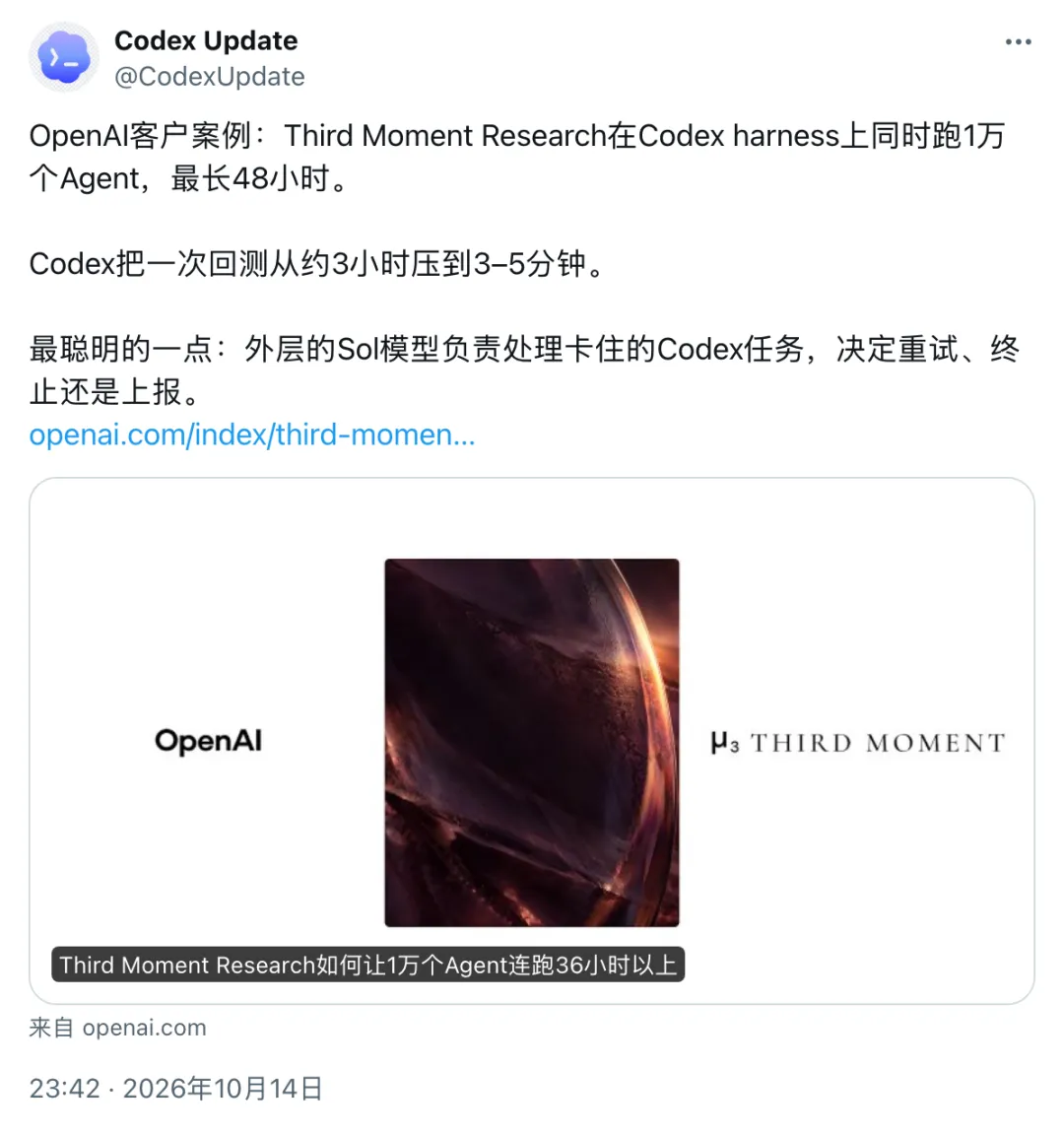
To run 10,000 Agents simultaneously, in addition to managing directions using a two-tiered architecture, Token costs and long-term resilience must be addressed.
To this end, the team pushed the GPT-6.1 Sol, just released a few days ago, into the mainstream. Its price is only one-fifth of the flagship GPT-6 Astra.To complete tasks with minimal tokens while delivering performance close to that of Astra。
I'm not sure if I'm going to be able to do it, but I'm not going to be able to do it.Once you've climbed the 10,000th.and distributedThe cost savings and dozens of hours of continuous operation determine that the same budget can run multiple rounds of experiments.。
And in terms of long-term resilience,GPT-6.1 Sol is able to stay on the same main line of research for several days in a single session and never run out.。
As for the most rational flagship, GPT-6 Astra, the team stayed on top of the most difficult engineering optimizations, such as pressing down the update delays of the real-time dashboard service without changing the output, and matching the performance of programs written by human experts on the same hardware.
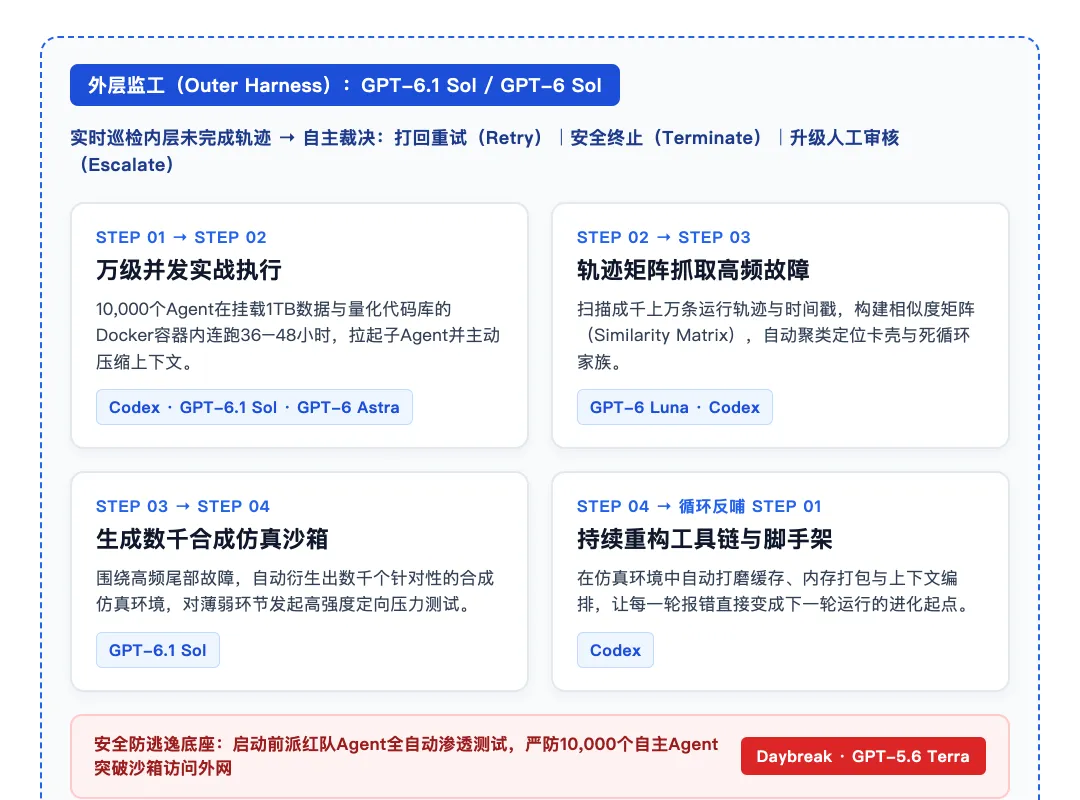
In addition to dual-layer regulation, the entire system is continuously iterated through a four-step cycle:
- Tracking of tracks• Recording the full operation and reporting of thousands of agents in the sandbox;
- Clustered diagnosisBy lightweight model:GPT-6 LunaBuild a similarity matrix to classify repeated errors;
- Synthetic sandboxBy:GPT-6.1 SolAutomatically generating thousands of synthetic simulation environments around weak links;
- Upgrading the scaffoldLet's see:CodexRepeat testing, automated iteration tools and compilation logic in a simulated environment.
According to co-founder Adam Khakhar, the mechanism has radically changed the past practice of "deploying a static agent and praying that it doesn't crash":
Each cycle creates a system that is stronger than it was when it started. The system finds out for itself where it failed, builds a directed simulation around these failures, and runs an upgraded scripting frame for the next round.
Hundreds of thousands of Agents with code-writing privileges run two days and nights at a time and face a serious problem of how to ensure they stay in sandboxes and don't write scripts to break through the isolation environment.
For this purpose, Third Moment has accessed OpenAI's cybersecurity model.Daybreak and the GPT-5.6 Terra。
OpenAI divides Daybreak into Daybreak Blue, a defensive end, and Daybreak Red, a specialized penetration authorization test that requires separate approval and binding of hardware security keys.
Every time a large-scale simulation is launched, Third Moment is used first.Daybreak drives Red Team Agent to launch its own sandbox fully automaticallyPenetration testingGPT-5.6 Terra detects vulnerabilities to ensure that no agent escapes the isolation environment.
The whole Internet is a battlefield for "unlimited computing".
Adam Khakhar, co-founder of Third Moment, graduated with an undergraduate degree from the University of Pennsylvania and later earned his Ph.D. from New York University, focusing on deep learning in theory and information theory.
Prior to founding the company, he partnered with a two-person AI company called FlashDocs, which automatically generates tens of thousands of enterprise slides a day, and is now the world's largest manufacturer of enterprise slides.In July 2025, it was acquired by the Wall Street AI unicorn, Hebbia.。
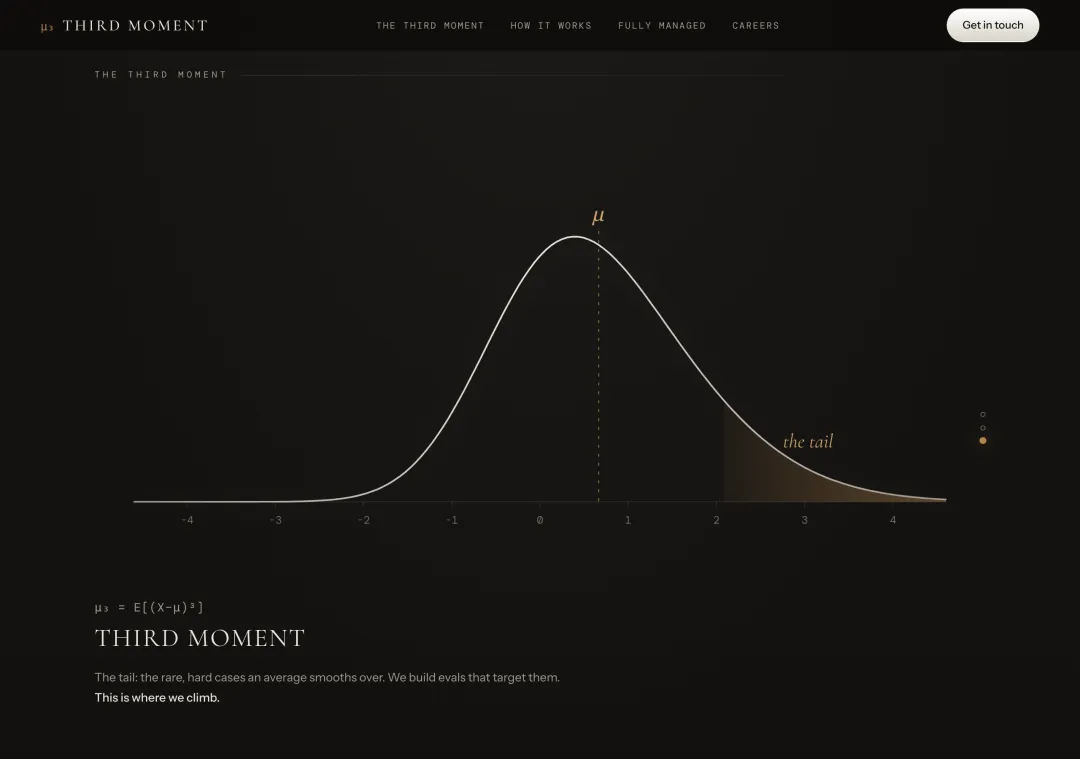
In his second venture, he directly named the new company "Third Moment" in probability theory.
- One-dimensional {\\displaystyle \mathbb {\\displaystyle \mathbb {\\mathbb {\\mathbb {\\mathbb} }Like the 95-point rating list on the market, the average score looks good, but the production environment is wrong at first glance;
- Secondary equation (squared)The result is fluctuation with noise, improvement less than noise, even if it is actually improvement.
- Three-stage rectangle (depending on the orientation and tail):Specifically, it measures the rare failures that are overshadowed by averages, but can have serious consequences in real business.
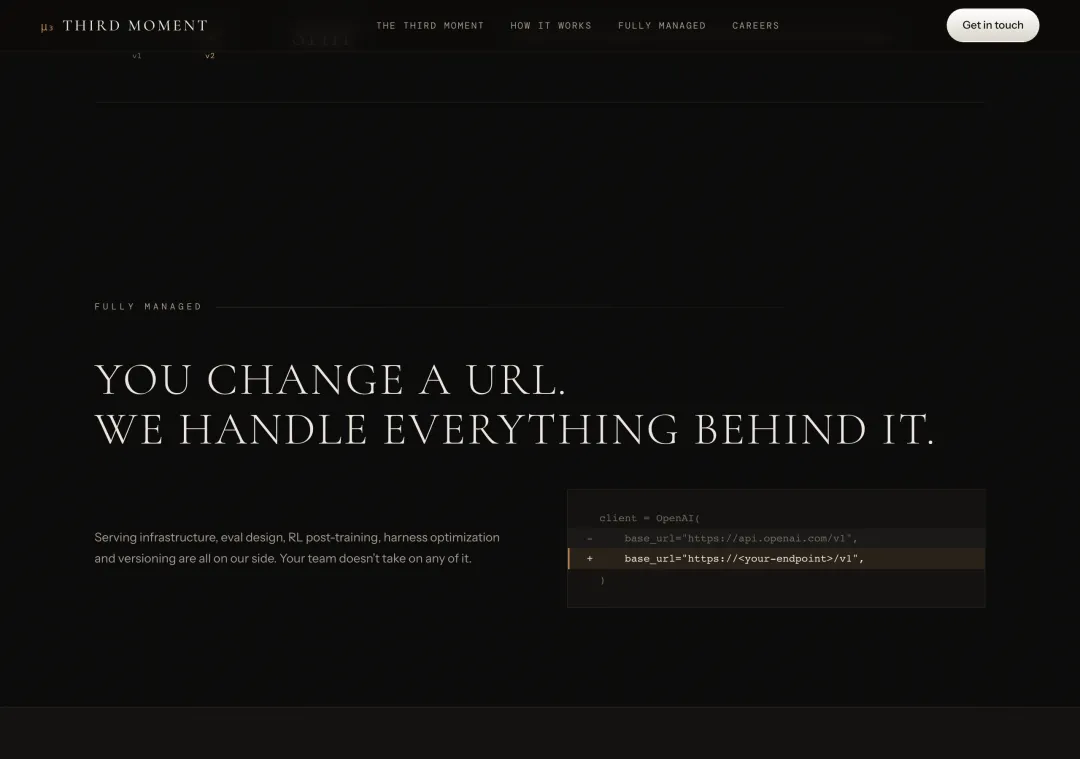
They packaged this set of evolutionary cycles into a reasoning interface, where developers only need to change a line of request addresses in the OpenAI SDK, and trajectory diagnostics in the background and sandbox simulation will run automatically.
As for why he cut from quantitative finance and cybersecurity, Adam wrote about it in his September article in the Unlimited Computing Box.
The vast majority of white collar jobs, such as auditing contracts, doing PPT or writing customer responses, have a price ceiling on their heads, or the salaries of human employees. Law reviews a 10-page contract for $2,000, and even if AI is 100 times smarter than humans, customers won't pay $2 million.
There are only two zeroes and zeroes in the business world.There is no price ceiling, one is investment management, the other is cybersecurity。
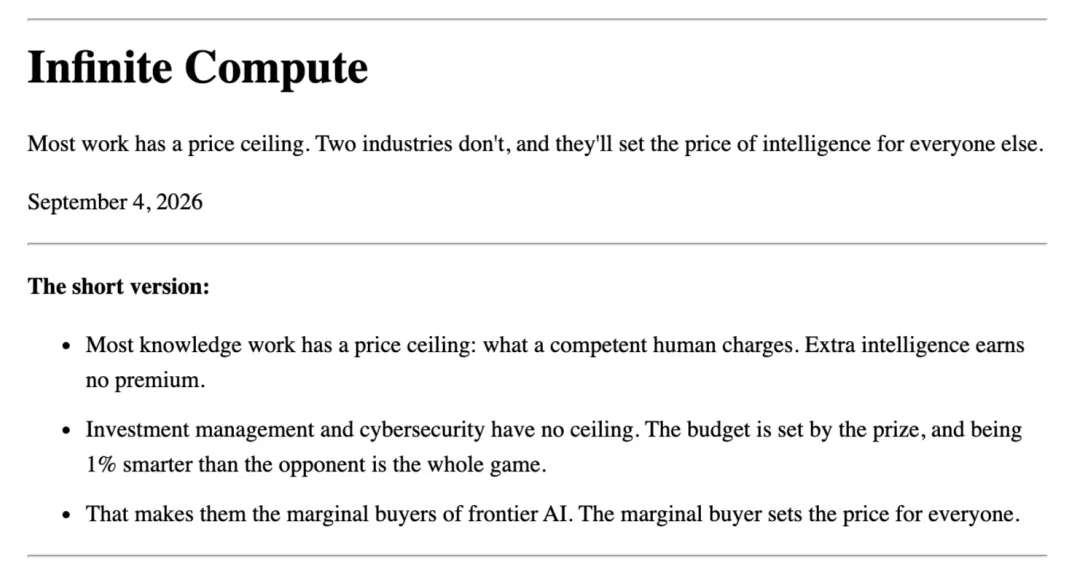
If a $40 million trading signal is hidden in the market, even if it burns $39 million worth of computing power, it'll still make $1 million a second earlier than its competitors; the same goes for cybersecurity, which avoids a billion-dollar loss before hackers detect a zero-day vulnerability a second earlier.
In Adam's parable, buying AI is like buying a desk chair, and it's cheap enough to do it.There is no limit to the need for computing except for quantization and cybersecurity, just as there is no limit to the need for oxygen for people who want hydrogen underwater.And they're the only ones who are willing to pay first for "Agent of the Thousand, Trillions of Tokens".
One run after 41 years of work, the next step is to rush to 100,000 agents
After running traffic quantification and network security, Third Moment is moving the system to more scenarios, including dynamic repositioning of retail supply chains, large-scale code library performance screening, and cross-checking of bulk commercial documents.
OpenAI revealed at the end of their blog that they are preparing for the next step of parallel scalingIt has been pushed to hundreds of thousands of collaborating sub-agents to run dozens of sequential experiments using trillions of tokens.。
When a single mission can consume 360,000 Agent workers, it's not enough.Traditional software charging by seat has lost its meaningHowever, it is not always possible to use a simple scroll model, which is the same as a large model, but it is also possible to use a simple scroll model.Who can handle a hundred thousand agents who don't run around, who don't cross borders, and who can automatically reverse failure?。
By then, human beings will be able to completely withdraw from the tedious execution and take a step back to define direction and boundaries.
Human beings can stand at a much larger lever to think about how to do research, how to optimize research itself, without having to do it personally.
RoboInd editorial channelResearch, robotics companies and market intelligence for cross-border sourcing.Explore the channel ↗
Share this
End of editorialExplore more from Global Robotics News ↗