Recently, the Data Science and Intelligence Laboratory of the Department of Electronic Engineering at Tsinghua University proposed SRHarness [1], a runtime framework for AI for Science aimed at agentic symbolic regression, to allow AI to more reliably discover formulas from observed data; while building mechanisms to discover the benchmark MechBench [2], the system evaluates whether AI can further reveal the mechanisms behind the formula.
This follows the team's further work in the field of AI for Science following the introduction of a feedback AI framework on the Nature Reviews Physics column [3] and the introduction of the neural symbol regression method ND2 on the Nature Computational Science column [4].
The two results combined to answer the two key questions of "how to find mathematical formulas" and "whether or not the physical mechanisms behind the formulas are really understood" in AI scientific discoveries, which pushed AI science from "fitness observations" to "mechanisms of understanding".
Experiments showed that under the same DeepSeek-v4-flash-0731 kernel, SRHarness had a symbol recovery rate of 72.97 percent in anonymized tests, well above Codex's 20.72 percent, and the GPT-5.5 and GPT-6-Astra Codex; while MechBench revealed that even with the GPT-5.6-sol Codex, the mechanism recovery rate in the core set was only 13.75 percent, well below its rule recovery rate of 35.00 percent, indicating that current advanced AI scientists still have a significant gap in the ability to "discover laws" and "understand mechanisms".
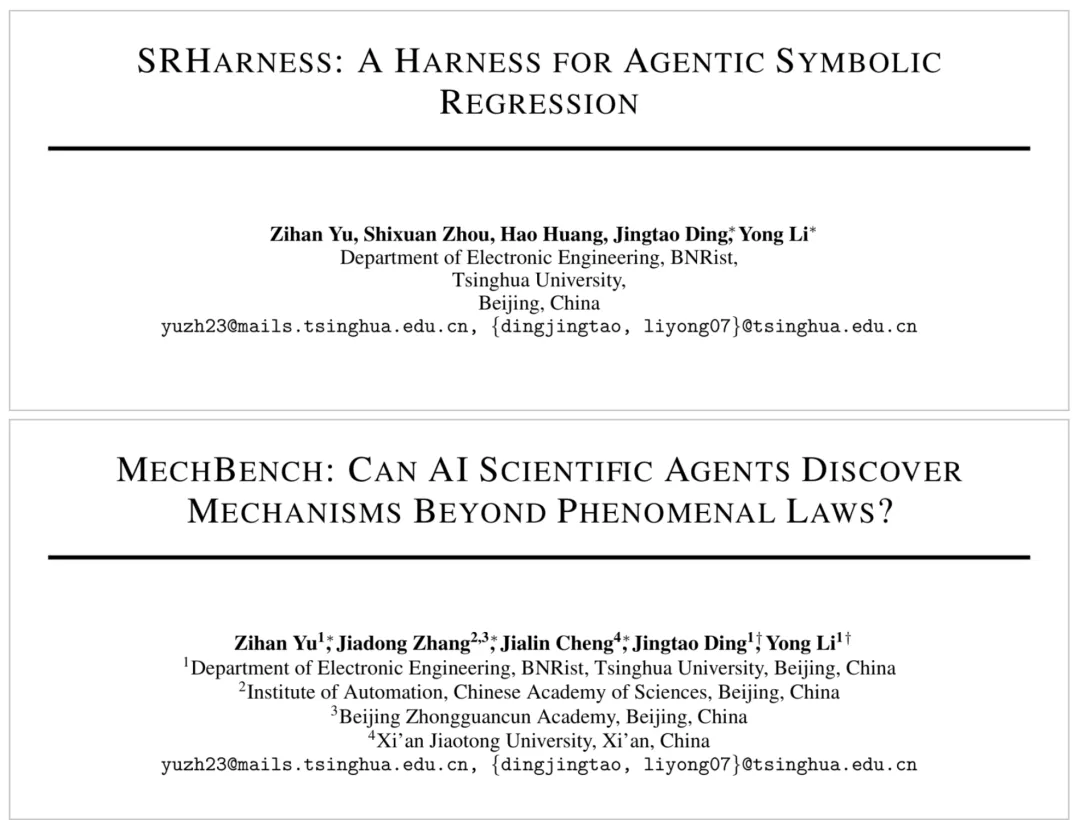
Two papers on this project: SRHarness (top) and MechBench (below)
First, the two steps of science: from Kepler to Newton.
Describing the mathematical laws of phenomena from observational data and further exploring the physical mechanisms behind the laws is a classic path for scientific discoveries. More than 400 years ago, Kepler summarized the laws of planetary motion from observational data, accurately sketching the planets "how they move"; Newton's mechanics went further, starting with gravity, and physically explaining the planets "why they move".
Today, large language models (LLM) and scientific agents (Scientific Agent) are able to autonomously analyze data, call tools, iterate hypotheses, and deeply engage in scientific discovery. A key question arises: Will AI be able to reliably discover the stable laws behind the data first?
On both of these issues, the research team made two advances: first, by proposing SRHarness, which provides a replicable, durable, and traceable running-time infrastructure for the return of intelligent body symbols, allowing scientific intelligent agents to find mathematical formulas more reliably. In standard assessments, the symbol recovery rate reached 93.69%, up more than 30 percent from the previously advanced method; second, the MechBench framework for constructing mechanisms, which evaluates whether AI can be launched directly from limited external observational measurements, but can not explain the underlying mechanisms of how phenomena arise. This framework will for the first time clearly distinguish between the "restoration of the laws of observation" and the "restoration of the underlying mechanisms" for measuring whether AI can "really understand scientific objectives".
Second, let AI find the formula reliably: SRHarness
As the return of symbols from "LLM generating formulas" to the operational infrastructure that supports these long-range scientific interactions by autonomously analyzing data, invoking tools, and iterating assumptions by intelligent agents becomes a key issue. Although the existing work has been fragmented to implement the relevant mechanisms, it usually serves only their own methods, and has not seen Harness as an independent, replicable research object.
SRHarness, developed by the research team, visualizes this layer of infrastructure. It does not specify a specific search strategy, but provides replicable running time support so that different models and search strategies can run on it.
1 Reusable Scientific Actions: Unified packaging analysis, adaptation, search and evaluation tools, standardizing operations such as data analysis, numerical optimization, symbol engine, and candidate evaluation, allowing heterogeneous scientific operations to be executed through unified interfaces and consistent evaluation semantics, allowing the intelligent body to focus on "what to do" rather than repeatedly processing the underlying execution details.
2 Persistent Scientific State: Continuous updating and preservation of candidate formulas and their scientific evidence, making assumptions, evaluation results, complexity and source records independent of the context in brief conversations, supporting cross-sectional comparison, sequencing and duplication.
3 Trajectory Lifecycle Management: Manage the continuation, branching, restarting and terminating of long-range searches, supporting track tracking, failure recovery and retention of best results, allowing long-range scientific searches to be observed, audited, and recoverable.
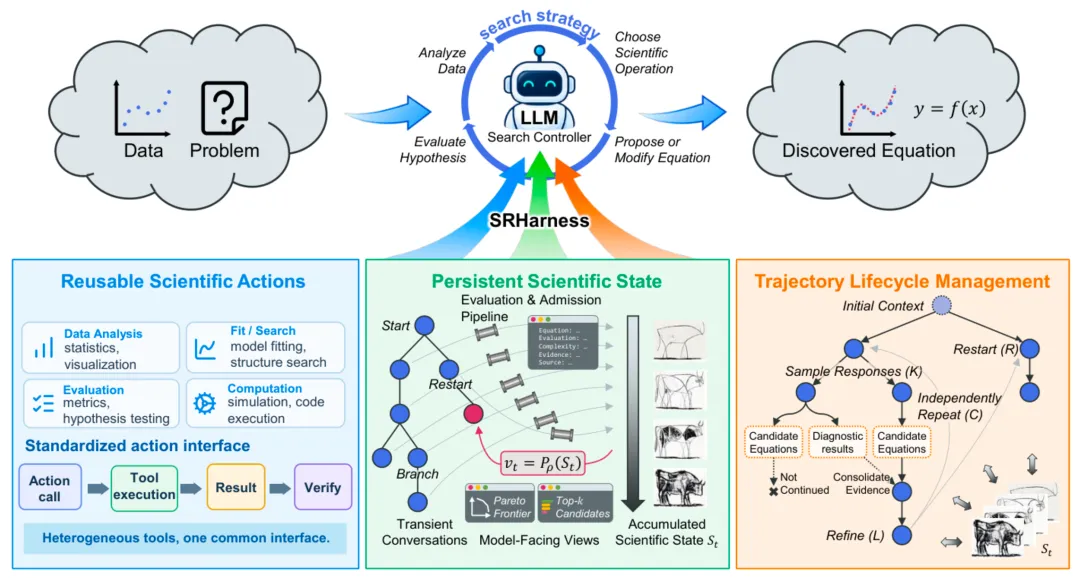
Figure 1 SRHarness overall framework. The upper layer is the LLM search controller, which conducts the symbol search through a closed loop of "analyzing data, assessing assumptions, selecting scientific operations, proposing or modifying equations"; the lower three-color modules are the repeatable scientific action (a unified tool interface), the persistent scientific state (a continuous accumulation of candidate formulas and evidence with Pareto front-end management), the continuation, branching, restart and termination coordination of trajectory lifecycle management).
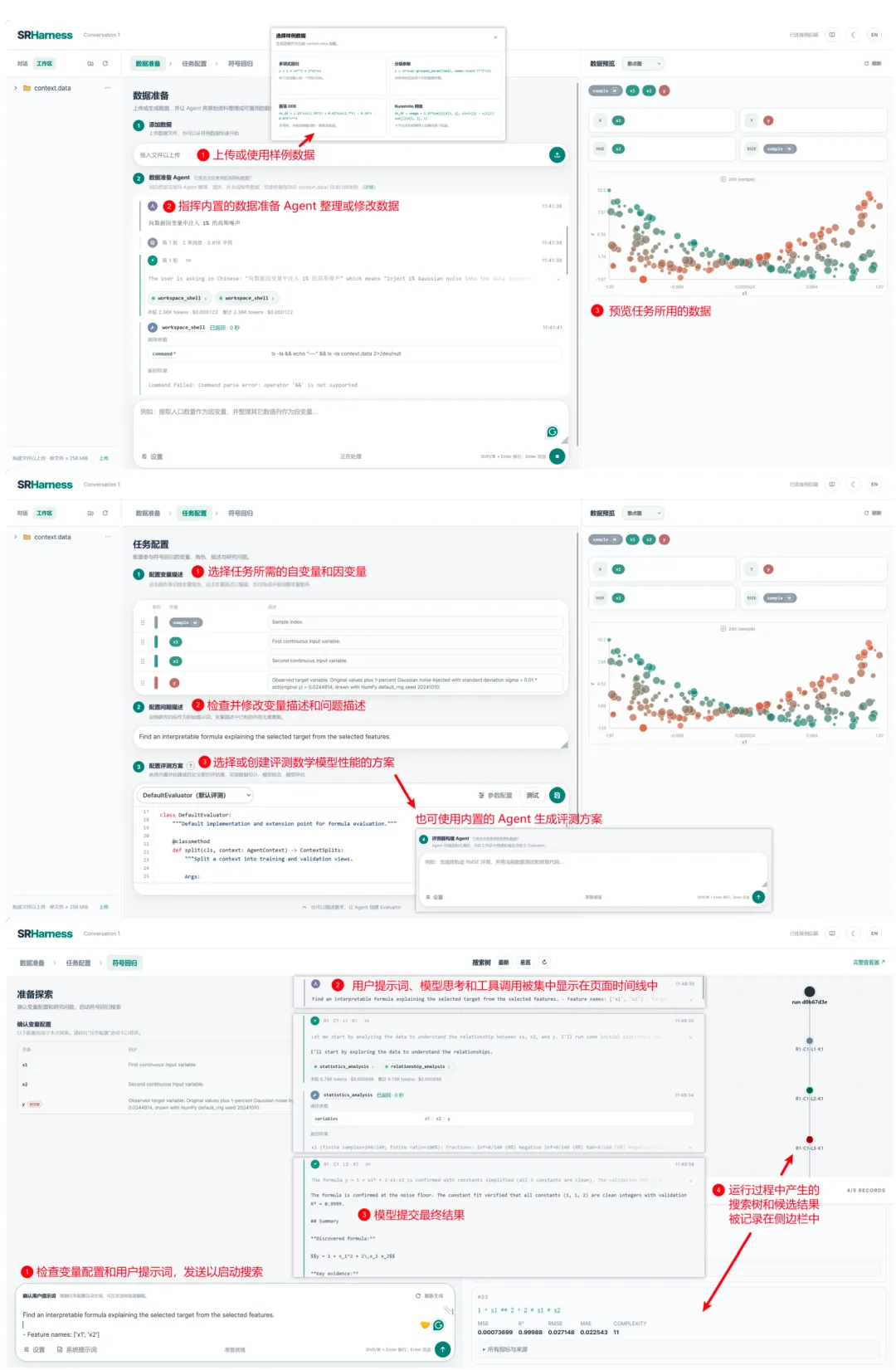
Based on this, SRHarness has been developed as a complete system of intelligent systems that can be used directly for symbol regression and scientific discovery tasks, covering data analysis, numerical matching, symbol search, candidate management, unified assessment, status persistence, track tracking, and failure recovery. Researchers can also add further field-specific scientific tools and search strategies to it to expand their own symbol regression intelligence.
As of now, SRHarness is open-source, and both the code, documentation and online demo have been made public: the code is hosted on GitHub and can be installed via PyPI with a single click; the research team has also built an online demo, where users can experience the entire process from data analysis to formula discovery on the web without local deployment.
It's a great way to get started.
Supporting the use of documents:
The online demo address is:
Experiments showed that under the same DeepSeek-v4-flash model, SRHarness achieved a signal recovery rate of 93.69% on the LSR-Transform rating benchmark, well above the 62.16% of the earlier advanced method SR-Scientist (ICLR 2026) and improved the amplitude by more than 30 percentage points, a relative improvement of about 50%, which refreshed the benchmark's best results; on the LSR-Synth benchmark for the four fields of physics, chemistry, and biomaterials, the accuracy of the predictions of extra-distribution values reached 78.00%, 78.87% and 87.09% respectively.
More importantly, even when removing the scientific context and the semantics of the variables in the problem (LSR-Transform-Anon), SRHarness still finds the target equation with a symbol recovery rate of 72.97%, which is much higher than SR-Scientist's 39.64% with Codex's 20.72% under the same underlying model, and exceeds Codex's level with the stronger model GPT-5.5 (68.47%); even when faced with the latest generation GPT-6-Astra, SRHarness is able to approximate its performance with lighter models (see below).
Taking into account the superior performance of the latest cutting-edge model GPT-6-Astra in mathematical reasoning, the research team further compared it to the GPT-6-Astra. Experiments showed that SRHarness only had to be equipped with the more economical DeepSeek-v4.1-flash to achieve a performance close to that of Codex+GPT-6-Astra on LSR-Synth: Specifically, SRHarness achieved an overall in-distribution accuracy of 95.52% and an overall out-of-distribution accuracy of 92.41% with a distribution accuracy of 98.59% in the biological field and a 100% in the material field, respectively, in proximity to and parallel to the Codex of the GPT-6-Astra under the same conditions.
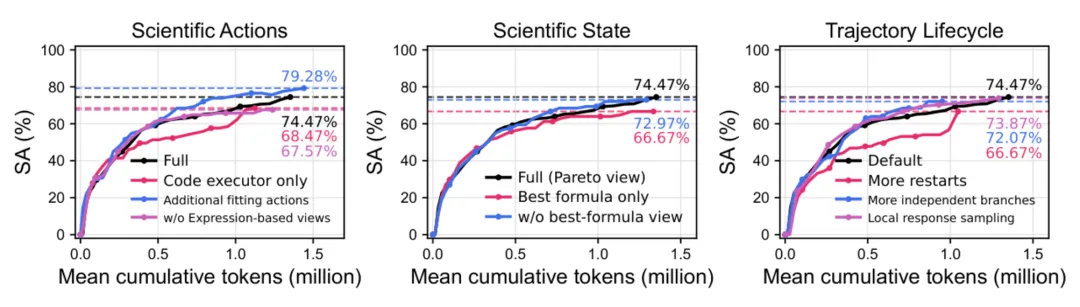
Figure 2 In the dissolution experiments on LSR-Transform-Anon, the signal recovery rate (SA) decreased significantly after the key components in the streamlined reusable scientific action (left) and the stabilized scientific state (middle) or the trajectory lifecycle management (right) respectively: for example, retaining code executors alone reduced the recovery rate from 79.28% to 67.57%, while retaining the optimal formula view decreased from 74.47% to 66.67%, and rebooting from 74.47% to 66.67% respectively.
Third, after discovering the formula: Can AI reveal the mechanisms behind the formula?
Discovering mathematical formulas and laws is not the same as understanding physical mechanisms. Existing symbol regression methods and evaluation benchmarks are largely aimed at restoring the phenomenological model to describe observational behaviour: as long as the formula is well suited to the data, it is successful. However, just as Kepler's law does not explain why the planet is moving, adapting the correct metaphorical equation does not mean really understanding the mechanism behind it.
To this end, the research team constructed the MechBench Mechanism, a benchmark that clearly distinguishes between the ability to "restore observational laws" and the ability to "restore productive laws" (see Figure 3): the elephant model carries out the relationship between observable inputs, modulations and outputs; the mechanism model further describes the internal components of these phenomena, the relationships to organizational structures, and the quantity of internal science that cannot be determined by the observational laws themselves.
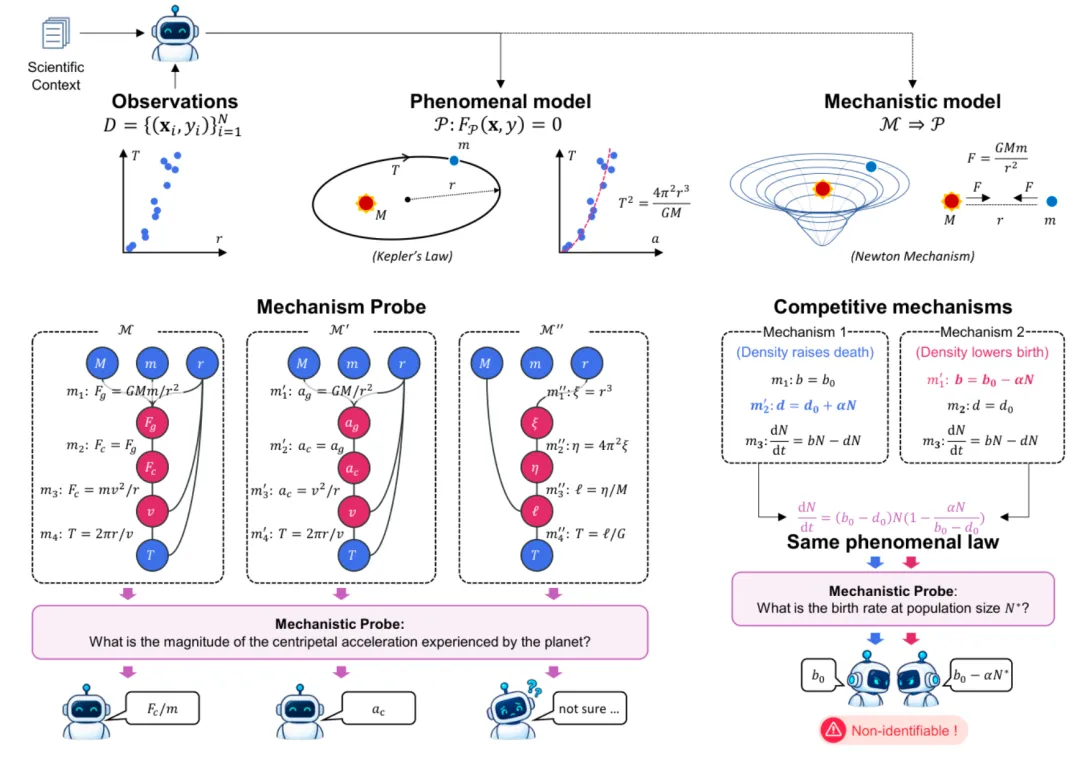
Figure 3 Returns from the laws of physics to the discovery of mechanisms. Examples of planetary motion in the upper row: Kepler's law (The Elephant Model) describes the laws between observations, Newton's mechanism (The Mechanism Model) further explains the source of the laws; the bottom row left-handed demonstration mechanism probe (Mechanism Probe) examines whether the submitted mechanism can correctly derive an internal scientific quantity that the laws of physics cannot determine (such as planetary acceleration); the right-hand side shows competitive mechanisms (Competitive Mechanisms) which are used to exclude mechanisms that cause "multiple scientifically reasonable mechanisms to produce the same observational phenomenon".
It is not easy to find the benchmark for constructive mechanisms: the structure of the mechanism must be objectively assessed; it is necessary to distinguish between "true rebuilding mechanisms" and "recalling material answers"; it is also necessary to address the problem of "mechanistic indistinguishability". Many scientifically reasonable underlying mechanisms can produce exactly the same observation phenomena.
MechBench's construction and evaluation process is shown in Figure 4. The research team selected 16 real-world scientific mechanism missions from four fields of physics, chemistry, biology, and materials to construct an alien mechanism system by means of scientifically meaningful controlled mutations, avoiding models directly reciting instructional answers, and generating a set of guideline questions containing 512 mechanisms to find out the answers to the questions.
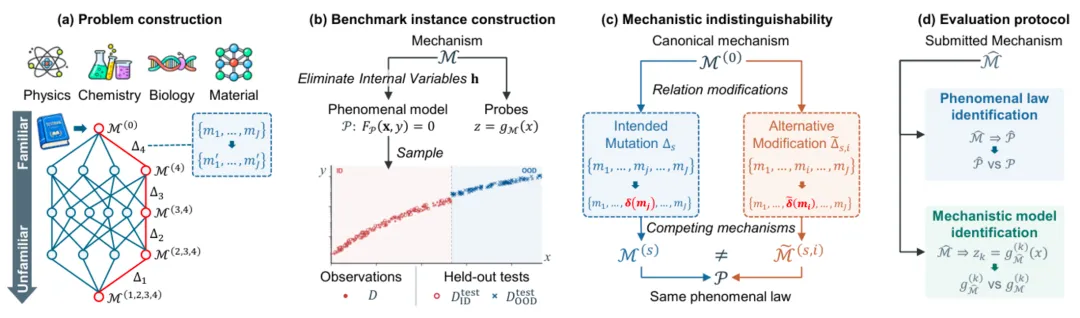
Figure 4 MechBench constructs and evaluates the process. (a) Constructing problems: applying scientifically meaningful mutations to familiar classical mechanisms to construct alien mechanism systems along the "familiar→stranger" lines; (b) Constructing benchmarks: Eliminating internal variables to generate observational data and leaving out test sets; (c) Discriminate screening of mechanisms: Looking for equally reasonable competing mechanisms to eliminate misconceptions; (d) Constructing evaluation protocols: simultaneously verifying metaphysical rule recognition and mechanism model recognition, the latter requiring correct scientific measurement by the determining mechanism, but only metaphysical rules cannot give.
Based on the MechBench, the research team system compared the capabilities of several cutting-edge scientific intelligences on "discovery laws" with "discovery mechanisms" and found a significant gap in capabilities between the two (see Figure 5); for example, in the Codex (GPT-5.6-sol): its core set's subjective law recovery rate is 35.00%, while the mechanism recovery rate is only 13.75%; even in the case of subjective law recovery, 64.29% of the mechanisms still fail to recover.
To test whether this conclusion is still valid in the latest generation of front-end models, the research team further tested GPT-6-Astra, which recently demonstrated strong mathematical reasoning abilities. GPT-6-Astra significantly increased the regression of the axiomatic rule in the core set to 72.50%, showing that the new generation model made great progress in formula discovery; however, its mechanism recovery rate was still only 47.50%: 43.10% of the GPT-6-Astra missions correctly restored the axiomatic rule in its entirety.
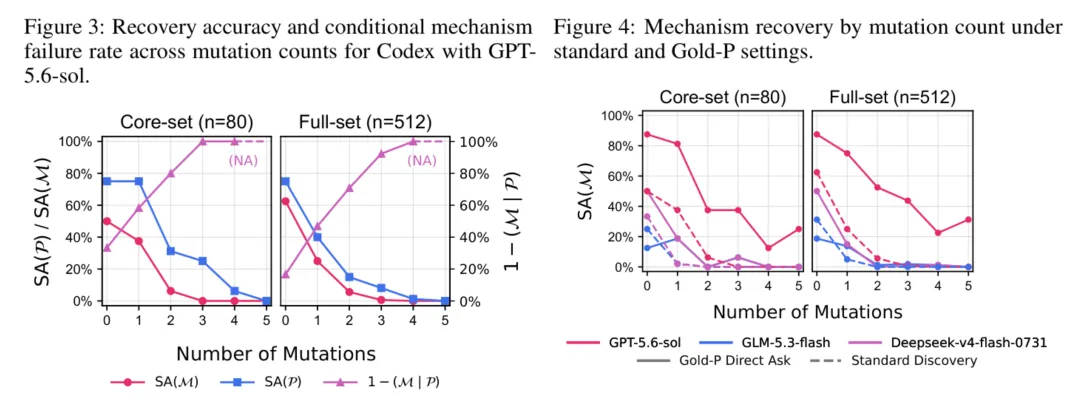
Figure 5 Law detection and mechanism detection capability gaps. Figure 3: As the number of mutations increases, the law recovery rate SA (P) and the mechanism recovery rate SA (M) decrease simultaneously, but the mechanism recovery deteriorates more rapidly, and the condition failure rate to recover the mechanism at the right time under the law is always low; Figure 4: In the standard finding of false lines, the recovery rate of each model increases rapidly and decreases with the number of mutations, indicating that the difficulty of the intelligent body is not only in "first finding the formula".
These results show that even the current most powerful large models (such as the GPT-6-Astra, which has a mechanism recovery rate of only 47.50%), although it has been able to better detect "the laws that the data obeys", there is still a clear gap in the answer to "why this law will occur"; adapting or restoring the correct hypothetical equation does not mean that the mechanism behind it is really understood. MechBench means that it is combining the current level of the most powerful model's ability to quantify this long-term neglected gap between "the laws" and "the mechanisms of discovery", and that science has established a higher value threshold to measure whether future scientific intelligence can truly "understand".
Four: From "knowing what it is" to "understanding why".
SRHarness and MechBench respectively correspond to two levels of AI scientific discoveries: the first allows the intelligent body to find mathematical formulas more reliably, and the second to test whether the intelligent body can further understand the physical mechanisms behind the formulas. Both point to the same trend: AI for Science is moving from "adaptive observation" to "mechanism of understanding", from single formula generation to long-range scientific search.
In the future, truly competitive scientific intelligences may no longer be simply "some strong model + some suggestive word", but rather a synergy of models, search strategies and operating frameworks. Who can make intelligent agents more reliably call tools, preserve assumptions for longer, reproduce evidence more effectively, and objectively verify mechanisms, who will have more opportunities to move AI from "discovery laws" to "discovery mechanisms".
Perhaps this is the next stage of AI for Science: not only knowing what the world is, but also explaining why it is.
Paper information
[1]. Yu Z, Zhou S, Huang H, Ding J, Li Y. SRHarness: A Harness for Agentic Symbolic Regression.
[2]. Yu Z, Zhang J, Cheng J, Ding J, Li Y. MechBench: Can AI Scientific Agents Discover Mechanisms beyond Phenomenal Laws?
[3]. Ding J, Zheng Y, Xu F, et al. Understanding emergence in complex systems using abductive AI.
[4]. Yu Z, Ding J, Li Y. Discovering network dynamics with neural symbolic regression.

© THE