The long-held Google Gemini 4 series model has come true this time around...
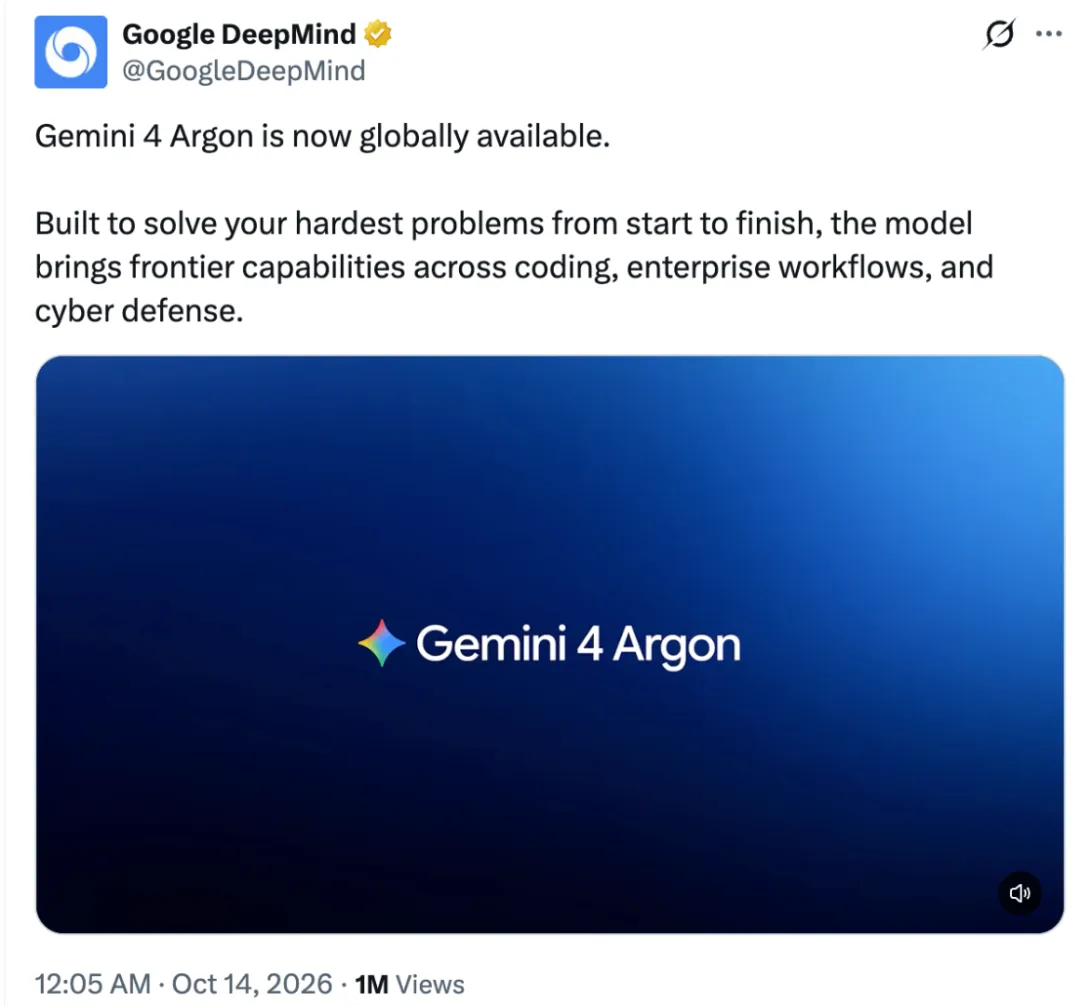
Recently, Google DeepMind officially launched the first flagship model in the Gemini 4 series, the Gemini 4 Argon.
The goal of Gemini 4 Argon is to solve complex real-world tasks, focusing on software engineering, business knowledge, and cyber defense, and is now gradually opening up to developers, businesses, and consumers globally.
In its core core capabilities, the Gemini 4 Argon continues to consolidate Google's advantages over its long-term context and multi-modal native architecture: support for 1 million token inputs over 1M, native coverage of text, high-resolution images, video and audio; and for complex tasks in ultra-long chains, Argon supports the cross-request continuous output of up to a million tokens, attacking the often encountered overtime and disrupted flow bottlenecks when executing Agent long-cycle planning tasks.
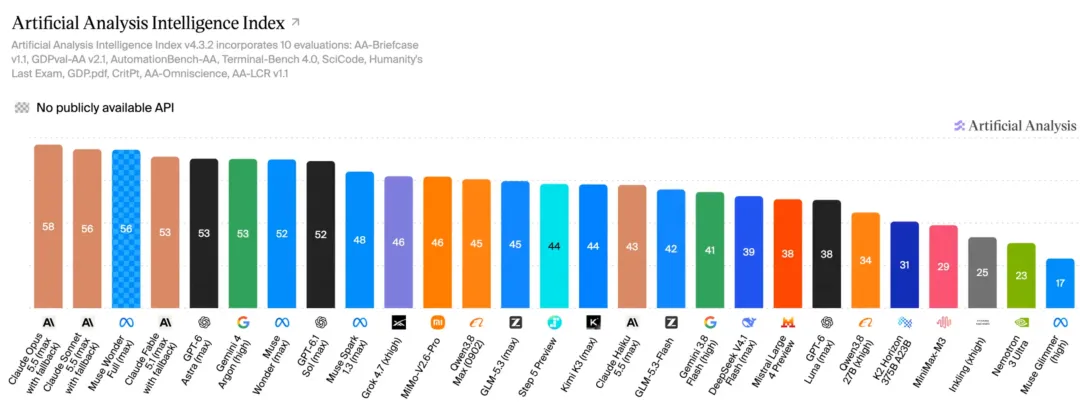
In the initial benchmark of Artificial Analysis, Argon earned 53 points in the Intelligence Index, the equivalent of the GPT-6 Astra (Max) flagpole, but thanks to its structural efficiency and pricing ratio, its single-task overhead on equivalent high-intelligence missions is only about 60% of the previous one.
According to official pricing, Argon's API is currently priced at $2/million tokens for input and $10/million tokens for output. For context caching, which is frequently used in long-distance interactions, a discount of up to 95% is given.
However, it is worth noting that the offer lasted until November 30, after which it will return to normal, rising to $4/$20.
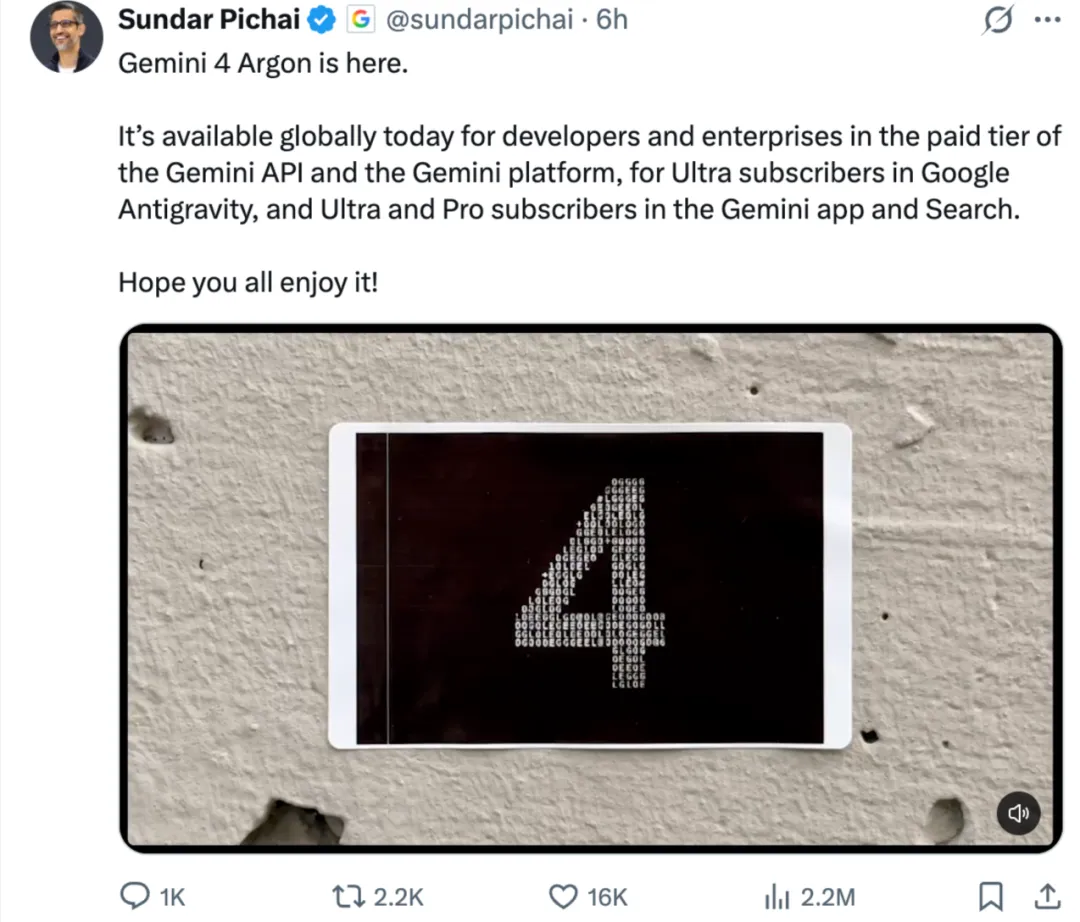
Currently, the model is available to developers and enterprise users worldwide through a paid version of the Gemini API and the Gemini Platform; at the same time, Ultra subscribers to Google Antigravity and Ultra、Pro subscribers in Gemini applications and searches can also experience the model.
We've been working on Chrome for weeks and months.
Programming is the Gemini 4 Argon's ability to demonstrate this focus.
Google says that within the company, Argon has been widely used in complex software engineering tasks. Over the past few weeks, with the help of Antigravity, the team's code submission by Agent has grown by more than 35%, while code re-rolling has decreased by almost a third.
A typical example is Chrome.
Chromium has about 40 million lines of code, including about 6 million lines of code in a historical heritage directory that contains browser functionality.
The Chrome team has always wanted to separate the core webpage processing logic from the browser functional code so that the webpage can switch freely between the tag page, sidebar, and floating window without having to reload.
With the help of Argon, the team compiled several batches of code modifications, compressing months of reconstruction work to weeks, laying the foundation for the implementation of these functions.
In Google's open-source Agent Development Kit (ADK), Argon has also been shown to improve efficiency.
The engineers only provided Argon with a project rule document and a brief description of its objectives, requiring it to reduce framework costs while maintaining compatibility with existing applications.
Argon ran independently overnight, and the proposed optimization has now been incorporated into the open source project, reducing the memory session preparation time in long sessions by 40%, and increasing the input speed in cold starts by 21%.
In terms of model reasoning, Argon also helped the team optimize the Gemma 4 E2B.
In just a few days, the team achieved an end-to-end reasoning acceleration of 2.85 times on the A100 GPU, increasing throughput from about 379 000 tokens per second to more than 108 000 tokens, while keeping the output tokens completely consistent.
In addition to underlying engineering, Argon has also been improved in visual programming.
Google has shown several cases completed through Antigravity, including using Bl.