“ The world model is moving from technical discussions to more specific industrial scenarios.
In early 2026, the company's Pre-A round of financing was successfully harvested, jointly sponsored by Beijing Future Science City Startup Investment Fund, Hangzhou Creative Group, Dongguan Creative Group, Sotheby's Capital, with the cumulative funding of nearly billion yuan to invest in capital for enterprise technology research and development and business expansion.
The same route is being acquired by an overseas giant.
Recently, AMD officially signed the final agreement to acquire World Labs for a full stock transaction valued at approximately $8.2 billion, expected to be completed by the end of 2026. Following the transaction, World Labs founder Li Feifei will join AMD as executive vice president and chief scientist, reporting directly to Suzhou.
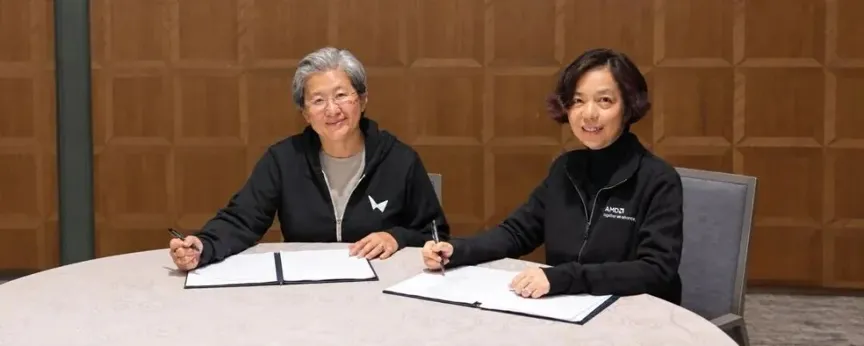
This is one of the biggest deals on the world model circuit this year. In a continuing bidding process, Physical AI, AMD directly bought the next Atlas, a space-intelligence company that was founded less than two years ago, from its launch in September of native text, images, video and 3D information, to its acquisition in July of the robot simulation company SceniX, which acquired World Labs for $8.2 billion, and the giants are pushing space intelligence, world models and robot learning to a more central position.
At home, different technological start-ups have emerged around the same question of how AI can obtain a stable representation of the physical world and use it for robotics.
Tencent is cutting in from space generation, group nuclear technology is cutting in from space data and simulation, and shadow intelligence is cutting in closer to the real world, first recording and reconstructing the real world, then training 4D world models, and finally entering robots and manufacturing sites.
The company is headquartered in Beijing's Future Science City.
01.
The real field, starting with data.
Over the past two years, one of the most common words in the physical intelligence industry has been data. Real-time machine acquisition, remote operation, human video, Internet video, simulation and data synthesis are rapidly expanding into the training system of robot models.
But as the data grows, the real impact on the model's performance is not only the number of hours it takes, but also what exactly the hour records, and how much state information it contains that the robot can actually use.
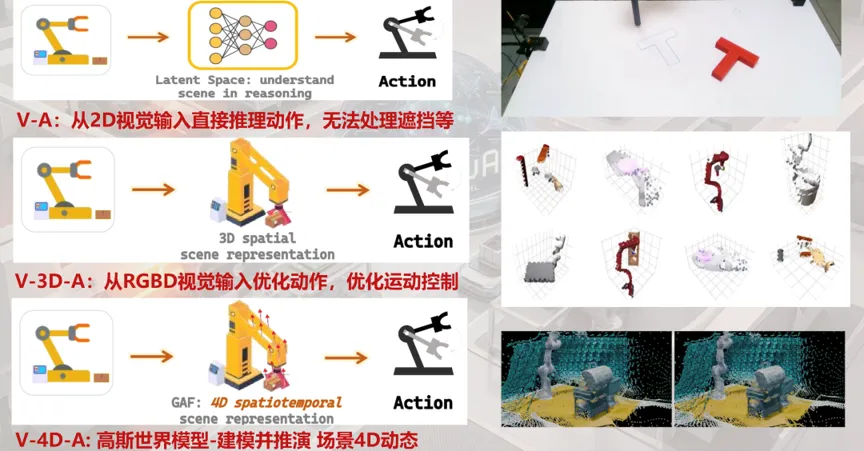
It doesn't directly use single-track video as the final data, but instead uses multiple cameras to simultaneously record the same scene from different directions, complete spatial alignment and dynamic reconstruction, restore different images to unified space, and preserve the continuous changes that occur over time.
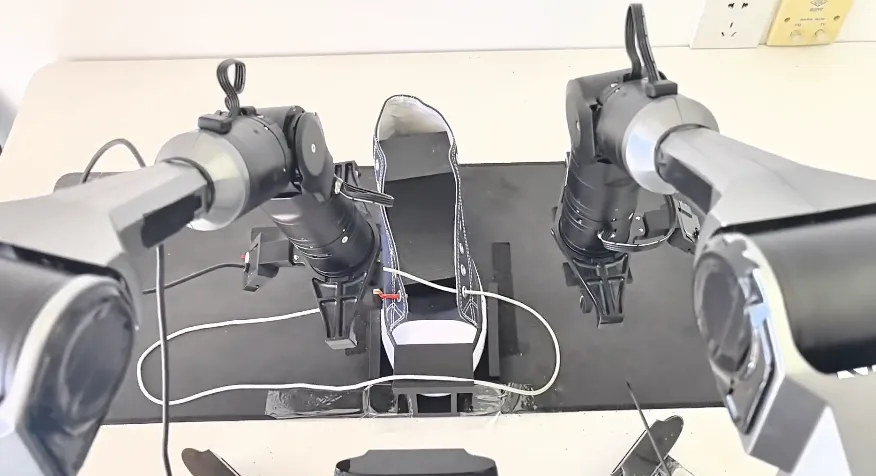
Similarly, a person picks up a shoe. Normal video can record how a person's hands move, where the shoe ends up going. Multipurpose 4D data can also further restore the shoes' position in space, the correspondence between different angles, the shading process, and how the state continuously changes over time.
Shadow Intelligence refers to this intermediate processing process as the hydrogen data drilling process. Removing the concept packaging, it is essentially a set of data engineering hydrogen cameras responsible for extracting raw materials, spatial reconstruction and models responsible for processing raw materials into time-space information that can be used to train world models.
Mechanical arms with "flexible body model" are being operated with shoelaces.
Its collection method is not entirely dependent on the robot's body. According to the obvious path, the camera can be placed directly around the workplace and around the real production environment. While the workers work normally, the system can continue to generate multi-faceted data, without requiring operators to wear helmets for long periods of time, and without necessarily requiring the occupation of robot-specific runtime data.
But the data is only the first step. Shimizu is currently trying to connect the whole chain: real scene collection→ 4D reconstruction→ world models→ action planning→ real machine execution → new data flow.
By the time we get here, 4D is not just a data format, it's starting to become a layer of interface between models and robots.
02.
From model to production line, the 4D world model enters the age of validation
The technological path to the end, or to return to the real scene. The first important industrial scene for the intelligent choice of shadows, is the manufacture of shoes.
Data released by the city of Jiangsu in April this year showed that shadow-body intelligent robots have entered the footwear industry and are gradually being verified on a large scale. Local reports also mention that its twin-armed robots can switch between shoes without requiring any artificial reprogramming.
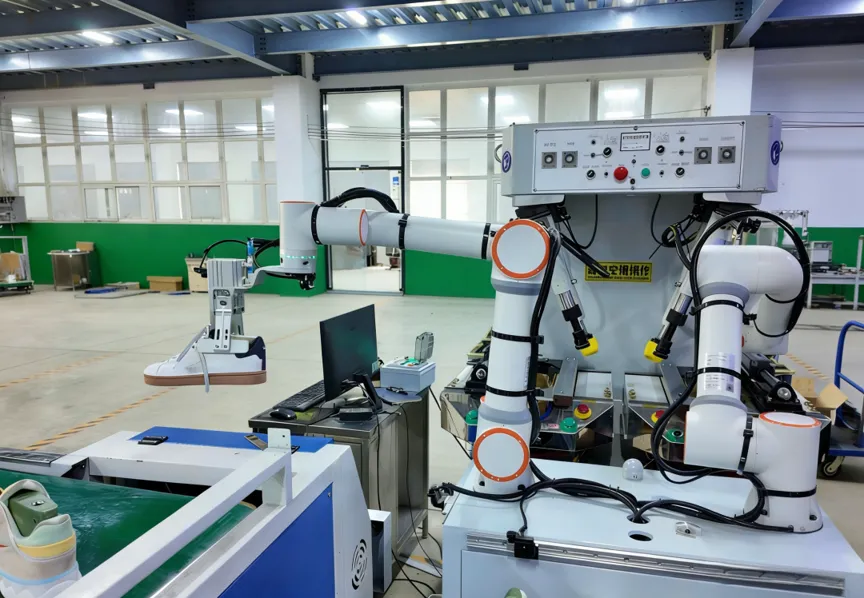
A month later, Shadow Intel released graphite robots, compressor robots, and other devices in Jinjiang. Public information showed that the devices adopted their self-developed 4D Gaussian world model, and combined dynamic compensation algorithms to process positions, gestures, and contact changes in real-world operations.
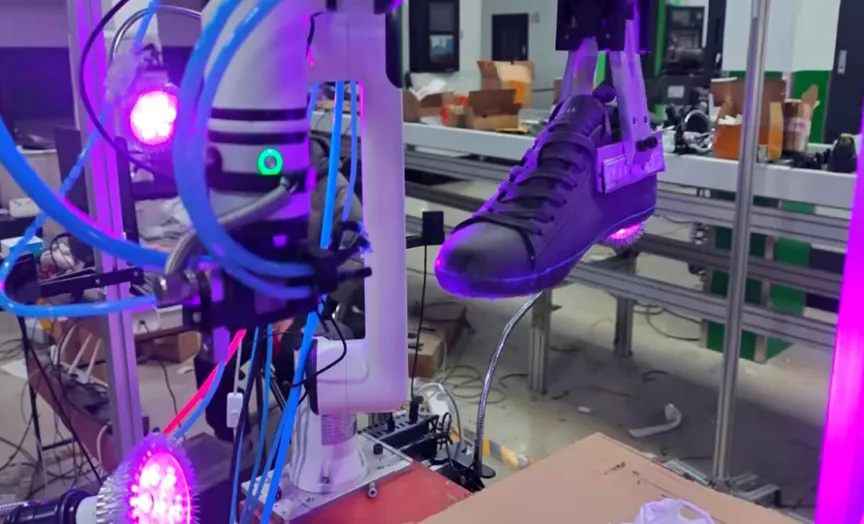
The reason why shoes are suitable for verifying the world's models is not because of the industry's traditional shoes, but because they are the typical double-flexibility shoes scene.
On the one hand, there is the flexibility of materials and objects. Different styles of shoes, footwear codes, materials correspond to different curves, shape changes and positioning is not completely fixed. On the other hand, there is the flexibility of ordering patterns.
Simply put, what the photographer really wants to verify is that the model can adjust the movements based on the real-time state of the shoes in front of him, rather than a trajectory.
According to current public data, the route has begun to enter the efficiency verification phase. According to public statements made by Zhengwei in a report by the Jinjiang Municipal Government, about 3000 pairs of shoes can be produced in 8-10 hours at the relevant production link; brush link, one equipment can process about 1000 pairs of shoes per day, corresponding to about 1.5 workers.
From a far-reaching perspective, if this capability can be replicated from shoe-making to clothing, flexible assembly, etc., it doesn't mean just a few robots. More importantly, it will prove one thing: the same world model can be replicated across products, across devices, and even across industries.
This is a crucial step in the 4D world model from technological creation to commercial creation.
03.
From a production line, rolling out a flying saucer
Factories have another layer of value for shadows. It's not just a landing scene, it's a place where real data continues to be generated.
Different styles of shoes, sizes, materials, positioning and abnormalities are constantly present in real production. As long as these data can be re-introduced into the training system, the production line will not only be the end of the application of the model, but will also become a new data input.
Thus, a more complete cycle began to form: deployment generates data, data continues to train models, and models reduce the cost of subsequent deployments and debugging.
The same underlying capabilities have also been replicated beyond the industry. At the 2026 World Trade Center, the company presented a set of 6 camera 4D live broadcasting schemes: multiple locations capturing the same site, then completing real-time space reconstruction with models, and generating new perspectives that the camera does not directly cover.
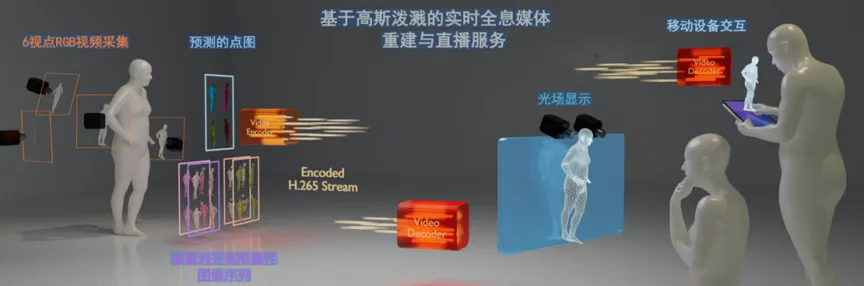
4D live broadcasting and shoe-making robots are targeted at different markets, but the underpinnings are replicated with multi-point acquisition, spatial alignment, dynamic rebuilding and 4D generation capabilities. This gives the technology a layer of added value and the same underpinning capabilities that can be replicated in different industries such as industrial hardware and digital content.
For a heavier 4D route in the early stages, this reuse could both improve technology utilization and lead to more real data inputs.
04.
The Future and the Word
$8.2 billion, which can be seen as a pricing frenzy about the world model, but it has not chosen a standard answer for the world model industry.
However, one thing has become increasingly clear: the value of a world model cannot ultimately be proven only by generative effects. It needs to go into simulation, it needs to go into training, and it needs to receive feedback in the real world.
The real need for shadow intelligence is to demonstrate that the chain from real 4D data, world models to robots can continue from one production line in Jinjiang to more factories and more flexible tasks.
A production line must be replicated into a network that relies not only on the engineering capabilities of the enterprise, but also on the industrial ecosystem underneath it.
As the core bearer of the northern product research and development and demonstration zone in Beijing's Yangtze-Yangtze region, Future Science City is focusing on developing robots, equipped with smart emerging markets. The region relies on university research resources, multi-industry investment funds and standardized industrial parks, building a collaborative empowerment model for Yangtze-yangtze-yangtze universities-funds-parks, providing early financing for robotic hard-tech projects, and supporting the entire chain of R&D to outcomes.
The region brings together a large number of innovative enterprises with deep body perception, robotic entities, and core components to realize technological innovation and dual-directional empowerment in industrial settings. Shadow intelligence is the representative of the industrial reality rooted in this industrial ecosystem, relying on the connectivity of local scientific research platforms and industrial funds to continuously explore the path of the world model from the laboratory to the landing economy.
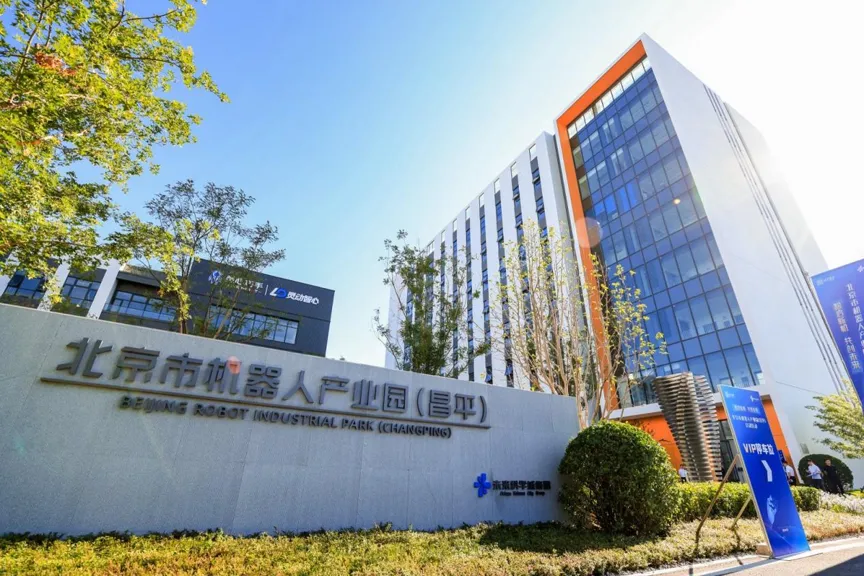
Located in the city of Beijing's robotics industrial park in the western district of the future City of Science, Shenzhen is the core entity carrier for the development of this industry. The total building size of the park is more than 300,000 square meters, and a period of 646,000 square meters has been put into use, building an industrial system with the robot as its core, core components, intelligent sensing systems and technology as its focus.
Public infrastructure such as the National Robot Testing Assessment Platform, Enterprise Testing Platform, Park Landing, fully matching the diverse demands of R&D, mid-testing and precision production of robotics enterprises, opening up industrial space and testing conditions for robotics in all segments, continuously bringing together upstream and downstream innovation subjects, opening up technology research, test certification, small-scale testing to industrial applications, and providing perfect industrial suites for innovative enterprises such as Shadow Intelligent with the ground for collaborative development.
Capital, parks, and production lines have all been put into the same coordinate system. AMD has spent $8.2 billion to push space intelligence back into focus, and the toughest part of the competition is who can really make robots understand the world and get it done.
If you would like to know more about policy or industrial cooperation, please contact:
Mr. Liu, telephone and e-mail: 1355296 1992