“ Liang Weiwei admitted that he doesn't understand robots and then invested $400 million?
Two months ago, DeepSeek was distributed with about $141 million as part of its IPO strategy. This investment is understood by many as a financial arrangement. After all, the initial public offering price of $845 on the first day of the IPO, according to the issuance price of $150.8, DeepSeek's investment account floated about $648 million.
But what happened two months later shows that Liang's intentions are far more than financial returns.
Recently, a number of media outlets reported that DeepSeek plans to lead a seed round of funding for Winverse AI, a robotics startup, totaling tens of millions of dollars, valued at about $400 million. The company was founded in just a few months, and its founder, Huang, is one of the authors of the paper Swin Transformer, and was formerly the head of Tencent's mixed multiple model large model.
A company that was founded just a few months ago, with unreleased products, unknown team size, and zero revenue, but the direction is clear enough for robots to understand instructions, AI models that handle real-world tasks, and are more likely to build brains.
Deepseek's move can be said to be a double bet on the clutch and the clutch direction, betting both on the technical judgment of the clutch and the central position of the clutch in the future physically intelligent landscape.
Looking back on the two-month deal, both Deepseek and Utrecht agreed to a three-way, deep collaboration between them to collaborate on the development and development of high-performance general robotics and AI models for Utrecht. Deepseek's investment took a 2.31% stake in Utrecht, with a 36-month lock-in period, a significant increase over the 12-month lock-in period of conventional warfare. This is more like a long-term tied-in technology marriage.
In addition to investments, relevant information suggests that Liang Wen has recently been in close contact with smart entrepreneurs. This high-frequency offline communication is more like a crowdfunding campaign targeting smart core talent.
Perhaps the breakthrough in physical intelligence lies not only in the evolution of algorithmic models, but also in a deep understanding of the complex logic of interaction in the physical world. He attempts to distinguish teams that truly have the ability to integrate across disciplines by engaging in deep, face-to-face conversations.
This pro-person stance reflects the caution and ambition of Deepseek in its intelligent layout. It is not reluctant to invest online, but strives to lock in the most potential technical paths with partners at an early stage, from the headset to the startup brain, Deepseek's path becoming clearer.
A man who admits he doesn't understand is entering a realm he doesn't understand with real gold and silver.
01.
It's so bitter, why is it so early?
To understand why DeepSeek is choosing to approach physical intelligence at this time, it is necessary to look at the AGI roadmap that Liu Wenqian has previously released.
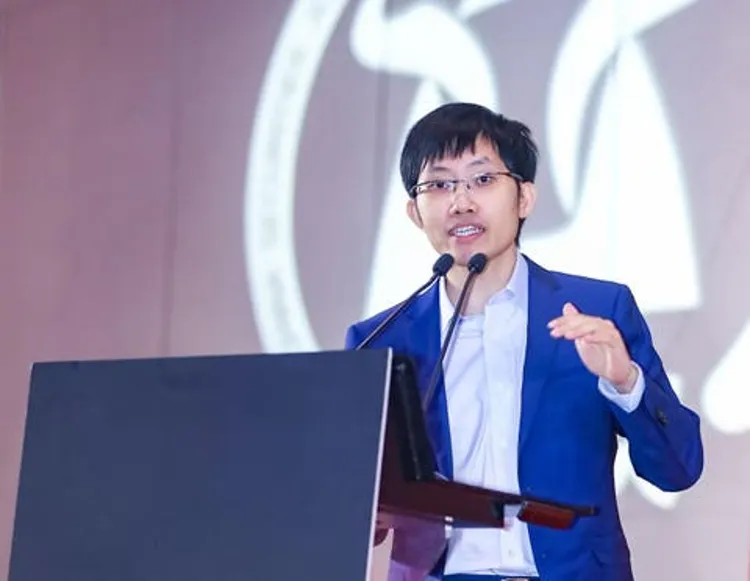
In that widely circulated investor exchange recording, Liang Weiwei gave the following order: language models, mind chains, agents, continuous learning, self-transformation, and ultimately, physical intelligence. He even went so far as to say that it would be a painful ordeal if the order were to be made physical intelligence first.
Then the question arises, why would a person who is physically intelligent at the end of the line move ahead in the middle of the road map?
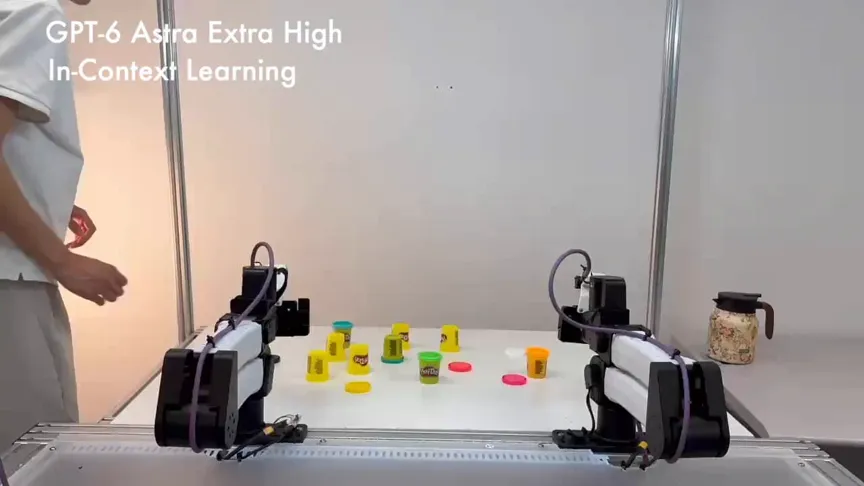
A key change came from external competition, the emergence of the GPT-6. It is known that the GPT-6 Astra's success rate in a robot-controlled mission was 95%, while the previous generation Fable 5.1's performance was only 40%.
Over the past two years, the core of big model competition has been parametric scale, training efficiency, and reasoning ability. But the industry is forming a new judgment that if AI can't understand the real world, it still exists at a distance from true intelligence.
A real intellectual leap may occur at the moment when a model interacts with the physical world, rather than just at the dimensions generated by the text.
At the same time, DeepSeek is also facing real-world pressure. A V4 technology report released in April 2026 shows that 10 of the nearly 300 people on the list who have marked the company have left the job, covering the four core technology main lines of baseline models, reasoning, OCR, multimodal. Liang Weiwei made it clear at an investor exchange that DeepSeek's core, the only irrevocable interest is to keep the team stable.
In April, Deepseek launched its first round of external financing and completed the round in late June, with total funding of about 510 billion yuan. At the same time, it was rumored that Deepseek would complete the 100 billion yuan financing.
Financing is not only about solving employee problems, but also about paving the way for an IPO. A company that is about to go public needs to answer the question that a secondary market will inevitably ask.
Where is your second growth curve after language modeling?
Physical intelligence is precisely the answer to the continuity dilemma of the AGI narrative and the trillion-dollar market fantasy space dilemma, providing both a completely new technological narrative and a more imaginative direction for core talent.
02.
OpenAI and its spin-off
Almost all articles discussing Chinese AI companies with a physically intelligent layout use OpenAI as a reference. But interpreting DeepSeek's input as a reference to OpenAI would be a big mistake.
What needs to be acknowledged is that OpenAI's physical action is indeed one of the decision variables in DeepSeek.
In June 2026, OpenAI announced a major expansion of its internal robotics division to officially fully enter the hardware racetrack. In September, Ottman made it clear for the first time on podcast that the company would self-develop humanoid robots while also developing special robots for data centers.
It's easy to see that OpenAI's strategy is vertical integration, from algorithms to hardware self-development.
The narrative value of this path is strong, but the cost is equally high, even for OpenAI. Execution components account for 40% to 60% of the material cost of human robots. OpenAI revealed to investors that it generated $6.7 billion in revenue in the second quarter of 2026, up 18% from the first quarter.
Deepseek's heavy-duty strategy is not practical for Deepseek. From large models to physically intelligent, Deepseek can't walk on OpenAI's footprints and won't walk on its footprints.
Looking at the large-scale model level, Liu Wenqian acknowledged that DeepSeek and GPT-6 had a gap in some capacity dimensions, which is an honest self-positioning. But the threat was never one-sided.
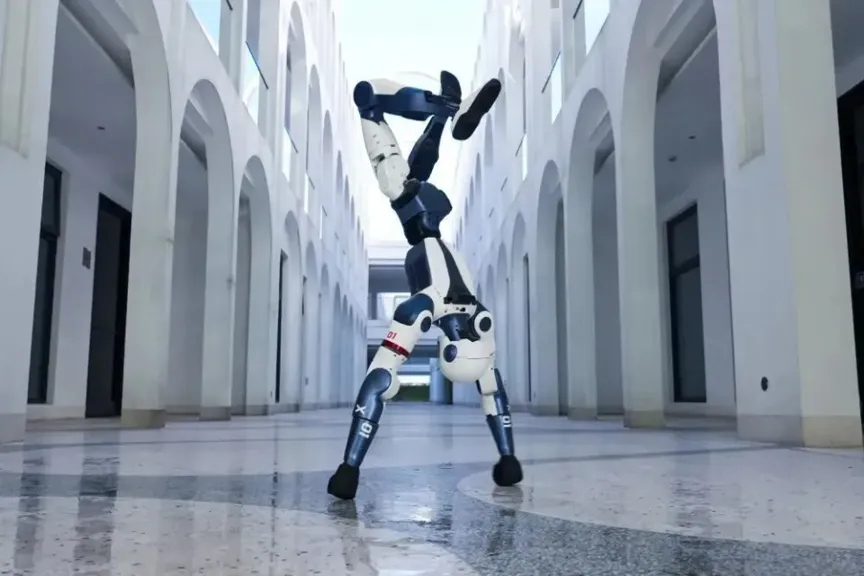
From a physical point of view, DeepSeek chose a different path. Investing in Nutritional Technology as a bodybuilder, investing in Winverse AI as a brain builder, they don't touch the institutional fabrication themselves, but through capital links and technical collaboration, they build an alliance of a bodybuilding model + bodybuilding.
The logic behind this unified layout makes it possible for professionals to do things professionally. U-turn technology has deep accumulation in mechanical engineering, motion control and mass production capabilities, Winverse AI has technical judgment in intelligent models, and DeepSeek provides the basics and training capabilities of large models.
This is reminiscent of the two models of the smartphone era, Apple's soft-hard drive and Google's Android ecosystem. OpenAI is making iPhone chips and DeepSeek is making Android chips, at least at this stage.
It is worth noting that the current layout of DeepSeek has not yet demonstrated systemic thinking at the data infrastructure level. Investing in Utrecht and Winverse AI is a daunting layout, but the competition for physical intelligence is fierce, with data, simulation, evaluation, deployment, and lack.
03.
Liang's third road junction
More importantly, what will DeepSeek do next on the Intelligent Track? Will it be a robot like OpenAI?
From the current signals, the answer tends to be uncompromising. DeepSeek's core capabilities are large model R&D and training efficiency optimization. To extend this capability to the field of physical intelligence, the most natural path is to build a body-smart base model pump and pump training infrastructure. This can both exploit DeepSeek's technical advantages and avoid falling into the mud of heavy asset manufacturing.
After all, self-developing hardware essentially means starting from scratch the supply chain, mass production, product control, delivery, a whole line of heavy assets after sales, and that's no different than rebuilding a company.
In addition, the body end is already a red sea, valuations are being squeezed. There are nearly 300 companies in the domestic body racing circuit, and the industry judges that the market could eventually accommodate only 20 tons to 30 tons.
So, in the field of physical intelligence, is the value of silicon-based model silicon big enough?
In the field of language modeling, the baseline model is at the core of the value chain. OpenAI, Anthropic, DeepSeek itself are all based on the baseline model. However, in the field of physical intelligence, the value of the baseline model may be diluted.
Tesla's FSD model cannot run directly on a Jupiter robot, nor can a Jupiter model run directly on an Optimus.
This means that if DeepSeek were to build a baseline model of physical intelligence, it might need to prove that this baseline has cross-bodied universality. This is precisely one of the most unresolved problems in the field of physical intelligence today.
The two technological routes of the VLA model and the World Model are moving in parallel, but the merger of the two is just beginning. VLA is responsible for rapid reactive control, World Model Processing is a slow decision making process that requires reasoning and planning, and the collaborative architecture of the two is not yet typical.
DeepSeek's layout on a physically intelligent trajectory is essentially a judgment about what an AI company should and shouldn't do. OpenAI chooses to break down boundaries, from algorithms to hardware; DeepSeek chooses to stick to boundaries, and use capital and collaboration to bridge capability gaps.
There is no absolute right or wrong between the two options. However, it is worth noting that in the global competitive landscape of physical intelligence, Chinese companies focus on hardware manufacturing and landscaping, while U.S. companies focus on basic models and simulation platforms. DeepSeek could form a unique competitive advantage if it can effectively inject large model capabilities into China's hardware ecosystem.
But the premise of this path is that Liu Wenqian could find a technical answer to the hydrogen base model that crosses the general hydrogen core.
The time for Android to be smart has not yet come. But at least, DeepSeek has begun betting.