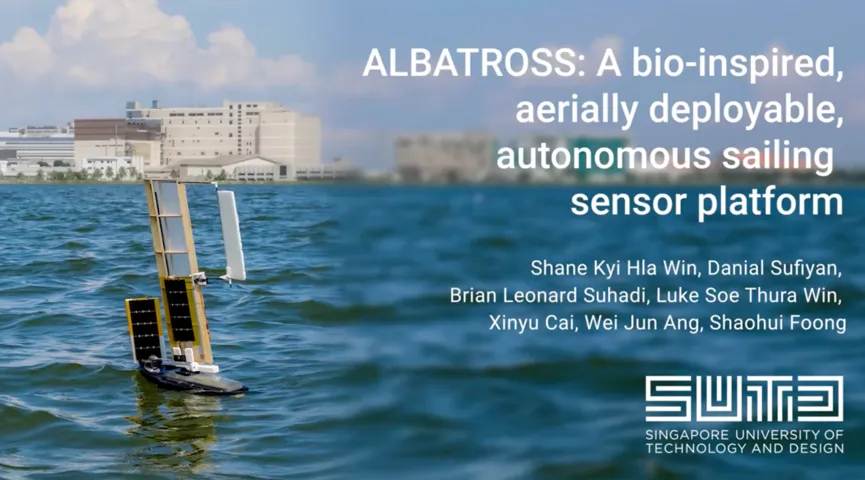
“ After the air launch, it spins into the water, passively supporting and navigating again.
If you want to get a robot to do environmental monitoring in remote waters, there are usually only two routes, either by boat or by flying a flag.
Boating is too slow. Although unmanned sailing ships can cruise for long periods of time, it may be cool to leave the shore or ship base and reach the target area. Air throwing is fast, but the impact of the landing of the instrument, or dismantling on the spot, or having to make a heavy and expensive anti-shock tank, is thrown out once used.
Is there a way to make it spin as lightly as a seed, straighten itself out of the water, and then move slowly to the target area like a sailboat?
This is what ALBATROSS (Airborne Landing and Buoyancy-Assisted Spinning Sailing Sensor) wants to do, which translates literally as an airborne landing with a float-assisted self-propelled navigation sensor.
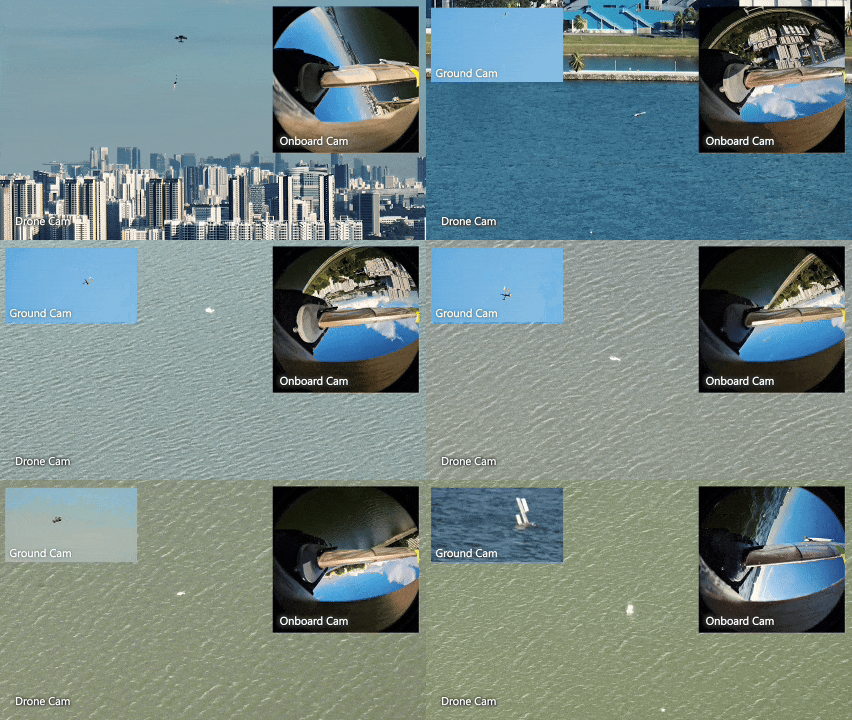
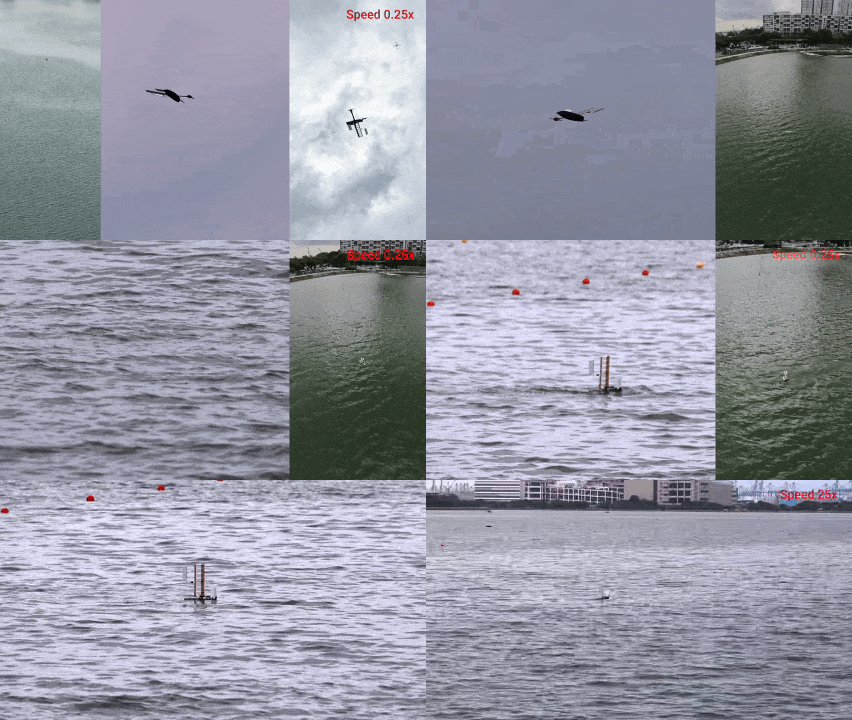
A team from the University of Technology and Design, Singapore, has recently developed and validated a hybrid robot that does not require complex mechanical rebuilding or additional aerial propulsion to complete the entire process from landing to navigation.
01.
One pair of wings, two jobs
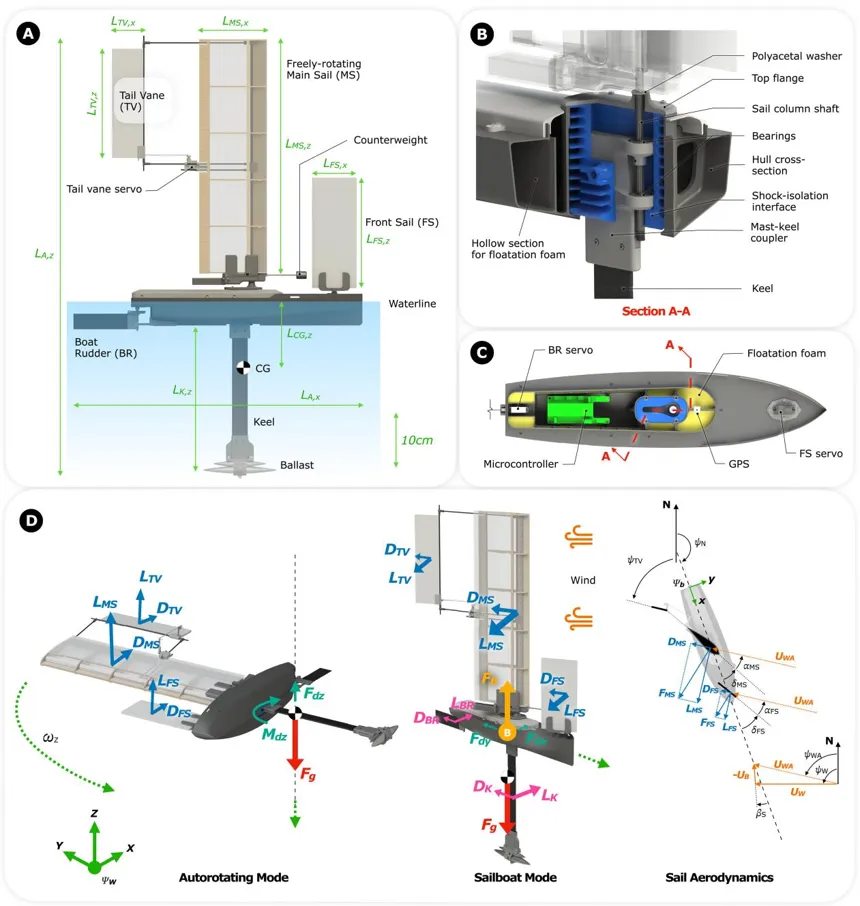
The core design of ALBATROSS is a pair of rigid winged sails.
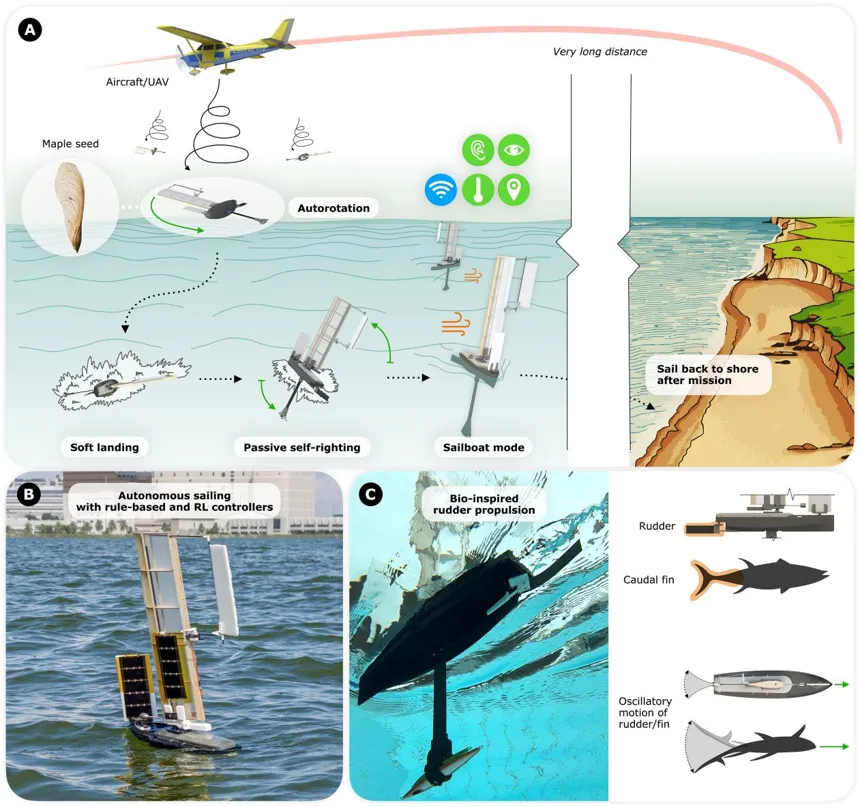
In the sky, they provide lifting power like helicopter wheels, allowing the entire platform to rotate steadily at about 7.36 meters per second; after landing, the same pair of wing sails instantly become the main sails and front sails of sails, propelled by wind.
In other words, the wings have to do two things: landing gear and engines.
This design spared the headache of traditional mixed-air and water robots, which often require folding wings, replacing propellers, adjusting pressures, and increasing mechanical complexity and weight when switching between air and water modes. ALBATROSS uses the same set of structures to meet the needs of both mediums simultaneously, relying not on deformation, but on geometry and gravity.
The center of gravity of the platform was deliberately pressed very low, along the distribution of the dragon bone, so that the center of rotation of the air dynamics is aligned with the dragon bone. This stabilizes the rotation at the descent, which can be steered passively after the water falls.
The entire robot has only three performers: a tail controller, a front sail controller, and a bow controller. Navigation uses only three sensors: GPS, hull panel, and main sail panel.
The concept of minimalism is the core principle behind the design.
02.
How did it come down from 150 meters in the air?
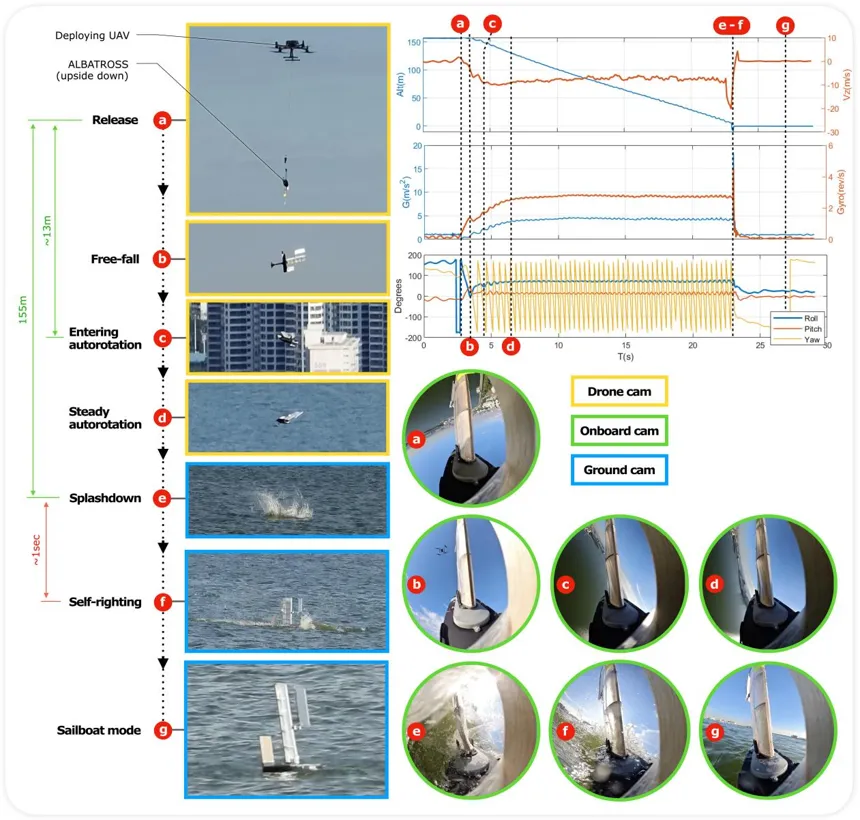
It relies not on resistance to wrestling but on rapidly turning the free-falling body into a stable rotation.
The team used a DJI Matrice 350 drone to release the ALBATROSS S-type prototype to a height of 50 meters. The release platform was reversed, but was soon able to trigger the airflow through a short free fall and into steady rotation.
Test data showed a steady-state drop rate of about 7.36±1.72 meters per second and a rotation rate of about 2.75 turns per second.
In contrast, the research team estimated that a sailboat with a geometrically similar but not self-propelled design could reach a speed of about 31 meters per second if it fell directly, and that the impact power would be about 18.5 times that of the self-propelled descent mode.
This digital gap indicates that rotation is not a maneuver, but the key to making a jet-jet flywheel feasible. It turns a hard landing into a controllable soft landing.
03.
When it's not windy, they push themselves by the tail of the shark.
The biggest enemy of sailing ships is the lack of wind, or the turning of the wind towards difficulty.
Its hulls are not simply used for turning, but instead oscillate horizontally like a fish's tail, producing additional thrust. This design allows the robot to move at low wind speeds and even close to windless conditions, while also helping to complete the reverse turning.
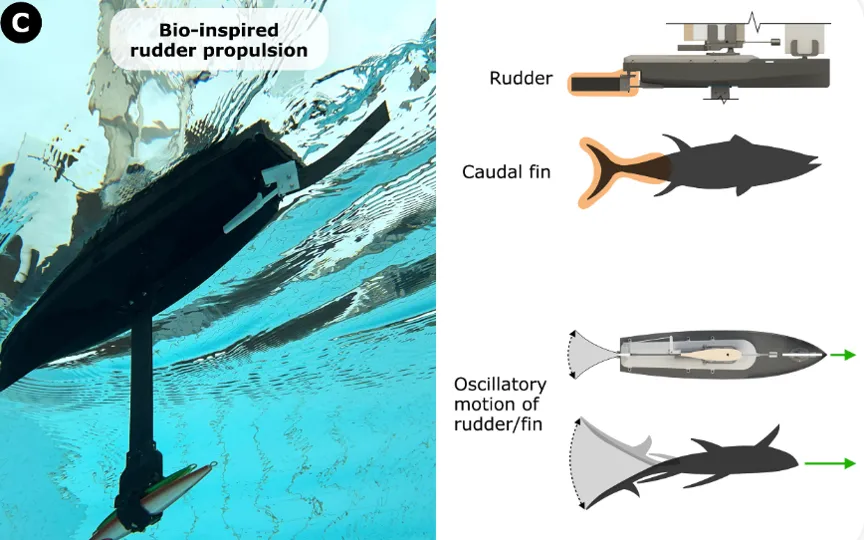
According to the paper data, the platform can move forward at a speed of about 0.38 meters per second with an average power consumption of 2.7 watts. At wind speeds of 4 meters per second, the L-type platform reaches a peak speed of 0.82 meters per second in horizontal and near-wind navigation, with an average power consumption of 3.98 watts, and the peak power consumption of 7.97 watts when the cylinder is rolled as an auxiliary torque.
In terms of control, the research team used two approaches: one is a controller based on traditional navigation rules, and the other is a controller trained with reinforcement learning. In simulation, the RL controller performs similarly to RB and achieves smoother movement in field trials.
04.
Where can it go and where can it not go?
How do you navigate?
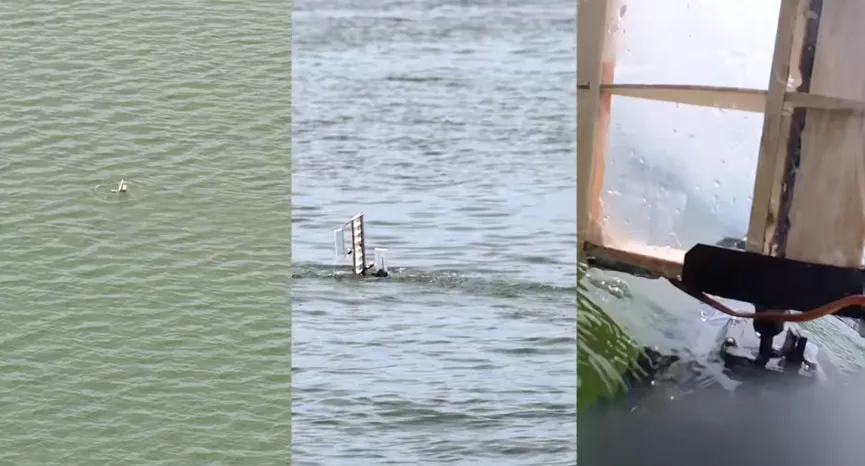
The research team conducted a large number of tests in Singapore's Ayurveda and Bandhan Reservoirs. The application scenarios are clear, environmental monitoring, disaster response, and marine science observations.
For example, tracking algae flooding, monitoring of marine litter, monitoring of marine wildlife, sustainable fisheries monitoring, oil spill emergency response, rapid ocean observation after a typhoon or undersea earthquake. All these scenarios have in common the sudden, remote locations and the need to quickly put the sensors in place.
An autonomous navigation experiment conducted in a local reservoir. A) The trajectory of an ALBATROSS L-type sailing vessel along an octagonal path, with colour representing its speed. A small arrow mapped at constant intervals of time indicates the instantaneous direction and direction of the sail. The black part of the trajectory indicates when the torque movements are used to achieve a turn and increase the thrust forward. The chart also shows the direction of the sail in favour of wind travel, transverse navigation and high wind travel. B) The coordinates of land speed and angles of view are mapped simultaneously.
The advantage of ALBATROSS is that it can launch large volumes of aircraft or drones into target waters, and then navigate autonomously with wind power, collecting data for long periods of time. It is faster to respond than traditional drones, more durable than single-shot landing instruments, and more flexible than platforms that require shore-based deployment.
However, it is not yet a sea-level product. The paper also admits the limitations, the current sample is mainly used for conceptual verification, small in size, light in structure, unsuitable for strong currents, strong winds, and tidal waves; sliding range is restricted by rotational and navigational design weights; rotational behavior is more sensitive to gravitational deflection.
Future generations will need to work hard on structural reinforcement, corrosion-resistant materials, and scale-up to move toward real marine deployment.
05.
Imagine the future of flying sailing robots
The value of ALBATROSS lies not only in its ability to fly by itself.
What it really demonstrates is a set of design philosophies that use passive dynamics and multifunctional structures to minimize the number of executors and sensors while completing cross-medium movement.
The research team summarized several general design principles: low-pressure achievement of passive steady rotation and self-support; rigid wing sails simultaneously assume the functions of aerodynamic lifting and propulsion sails; deployment in the air as a steam instantaneous delivery mechanism instead of continuous flight; and biomimicry to compensate for poor mobility in low-wind environments.
If this idea is implemented and gradually matured, in the future we may see a multitude of low-cost marine sensors being flown to the surface, navigated, networked, and retransmitted.
Thus, ALBATROSS is more like a starting point. It validates the feasibility of a jet-launched sailing robot jet and provides direction for future fast, low-cost, airborne marine sensing robots.