On the EmbodiedBench, the average success rate of using GPT-5.5 directly is 56.9%; the model parameter is constant, only allowing the system around it to continue to evolve, and this figure becomes 72.7%.
The difference comes from outside the model: what information is sent to the model, what experiences are retained, and how decisions are turned into the robot's physical movements.
Large-scale models have shifted their roles in robotic systems: from high-level planners to Code-as-Policy, which combines perception with native-language control in the decision-making core. However, most of the systems around the model remain manually built and fixed after deployment. Work already done tends to improve only one component in memory, skills, and interaction harness; the issues exposed in execution are mostly only used for evaluation or artificial modeling, and the same weaknesses are repeated over and over again.
This raises a question: can a physically intelligent person take their entire system as a strategy, diagnose where the system limits behavior, and then evolve from the corresponding part of the physical experience?
A team of researchers from institutions such as the South China University of Technology, Beijing Aerospace University, National University of Singapore, Shanghai University of Transportation, and Cloud Butterfly Technology proposed RoboFoundry and positioned it as the first to formalize the intelligent system itself as a "Self-Evolving System-as-Policy" (SELF-Evolving System-as-Policy): the baseline model is frozen, evolution occurs at the interface of the context system around the model, the execution of the skill system, and the replication between different robots through a shared layer of semantic interfaces.
In the experiment, RoboFoundry upgraded all five base models on the EmbodiedBench; on the long-range memory benchmark RoboMemArena, the mission success rate was at least 39.0% higher than all baselines; in the LIBERO-PRO disruption test, it was 243.8 tons 679.7% higher than CaP-Agent0.
RoboFoundry: System-as-Policy Evolution for Self-Learning Embodied Agents
Link to the paper:https://arxiv.org/abs/2609.32862
The main page of the project:
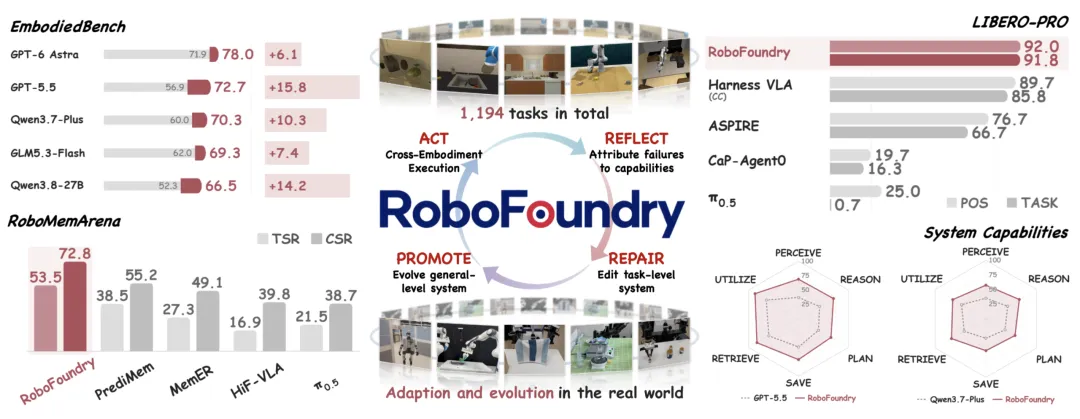
Figure 1: RoboFoundry overview. Contains the evolutionary closure of the pump execution, pump reflection, pump repair, pump promotion; the results of the three benchmarks, as well as the six system capabilities before and after access, are significantly improved.
Models are frozen, systems evolve:
It's like maintaining a code library.
RoboFoundry does not update the parameters of the baseline model, and is optimized by the system that supports the model to complete tasks. The system exists in file form, where the model can be viewed with cat, grep, and modified with add, modify, delete. The system is divided into two layers: the task-level system that serves the current task, and the general system that is continuously maintained across tasks and entities.
Evolution performs two layers of internal and external cycling: internal cycle execution tasks, recording execution trajectories; and external cycle modification based on the trajectory and subsequent execution tests.
Context: Manage the active context of the current cycle and the memory of the file system across the current cycle, deciding what to remember, what to take and how to use using SAVE, RETRIEVE, UTILIZE.
Skills: From atomic skills, to pumps moving, pumps grabbing, pumps placing, and so on, to failed tree recovery. When execution fails, the system replans from a still-effective state.
Under the two evolutionary faces, there is a layer of shared semantic interfaces. The semantic layer only deals with cross-core shared task logic; the execution layer adapts decisions to specific robots, the back end of which can be frozen VLAs (such as π0.5), encoded functions generated by intelligent agents, or visual motion interfaces such as CuRobo. Because of the evolutionary role on the semantic side, systems that evolve on one robot can replicate one set of execution adaptations on another robot, or can access different base models.
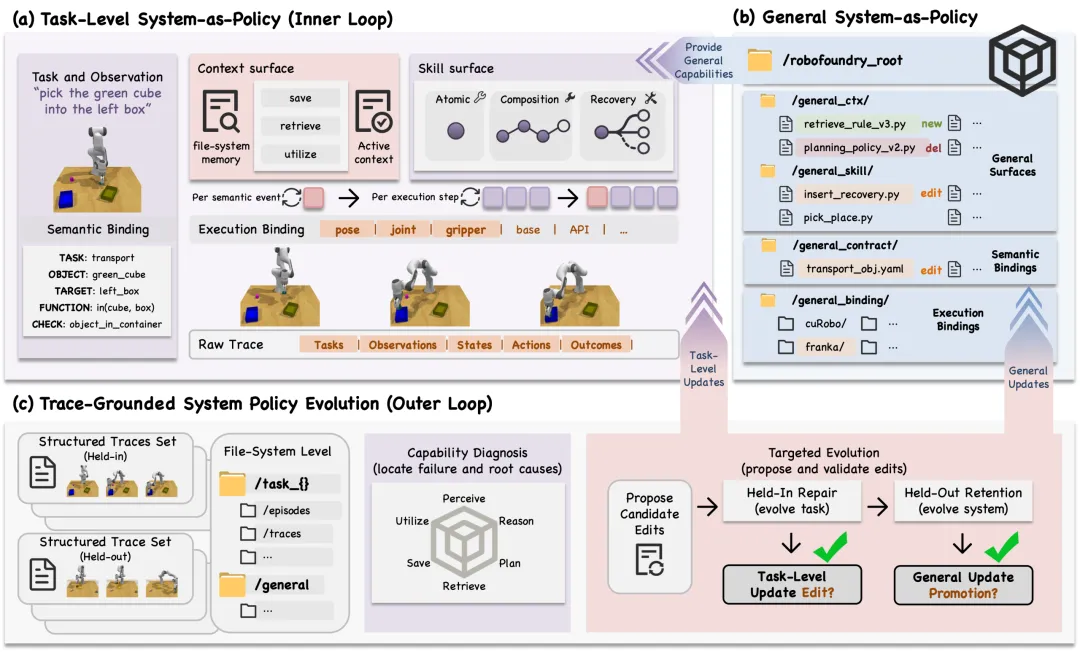
Figure 2: RoboFoundry method framework. (a) Internal loop execution and trajectory creation; (b) General System in the form of file directories, providing replicable rules and skills; (c) External loop diagnostics capability gaps: modification of the current task to update the task-level system that can repair the task, further maintenance of the test modification on other tasks, and advancement to the General System.
There is a diagnostic and verified evolutionary closure.
Instead of an unbounded self-rewrite
Failure or inefficiency in execution is first attributed to one of six capacities: perception, reasoning, planning, decision-making, preservation, retrieval, memory management. The system makes modifications only in the corresponding evolutionary aspect; modifications are submitted only when the current task fails to be corrected.
RoboFoundry first transforms the successful modification of the abstract into a candidate rule, then finds a repair record of similar capability gaps in other tasks, returns these tasks to the state prior to the repair, and allows the system that applies the candidate rule to re-give the repair program. Subsequently, the system itself acts as a verifier, comparing the new program to the actual repair that worked at the time. Only the average score is not lower than the original repair, and the candidate rules are written into the general system.
Figure 3 is an example of an evolutionary process, in which the baseline model for the EB-Habitat spatial relationship subset is GPT-5.5, with a total of six candidate assessments:
The first three amendments were submitted, and the Held-in success rate increased from 21.4% to 50.0%;
Only 42.9% of the next two candidates were not accepted;
The last candidate pushed the success rate to 78.0%, and passed the held-out check and was marked as promoted to the General System.
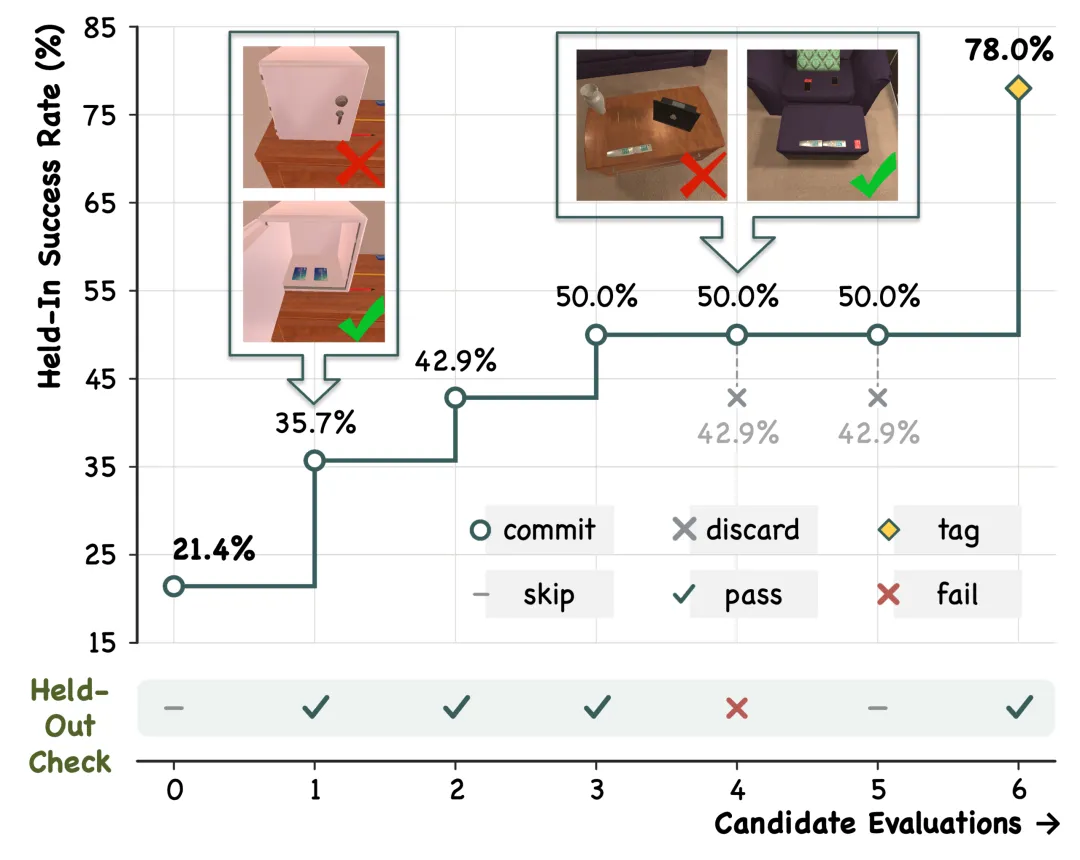
Figure 3: An evolutionary trajectory in the EB-Habitat space-relationship subset (GPT-5.5), below are the results of the hold-out checks of each candidate.
The modification accepted will be a specific modification in the document. For example, in order to move all the cleaners in the sink to the couch, the instructions, the system rules are rewritten as:
- Each plan should include no more than 20 actions.+ Prefer one action; at most two when both are currently supported.+ After Navigation, observe before Pick/Place/Open/Close.+ Trust environment feedback over visual appearance for proximity.+ After a not-near Pick failure, navigate before retrying.
The new rules do not contain any specific objects, such as cleaners, sinks, sofas, and so on, so that they can be shared across tasks. The entire evolutionary process is recorded in the.robofoundry/directory, called the Evolution Ledger, which can be viewed backwards.
All five base models have been upgraded.
Clearly narrowing the gap between bases
The EmbodiedBench contains 1,128 tasks in four environments, covering high-level semantic planning and execution of underlying actions. All settings use the same task flow and interaction budget, evolving from the first counting round, with each trajectory in the evolution process scored.
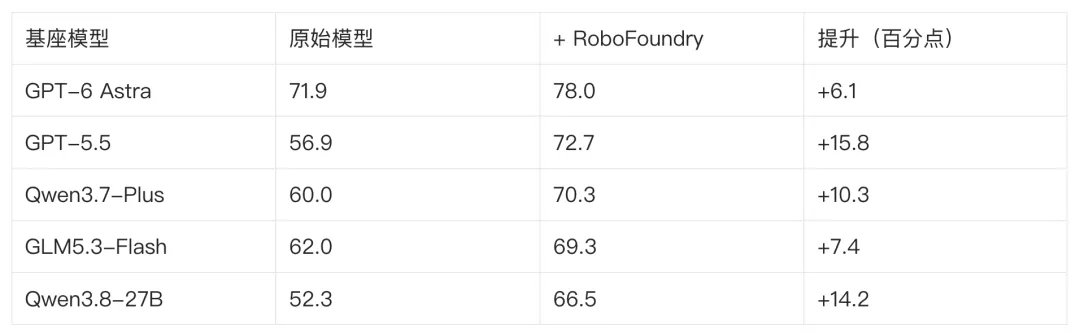
Note: EmbodiedBench has an average success rate of 4% for all four environments; the enhancements are consistent with Figure 1 of the paper; as a result, the individual enhancements may differ by 0.1 from the two columns directly.
GPT-5.5 is up 27.8% relative to GPT-5.5 which is 72.7% higher than GPT-6 Astra which is 71.9% higher.
The gap between the bases has narrowed significantly. The maximum gap between the original five bases was 19.6 percentage points, which narrowed to about 11.5 percentage points after RoboFoundry joined.
The strongest models also benefited, with the GPT-6 Astra up 8.5% relative.
The dilution experiment showed that general evolution was key: with Qwen 3.7-Plus as the baseline, the full version was 11.2% higher relative to the Lite version, which retained only the task-level modification. After expanding the context budget from 4K to 16K, the results of the original model increased and decreased; in the 16K setting, RoboFoundry still allowed the four baselines involved in the test to improve their respective baselines by 7.9% and 13.1% respectively.
Long-term memory and distribution bias:
Evolution is more than just a cue.
RoboMemArena is a long-range memory benchmark with 26 tasks in the transportation, shading, counting, and sequencing quadrants. Based on Qwen3.7-Plus, RoboFoundry has a 53.5% mission success rate (TSR) and a 72.8% cumulative success rate (CSR), all four tasks leading the way. Its TSR is at least 39.0% higher than all baselines, compared to the object that includes PrediMem with Qwen's 3-VL-8B-Instruct memory management.
On this benchmark, evolutionary modification is not merely a prompter, but also a determination of what state the mouse retains, what evidence it retrieves, and how to present the mechanism to the model mouse. For example, converting the task's progress into the current sub-goal, and clearly stating that the mouse's attempted instructions cannot serve as evidence of physical success.
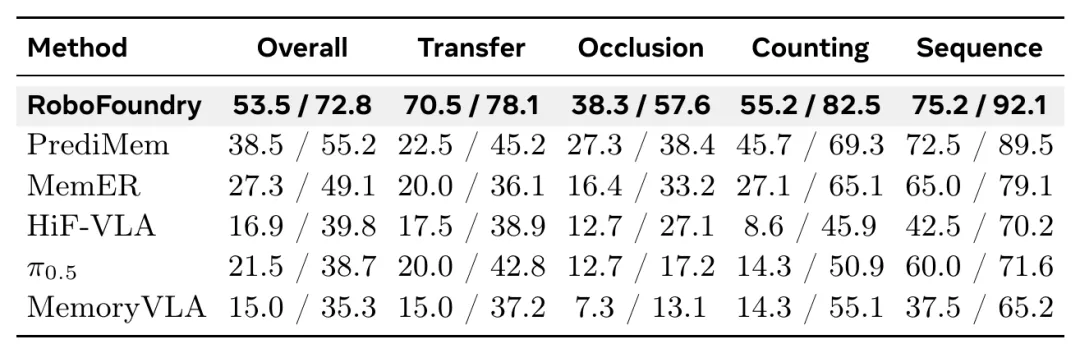
Figure 4: RoboMemArena long-term memory results, each with a TSR/CSR ((%)).
LIBERO-PRO is used to test the robustness of the system under changes in object layout and task setting. In methods that do not use privileged object positions, RoboFoundry has the highest average success rate, at 91.9%, Harness VLA (CC) at 87.8%; it is 243.8% higher than CaP-Agent0 and 679.7% higher than its relative value.
Post-evolutionary systems also divide improvements into two time scales: replicable combined skills that are retained in a shared system for a long time; and recovery logic that is temporarily generated in an experiment that remains in the experiment.
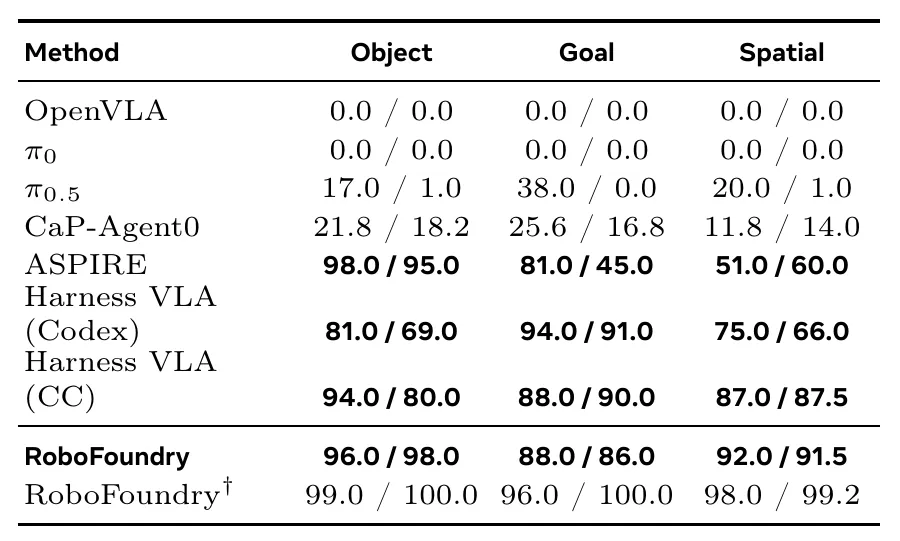
Figure 5: LIBERO-PRO disruption test results, with the success rate for each position disruption/mission disruption (%) † showing the position of the privileged object.
Zero-sample migration on the real machine, marginal evolution
The real question is whether the universal RoboFoundry system can migrate to a physical robot and continue to evolve after deployment. In the experiment, RoboFoundry uses GPT-5.5 as the base model, with π0.5 as the back end of the operation; to ensure fairness, RoboFoundry uses the same fine-tuned checkpoint as the separately used π0.5 on the corresponding task.
The first trial required both small-to-large sorting and precise insertion. The first trial ended in a fall, with the system joining the target check (skill-facing modification); the second trial modified the belt-facing insertion, but the execution lost the progress of the task, the system added the progress tracking (contextual modification) to allow the execution to continue from the last completed subtask; the third was complete. The final success rate of RoboFoundry was 70%, and the individual use of π0.5 was 30%.
Folding towels: Zero sample migration. Folding towel skills evolved only on blue towels, which were then directly applied to green, pink towels with different appearances, geometric shapes and materials. In the absence of additional adaptations, RoboFoundry's success rate was more than 80%, whileπ0.5 was less than 20%, requiring further refinement.
On the G1 humanoid robot, RoboFoundry uses a shared semantic interface to find drinking water. This instruction corresponds to a drinking water machine identified in an RGB image and is then converted into a navigation action by the body-related executive binding.
Chemical experiments: the length of the cross-submission depends. The six interdependent sub-tasks are: insert the funnel into the cylinder, place the measuring plate, flatten the skin, add powder with a medicine key, drop the medicine key back, pour the powder into the cylinder. RoboFoundry uses the task state record to sequence the entire process, and the final drop-off steps will read the funnel written before several subtasks to guide the execution; π0.5 used alone is difficult to complete the entire process.
Figure 6: Machine evolution and migration. (a) Priority and progress tracking is added to the suite of tasks; (b) Towel skill is transferred to an unseen towel; (c) Semantic navigation on the UZK G1.
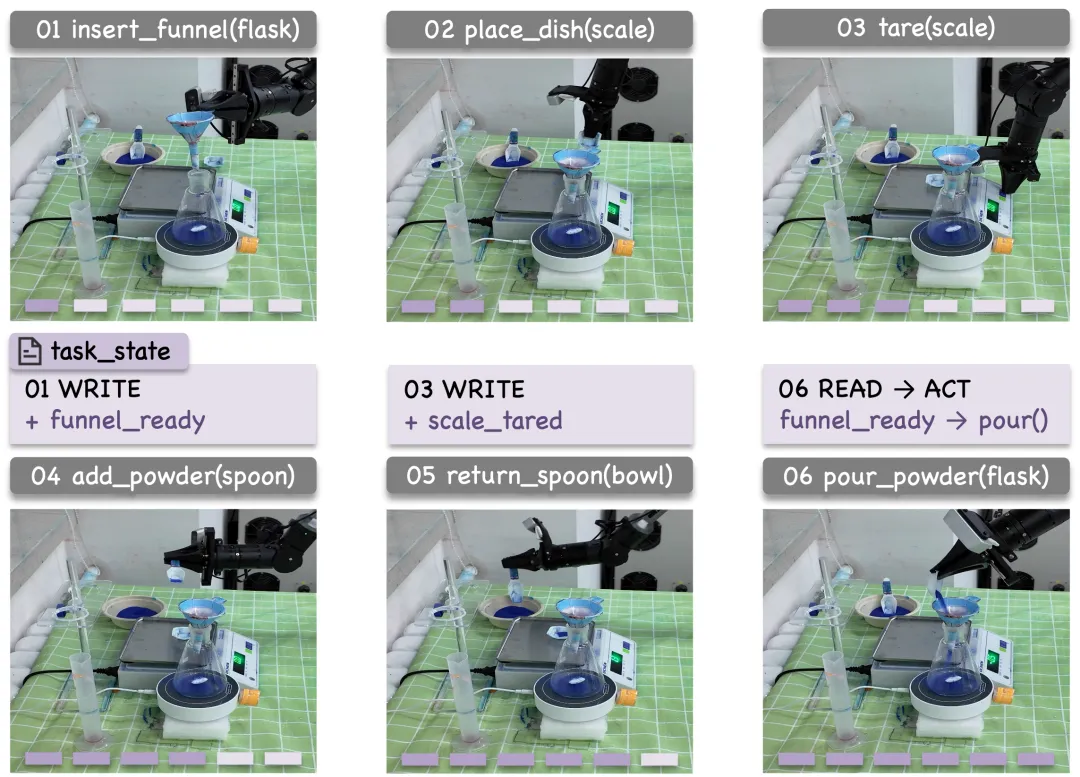
Figure 7: In a long-range chemical experiment, the mission state records six interdependent subtasks.
What is the meaning of this verse?
It's not like I don't know what I'm doing.
To make the model's systems stronger and stronger
From language model planning, to execution of code as a strategy, to the evolution of systems as a strategy, the role of the big model in the body system has been shifting upwards. RoboFoundry gives a specific approach: the baseline model remains unchanged, which part of the execution trajectory determines the system needs to be modified; each modification must first verify the ability to correct failures on the current task, and only effective improvements on similar capability gaps in other tasks can be validated as general capabilities, service follow-up tasks.
Information from the author
The study was carried out in collaboration with researchers from the South China University of Technology, Beijing Aerospace University, National University of Singapore, Cloud Butterfly Technology and Shanghai University of Transportation. The first co-author was Liang Yixin (South China University of Technology, Ph.D.) and Liu Liu (Beijing Aerospace University, Ph.D.).