
It's the first time in the history of the world.
Amazon has just unveiled an AI acquisition worth about $7 billion!
On October 11, the Wall Street Journal quoted people familiar with the matter as saying that Amazon was acquiring the AI startup Decart, with a potential deal valued at about $7 billion.

The company's main goal is to help AI use the chips of different manufacturers, and to make more use of the computing power of these chips.
Before that, Anthropic had been working on it.
Bloomberg reported in September that the two sides had been discussing a deal worth about $6 billion, but Anthropic decided not to proceed after a thorough investigation.
Anthropic has just left and Amazon is back at the negotiating table.
It is worth noting that the company was valued at nearly $4 billion when Invisalign invested in Decart in May.
In just a few months, the value of potential acquisitions has risen to about $7 billion.

A company that "changes chips" with AI, why are these AI giants connected?
Because buying a chip is just the first bill.
After buying it back, how much work can be done, how much money can be spent to complete the work, and how well you can calculate it.
Decart's goal is to make the model run faster and more cost-effectively with different chips.
AI switches the chipsIt's just a matter of software.We talk to AI regularly, and it also allows us to see data, write code, and process files.
The calculations behind these tasks must be done on a chip.
Invidia has a GPU, Google has a TPU, and Amazon has a Trainium. The hardware architecture of different chips varies, and models have to be adapted to run efficiently.
A program that runs smoothly on Intel's chips often has to be adjusted and optimized to replace Amazon's chips with new hardware.
Therefore, choosing a chip for AI requires a transfer account:
How much time will it take to change the code, how fast and how cheap will it be to change the model?
Decart's DOS (Decart Optimization Stack) is a set of software that helps models adapt to different chips and improve performance.
According to the official press release, DOS supports hardware such as Intel's GPU, Google's TPU, and Amazon's Trainium, and is used for model training and reasoning.
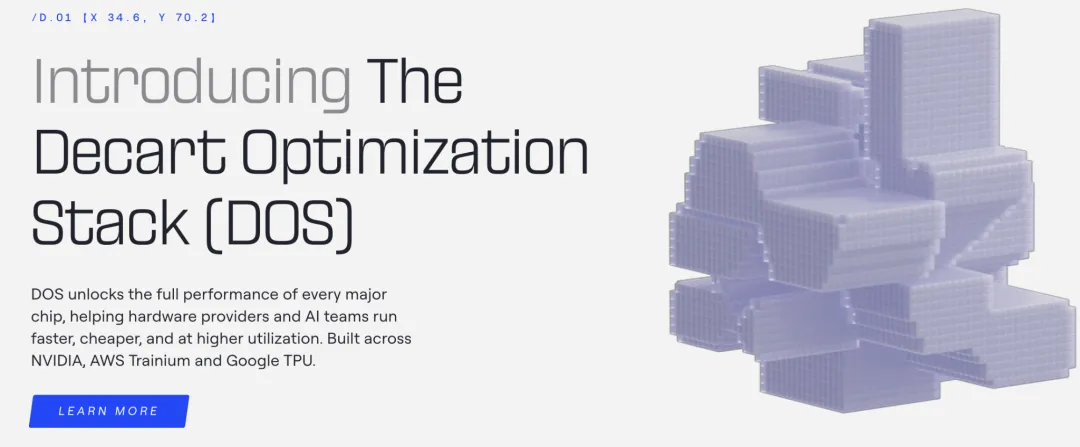
DOS provides training and reasoning optimization for multiple AI chips
It will target the characteristics of the chip, adjust the way the model works, optimize the underlying calculations, make the chip less waiting and more efficient calculations.
In this way, the same hardware has the opportunity to run faster and save money.
Amazon already has its own Trainium chip, and the ability of Decart could help it win more customers.
If the developers were able to spend less effort on the adaptation, the model would run faster and more cost-effectively, there's another reason for choosing Trainium.
The two sides have already started working together.
In May, Decart listed Amazon as a strategic customer in an official announcement and revealed that its video model Lucy 2 is already running on Trainium 3.
In the same round of financing, Invisalign also became a new investor in Decart.
The more intense the chip competition, the more manufacturers need to answer a question: Why are customers willing to use my chip?
Making it easier for models to fit into different chips and run on them faster and more cost-effectively is where Decart plays a role.
Real-time videoSlow down and get dressed.Decart has also created an AI model that enables them to run faster and save more money.
Among them, Lucy can modify video images in real time, while Oasis can generate a virtual environment that changes with the operation.
According to the official announcement, Lucy 2.5 supports changing characters, changing clothes, adjusting backgrounds, adding special effects, or even removing objects through text or reference images while playing video.
It's a great way to get a feel for the film, and it's a great way to get it done.
Officially, the Lucy 2.5 supports 1080p resolution, with real-time generation of 30 tons per second.
Changing the background during live broadcasting, trying to wear clothes on the lens, and giving the effect of the images being shot, can be an application of this type of technology.

Lucy 2.5 real-time video editing demonstration: changing character shapes, virtual dresses and dresses.
But to make people willing to use it, the image must follow the movement and the effect must remain stable.
This requires AI to receive the video, modify the image, and display the results in a timely manner. From input to processing, and then to display, any link slows down, causing users to feel delayed.
The official AWS customer page reveals the results of an early set of tests by Decart:
According to Decart co-founder and CEO Dean Leitersdorf, real-time video models on Trainium have a lithium throughput of up to four times that of controlled GPUs, and cost-effectiveness of up to two times that of delaying from 40 milliseconds to 10 milliseconds.
In this video test, the combination of the model and the chip resulted in an improvement in speed and cost.
Lucy focuses on real-time video editing, while Oasis uses AI to create a simulated world that can change with operation.
Decart's Oasis 3 is primarily aimed at autonomous driving.
It can be understood as a "virtual practice car park" for self-driving systems.
According to official reports, the vehicle turns, accelerates or brakes inside, and the surrounding picture changes as a result.
The system can also observe traffic conditions, practice and test driving from multiple synchronous camera perspectives.

Six road simulation scenarios created by Oasis 3 show driving images in different environments.
It's like playing a driving game: you hit the steering wheel and the road ahead changes in time.
The longer the practice time, the more images and calculations that need to be generated and completed. The more efficiently the software arranges these tasks, the more you have the opportunity to use the same budget, practice multiple scenarios, and do multiple rounds of testing.
From real-time video to virtual practice cars, AI needs to keep up with the operation and continuously provide feedback behind the scenes.
It is only by using the computing power of the chip that more AI functionality can be used more efficiently and at lower costs.
The Giant CalculatorCan users spend less?Speaking of AI, would you be willing to wait a little longer and spend a little bit less?
For example, can you create a video with a little bit less progress; can you spend the same money, can you change more details, can you try on more ideas; can real-time test suits, video special effects, can you keep up with the action?
The same chip can work more efficiently, and the cost of single-generation can be reduced. Manufacturers also have greater space reductions, increased use times, and more people can use it more often.
But if the manufacturer saves money, it doesn't mean you have to pay less. How much the product sells, how many times a month you use, is still up to the manufacturer.
As for whether the image is fluid, the effect is unstable, the quality of the model, and whether the network and equipment can keep up.
AI chips are competing, ranging from the performance of the hardware to the performance of the software.
For us, the value of this competition is reflected in each use: the results come faster, and when you want to press "re-test", you don't always have to re-count the time and cost.
AI is becoming more and more useful, more and more affordable, and this is the change we most want to see.