In an unknown corner, OpenClaw is updated again.
OpenClaw has just officially released v2026.10.1. According to official data, this update brings together the work of 402 contributors, involving 2425 PRs, 3055 submissions.
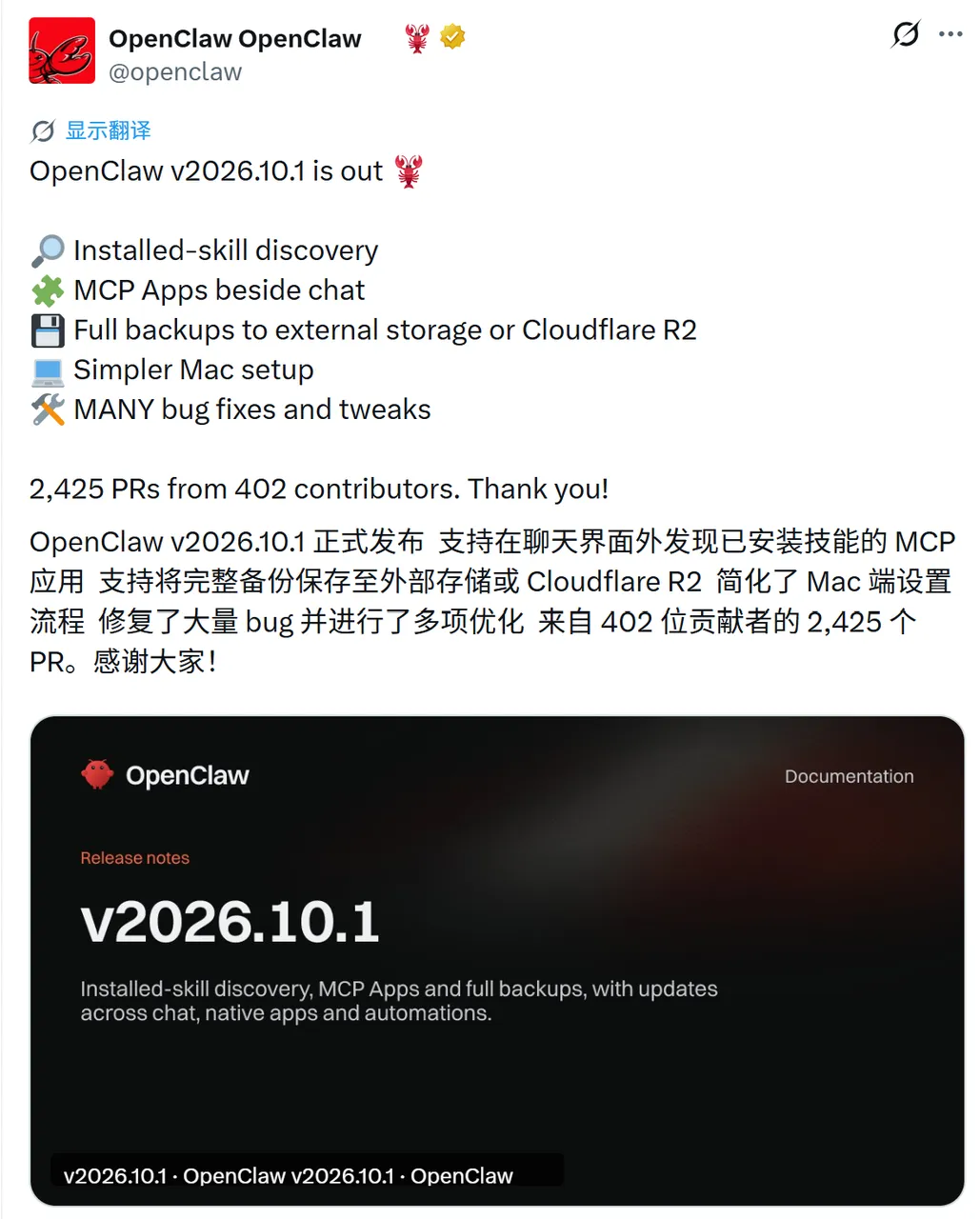
Updated documentation:
Two of the most notable features of the new feature are that the Agent can actively search for installed Skills and open interactive MCP Apps directly next to the chat window.
In addition, OpenClaw brings a complete backup, simpler Mac installation process, and a series of improvements to automation, session management, and model tools.
As of the publication of the article, only about 340,000 subscribers have seen OpenClaw's subsidized post, and the buzz has long since disappeared compared to the "feedback" atmosphere of the entire population at the beginning of the year.
So where is OpenClaw going after leaving the public spotlight?
Agent will find Skills for himself now.
Skills as an Agent's skill manual is becoming more and more involved in the day-to-day work of developers. Writing down the processes, tools, and notes that specific tasks need to be followed in SKILL.md enables the Agent to read the instructions while performing the relevant work.
But as more and more Skills are installed, how to find the right skills becomes a problem.
Previously, OpenClaw provided a directory of available skills in Prompt to help the Agent understand what skills they have. As the number of skills increases, this directory needs to take up more context space and is limited by the Prompt budget.
After this update, the agent can actively search for skills while performing the task and read the full description of the correspondence on request.
The new skills_search supports retrieving the names, descriptions, and instructional content of the installed Skills; after finding the appropriate skills, read the full SKILL.md via skills_read.
For example, when a user alternates between tasks involving file processing or specific tools, the Agent can first verify that there are relevant skills in the current environment and then decide what to do next.
This mechanism applies to supported embedded Agent, Code Mode and Codex conversations.
Next to the chat box, open the App directly.
Another noteworthy update comes from MCP Apps.
MCP enables AI systems to connect external tools and services, while MCP Apps further provide interactive interfaces for these tools.
Now, compatible MCP Apps can be opened next to the chat area of OpenClaw. The user does not have to describe all the operations in text alone, but can directly use the form, the selection of content provided by the application, and add it to the next round of conversations.
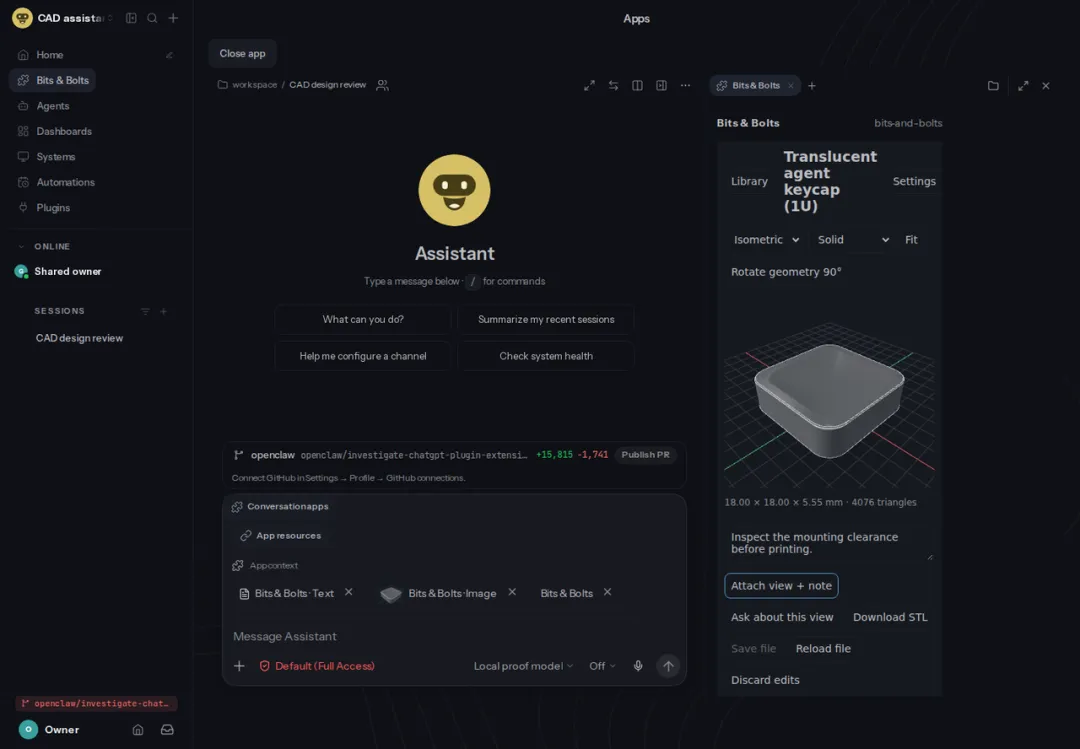
For supported workspace files, MCP Apps can also provide viewing and editing functionality.
During the interaction, the application can also request a call tool to its MCP server. Operations involving the authorization will display the confirmation option, which the user can choose to allow once, allow while the current application view is open, or refuse.
This means that OpenClaw's chat windows can accommodate more interaction: users switch tasks in natural language, view content, fill in parameters, or confirm operations through the adjacent application interface.
Full backup, now available in the cloud
In addition to Skills Recovery and MCP Apps, OpenClaw also extends full backup functionality.
Users can now save backups to external hard drives, installed storage devices, or Cloudflare R2 without being limited to OpenClaw devices.
The new version also supports timely backups and automatically clears old backups. When restored, the system writes the data into a new temporary directory rather than directly covering the existing environment, reducing the risk of problems during the recovery process.
For long-running agents, it is equally important to ensure that configurations, databases, and credentials are properly stored and restored after equipment fails.
In addition, OpenClaw has improved on desktop edges, Code Mode, Workboark and automated tasks.
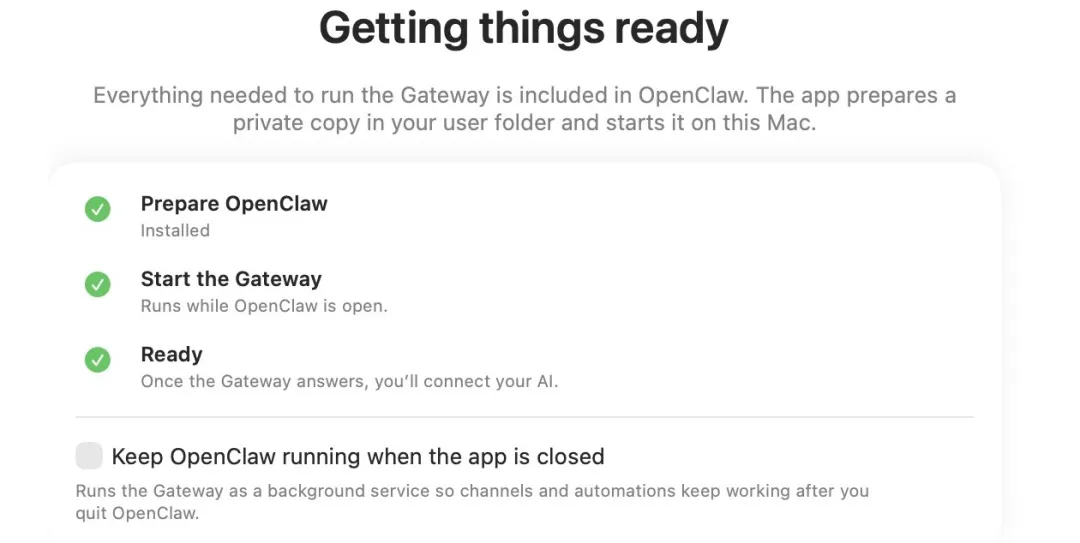
Mac desktop applications now have a built-in operating environment, with new users no longer having to install Node.js or command-line tools separately; Code Mode supports storing small amounts of JSON data for later execution or restarting; and Workboard introduces session management based on rules and task states.
In terms of automation, the new version improved task search, running record queries and failure handling mechanisms, making it easier for users to track task execution and handle repeated failures.
In addition, the model directory can now be updated without rebooting OpenClaw, and the Web interface also adds temporary dialogue hiding, offline draft saving, and more.
Repairs and optimizations are also part of this update, which mainly involves installation maintenance, message receiving, memory functionality, Skills, model adaptation, automated scheduling, and security and privacy.
Updates are ongoing and users are tired.
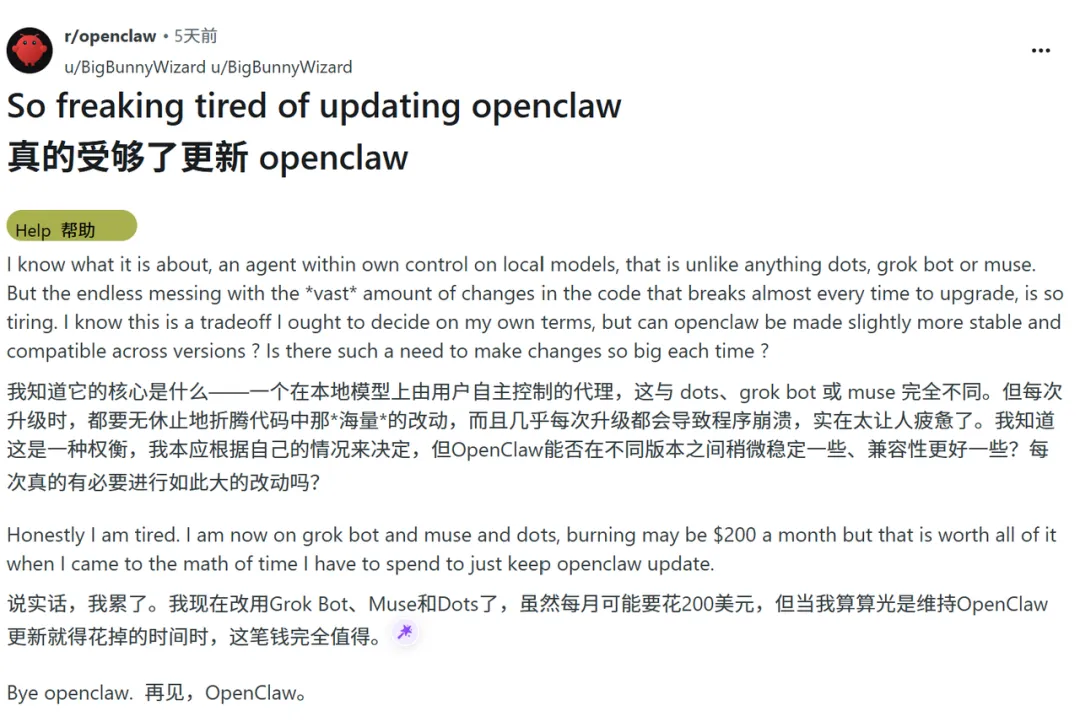
Just days before this update, a post on Reddit called "Really Enough to Update OpenClaw" expressed the fatigue of many users.
The publisher admitted that he was aware of the unique features of OpenClaw: the ability to run on a local model, giving users real control over the Agent. But the compatibility issues that come with frequent updates are tiring, and almost every upgrade takes time to repair the environment.
Eventually, he decided to switch to Grok Bot, Muse and Dots. Even if it could cost more than $200 a month, it was worth the time spent maintaining OpenClaw.
The remaining portion will not be upgraded successfully by users who insist on "keeping up with the Joneses".
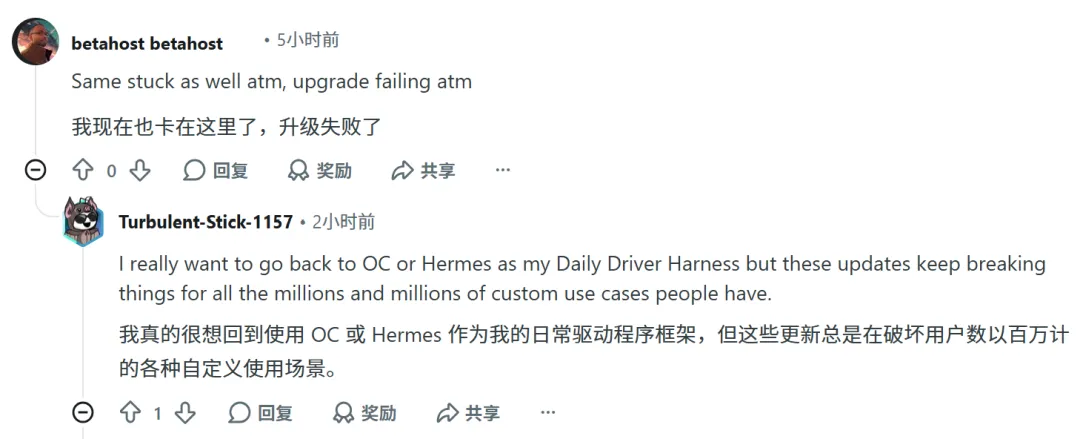
Following the release of the new version, some netizens complained that they were still stuck with version 9.9 and couldn't complete the update even with ChatGPT's help.

Another user said he encountered the same problem, and others were frank about wanting to re-use OpenClaw or Hermes as a regular Agent framework, but continuous updates always undermine existing custom workflows.
A similar failure report appeared on Github. A user attempted to upgrade from v2026.9.5 to v2026.10.1, but the update failed and the codex plug-in remained in the old version. The gateway appeared to be running normally, but the agent was unable to complete any response rounds.
Github:
These may also explain why the unusual "heating" that once heated the potatoes has gradually cooled down.
Initially, people were attracted to the idea of allowing AI to do the work on its own, and after its actual use, deployment, maintenance, Token cost and stability gradually shattered the fantastic imagination.
At the same time, more and more AI products are beginning to offer similar capabilities and users have more options.
As a result, users need a more carefree one than a continuously evolving dragonfly.
The link is as follows: