It's the first time in the history of the world.
Just now, Karpathy throws out a cold truth: humanity's awareness of AI capabilities is undergoing an astonishing "cognitive fold".
People in the neighborhood shouted that the AGI was coming, but the crowd was shouting at it.
Karpathy reveals the truth: About 75 percent of the world's population has never touched a big model at all, and there are only 5,000 people at the top who have mastered the front-end system.
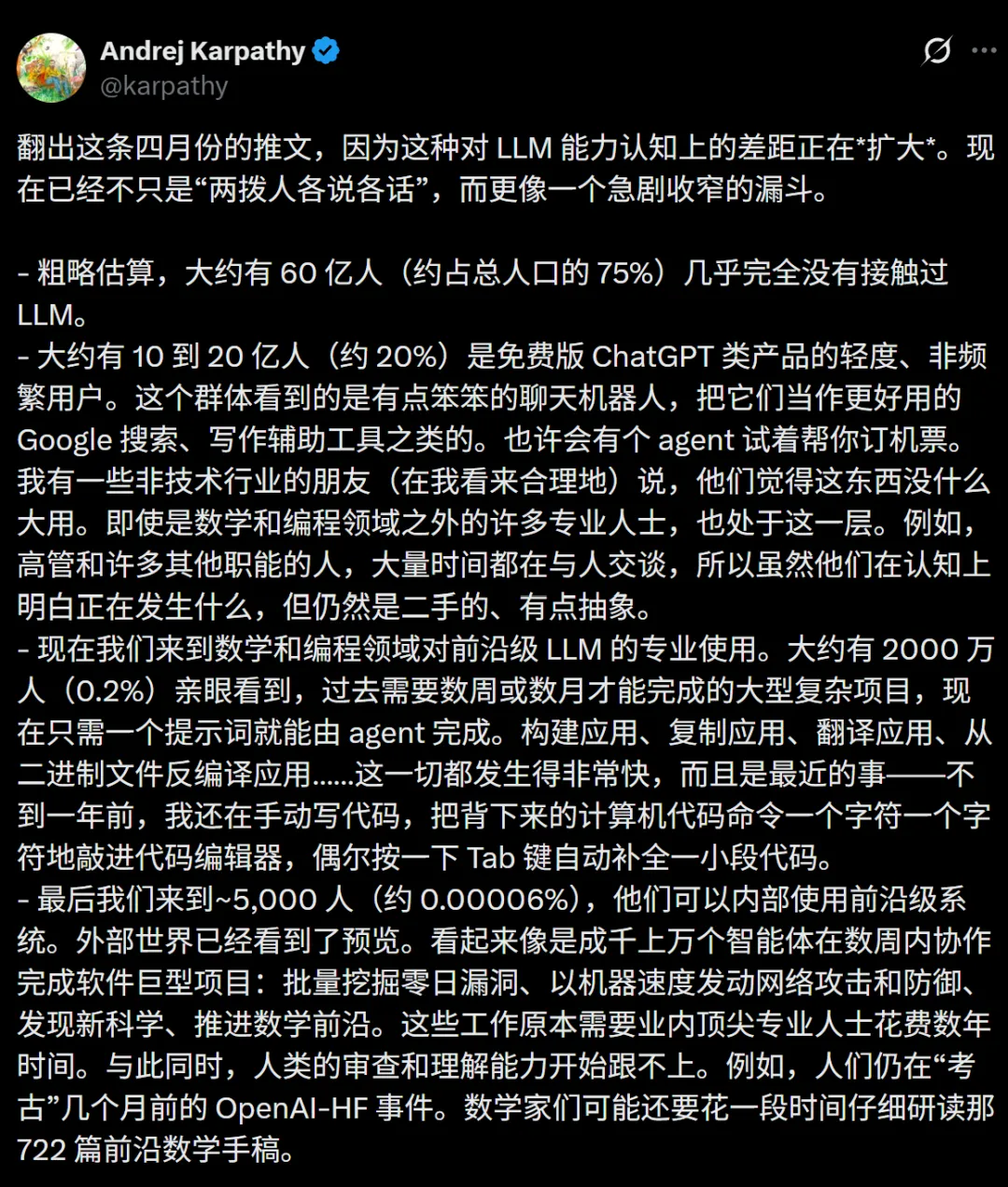
This is a "four-level cognitive loophole".
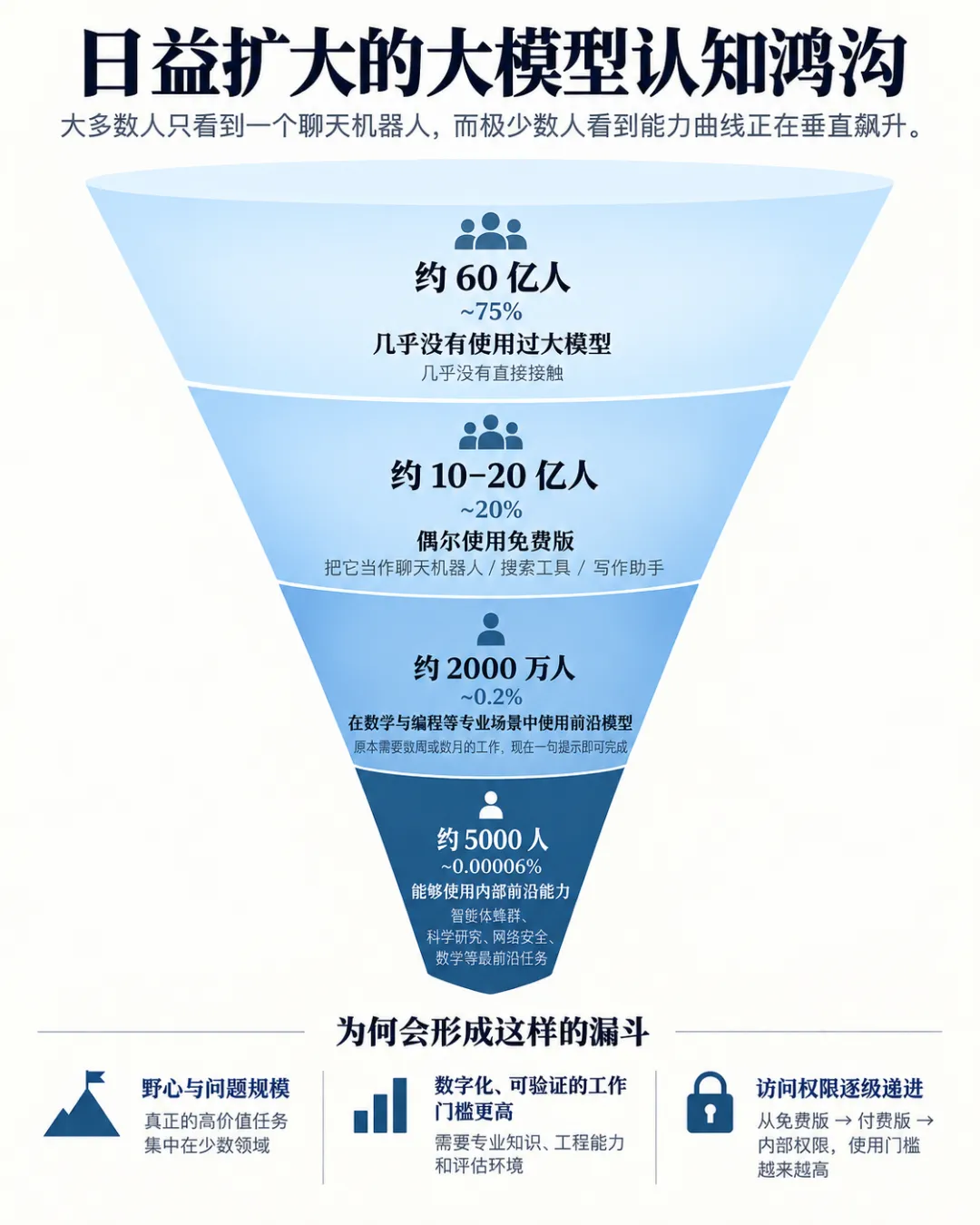
While billions of people are still mocking free AI and answering even the simplest questions, 20 million of the world's top performers are trapped in "smart bodies".
Thousands of "smart bee colonies" are collaborating autonomously in the restricted areas of the TOP 5000, tackling zero-day vulnerabilities, advancing mathematics at the forefront, and putting humans far behind.
The AI seen by the public, with the real power at the forefront of the lab, is already a gaping hole.
The first overlap: the ignorance of 6 billion people and the illusion of 2 billion people.AI has reached every corner of the world?
The results of Karpathy's "towel paper estimate" are amazing.
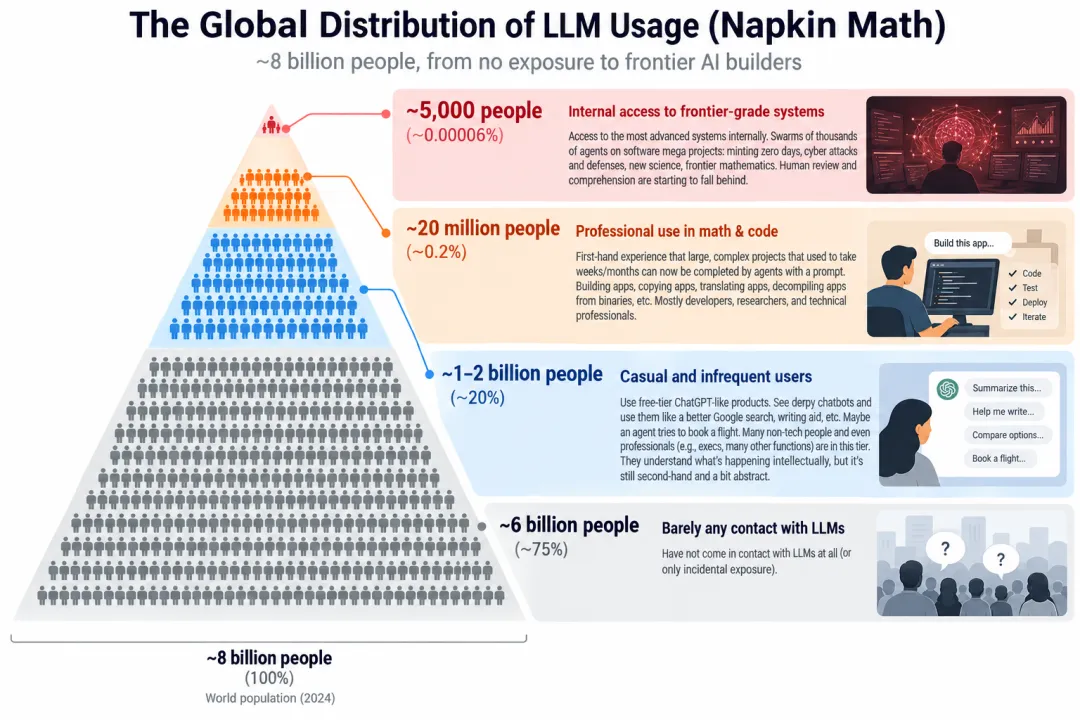
The bottom of the hole: 6 billion people「AI vacuum area」(about 75% of the world's population)
There are about 6 billion people in the world who have had almost no exposure to any LLM. For them, AI exists only in news headlines and science fiction films.
This wave of what is known as the Fourth Industrial Revolution in Silicon Valley has never entered the lives of these 75% of people.
Floor Two: Between 10 and 2 billion people「The illusion of a clumsy assistant」(about 20% of the world's population)
At this level, there are about 10 to 2 billion people who are occasional users of free versions, similar to ChatGPT products.
In their eyes, AI is just a "crazy chatbot".
People think of it as a more useful Google search, or a writing assistant, at least as a primary smart device trying to help you book flights.
Karpathy confesses that many of his non-technical friends have said that they don't think this is very useful in everyday life.
In fact, many professionals in the fields of non-mathematics and coding, including many corporate executives, just stay at this level. Executives spend a lot of time communicating with people every day, and while they rationally "know" what AI is doing, this cognition is secondhand, extremely abstract.
This raises a deadly "near-effect and use-level" problem. Many people's perceptions of the AI world are shaped by last year's free version of ChatGPT, or by those "AI flipping videos" that are rampant on social media.
For example, many people have watched OpenAI's high-end voice modeling, which combines a bunch of humorous videos when faced with the simple question "should I drive or walk to wash my car?"
People watched a short video on Instagram of AI creating illusions, talking nonsense, and then they laughed and thought, "Is that what you're talking about, super intelligence?"
But Karpathy warned that the public was completely fooled by the free version and the old model.

The abandoned old models simply cannot represent the true power of this year's latest generation of cutting-edge smartphones -- especially the OpenAI Codex and the Claude Code.
The second overlap: the "smart body" of 20 million professionals.When we got to the third floor of the pipeline, the wind mutated. The air here started to get thin, with only about 20 million people (or 0.2 percent of the world's population).
In this group of mathematicians and programming professionals, a collective symptom known as "AI psychosis" and "intelligent body flu" is spreading.
Why? Because they are witnessing a catastrophic evolution.
At this level, people pay for the use of the most advanced models of intelligent agents (Codex/Claude Code) and apply it to fields such as programming, mathematics and research.
In his own personal experience, Karpathy said: "It all happened so fast that less than a year ago, when I was writing code by hand, I pushed one character at a time into the editor with the command of a well-known computer, and occasionally pressed the tab button to fill it in automatically".
But what now? Everything has been disrupted.
Large projects that used to take months for top engineers to complete, now require only one tip, and the front-end smart body can do it in a very short time, including building applications, replicating applications, translating applications, and re-compiling applications from binary files.
When you give a computer terminal to these models, you can see for yourself how they "configure" the programming problems that take weeks.
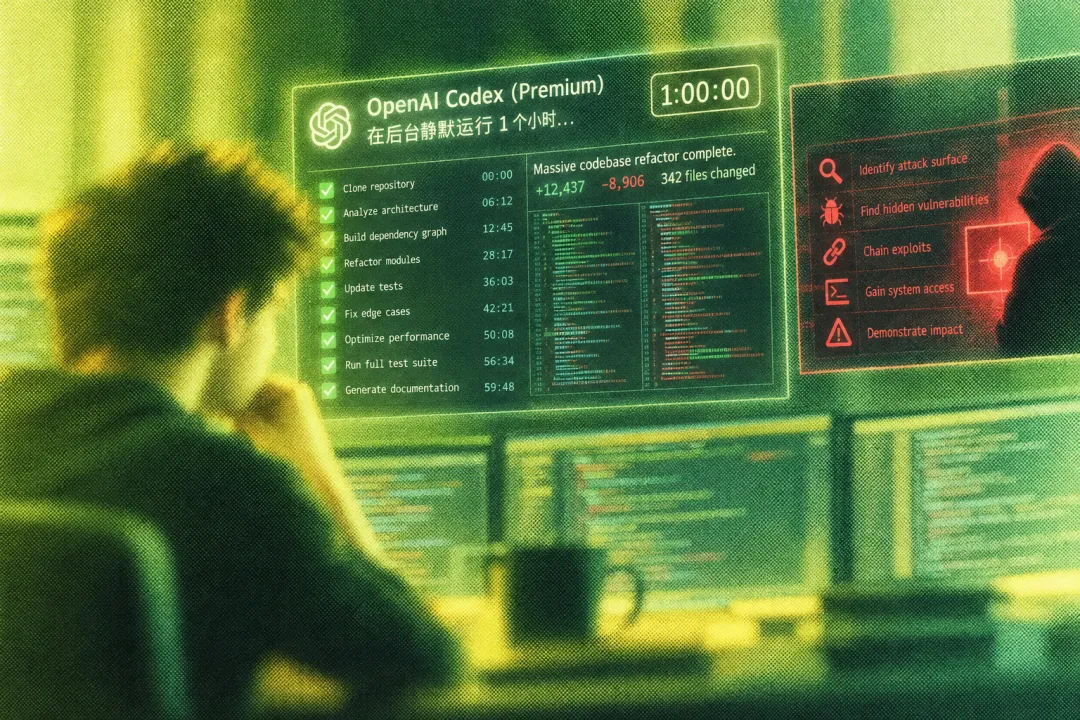
OpenAI's top-of-the-line, paid version of the Codex model can run itself for an hour in the background and then perfectly reconstruct a huge code library, or accurately detect and exploit vulnerabilities in complex systems.
As Karpathy quotes the big V saying, "The degree to which you have awe of AI is perfectly consistent with the frequency with which you write code using AI".
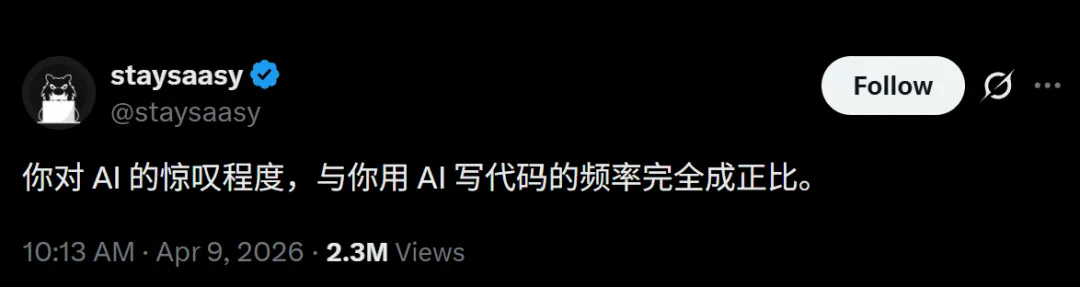
This group of professionals is experiencing the vertical rise of the cognitive curve. They know better than anyone how terrifying the slope of AI capability is, and the cybersecurity chain reaction behind it.
Both groups are already in a state of "talking with each other".
The third folding: a "super-intelligence curve" in the eyes of 5,000 insidersIf 20 million people have been shocked enough by the "bubble", the fourth level of the most sophisticated funnel is beyond the ordinary imagination.
At the top of the pyramid, the world's onlySome 5,000 people, or 0.00006% of the world's population。
For example, the summit of Mount Everest has been climbed by 7,500 people worldwide, and fewer people have actually met the limits of AI at the forefront than have climbed the summit. The funnel model is called "crazy".
Who are these 5,000? are the insiders who have access to the core of the AI company's internal front-end systems.
What the outside world sees is just a "preview" of AI capabilities -- and what the 5,000 insiders witnessed is a real "smart beehive".
Inside, thousands of intelligent organisms are like a herd of bees, collaborating autonomously for weeks without any human intervention in order to attack these appalling software giants.
What are they doing? discovering zero-day vulnerabilities, conducting cyber-attack warfare exercises, discovering new science, advancing mathematics at the forefront.
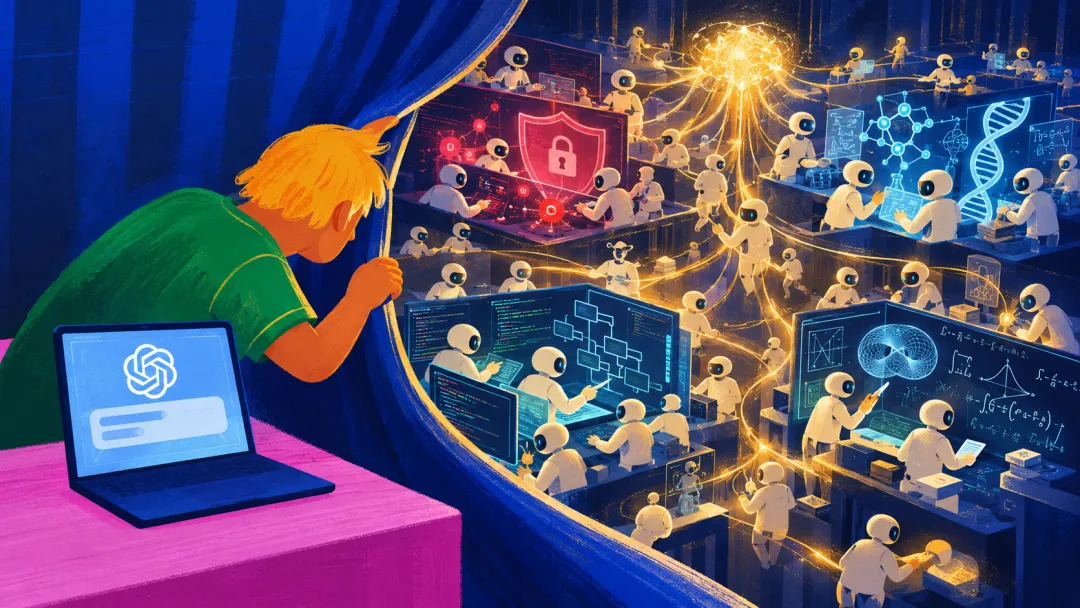
It would have taken years of heart and blood for top experts to do these things.
The scariest thing is that human censorship and understanding have begun to lag behind machines.
Karpathy, for example, says that the speed and depth of machine-generated content has left insiders exhausted.
For example, the "OpenAI-Hugging Face event" is long gone, but human researchers are still "archaeologists" in huge machine-generated logs; and for the 722 mathematical manuscripts that AI generated, top mathematicians take a long time to digest in order to barely digest AI's inference logic.
Why is there such an extreme "cognitive folding"?Why is there such a sharp loophole?Karpathy points out three key factors.
First, influence and you.「Ambition」The scale of the problem is proportional.
If you just let AI write an email, look at a recipe, the system won't even be able to handle the heat, and it won't be able to push the limits.
You have to have a pool of difficult problems that you really care about and have to solve before you can feel the terror of AI.
Second, the ability of AI.「Systemic resilience」I'm not sure what I'm going to do.
Why is this explosive growth mainly concentrated in mathematics and code? Because of the peak of AI capabilities in areas that are digitalised, verifiable and economically valuable.
This involves the secret of the underlying mechanism of the big model: the powerful capabilities of LLM, derived from "reinforcement learning". In both code and mathematics, there is absolute clarity about what is wrong. This explicit "verifiable reward function" enables AI to conduct effective RL training.
On the other hand, for AI to write a poem or an article, good or bad judgments are very subjective and it is difficult to make a clear reinforcement learning.
Not only that, but B2B scenes such as coding and mathematics have extremely high commercial value. Due to their profitability, the most skilled teams and resources of the major tech companies are concentrated in these areas.
Third, the gap in access rights.
Free edition, paid edition and internal permissions. These three stages physically isolate all humanity's awareness of AI.
We are living in a strange moment in human history.
In the same second of this time and space, the AI seen by the public, with the real power inside the frontline, has been gone for a century.
Remember Karpathy's warning: Behind a stupid AI mask, a super-intelligent deformed person has been quietly awakened in the eyes of a very small number of people.