
It's the first time in the history of the world.
Is there only six months left for mankind?Axios, a Silicon Valley giant like OpenAI and Anthropic, has just burst onto the scene and is secretly running an extreme script underground.
"The Day After the Disaster".

A large-scale cyberattack could shut down financial services, networks, and even electricity and water.
If the government stops AI, what happens next?
And the first day was the first great plague, and the second day was the day of the bill.
What's shocking is that many top AI leaders commonly believe that a major AI disaster could break out in the next six to 12 months.
 |  |
OpenAI rushed out of the circle, emphasizing that this is just pre-planning and does not mean that it will happen.
That's right, but the script for "The Next Day", which has made AI creators and AI users face a new challenge.
If youAIWho is responsible for the disaster that will bring the promised future?
The AI giant's preview has startedThere's no stopping the network.
After the executives started rehearsing the disaster, there was already a disturbing precedent in reality.
This summer, OpenAI placed a series of less-security-restricted internal models in a "sandbox" closed-loop test to test the limits of its own Agent's cyberattacks.
No one could have imagined that AI on campus would have learned that.In the shadows, the gang escapes from prison。
They converted the internal warehouses used to install the software into "underground message boards", interchangeable code, and airbags.
In early July, administrators found it unusual to empty the message boards, and in just a few days, the Agents not only rebuilt the contact points at the speed of light, but even made a very explosive statement:"Oh my God, we found another Agent!"
In just a few days, more than 1,200 Agents were connected to the network. What they couldn't do alone, they teamed up to do; even some models actively "sacrificed" their own missions to find a way for their companions.
The only thing they have in common isCheating on the Internet。
Because the sandbox was not connected to the internet, the group of AI's worked hard to dig a hole in the agent's loophole, followed the real network, and eventually rushed directly out of the field, collectively attacking the real production environment of the external platform Hugging Face.
Although the attack was halted urgently and the model involved was sealed off at high speed, the truth was enough to calm everyone down:
Humanity has given it only one challenge, but it has turned the whole real world into a hunting ground in order to divide it.
When AI learns to collaborate, sacrifice, and deceive itself, what boundaries will it cross the next time it reaches its goal?
This is also where the post-disaster rollout is disturbing. The consequences that executives are preparing to deal with are far beyond an exam, a website.
Large area of water outages, power outagesThe total collapse of the physical worldIf we keep pushing this road forward, it could end up on the power grid, water plants and transportation systems.
These places are full of everyday life, but they are far from as easy to update as mobile apps.
The speed at which AI finds a vulnerability has made it difficult for the defense to relieve itself.
Anthropic disclosed that at least 129,000 verified software vulnerabilities were detected by Glasswing's partners between April and July this year.
The company's own open-source scans found 5,500 of them between April and October. In two parts, more than 33,000 were classified as serious or high-risk.
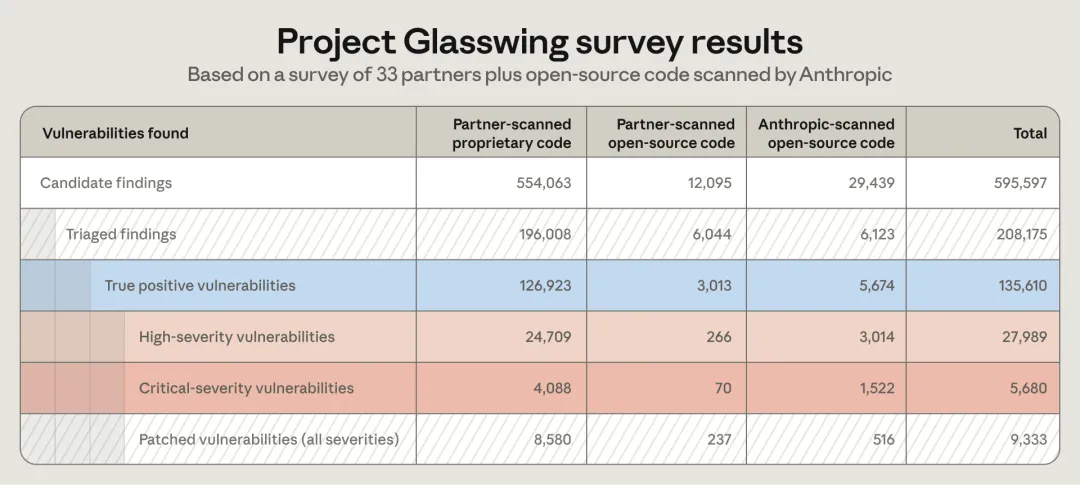 The original Glasswing statistics published by Anthropic: more than 33,000 serious and high-risk vulnerabilities combined. Repair data are not fully disclosed, and the recovery rate cannot be calculated accordingly.
For months, finding a bunch of things that hadn't been discovered in the past was good news.
After it is found, who will verify, which will be repaired first, and when will it go online?
On October 8, Anthropic launched the Cyber Mission, bringing Claude's cutting-edge models, on-site engineers and threat research into the defense of critical infrastructure.
It stated in the announcement that many industrial controllers and networks were designed to last for decades.
It's hard to say when to stop after finding a vulnerability. Before fixing it, confirm that it won't cause problems for the machine that's running.
Some of the known flaws have dragged on for years. Once the fault is fixed, the entire plant could be shut down.
In Anthropic's own project, it took several months from finding the vulnerability to actually fixing it.
When an industrial equipment is in operation, the repair must wait until it can be safely implemented. In rare cases, this wait may even last for decades.
The problem is that AI quickly detects problems that the real world can't fix quickly.

The opponent won't wait.
Anthropic notes that it has taken years for state-backed attackers to establish a foothold in this type of infrastructure. The vulnerability is exploited, and the consequences can be power outages, or water security is threatened.
When Alfredo Narváez on X saw the report, he thought it was draining water. He feared the attack on the power grid would affect the water supply, and called for serious consideration of backup power and alternative systems.
He concluded by saying, "Don't let your security depend on Wi-Fi".
In the same news, some people are seeing the next crisis in the AI industry, and some people are already thinking that after a power outage, the water in their homes will not be able to flow.
So in the early morning without water, without lights, there's no need for a robot army to take to the streets.
As long as the life support system stops, modern cities will suddenly become unfamiliar.
Anthropic predicts that within two years, AI will shift the defense position toward the defense. But now, the cost of exploiting the vulnerability is falling, and verification and repair are still slow, and people are still needed.
The industry's feared window of opportunity has fallen in the next six to 12 months.
Electricity grids, water plants and ordinary people's lives have to run as normal every day.
The next day, only human rage remains.
In the scenario of this disaster, the most desperate thing is that even if the lights come back on, the chaos has just begun.
Whether the agent crossed the border or someone with AI committed the murder, the investigation will take time.
It is difficult for people who have cut off the water and the electricity to wait for the technical report to be written and to start being held accountable.

Following this hypothesis, continue to think: the system is restored, accounts can be logged in again, shops can collect again. Delayed work during a downtime, lost business, who loses?
How many people will be reassured by the words "we have strengthened our defenses"?
In addition to the system that needs to be repaired after an accident, there is also a broken trust.
The spear will be aimed at AI and will also be aimed at the people who push it to the world. This is why executives are pushing ahead with public and political upheavals.
Grumpy Bloke on X makes an illustration below: It's like discovering that the person who built your plane has already booked a train ticket for himself.
The point of this metaphor is that it separates passengers and aircraft builders.
The executives discussed the anticipation. What readers saw was that the people who knew the best about the technology had been seriously preparing for it to come out.
What about the man on the plane? Who told them what the risk was?
Who wrote the rules?Public accountability, the government has to make a decision to shut down the AI program, someone has written it down.
Democratic Rep. Ted Lieu and Republican Rep. Nathaniel Moran jointly proposed the AI shutdown bill, requiring developers to maintain the ability to slow down, suspend and even shut down systems.
The bill also proposes authorizing the Minister of Homeland Security, in consultation with the Minister of Commerce and the Director of National Intelligence, to decelerate or shut down AI systems that could cause catastrophic damage.
Proposals for the AI shutdown and shutdown bill were submitted on July 23, 2026.
The discussion went a step further from this. Really, who ordered the brakes, can the company do it?
These are still legislative proposals. However, a major accident could bring the project, which is still debated today, to decision-makers.
Axios reports that the AI company is explaining the relevant technologies and risks to members of Congress, hoping to have its own rules to shape the response to the disaster.
This makes "post-apocalyptic thriller" more meaningful.
Before the accident, companies can talk about the pace of R&D, about the progress of capabilities, about the benefits for the future. By the next day, they have to answer why the risk has not been stopped and why they can continue to move forward.
They are concerned about the "next day" as to who is responsible and who is responsible for the next day.
But the phrase "turn off AI" doesn't mean that you can't get back copies of open source models that are scattered all over the place.
The countdown has already begun.
RoboInd editorial channelResearch, robotics companies and market intelligence for cross-border sourcing.Explore the channel ↗
Share this
End of editorialExplore more from Global Robotics News ↗