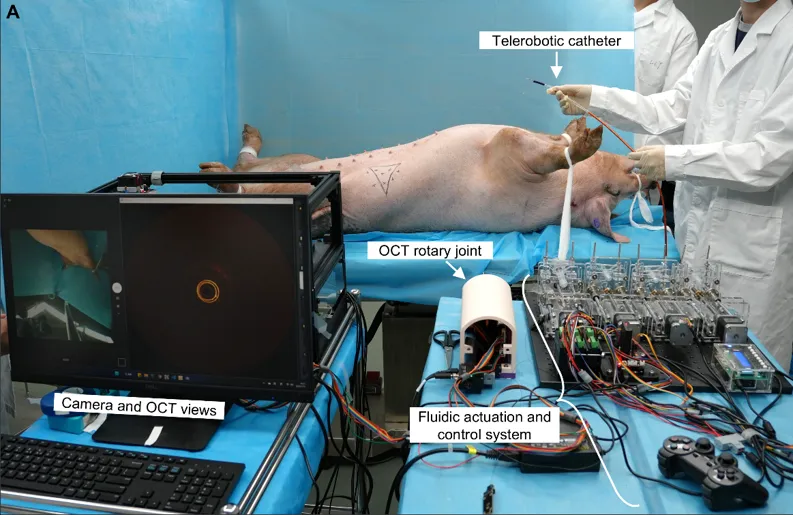
“ The propeller support helps the robot to resist breathing disturbances.
A robot has to perform precise imaging and interventions at the bottom of a gas tube, and the paralyzed lung moves as it breathes, and the end of the tube may also follow the deviation. For a robot, it's like standing on a constantly moving ship and pointing at a constantly moving target with a needle.
Even more tricky is the need for a structure to provide support for the instrument to stand; but improper support may increase the mechanical load on the airway walls, the structure is too large and may prevent air from passing through.
Is it possible to give the robot a temporary stop-gap device that can both stabilize the device and not delay the respiration of the lungs?
A team of researchers at the Chinese University of Hong Kong led by Prof. Lin Hongling and Prof. Liu Wu designed a spiral support capable of changing shape by hydraulic means. In a model that simulates deep breathing, it reduces the diameter of the pipe from 2.97 mm to 0.12 mm, reducing it by about 96%. At the same time, the airflow conductivity of the airway remains above 97.4% of baseline levels.
The study was recently published in the international robotics journal Science Robotics, titled "Stabilizing telerobotic endobronchial imaging and interventions in breathing lungs with a helical bracelet".

Researchers not only tested whether the support can hold the conduit, but also combined it with a remote-controlled robotic system, performing air tube piercings, fluid transmissions and suction operations in live pig models, and verifying its help with fine-grained imaging.
01.
How does breathing affect the operation of robots?
For lung-intervention robots, the pipeline is only the first step to reach the target area.
The lung duct is not a stationary duct. The position of the end of the duct may change as the breathing, pulmonary tissue and airway moves. This displacement changes the relative position between the needle and the target tissue for puncture operations that require precise positioning.
If the probe moves as it breathes, continuously collected images may appear as motion illusion, affecting the observation and measurement of tissue structure.
The first thing the research team had to solve was how to provide a stable support point for the equipment.
Traditional programs have their limitations.
Sturdy shaped locking structures can provide support, but in curved air ducts, some designs require continuous shafting to maintain the shape, potentially bringing additional mechanical load to the pipe walls. Some electro-thermal drives also involve heating and electrical safety issues.
The ball-bag support relies on expansion after inhalation, resistance to the wall of the tube to achieve fixation, but it will occupy the cavity space of the tube, which may affect airflow.
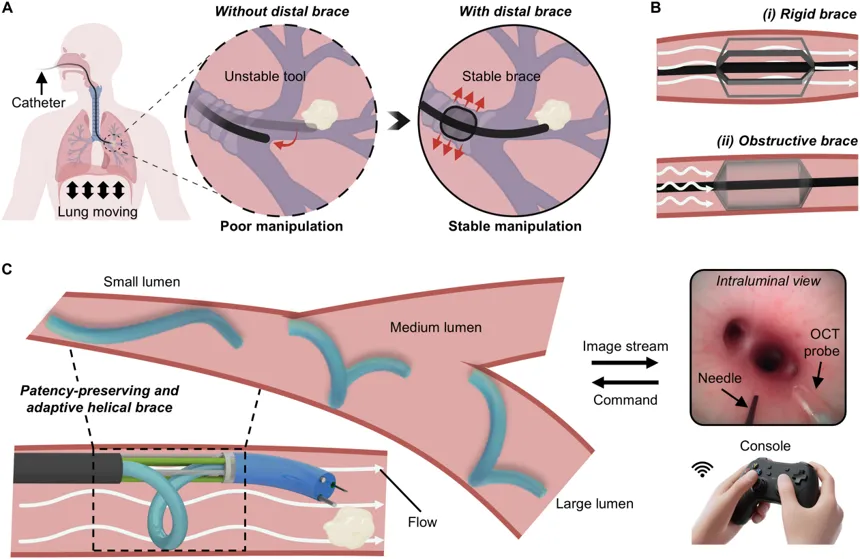
Changes in the size of the air ducts further increase the difficulty. The paper notes that the diameter of the main ducts is about 10 mm, while the diameter of some of the more distant ducts can be shortened to about 3 mm. A set of fixed structures must be adapted to different pipe diameters while taking into account stability and ventilation capacity.
What researchers need is not simply to tighten the device, but to give the robot sufficient torque and as little interference with normal functioning of the airway as possible.
02.
A spiral support with a diameter that can be adjusted nearly 10 times
The special feature of this device is that it is able to actively change its shape.
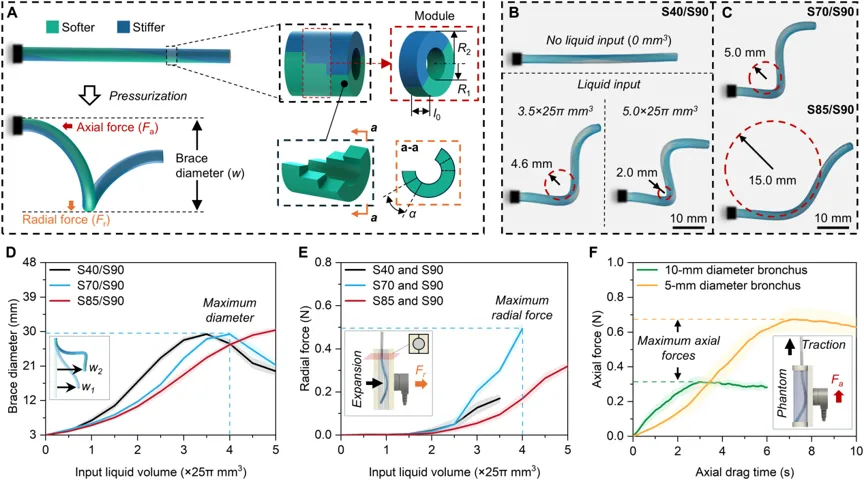
The researchers designed a spiral support composed of several non-asymmetrical rigidity tubing modules. Simply put, different parts of each module have different rigidities and are curved when subjected to liquid pressure. When these modules are piled at a certain angle, the entire structure can be gradually reconstructed into a spiral shape as the hydraulic changes from a relatively straight state.
After contact with the wall of the pipe, the spiral structure can provide support for the pipe; adjusting its shape to accommodate different sizes of the tube cavities. In the drive mode, the research team used water pressure rather than air pressure to avoid the control loss caused by gas compression.
After structural and material optimization, the researchers produced a pipe support of 50 mm in length with an initial diameter of 3 mm. Using an optimised S70/S90 material combination, its diameter can be expanded from 3.0 mm to 29.3 mm, with a maximum diameter of about 9.77 times the minimum diameter.
This is almost 10 times the regulatory range, providing the basis for adapting it to different pipe diameters.
Of course, the support cannot only pursue the expansion capacity. The support force is too small to effectively fix the conductors; the support force is too large and may damage the airway structure. The research team therefore tested the radial and axial forces of different material combinations, ultimately choosing a solution that takes into account the support capacity and structural deformation characteristics.
It is worth noting that the propeller bracket is not entirely devoid of airway space. Its design advantage is that it achieves stabilization through a reconfigurable propeller shape, keeping the airflow through as much as possible, rather than relying on overall expansion like a ball bag to fix it.
03.
The pipeline's displacement has decreased by 96%, and the air ducts can still be ventilated normally.
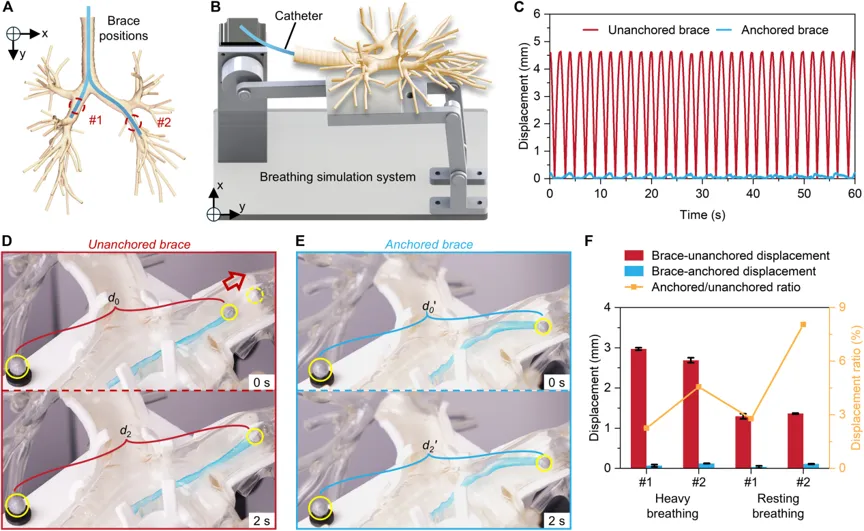
In order to verify the effectiveness of this design, the researchers first simulated normal still breathing and intense breathing in a dynamic tube model, comparing the movement of the tubes from front to back fixed to the spiral support.
In simulated extreme breathing conditions, with no braces fixed, the conductor displacement was approximately 2.97 mm; after the braces were enabled, the displacement was reduced to within 0.12 mm, a decrease of about 96%.
This means that the spiral support can significantly reduce the impact of breathing movements on the position of the conductor, providing a more stable operating basis for remote instruments.
But stability is only half of it. The other half cannot prevent lung ventilation. For this reason, the researchers measured changes in airway pressure under different conditions in a simulated branch of air ducts with diameters of 10 mm and 5 mm respectively.
The results showed that the relative pressure changes under various test conditions did not exceed 2.6 per cent after the support was fixed, and the airflow capacity of the air ducts remained above 97.4 per cent of baseline level. In contrast, the ball-bag support in a fixed state would cause a noticeable blockage of the air ducts.
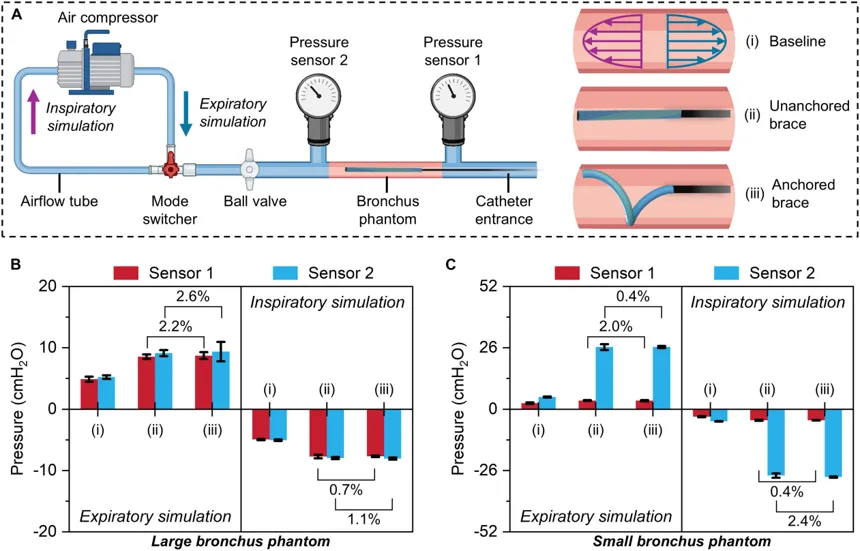
In addition, the research team conducted organisational safety tests.
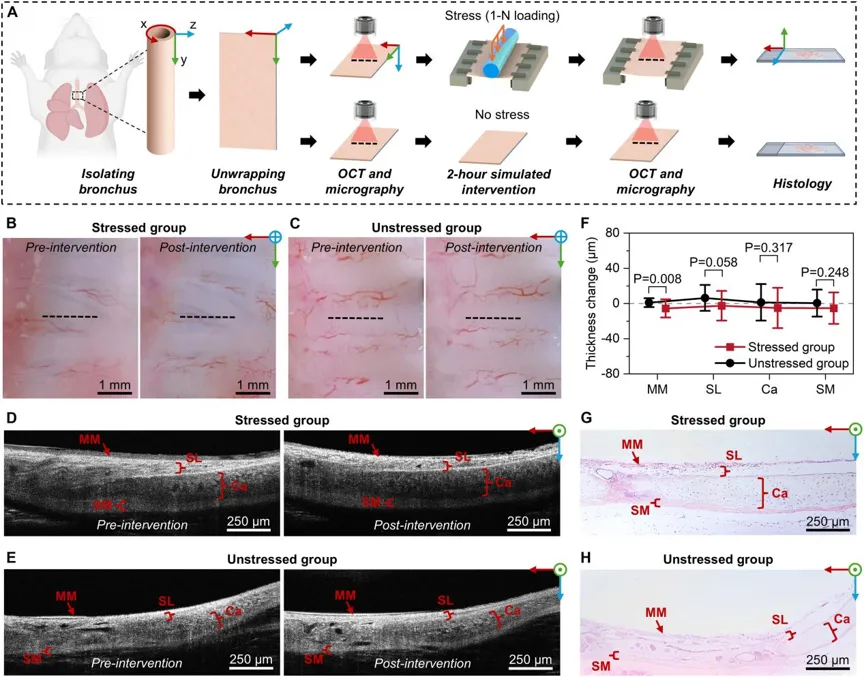
In an off-body mouse tube experiment, researchers applied 1 Newton radial force to the support for 2 hours and observed tissue changes through optical microscopy, optical intermittent scanning (OCT) and histological analysis.
The results showed no apparent surface or deep tissue damage, with an average tissue layer thickness change of no more than 6 microns. However, there were still statistically significant changes in the membrane layer, indicating that the response of the tissue to mechanical loads cannot be completely ignored.
In live pig experiments, the animal breathing humidity was 866±15 ml, close to the 875 ml set by the respirator, and the external blood oxygen saturation level was maintained at 100%.
04.
Not only are the pipes fixed, robots have begun penetrating.
The pipeline is stable, and it remains to be seen if the robot will be able to perform more precise intervention operations.
The research team combined the propeller support with a remote-controlled robotic conductor. The conductor end integrates a fluid-driven mechanical arm, which can be fitted with an intervention needle, cabinet camera and OCT probe to complete rotation, positioning and operation within a branch of the pipeline.
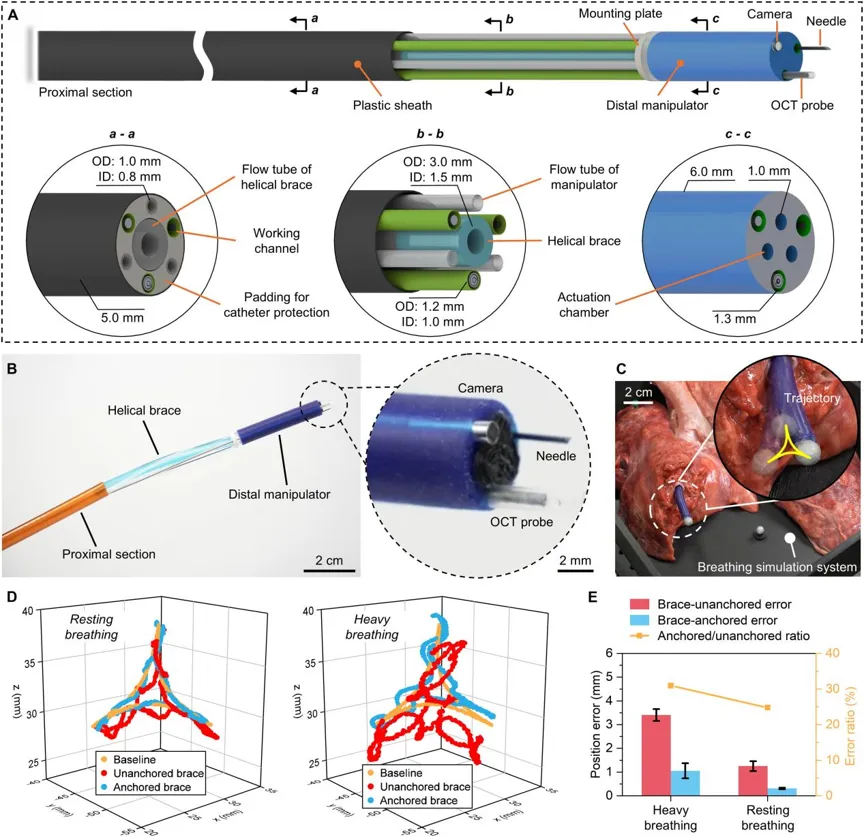
Remote robotic fingers are handled by the operator through a controlled end-to-end manipulation system, rather than by the robot itself judging and performing the surgery.
In a simulated breathing isolated pig lung experiment, the researchers set a path movement along the end of the mechanical arm. The mean positioning error under severe breathing conditions exceeds 3 mm when no support is fixed; after the support is enabled, the mean positioning error decreases to less than 1 mm.
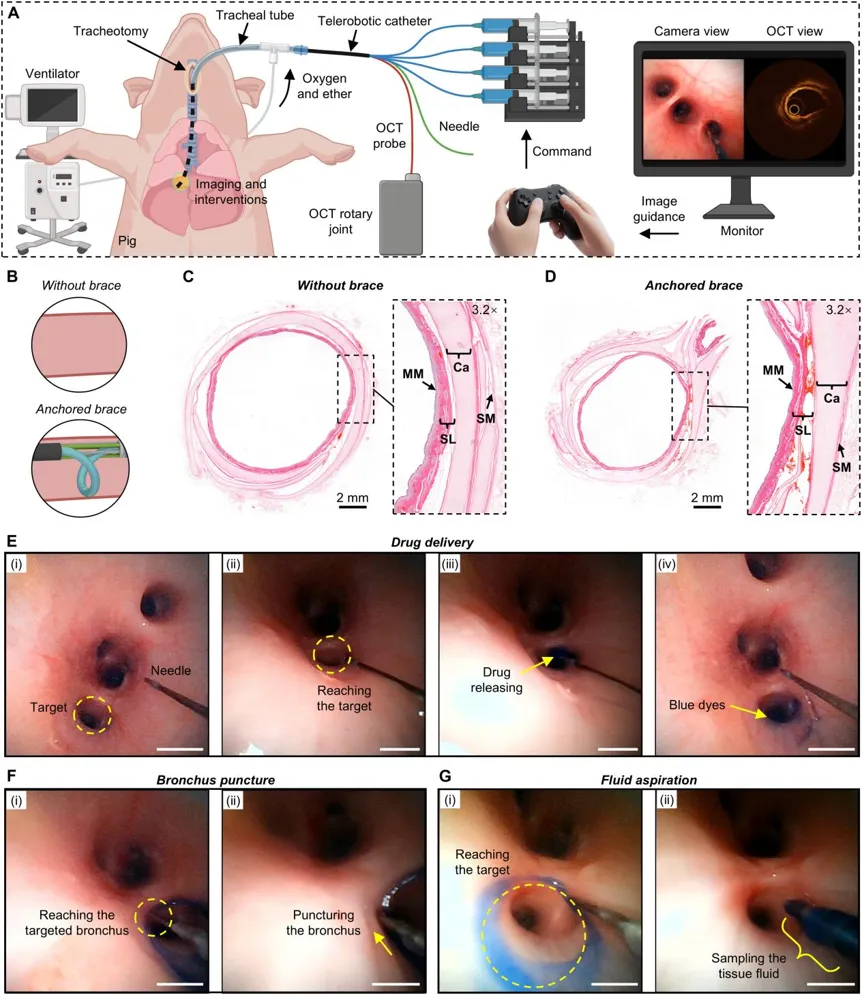
Subsequently, the team verified three types of branched air duct acupuncture in a live pig model.
The first class is drug delivery. Researchers use blue dye to simulate drug delivery by means of a needle to deliver liquid to the target location.
The second type is the penetration of the tube. The robot adjusts the direction and position of the needle and pushes the needle into the wall of the tube.
The third class is liquid suction. After the needle is re-aimed at the target branch, tissue fluid with blue dye is extracted through rotation and retraction operations.
These experiments show that the propeller support not only makes the position of the instrument more stable, but also provides mechanical support for needle positioning and intervention operations.
However, these results from the live pig model do not mean that the system can be used directly for human lung surgery. Whether it can improve clinical sampling accuracy and reduce complications remains to be studied further.
05.
The image is also more stable, but far from clinical application.
In addition to intervening in the operation, the researchers also tested the help of the propeller support for OCT imaging.
OCTs use near-infrared light to obtain tissue microstructure information to assist in observing the walls of the ventricles and their internal tissues. However, in dynamic pulmonary environments, the location of the probe may affect the stability of continuous scans.
In isolated pig lung experiments, unfixed OCT probes, under simulated still breathing and intense breathing conditions, averaged about 57 μm and 116 μm in diameter, respectively. The mean distance in both cases decreased to about 15 μm after the braces were fixed.
In live pig lung experiments, under unstable conditions, the average diameter of the probe shifted by 141 micrometers; after the bracket was fixed, the shift decreased to less than 40 micrometers, reducing by about 71.9%.
This means that the propeller support can not only stabilize the needle, but also help to reduce the respiratory movement interference of the imaging probe, providing conditions for more stable imaging within the tube.
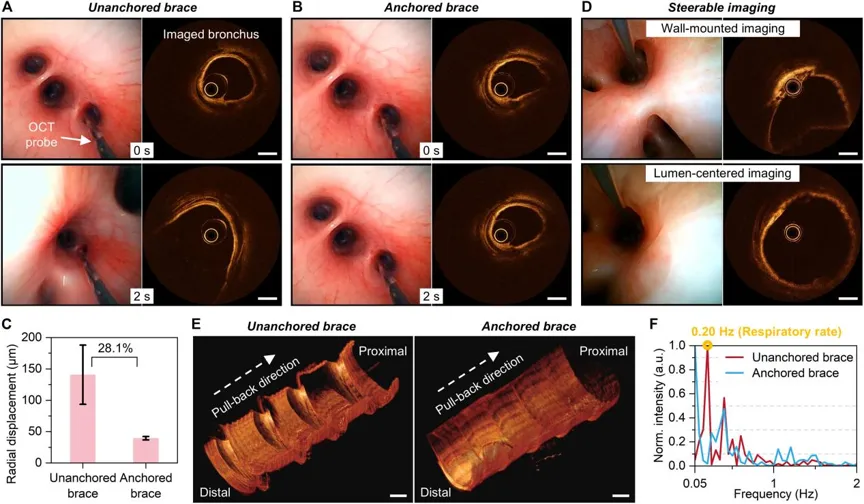
However, the imaging was not completely immune to movement. The researchers observed a small number of scanning vibrations and residual breathing-related movements. The paper also noted that there was room for improvement in the device. For example, the longitudinal and axial supporting forces of existing braces were still insufficient to directly extend to situations such as heart intervention requiring greater force; the transmitting efficiency of needles would also decrease under larger curved angles of the mechanical arm.
Next, the research team will need to evaluate its safety, positioning accuracy and intervention effects through human studies, and compare it with conventional systems such as branch tube lenses.
The design idea of the spiral support may extend into the gastrointestinal tract and urinary tract as well, but these applications still need to be verified separately.
The research was inspired by the fact that the precision of a microbot depends not only on whether the mechanical arm is able to execute instructions accurately, but also on whether it can obtain a stable operating basis in a real physiological environment.
When robots enter deeper, more complex internal spaces, how to stabilize the device without interfering with the normal functioning of the organs will be a question worth continuing research on.