The paper boxes moved forward one by one. Some were distorted, some were packaged in a small way, and some were incorrectly coded for dates.
The linear mechanical arm detects problems during the movement of the box, then reaches out, grabs, supplies.
The whole process.In five seconds.
Doesn't that sound difficult?
The difficulty is that the box is moving and the mechanical arm is moving. It can't wait for the box to stop and see for itself, but it must decide beforehand: where will the box go the next second?
In other words, the robot has to preview the next few seconds in its "brain".
This ability to foresee the world in the brain has a specific name:Model of the World。
And the mechanical arm on this production line is owned by this "brain", a conglomerate that was founded less than six months ago:Bayeux border crossing。
It's not just an algorithm, it's a whole set of brains that can fit into a robot's body: responsible for understanding the world.The trace-in model of the world AWMHe's responsible for squeezing models into robots.End-side reasoning engine BAIZ-RUNAnd finally carrying them.End of the calculationThe end.。
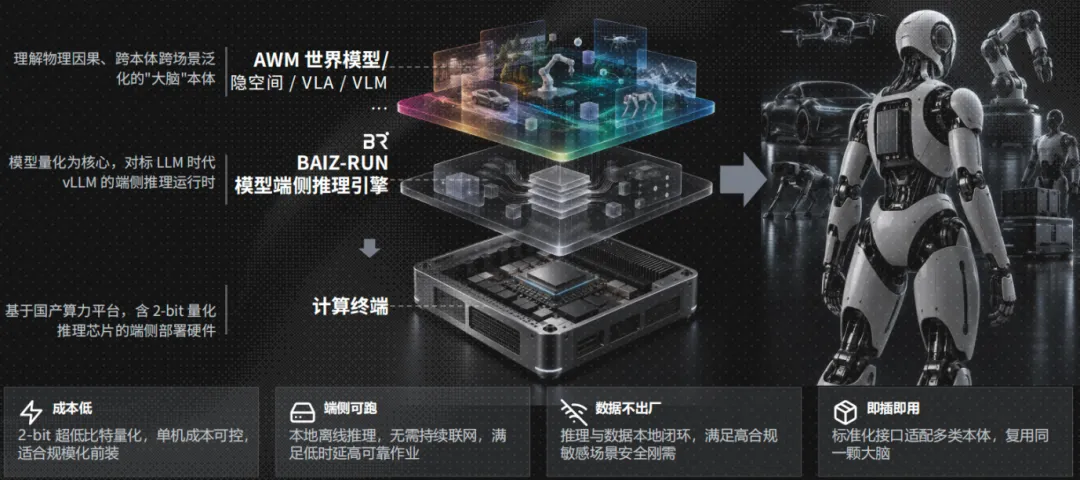
The three-layered structure of the body's brain at the Biase border
It is estimated that this is due to the following reasons:
A brain that asks, "Why?"
Over the past two years, world models have become almost the hottest word in physical intelligence.
But what most of the world's models do can be summed up in one sentence:Look now, guess the next second.
It's great, but it's still a long way off.
A child sees a ball rolling toward the corner of the table and knows it's going to fall, it's a prediction; he also knows why it's going to fall, because the table is up, the ball is still rolling forward, it's an understanding.
Bietz's AWM (Abductive World Model, traceable world model) is the next step. Its founder, Bietz, summarizes the idea in six words:
It's been a long time coming.
The AWM predicts what the world will be like next, and in turn asks: What led to this change?
Who's there?(Entity, entity) What are the objects in the picture?
How do you move?(Dynamic, dynamic) How these objects change over time.
Who will you meet?(Relation, relationship) What objects interact with each other?
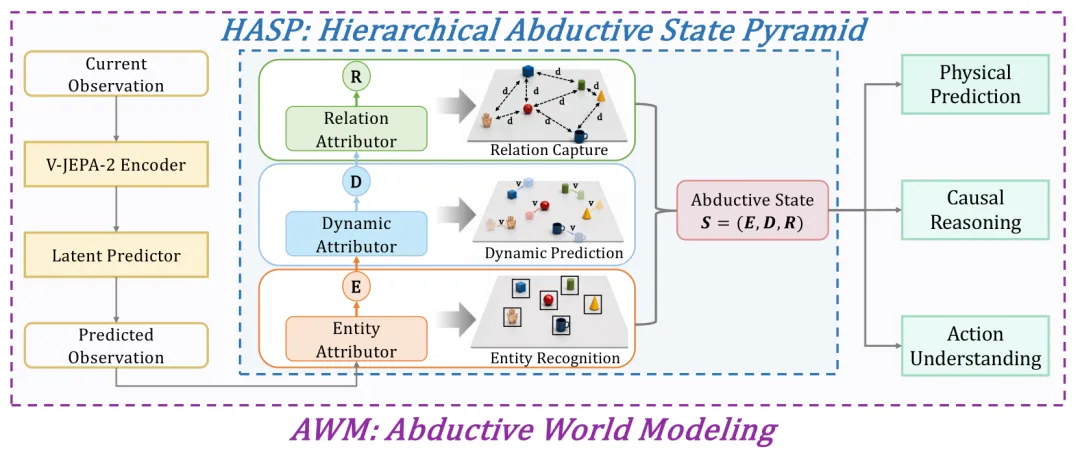
It's all about the AWM architecture.
If you use a more intuitive metaphor: a typical world model is like a weather forecast that tells you it's going to rain tomorrow; an AWM is more like a meteorologist that can tell you where the rain is coming from.
For robots, the latter is much more useful. What it gets is not a vague "future picture", but a structure-clear "world manual": which box comes first, which objects may collide, when to reach out.
Watch video to learn and learn quickly
The most expensive way to train a world model is often not in mathematics, but in data.
The traditional practice requires a lot of manual marking: what is in the box, wherever the object goes, must be marked by someone.
AWM can be directly derived from:Large number of unmarked videosLearning the laws of objects, movement, and interaction is a bit like learning about the world through "seeing". The Internet and factories have a lot of video, and training data can grow alongside video sources.
It also learns very quickly.
With a 75% success rate on the Push-T robot operation task, AWM was only used.2,000 articlesTraining trajectories; comparison methods Causal-JEPA requiredArticle 14,728This is seven times more than the previous one.
You might ask, "Is the data going to be so low that it's not going to hurt?"
On the contrary, when the same training data was added to 14,728 items, AWM's success rate was reached.About 92%。
For robotics companies, the bill is intuitive: every operational data in the real world is based on a single line of data from humans and machines. The same effect is that with only about one-seventh of the data, landing costs are significantly reduced.
The team has published a paper
The paper proposed that predicting accurately is not the same as understanding the world; that a good model of the world should be based on its own judgement.
Title of the paper:Abductive World Modeling via Causal Representation Learning
Address of the paper:https://arxiv.org/abs/2609.36985
Code address:https://github.com/baiz-tech/AWM
The experiment showed:
Compared to V-JEPA 2, AWM has improved on all three categories of tasks: physical outcome prediction, event reasoning, and motion understanding, with a 68% improvement in top-1 accuracy in motion understanding.
When shadowing critical objects in a picture, model judgement changes 3.9 times as much as when shadowing unrelated objects. Its predictions are actually based on "recognizable" objects rather than on hidden ones.

The main comparisons of each data set. Source: AWM paper Table 1.
"Clear evidence" is vital in factories. The production line can tolerate occasional mistakes, but it's hard to accept mistakes without finding a reason.
2bit quantification:
Putting a model of the world in a robot
The model is so smart that it can't run into a robot, and it's white.
Interns will ask: what's the joke about a world model that can't run at this level in a machine?
That's the problem. Chatbots can put the computation in the cloud, slowly for a few seconds, it doesn't matter; the boxes on the waterline won't stop until the mechanical arm is "thinking clear", and the network doesn't have time to wait until the patrol robot hits the obstacle. The chips, memory and batteries on the robot are limited, and the big model wants to get in the car and get "thin" first.
The answer to Bieser's question is a self-developed end-to-end reasoning engine.BAIZ-RUN。
It is based on two tricks:
It's much smaller.Using methods such as error-perception quantification, press the model weight to 2 bits, activate pressure to 4 bits, while maintaining accuracy.
Running faster.By combining arithmetic and underlying computation optimization, reducing redundant computation and memory transfer in the reasoning process.
It's easy to say and hard to do.
Compressing the world model into a chip on the edge is not as simple as compressing the packaging. Quantitatively saving space and not losing accuracy, the calculator has to fit the chip architecture one by one, delay, power consumption, heating, all hard bones.
The team's tests on the AMD Radeon edge integrated graphics card and SSV2 dataset showed:
Memory occupancy decreased by 2.56 times, reasoning frequency increased by 94.6%, accuracy loss of less than 1%.
That is, on the same edge chip, the model occupies more than half the space, runs almost twice as fast, and the accuracy of the judgement is almost unchanged.
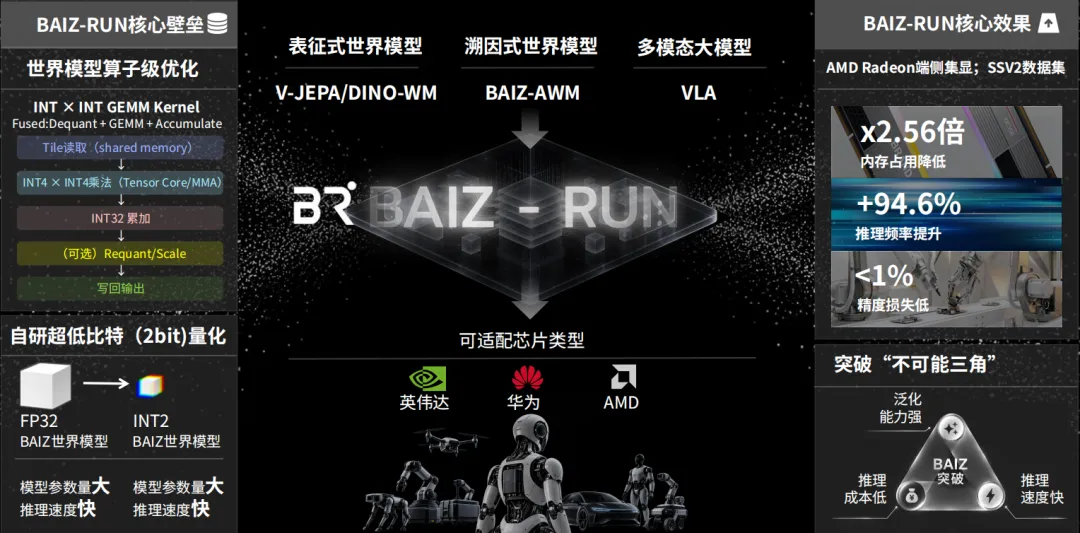
Technical routes and test results of BAIZ-RUN
There are two other details worth noting.
The first is:It doesn't pick up chips.。Hardware in the robotics industry is highly fragmented, with different manufacturers and even different product lines from the same manufacturer likely to use different chips. BAIZ-RUN simultaneously builds a multi-end logic system for NVIDIA, AMD and Huawei Ascend, which can be replicated on different hardware, reducing the cost of moving and deploying world models.
It is also worth noting that the infrastructure will be able to run fully on domestic hardware, and the cost reduction it will bring will be a key factor in the scale-up of the landing.
Second, it doesn't pick models.According to the plan, exaggerated world models such as V-JEPA, DINO-WM, and multi-modal large models such as VLA could be deployed to the edge via BAIZ-RUN. The team compared its goal analogy to vLLM in the field of large models: allowing all models to run efficiently on a general reasoning basis.
It's just a matter of putting it in.
A brain that can fit into different robots
The model is there, the engine is there, and the final step is the hardware.
In collaboration with hardware manufacturers, Baize plans to launch an end-to-end computing terminal that integrates the world model and the BAIZ-RUN into a device that can be directly accessed by a robot. According to the team's design, the terminal is based on a domestic computing platform and has four main features:
Cost is low.2-bit ultra-low-bit quantification makes single-bit cost controllable and suitable for large-scale deployments.
The edge is reliable.Local offline reasoning does not depend on the network to meet the reliability requirements of on-site operations.
The data is not from the factory.Both reasoning and data are locally closed, suitable for situations where data security is highly demanded.
That's what it's about.The same "brain" can be used repeatedly on different robots by standardizing interfaces to fit multiple types of robot bodies.
From models, to reasoning engines, to computing terminals, White's interface is not just about training a model, it's about running the entire engineering chain from the model's capabilities to the edges.
In White's words, the body manufacturer is responsible for "the body" and White is responsible for "the brain".
It's not just a paper:
The landing scene is the real shielding river
The scores in the lab are just the beginning. One of the things that is worth paying attention to is that it has put the brain in the real scene.
At present, three industrial scenarios have been signed and verified in practice:
It's an industry-wide charge.It is the start of the production line. In the case of variable feed, the anomaly is detected in 5 seconds and the feed is completed, based on dynamic forecasting and rapid decision-making.
Industrial quality inspection.In the face of a variety of models, robots have to crawle and perform qualitative tests, which are general identification and spatial positioning.
Factory area inspection.Real-time avoidance of previously unknown obstacles relies on sports prediction and route planning.
Practical verification of the three signed scenes
Relying on co-operative government resources and the eco-friendliness of Central Kochi, Whiteze has built a collaborative network that covers the downstream:
The scene:The company is the largest supplier to the Chinese dairy industry, as well as a close-knit cooperative.
The body:China's main core manufacturer ZERITH, China's main core manufacturer LIMX Dynamics, which is in its pre-IPO phase.
The data collection base:Relying on the support of the country's leading centers, joined the city-wide numbering base, forming a two-way counter-breeding.
The scene side brings a real need, the body side provides robots with "brains", and the data base supports models to continue learning. New data generated in the scene will return to the training pipeline to make the next version of the model smarter.
White's judgement was that having a physical intelligence is difficult to navigate the path of a large language model "before generalization, behind the scenes". The physical world faced by robots is so different that instead of creating a general brain that knows everything, it is better to move from a specific scenario, one step at a time, towards generalization.
In the global coordinate system, see:
Another solution outside of the JEPA route
It is easy to see how ambitious it is to put AWM into a global model of the world.
The most representative of these paths is the JEPA path proposed by Yann LeCun, and Meta's V-JEPA 2 is one of them. Their idea is not to generate a pixel-by-pixel image, but to predict the future in abstract feature space.
AWM and this route have much in common: they all learn from video, predict changes in the world in outer space, and serve to understand and plan for robots.
But the difference is equally obvious:
One step at a time, "Rescue".In addition to prediction, AWM also breaks down the world into entities, dynamics, and relationships, explaining where prediction comes from. In the paper, compared to V-JEPA 2, AWM improves on the three tasks of physical prediction, event reasoning, and action understanding.
It's more data efficient.With the same 75% success rate on the Push-T mission, AWM requires about one-seventh of Causal-JEPA trajectories.
I've been thinking about the edges from the beginning.With the 2-bit quantification and multi-chip adaptation of BAIZ-RUN, including support for Huawei's upgrade, AWM not only stays on the server, but runs on the robot locally.
If JEPA's answer was "machines can't predict the world", Bietz would go on to answer: machines can't tell you exactly why, and that ability can't really be embedded in a robot.
Three months in the making:
The journey of a team of physicians with brains
Finally, let's talk a little bit about the company from which Koda comes.
Less than half a year after its founding, the team came from the University of Science and Technology of China, and brought in business, data and engineering talent from major factories and abroad. The founder of the company, Liu Yi, was previously engaged in research related to model quantification, which later became the technical foundation of BAIZ-RUN. He gave the company the position of a "scenario-driven general utility brain".
Capital responds quickly.
The company was founded in less than three months.First round of funding in tens of millions of yuanThe first round's shareholders included the core polynomials of the semiconductor industry's leading investment institutions, as well as the commercialization of Coda Silicon Valley as LP; Galore, a conglomerate of local and other commercialized VCs, is currently under agreement with a post-investment valuation of over 400 million; and the second round is already well underway.
In addition, the company was included in the China Innovative Future Star Enterprise Research Report 2026, published by the Strategic Advisory Board of Greater Beijing Enterprises. The list includes 97 enterprises nationwide, with only six co-opted.
Its target customers are not just robotic companies: model teams can use its data pipeline, companies that already have models can use BAIZ-RUN separately, robot native manufacturers can access a whole set of brains, and industry customers can work with native manufacturers to complete integration and secondary development.
Of course, there's still a long way to go - whether AWM performs in more new environments, whether BAIZ-RUN works on more chips, whether industrial projects can go from verification to bulk deployment - will take time to answer.
But the direction is clear: the world model shouldn't just float in papers and laboratories.
What Benzeng wants to do is to get this brain to "roll back" and actually fit into every robot.