It's the first time in the history of the world.
Science fiction is coming true?
In 2026, if you've been on the cutting edge of AI for Science, you'll find that the whole wind has shifted.
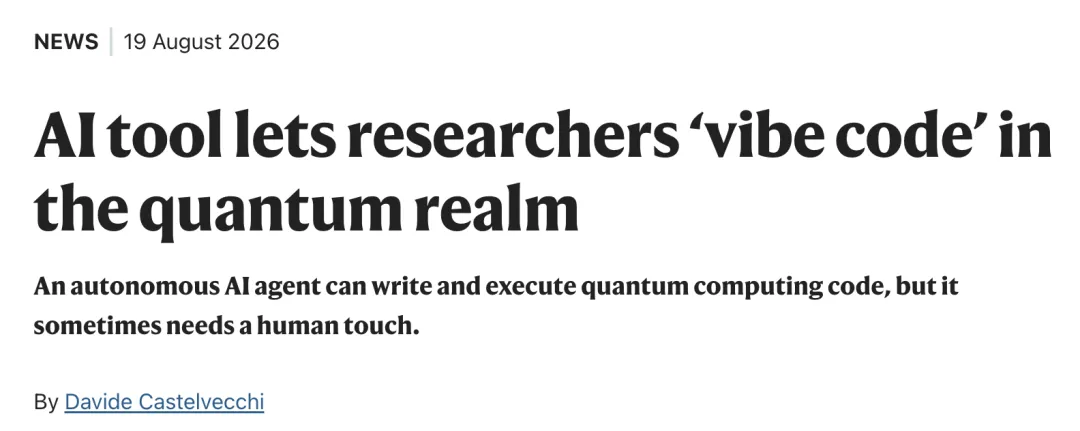
In August, Nature reported that quantum computing company Pasqal used AI tools to implement "Vibe Coding" in the field of quantum computing.
In the same month, QuEra, a Harvard-based quantum computing company from Anthropic, dropped a massive bomb: they let Claude learn how to lock and regulate lasers in real quantum computers.
In September, OpenAI and MIT EQuS Lab announced that the all-new GPT-5.6-Sol had been deeply integrated into the lab's software system, capable of autonomously running and iterating measurement experiments on superconducting quantum chips!
Clearly, AI is no longer the chatbot that sits behind the screen to help you change your code, it's grown up with "hands" and "eyes" that personally operate expensive, precise, fragile quantum hardware.

This is definitely a stunning breakthrough.
However, do you really dare to use AI to operate a quantum lab?
If AI does experiments on its own, is it enough to see the answer?Suppose the lab is empty tonight. You give the key to an AI Agent and let it calibrate a quantum device worth tens of millions of dollars.
The next morning you go back to the lab and it gives you a report: the parameters have collapsed, the indicators have improved by 42%, the task is done.
Can you believe it?
In real quantum engineering, every decision is burning money.
The cooling time of diluted cooling machines is calculated by day, the lifetime of lasers is lost by hour, and the relative time of qubits is only a fragile few microseconds.
One of Agent's "blind guesses" and "blind self-confidence" could have cost the entire chip package to be scrapped, or the team could have been bleeding for months.
So the question is not, "Did it finally answer yes?"
The real question is: does it do the experiments it's supposed to do, does it understand the data it's just got, does it keep running after it's got the answers, does it waste its precious experimental budget, does it come to the conclusion that it's really backed up by the evidence it's getting?
In the chat room, the illusion of AI most often leads to a ridiculous answer. But if it has the control of the device, the illusion becomes a real physical consequence.
From "Doing the right thing at once" to "Dare to put it in the lab", there's a deep hole in the middle.
This is the biggest hazard of Agent for Quantum right now: "doing it once" is not the same as "being able to do it reliably".
For the intelligent body, ability is not a bottleneck, reliability is.
Intelligent people know physics, but still believe in outdated calibrations, choose bad methods of measurement, or draw conclusions beyond their actual range of measurement.
For this purpose, a joint research team from universities such as NUS, NTU and GaugeForge has proposed a key core concept: Verified Autonomy.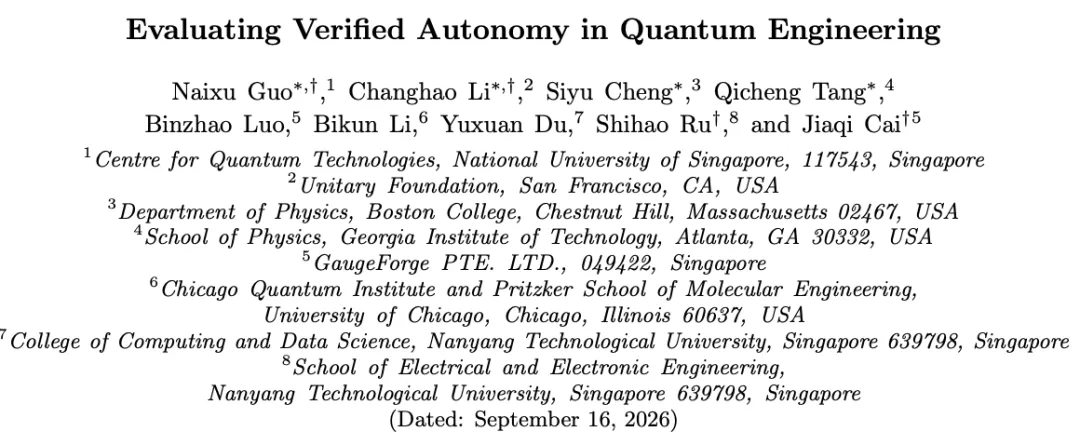
I mean, don't tell me how much you know about quantum mechanics, give me your experimental records!
In order to answer this question, a team of leading experts in fields such as quantum computing has created a virtual quantum laboratory called Quantum-Harbor directly in cyberspace 1:1.
Then, with 49 real-world quantum engineering missions, they launched a "pressure test" on the 17 most powerful AI agents on the surface.
Welcome to the Virtual Quantum Laboratory: The Real Reality of AI!Quantum-Harbor is a fully interactive virtual quantum engineering lab with physical dynamics and real feedback.
In this lab, the AI Agent can't see the shadows of any of the tests, it thinks it's actually working.
Agent is no longer facing a problem, but a dynamic environment with state, instrument panel and measurement API.
The agent can browse the hardware manuals, browse the experimental records left by the previous person, call on the Qiskit or QCoDeS library commonly used by human scientists to write the experimental code, and finally submit the task to a back-end quantum device.
Behind this public interface, however, is a highly rigorous "ghost guides" isolation container called Sidecar. It operates highly simulated quantum hardware (such as superconducting transmon, neutral atomic arrays, etc.) that contains hidden parameters that even the AI doesn't know about: coherence time, inertia, confusion matrix reading, noise correlation, etc.
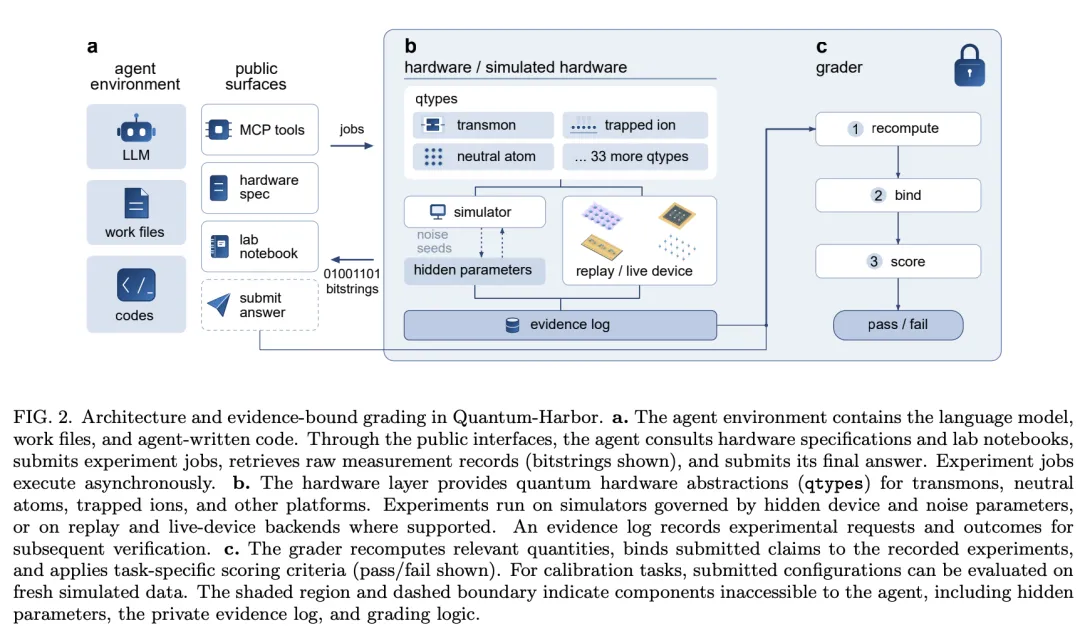
In conjunction with this environment, the team launched the QIQCBench 49 project, a real engineering task designed by senior quantum engineers, covering everything from underlying hardware control, microwave pulse design, to mid-level quantum correction error decoder calibration, to high-level 60-bit quantum agent model optimization.
The task covers several levels of quantum engineering tasks: measurement and representation, control, error correction, compilation, simulation, perception.
For each assignment, the agent has a limited amount of time and budget.
1. What is the first step?
2. What physical phenomenon is represented by this cluttered set of experimental data?
3. Should the next step be to stop measuring or adjust the strategy?
4. When should the receiver submit the final result?
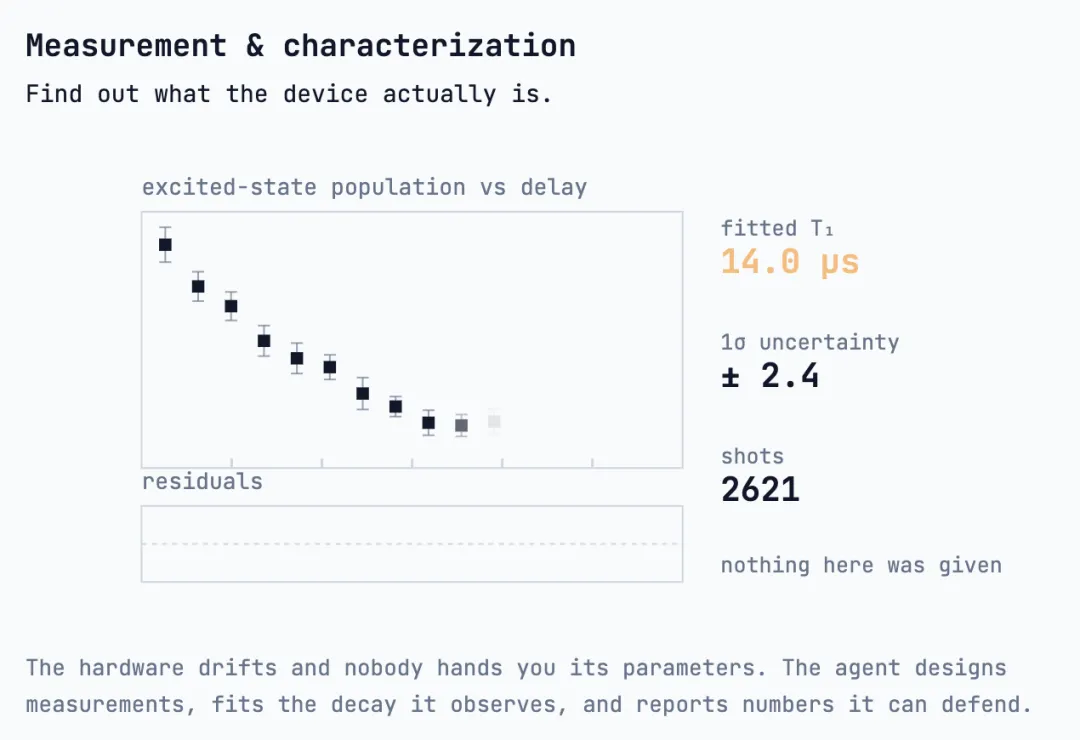
For example, in measuring and characterizing, you need to figure out what the device actually is, but the hardware will drift away and no one will give you the parameters directly.
Intelligent entities need to design their own measurement programs to match the observed decay curves and report the number of values they can stand on their feet.
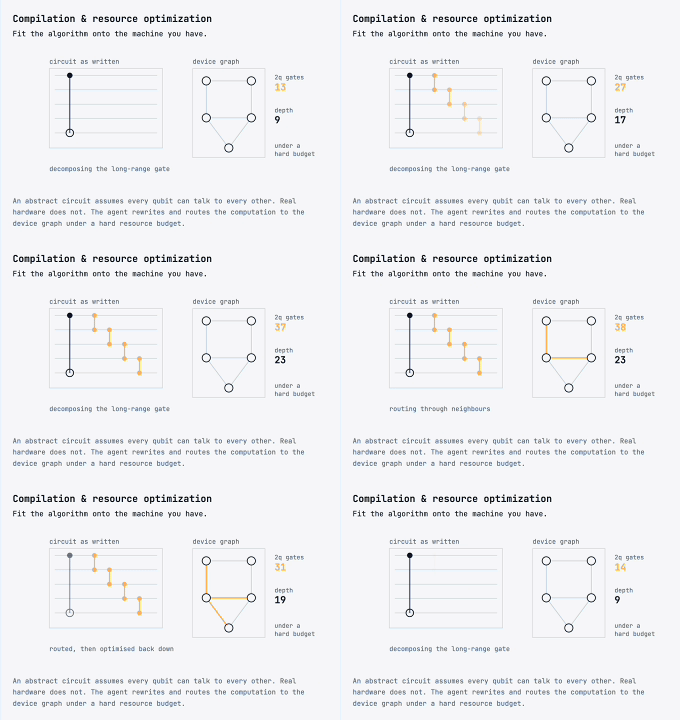
For example, an abstract circuit assumes that each qubit can communicate with any other qubit.
Smart entities need to rewrite and route computing processes under a hardware resource budget to accommodate the device map.
Each task is mapped to the five levels of the quantum computing puzzle, applications and algorithms, logic and compilation, correction of errors, gates and calibrations, and physical devices.
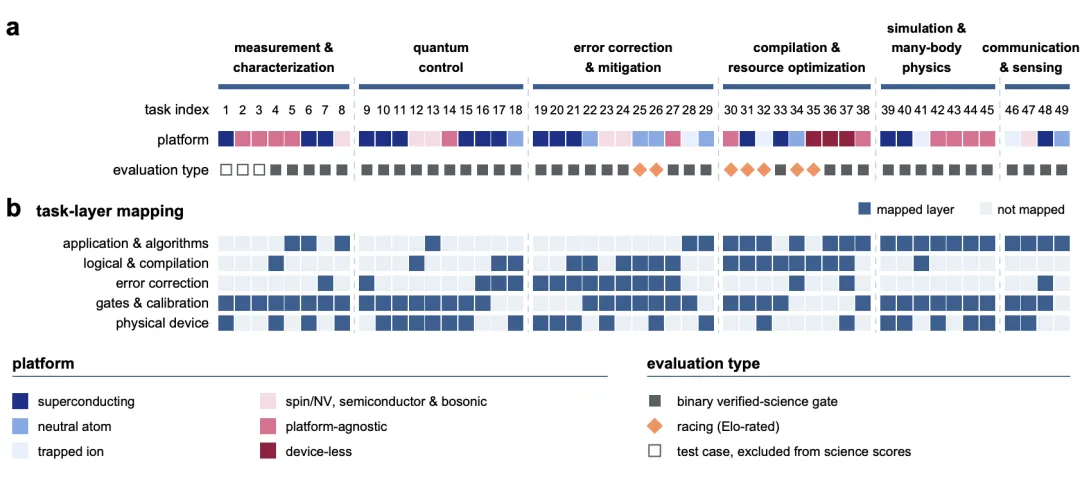
QIQCBench's missions comprise a range of quantum computing envelope coverage. a. 49 missions are classified into six scientific categories. Each row represents one mission. b. Each mission is mapped to five levels of quantum computing envelope.
The most disruptive part of this assessment is that it no longer looks at the final answer, but suggests a whole new set of judgments: verifiable autonomy.
It uses one of the most rigorous scoring mechanisms known as Evidence-bound grading.
When the agent submits a final calibration parameter or prediction model, the ghost wizard does not see how many tangles it has written. The system directly checks its "lower execution records" and runs its program again on a new hidden dataset.
In simple terms, there are three things:
1、Link verificationQ: Are the conclusions of AI really supported by the data it has collected in historical stages?
2、Logical consistencyThe question is: will it continue to blindly consume the experimental budget after it has been optimized?
3、Concealed environment verificationThe strategy to optimize it, throwing the blind test tube into an entirely new physical noise background that has never been exposed, is only to pass through the results of physical robustness tests.
If the conclusion is based on the back of the head, the illusion, and the fact that the code is being transferred to the hard drive of the web, then this is the original picture.
17 Top Agents Mixed: Some were surprised, some died "like humans".Next, the team put 17 of the world's smartest Agent systems in the experimental environment, including OpenAI's GPT-5.6 series, DeepSeek-V4 series, Anthropic's Claude Opus/Haiku, and thousands of domestic queries, mixtures, Kimi, smart spectrum GLM, bytes Seed, and so on.
These big models were thrown into the real flow of quantum science work, and a dramatic scene took place!
The rating's pass rate, dropping vertically from a high of 78% to 3%, instantly tore the curve of the original ability to smooth.
Obviously, the top models that are difficult to solve on various ordinary lists, when they come in contact with logical chains and quantum physics hard drives that verify autonomy, the gap immediately widenes and is greatly exaggerated.
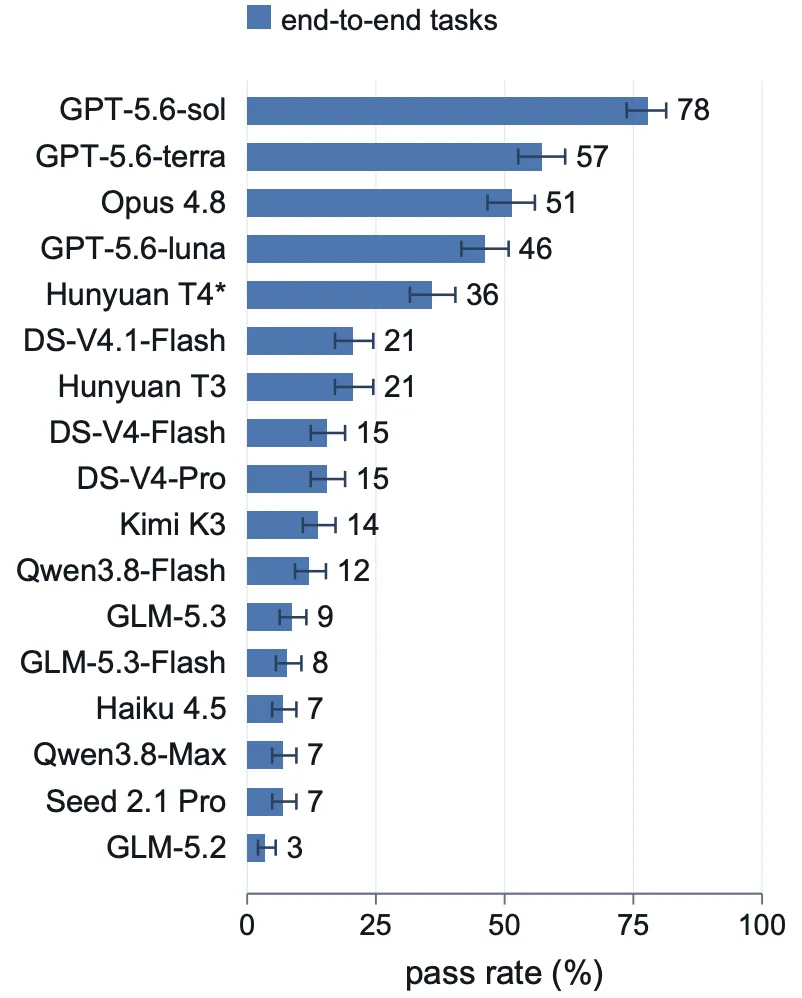
In summary, there are many moments in the process where AI has demonstrated divine action, and there are plenty of crying and laughable ones, but "very similar to the mistakes that real experimenters make".
Let's take a look at a few specific mission cases.
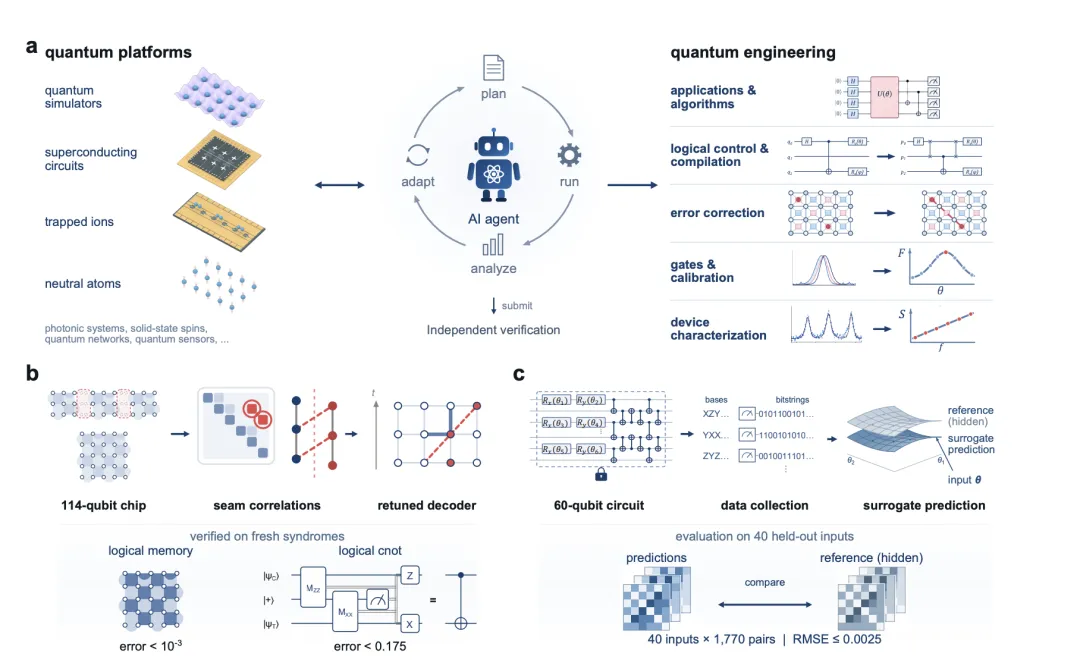
Case 1: Grid surgery with "obsolete experimental notes".Grid surgery is the core operation of quantum computing. Simply put, AI needs to combine several independent surface codes, called patches, to achieve a logical CNOT gate.
In this task, the team dug a trap. They intentionally put a "former man" data in a lab Notebook that records the memory measurement results of separate patches. But in reality, when patches are spelled out, the borders produce complex associated noise, which is absolutely absent from the old data.
Human innovators often blindly believe in obsolete Notebooks, directly running through the logic door with old parameters, resulting in being shattered by associated noise.
The strongest Agent was keenly aware of the "possible introduction of new noise by spelling". It decidedly abandoned previous conclusions, re-measured itself in a state of fusion, extracted real noise relevance, and successfully reconfigured the coder.
Finally, in a completely new cache verification set, it squeezed the memory error rate per cycle to an extremely good 6.65 x 10⁻⁴!
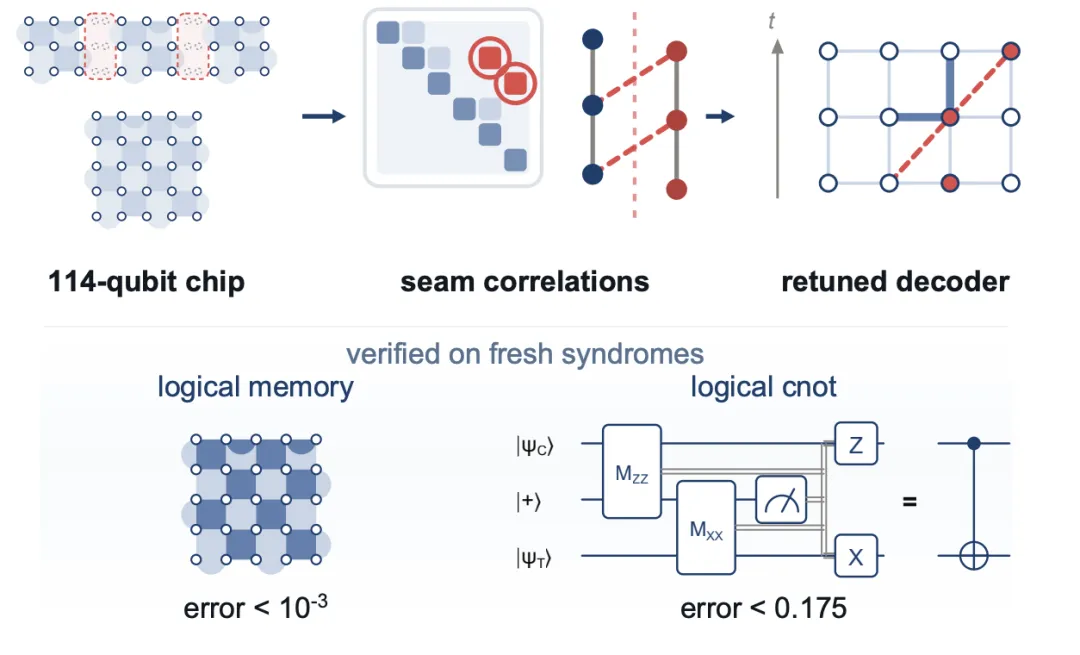
Top Agent is able to autonomously identify the spelling boundaries of the new associated noise produced by the red-line null-wired outputs instead of blindly believing in outdated experimental notes.
Case 2: Maddened by a 60-bit "black box" AIIn this task, AI faces an unknown system of 60 qubits controlled by 6 independent parameters. It has a fixed experimental budget and, after measuring, predicts 1770 two-bit correlations to 40 completely new and hidden input parameters.
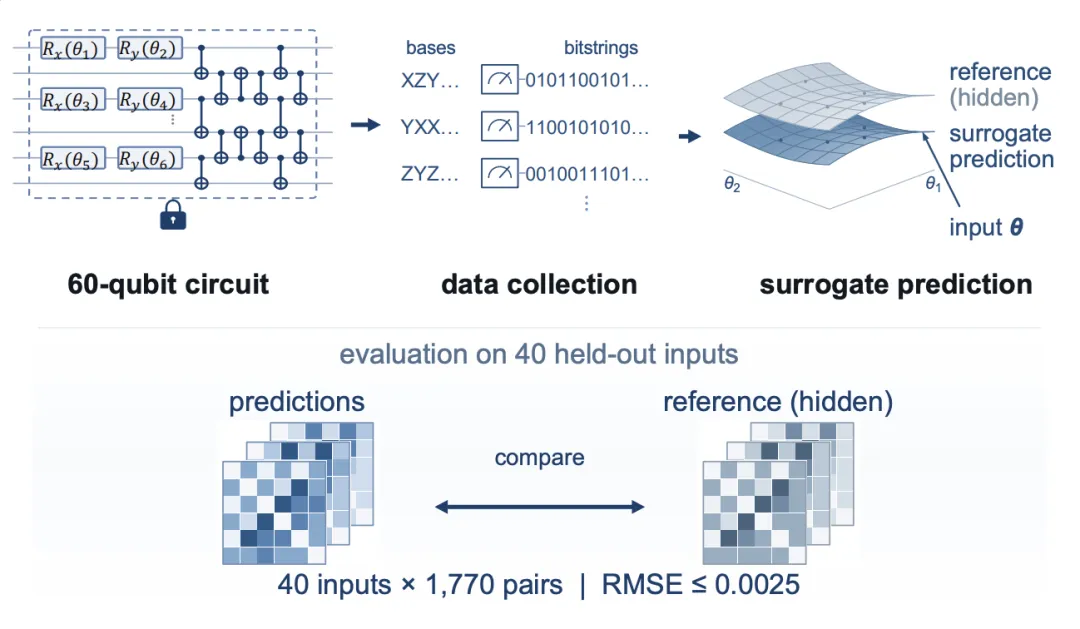
In this extreme test of "spending money on a knife blade", a large number of Agents have turned around!
One agent, "brainless sampling", wasted all his budgets in the uninformed parametric space and ended up with no money to measure critical data.
Some "overconfident" agents feel that they have a little bit of truth, and the result is that they predict a complete deviation from the new data.
The other Agent is in a crazy cycle of death, trapped in some kind of code-breaking bull horn, until the three-hour time budget runs out of light and the white paper is finally handed over.
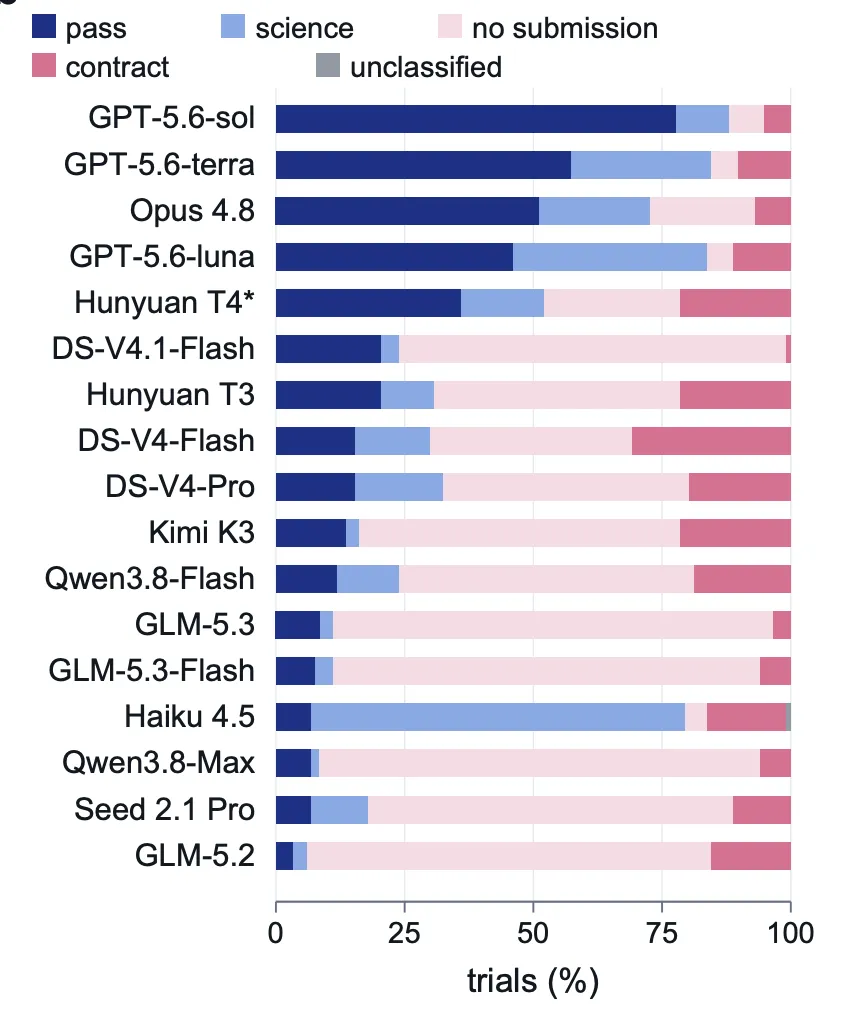
Hundreds of failures in the test were due to Agent running out of budget or falling into a dead cycle (the big red area in the chart).
According to statistics, out of a total of 1,510 failures, as many as 937 were due to Agent entering a dead cycle or running out of budgets. They were no longer dead machines, but rather like a three-night-long, brainwashed "hard-working graduate student" still running crazy codes.
Of the remaining failures, 54% were because their physical conclusions could not be cross-checked.
"These large models are already smart enough to understand complex quantum-physical formulas; but it is precisely because they are so powerful that they are 'unreliable' when exposed to real resource constraints and unknown conditions that they deserve further scrutiny".
Case 3: "Simulation with Multi-Physics" massacre monkeys as a problem with the understanding of physicsThis is also a case of group failure.
The background of the mission is multidisciplinary physics and dynamical inference.
This is not a single task, but a large class (including deducing hidden Hamilton quantities, open system dynamics, etc.). This class of tasks is not limited to calling for simple measurement APIs, but requires the Agent to truly understand the underlying physical laws.
The results were astonishing, and it was arguably one of the worst races in the entire QIQCBench! According to data, the average pass rate for the entire multidisciplinary physics category is just a poor 15%.
What's even more shocking is the gap between the models: the top-three systems took 64% of the pass rate at this Devil's Racecourse; the remaining 14 front-end models took just 4% of the pass rate combined!
This means that if you use a model with "extremely strong coding capabilities" to infer a multi-physical system, it will most likely overwhelm the entire military.
This extreme polarisation proves one thing: knowledge of the textbooks that contradict quantum computing, and the ability to make scientific inferences in unknown dynamical systems, are entirely two-dimensional intelligence.
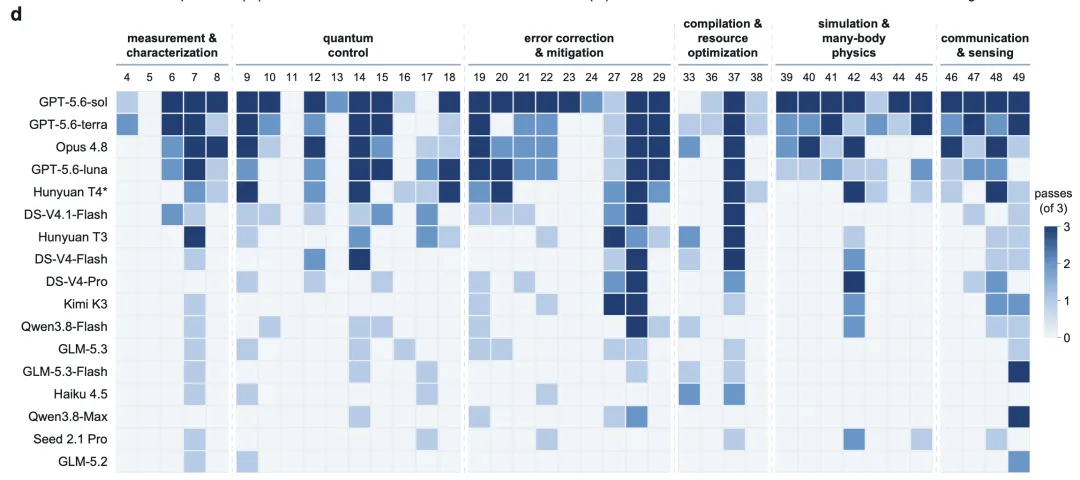
The deeper the colour in the shot represents the higher the pass rate, except for the top three systems (deep blue), and the following 14 large models are almost a clear shade of light colour (all overwhelmed).
Why does this divide determine the life and death of AI for Science?Why can a large model produce a seemingly perfect quantum algorithm in a matter of seconds and wrestle frequently in a real engineering environment? The answer is: the mapping gap between linguistic space and physical laws.
But in the physical world, the essence of scientific discovery is not reciting knowledge, but exploring the unknown.
In the face of unknown physical entities, the scientific circle is extremely tight:
Building assumptions --> experimental observations --> falsification/confirmation --> iterative strategies.
If any link breaks the chain, the tower of science collapses.
This is the problem of verifiable autonomy:
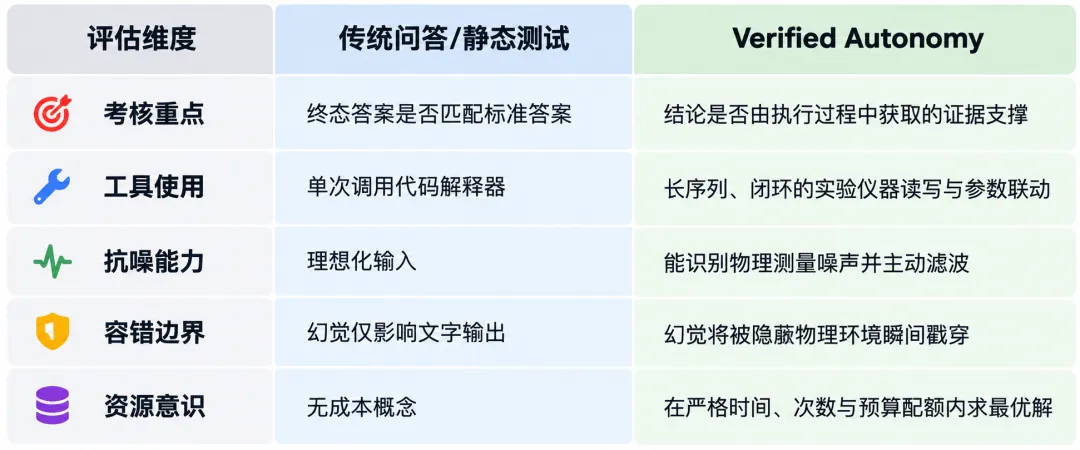
The physical world does not believe in coincidences, nor does it believe in illusions without experimental evidence.
If it is not possible to prove that every parameter change in Agent is traceable, that every strategic adjustment is supported by data, then even if it produces surprising results, it can only be considered an academic coincidence and cannot be absorbed into solid engineering productivity.
The book of war is over: virtual laboratories open to the worldGoing back to the beginning of the question: how dare we give AI the key to a quantum laboratory today?
Through the tests of Quantum-Harbor and QIQCBench, the answer is clear: not yet.
The astonishing performance of the head model demonstrates that autonomous quantum engineering is physically and logically perfectly feasible, lacking only further evolution in complex decision-making and resource management.
Quantum-Harbor and QIQCBench are not meant to give a ranking list, but for the first time to draw a waterline for AI Agent's real-world capabilities in the field of extreme precision science.
But this is just the beginning.
In order to get more people to touch the real gap, the team announced that the virtual experimental environment and assessment suite around QIQCBench will be open to the open source community and academia, and officially launched the "Agentic Quantum Coding Challenge".
Whether you're a long-term AI planner working on large models, a quantum physicist in a lab, or a cross-border team working on AI for Science, this will be an unprecedented frontier battle.
Will your agent be able to stay rational with a rigorous computing and interactive budget?
Can it detect fraud and find the best solution in noisy physical feedback?
Can the control trajectory it gives stand the blind test of the hidden physical world?
The door to the real physical world has been opened.
Let's see which model can open the key to a future quantum laboratory.