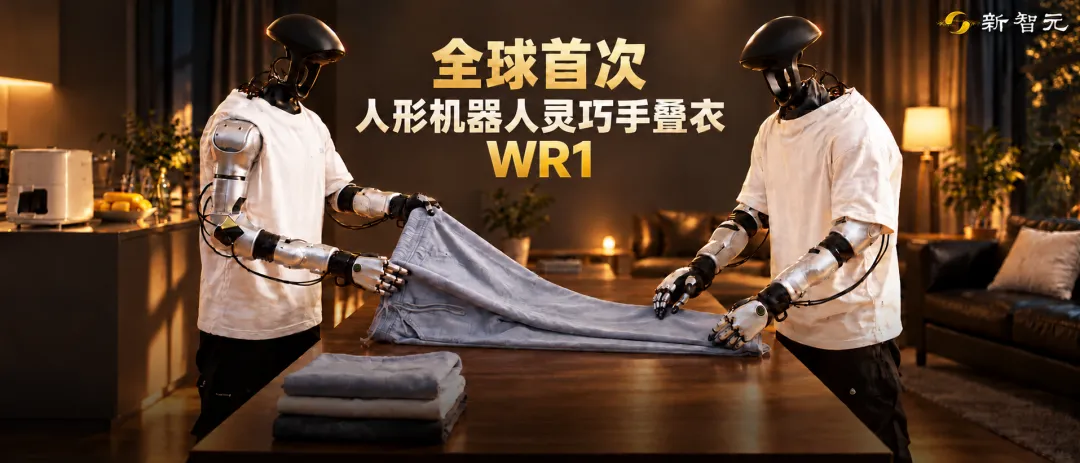
It's the first time in the history of the world.
Making robots do household chores is a recognized high-stakes scenario in the field of physical intelligence.
Where's the difficulty?
The home environment is designed for humans, with robots bending, bending, turning and adapting to human space, and household objects are mostly flexible objects that change shape with each pull.
More importantly, real housekeeping is never a one-stop-shop, but a chain of interlocking tasks.
From the fridge to the ceiling, from the sofa to the mattress, wherever it stops, breaks or is unstable, the whole task will come back.
That's why so many humanoid robots have demonstrated publicly that they mostly rely on single-point skills such as "catching a cup" and "folding a towel".
Once the task link is extended and the operational scene switches, the continuity and stability of the entire set of actions is difficult to maintain.
West Lake's newly upgraded general-brain WR1 has more critical capabilities to match or even exceed overseas benchmarks, facing the real complex domestic hardcore challenge.

WR1 uses the world's first general-size dual-brain pre-training system architecture to integrate multi-modal task understanding with full-body control depth.
WR1 combines the World Model (WM) and the Visual-Language-Actional Model (VLA) with a complete sequence of movements, based on visual observation and language instruction, consisting of body movements, body postures, and dexterous hand-operation; body control, handed over to GAE, the world's first general-action supermodel developed by the original self-development, completes high-speed stable execution.
Folding clothes, cooking, cleaning the living roomA consistent household demonstration of WR1When entering a real family, the opponents that robots encounter are often not rigid objects, but clothing that collapses and becomes deformed.
The classic difficulty in the operation of clothing lies in the constant change in the state of the object: the drawer changes the shape of the fabric, the movement of the shelf leads to a shift in position, and the movement of the collaborative object also affects the development of the clothing.
The first presentation of the WR1 addresses the issue of the high barriers to flexible clothing operation.
In the demonstration, the WR1 first removed the collar from the coat shelf, holding it on its arm like a human.
In the process of removing the clothes, the shelf moves with it, the position of the two T-shirts on the shelf is shifted back and forth, and the robot continues to observe, adjust in real time, and still stably finish removing the clothes.

It then threw the T-shirt over to the machine arm, which automatically recognized the clothes and began to fold; the humanoid robot turned and laid the long shirt on the table, folding it in sync with another humanoid robot.
The two robots observed each other's movements while adjusting the co-operation according to the real-time status of the long tail, taking clothes, carrying, transferring, unfolding and folding into a series of operations.

Among them,This is the first demonstration in the world of a humanoid robot's handy self-folding clothes.The technical difficulty is significantly higher than the standard fabrics such as folding towels and bath towels that are common in the industry today.
Figure has been publicly shown to be more focused on the smooth operation of objects, sub-paledness, simple fabric sorting, and has not yet shown such high-difficulty flexible tasks as removing clothing under external disruption, and folding in tandem.
The WR1 needs to continuously offset the friction, textile shape changes, multiple disruptions caused by bi-machine collaboration, and to exceed the Helix solution in flexible dynamic object handling capabilities.
If the skill test is "handcraft", the second demonstration test is "global scheduling and long-range task handling".
The WR1 moved more widely and opened the door to take out the corn before reaching the refrigerator; then, with a quick U-turn, the WR1 arrived at the air fridge, adjusted the station position, held hands and pulled out the fridge and put the corn in.
Next, she grabbed the receiver's hand, dipped the dolls on the couch and the tea room into the tray, and then went to bed to clean up the baby.

A chain of tasks, spanning three residential areas of the kitchen, living room, and bedroom, is executed consistently and uninterrupted.
The whole process does not require intermediate manpower resettlement, does not require instructions to be sent in stages, runs multiple scenarios at once and completes complex household tasks.
Don't stop. Don't stop.Rise of the three core basics of housekeepingFluidity is merely perception, dismantling these two demonstrations, and really determining the success of the three underlying capabilities is the synergistic generalization of flexible objects, the execution of long-range tasks across scenarios, the integration of fluid motion operations.
The three responded to the three core challenges of the family scenario: the uncontrollable shape of the object, the long and cross-domain chain of tasks, and the high demand for motion welding.
Flexibility of objects is the first of the three capabilities to face the home environment.
Clothing can be a typical object of continuous change in form: position, textile state and collaborative posture are constantly changing, while WR1 maintains observation during operation, real-time adjustment, and extends the complexity of tasks from single clutching and flat folding to continuous clothing sorting and dual machine collaboration under dynamic disruption.
In the face of changes in shape, external interference, the robot will not fail a direct task because the object state deviates from the default, and will be able to adjust the strategy in the field.
The difficulty of performing cross-scenes long-range tasks increases to one level.
The object, the direction, the position and the height of the body are changing, but the task cannot be stopped.
The robot must complete each link and maintain the order of the tasks and the linkage of the movements. In long-link tasks, the single-step success rate is higher and the overall success rate of multiple steps decreases rapidly, which is a common pain point in the robotics industry.
WR1 demonstrates the consistent conversion between different spaces, different objects, different operations. The value of long-range execution lies at the junction of these links.
To put it all together into a mirror-like perspective, the WR1 is a highly dynamic, streamlined motion-operation integration.
The humanoid robot handles the corn turning near the air-fried pot, takes up toys of different heights after the bottom of the pot, carries the long pot rolling out to the table, a set of movements, body movement, gesture adjustment and hand operation are always tightly bitten, feet, knees and hands are coordinated around the same operational goal, the stopping and mutation of the joint at the level of the mechanism are pressed to a minimum.
How to think, how to moveThe answer is "all the way".Where did the three powers come from?
Dismantling the system architecture of WR1, the answer lies in the division of general brain and body movement operations, and the permeation of an easily overlooked keyword.
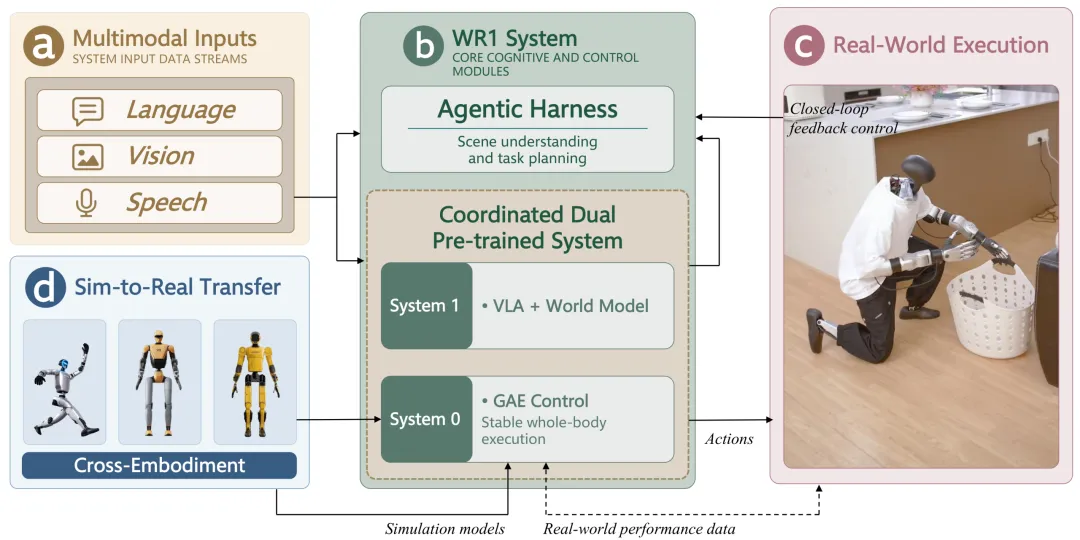
WR1 system architecture: task management module organizing tasks, VLA co-generating actions with world models, GAE responsible for full control.
On the general side of the brain, WR1 combines multiple viewpoint visual observation with its own state, in a single sequence of movements, gestures and hand-operation instructions, and is responsible for organizing instructions and task processes by the task management module.
Feet, feet, hands and feet are no longer in each other's hands, and parts of the body take precedence.
In order to ensure consistency of movements in long-range tasks, WR1 introduced a mechanism for short-range motion review, allowing the model to identify the current movement phase of the body and generate context for subsequent movements.
The real-time movement segmentation mechanism takes into account the trajectory being executed when the next movement is generated, while the robot continues the movement, the model is preparing the follow-up movement, reducing the stops and mutations from the movement update on the mechanism.
On the sports side, GAE assumes full body movement tracking and balance control.
It uses large-scale, multi-source human movement data and two-stage training, covering movements such as walking, turning, bending, and stretching, to provide a unified execution basis for cross-regional, cross-altitude operations.

Full-body movement tracking demonstrations: people and robots simultaneously perform movements such as bending, turning, lifting legs, jumping, etc.
At the same time, the adjustable forward mechanism is responsible for compensating for the execution of delays.
In WR1, this mechanism is calibrated for the remaining delays after action buffers, ensuring consistency of execution with the action coupling mechanism, allowing general brain intent to be timelessly aligned with hardware execution and intent to execution realization.
What really differentiates WR1 is its end-to-end route.
At the same time, GAE undertakes the underlying control of demonstration collection and autonomous execution in two phases, sharing the same set of control bases as training demonstration and autonomous execution, which compresses the gap between learning and execution from the root.
"Thinking Clearly" runs along the same lines as "Move On", which is the underlying reason why WR1 is able to make long-term housekeeping consistent.
From organizing dynamic clothing to cross-regional housekeeping, WR1 integrates task understanding, environmental feedback and body control into a complete chain.
This mirror is a coherent demonstration of household chores, and a step closer to bringing humanoid robots into the ordinary home.
Deeply cultivating the general brainFull-fledged man-made robotsWest Lake Robotics Technology (Hangzhou) Limited, is the first outcome transformation project in the field of artificial intelligence and robotics at West Lake University.
The company insistsGeneral brain + pupil full body small brain + self-developed pupil coreTrinity's fully self-contained research pathway, focused on the development of the basic general model of humanoid robots, with the core goal of understanding tasks and controlling the movement of the whole body, building a humanoid robot general brain for household services, industry and special job scenarios.
The team is committed to pushing humanoid robots out of the lab's single-point demonstration bottleneck to achieve a continuous autonomous operation of long-linked, high-disturbance scenarios under real production life environments.
The founder, Wang Tong Lin, is the chief scientist of the National Science and Technology Innovation 2030 major project, a lifetime professor at West Lake University, the deputy director of the Department of Artificial Intelligence, who works deeply in the field of robotic learning and is a leading figure in the field of physical intelligence and robotic learning in the country; the co-founder, Zhang Yue, a lifetime professor at West Lake University, the vice president of the College of Engineering, an internationally renowned expert in the field of natural language processing.
The company's R&D team, which brings together scientific and engineering talent from the world's top universities and industries, has completed several rounds of hundreds of millions of yuan in funding to continue advancing the evolution of the human-robot general brain.
Getting into the family is just the beginning, getting into hundreds of industries, serving thousands of millions of families, and that's the real distance between West Lake robots.
Rooted in fertile productive research soil, in the future, West Lake robots will continue to rely on Trinity's full-fledged self-development trajectory, allowing humanoid robots to enter the broader scenery of home care, industrial manufacturing, special operations, and accelerate the realization of intelligent GPT moments.