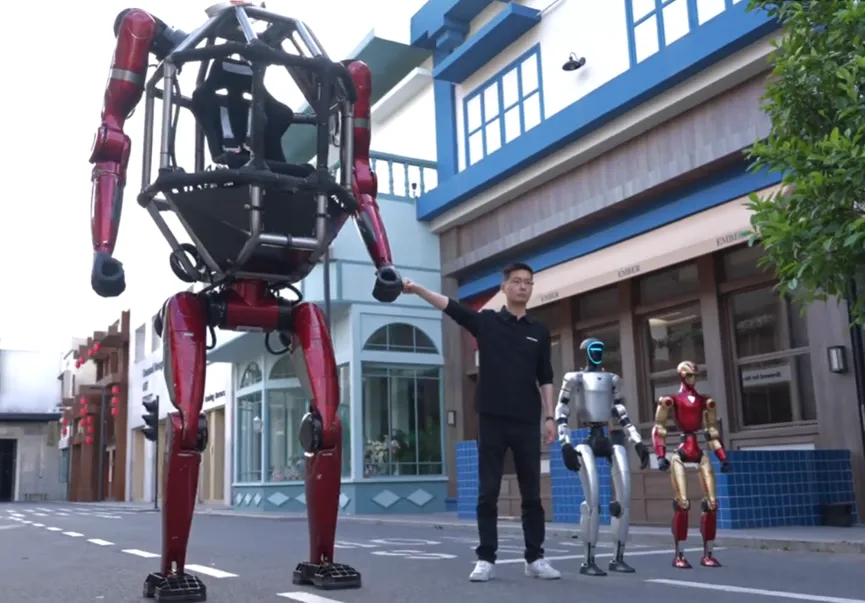
“ From a desk to two floors high, humanoid robots are no longer just a standard answer.
Full-size humanoid robots used to be the most well-rounded running posture in the industry.
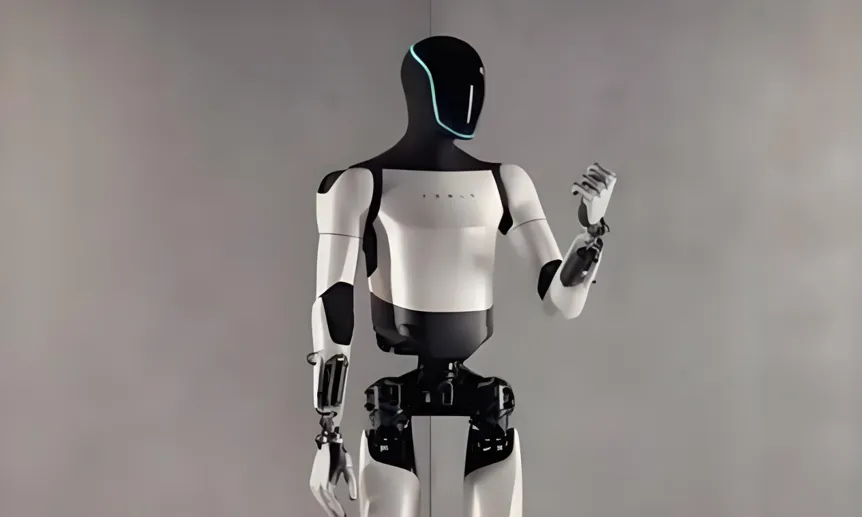
One-foot-seven in height, close to an adult, able to walk, run, and grip. This model, which began to be repeatedly copied from the Tesla Optimus, has become almost an industry-recognized standard solution.
Entrepreneurs use it to write BP, investors use it as TAM, and the media use it as a cover art. In the last two years, almost all similar conferences have followed the same answer.
The full-sized robot became the default option for human robots.
But the wind is blowing faster than imagined. The power to break this option comes from two seemingly opposite directions. On the one hand, small robots under a meter in height are accelerating the influx into the consumer market, with prices rising from hundreds of thousands of yuan to less than 10,000 yuan; on the other hand, large robots several meters high appear on the stands, becoming one of the top trends of the exhibition.
A curve down, a curve up. The body of the humanoid robot is being forked.
01.
It's time to make the next generation of chickens.
What is a small-sized humanoid robot? There is currently no uniform size in the industry.
Full-sized humanoid robots, as the mainstream model, are generally understood to be about or equal to the average adult height of about 1.6 to 1.9 meters. As a standard, Sullivan reports that height below 100 cm is divided into small sized rodents.
But according to the Robotics Workshop, from an industry-wide perspective, human robots between 0.6 and 1.4 meters in height should be divided into camps that are currently smaller in size. Less than 60 centimeters are closer to desktop electronic toys; more than 1.4 meters are starting to lean towards full size toys.
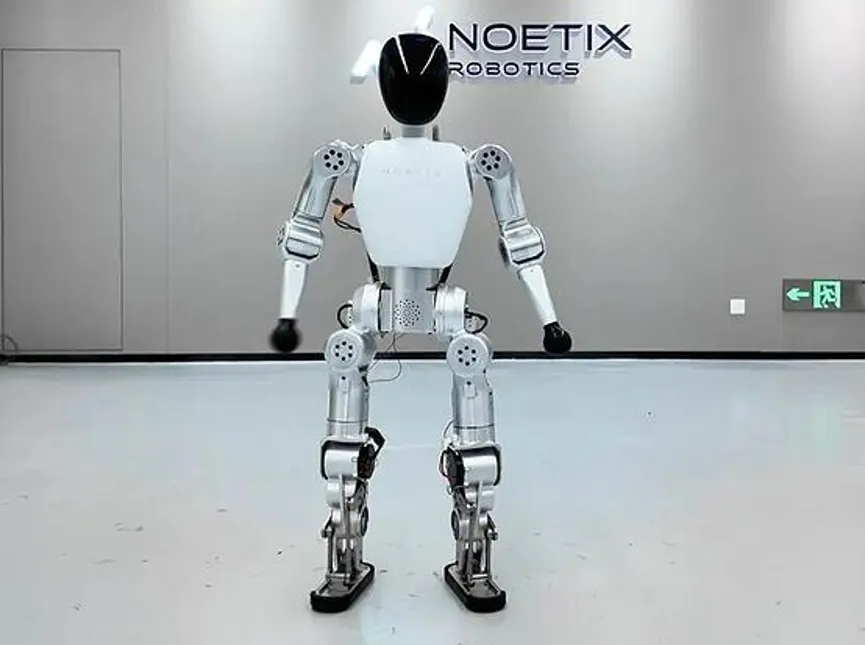
So why is miniaturization becoming a trend? The most immediate reason is that small robots have proven for the first time that they can sell out.
The Sullivan report shows that in the first half of 2026, global sales of humanoid robots reached 36,000 units and exceeded 35,000 in 2025, more than half of which, or 1,97,000 units, came from small robots under 100 cm in height.
This is well supported by the public market data for domestic humanoid robots. The slow-moving Bumi is priced at $9998, with the first 500 units sold in two days.
Behind the sales data of these small-sized humanoid robots is a completely different product logic.
The first layer of logic is the consolidation of technology. In the past, humanoid robots were difficult to make small, with the core bottlenecks in the joint modules. The decelerators, motors, drivers were stacked together, the volume did not decrease, and the cost did not decrease. When the QDD quad-direct drive joints were compressed to the size of an egg, the overall volume shrank to one-eighth of the traditional model, the engineering ceiling of small humanoid robots was unlocked.
The company's real technical barrier is the development of the world's smallest matrix joint with a diameter of only 6 to 7 millimeters, which is about the width of an adult's small thumbnail covering.
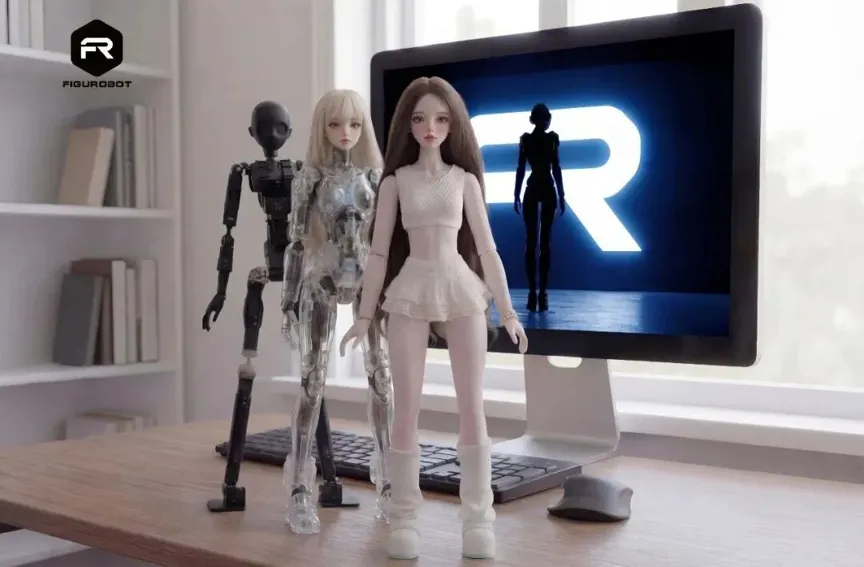
The second layer of logic, and more fundamentally, is that miniaturization is the first step in switching humanoid robots from capital market storytelling to consumer storytelling. In the technical testing phase, robots must be like humans, because humanoid robots are proof of technical strength. But in the landing phase, consumers do not need a metal giant nearly two meters high, with a sense of oppression.
At the same time, fewer joints, smaller batteries, lighter structural parts mean lower material costs and faster turnaround speeds. Small volumes, the cost of testing with shrinkage, the cost of breaking down into a shovel, and innovation gets a kick out of hand.
For the industry, the van is an important cannon, and miniaturization is the most realistic path across this cannon.
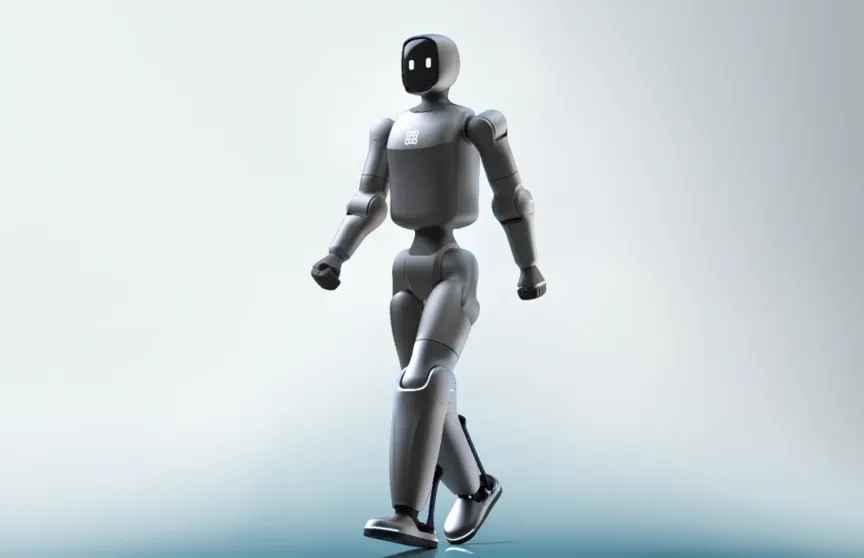
Of course, the price is both a weapon and a soft rib for small robots.
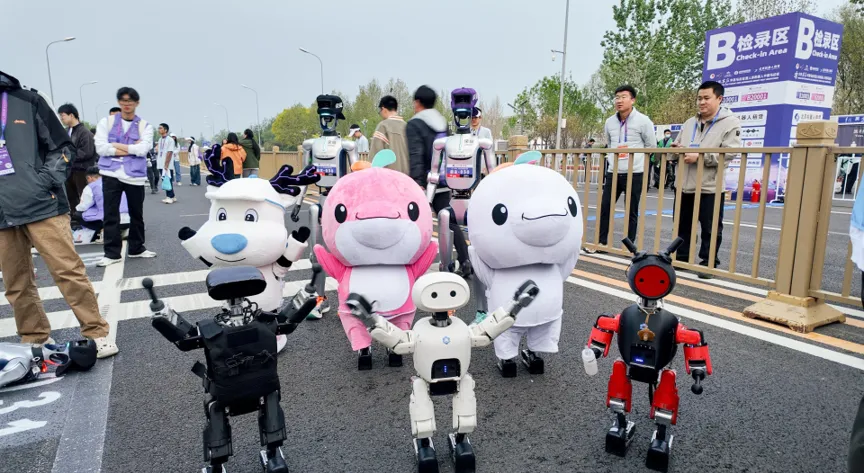
Currently, the core product matrix of small human-sized robots has been quite crowded, with slow-running power Bumi priced at $9998, the U-tree R1 Air priced at $299,000, accelerating the evolution of the Booster K1 with a limited sale price of $299,000, and the high-engine powertrain Crankshaft for around $50,000.
But the other side of the decline is the embarrassment of revenue ratios. According to the Sullivan report, only $199 million in revenue from 197,000 small-sized robots represents less than 4% of the total worldwide revenue of $540 million.
This is not difficult to understand. Yuan-level pricing means that profit space is extremely limited, and the use of small-sized robots, such as family companionship, programming education, entertainment shows, and so on, are currently at a stage where they are not just needed. These scenes have real demand, but the ceiling is clearly visible.
Of course, miniaturization is not a so-called silicon downgrading pump, but rather a precise trade-off: changing costs by size, changing scenes by scenes. Although the requirements for universal silicon are not so high, the requirements for price sensitivity, interoperability and deployment convenience are high, and the family scene is the most imaginable long-term check.
Related practitioners say that small-sized robots play more of a leading role, and the prospects for commercialisation of large robots are unclear at this stage, with consumer-grade products opening up market awareness, verifying user needs, and running supply chains.
This list continues to grow.
02.
The rise of enlargement: when robots no longer mimic humans
In contrast to the downward-compatible silicone consumption market, miniaturized silicone is a thoroughly hyperspecific silicone pipeline that far exceeds the full-size range, directly exceeding the size of humans.
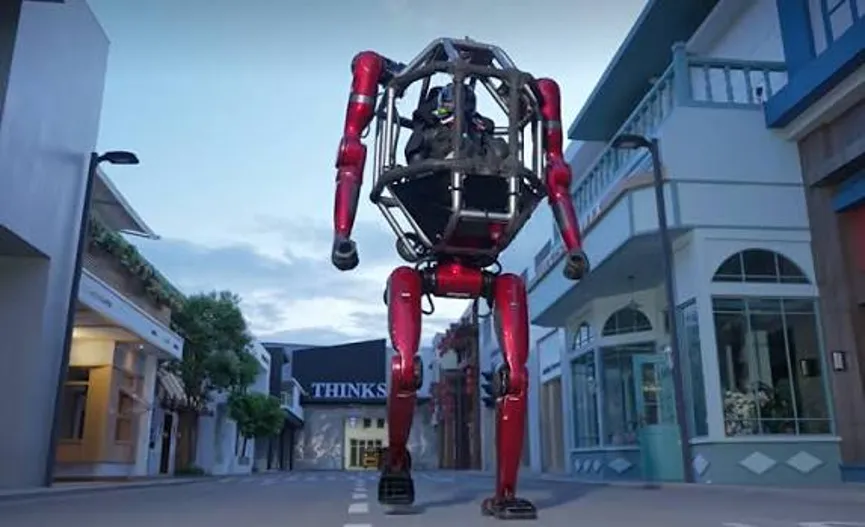
The U-Boat GD01 manned Transformers A, weighing about 500 kg after manned, sold for 3.9 million yuan and supporting the rapid switching of manned upright walking and four-legged crawling dual models.
The ultra-human robot has a height of about 4 meters and a single-arm load of 300 kilograms. The ZERO height is close to 300 meters, showing the internal structure in the form of a transparent disassembly column. The Chinese giant is up to 6 meters tall when standing and more than 3 meters in a sitting position, with one arm weighing nearly 100 kilograms.
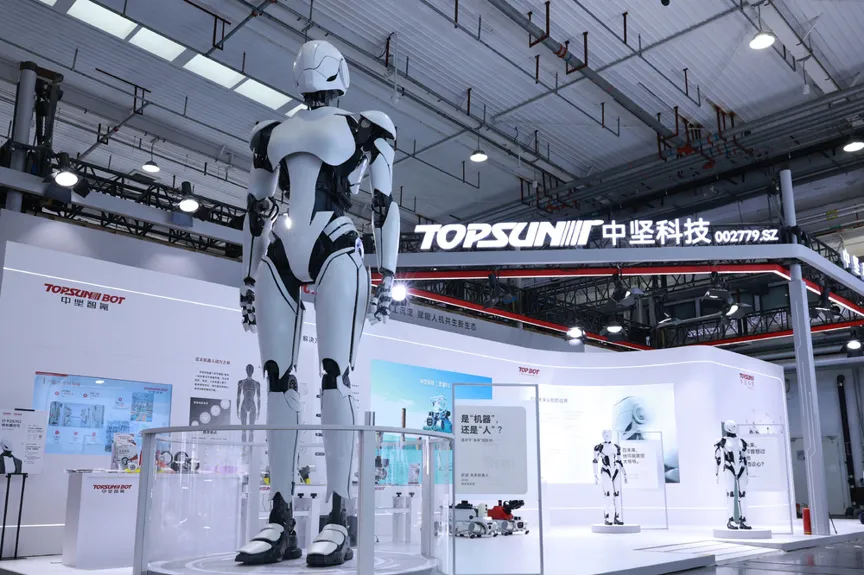
Why would enlargement become a new trend? Wang Xing's expression is the key to understanding this trend.
Faced with the curiosity of the outside world about why Wu-Tang is developing large-scale manned robot models, he responded that as AI and robotic underlying technologies continue to mature, the development of large-scale robots and small robots is not in conflict, and that large robots are an unstoppable development trend in the industry, even if Wu-Tang is not the first to launch, other companies will launch similar products in the coming years.
The logic of this passage is clear: miniaturization and enlargement are not two solutions to the same problem, but two completely different problems.
Scalabilization solves the problem of how robotics enter everyday life, the key words being cost, safety, and resilience.
The four-metre liquid-electric blend-driven super-human robot, with the goal of nuclear power maintenance, deep-sea operations, and mine rescue, has 41 active freedoms, 39 of which are powered by digital hydraulic linear actuators.
In the above-mentioned scenarios, human capability is a bottleneck itself. People cannot stay for long periods of time in a nuclear radiation environment, people cannot directly operate heavy components under high pressure in the deep sea, and human deforestation in the rubble after a mine collapse is extremely low.
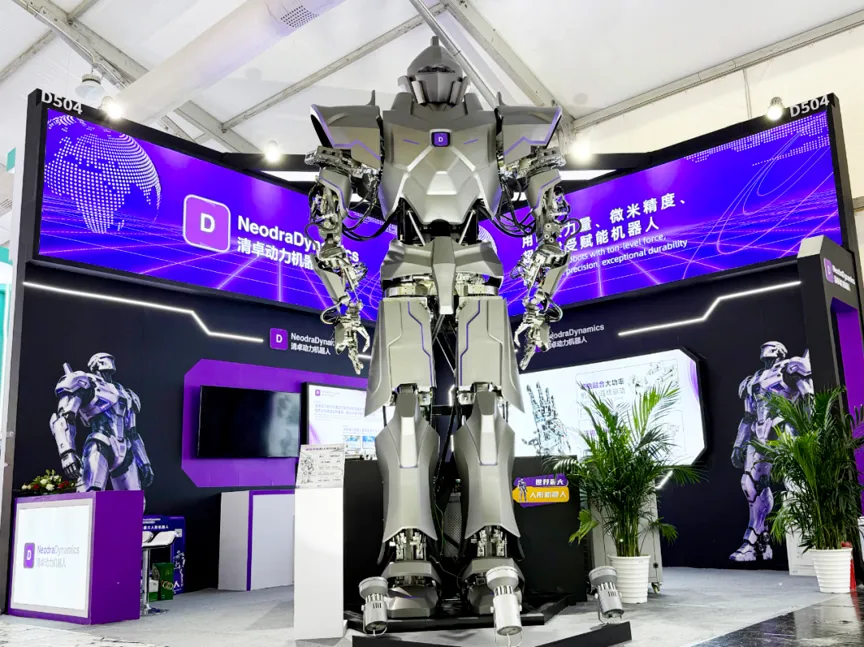
In terms of pricing logic, enlargement and miniaturization are not exactly in a coordinate system, which is closer to industrial equipment than to consumer electronics.
A deformed machine capable of walking in complex terrain, with dual-legged and quadruped dual-legged mode switching capabilities, with all-terrain rescue vehicles and special engineering machinery as a benchmark.
It is worth noting that the price of full-sized industrial-sized robots is falling rapidly. The price of industrial-sized robots itself has dropped to between 500,000 and 700,000 from last year's million level, and the two-year decline in the price of full-sized robots is like a mirror reflecting the imagination of the future price of large robots.
03.
From struggling stacks of bricks to forks, the industry has begun to make choices.
Back to that core question, when the industry started competing for full-size humanoid robots, why did it suddenly start chasing down both miniaturization and enlargement?
The answer lies in the industrial shift.
At this stage, full size is the most reasonable option. It is the default parameter for the human labor market, is the standard carrier to tell the capital market the story of the robotics industry, and is the largest convention in the valuation narrative.
But when the technological verification phase ends, and the industry enters a new stage where it proves commercially viable, full size is instead an embarrassing middleman, about cost and power, than small robots; about load and extreme environmental adaptability, than large overloaded robots.
Full-size is arguably the slowest role in the show, as it's not really comparable to humans in terms of replacement work, cost, efficiency, and reliability.
At the same time, miniaturization and large-scale explosion is essentially the inevitable result of human robots moving from fantasy fantasy to fantasy scenarios.
The underlying driver of miniaturization is the call for consumer-level markets. When the hardware cost of humanoid robots drops to a critical point, the willingness to pay to educate, accompany, and showcase these scenes begins to emerge.
Starting in the second half of 2025, more and more companies are opting for miniaturization, a low-cost miniaturization strategy, and relevant data shows that from May to September 2026 alone, seven companies have released small-sized humanoid robot products, six of which are new entrants. New players no longer start from full size, but directly choose miniaturized racetracks, which in itself indicates that the industry's default runway has changed.
The underlying drivers of enlargement are the real needs of special operational scenarios, which are no longer discussed here.
Of course, this does not mean that the full-size route will be abandoned. On the contrary, it may still be the industry's long-term most valuable direction. But the rise of both miniaturization and large-scale shows that the industry is moving from the early stages of pushing everyone to do the same thing to the divisive stage of pushing different people to do different things.
Human robots are physically forked, essentially the industry is looking for its own first principles. The robot does not have to be a replica of humans, it can be smaller and smaller than humans to become a consumer product; it can also be larger and larger than humans to become an industrial equipment.
From this point of view, the size fork is actually the liberation of the imagination. Just as mobile phones will not have only one size, humanoid robots will eventually have a full scale from desk to adult, from companion to worker.
The era of full-size isn't over, it's just not the only answer anymore.