Currently, papers and large-scale models in the field of touch are mostly concerned with how touch signals are perceived, expressed and integrated.
The first test: from simulation to simulation to real-world simulation.
Flexibility has always been one of the most challenging areas of research in the field of robotics. In academic research, many works have been able to accomplish sophisticated maneuvers in a simulated environment, but after moving from simulation to the real world, operational effects may still be noticeably impaired.
DexSim2Real: Foundation Model-Guided Sim-to-Real Transfer for Generalizable Dexterous Manipulation is a paper that quantifies the absolute difference between simulation and actual manipulation.

The authors used NVIDIA Isaac Sim and PhysX 5 to perform physical simulations and real-world tests using the Allegro mechanical hand,[16 degrees of freedom] in contrast to their simulation and real-world gaps. The results showed that even after special sim-to-real methods (DexSim2Real) treatment, the average gap between their simulation and real-world success rates remained at 8.3%.
Second test: Hardware can't penetrate the real world
Flexible hands in the lab can conduct targeted modeling around a demo; however, entering the real scene, they are faced with objects of different sizes, materials, weights, and shapes, as well as a large number of unexpected collisions, friction, and errors. This places higher demands on the freedom, drive, sensing, structural strength, dissipation, and lifespan of the flexible hands.
Thus, the second test was the skillful operation of the real landing, first of all the hardware that could not be bypassed.
Especially this year, both at the academic end and at the market end, the percentage of tactile sensation in sophisticated operations is increasing. Academic research is continually expanding the perceptual boundaries of tactile sensation, from the previous main layout in contact areas such as the thumb and forefinger, further extending to positions such as the fingertips and nails, in order to obtain more rich contact information.
For example, in A uSkin Fingertip with a Tactile Fingernail for Contact-Rich Dexterous Manipulation, University of Chicago computer science Ph.D. student Steven Oh and others designed the uSkin fingernail with a 6D hole effect-torque sensing nail that can estimate the contact force and locate the contact location in three interacting directions: back/tip/edge.
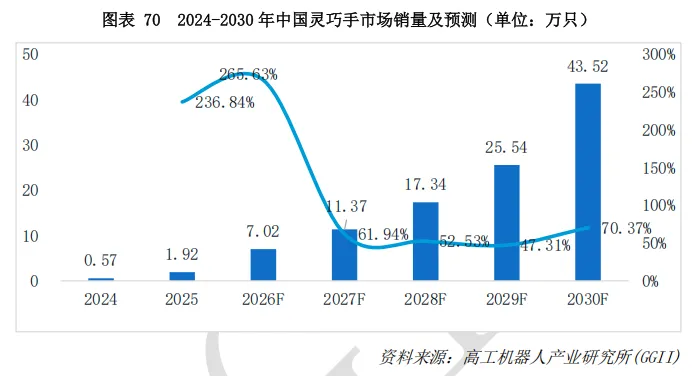
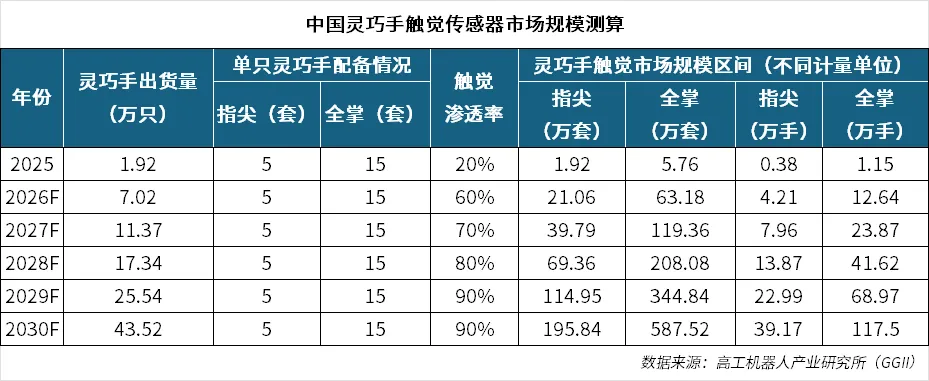
On the other side of the market, the supply of touch sensors is also growing rapidly. According to GGII statistics, in 2025, China's supply of touch sensors is expected to be between 1.92-5.76 million units, and in 2026, China's supply of touch sensors is expected to be between 21.06-63.18 million units, with touch penetration doubling.
The third test: the ability to continue working
However, hardware capabilities such as simple touch-to-touch capabilities are still not enough to support the ingenious operation of a real landing. After entering a real production environment, customers require long, continuous, high frequency tasks to be performed.
MIT assistant professor Pulkit Agrawal, in KaRMA: A Kinematic Metric for Fine Manipulation Ability in Robotic Hands, mentions that measuring how much time a robot should take to complete a task is not just a success rate; and he also believes that the role of touch sensing is not to get robots to complete tasks that were previously impossible, but to improve throughput.
This has begun to become a new way for enterprises to demonstrate landing capabilities. In May this year, Figure put F.03 into real-world logistics sorting scenes for a long-running live broadcast, which was originally planned to verify continuous work for 8 hours, then further extend the run time.
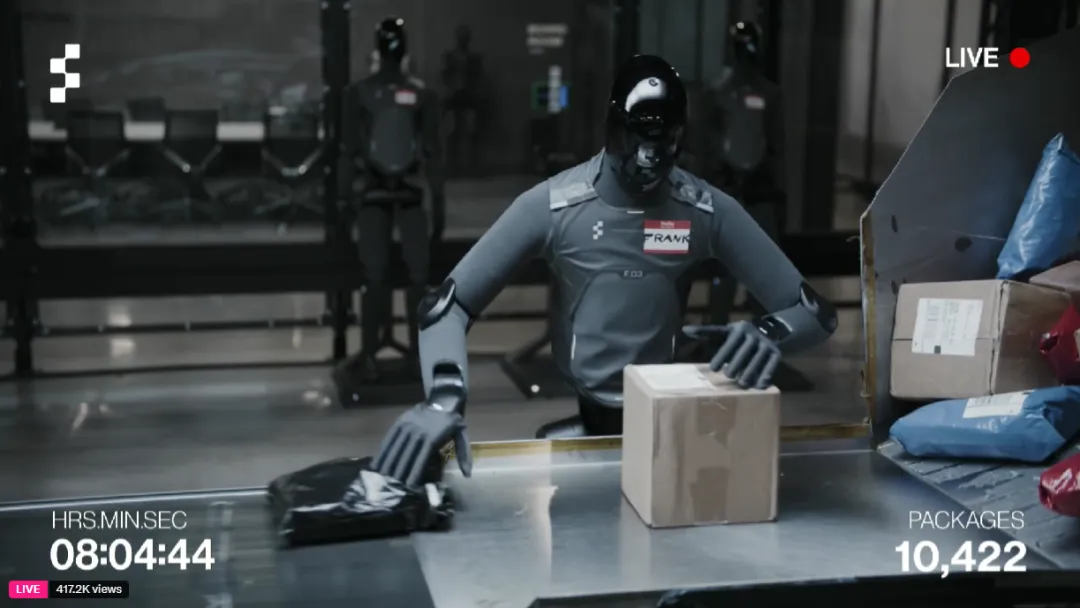
From eight hours to dozens of hours and even days, the industry is taking longer, more realistic production tasks to verify that robots can work.
Fourth Test: Data technology routes are still not crossed
From crawling, pinching, sewing, sorting, and robots entering real-world scenes such as industry, retail, and home, they are ultimately inseparable from the steady operation of complex objects, complex contacts, and complex task processes, which are highly dependent on large-scale, high-quality, diversified, and portable data supply.
However, the industry is still exploring different paths in terms of how to harvest data and how to effectively migrate human experience to robots:
Common methods, such as data gloves, remote operating systems, and outer skeleton systems, such as Intelligent Intel, have introduced the DexCap wearable remote data collection system and the DexTele remote data collection system. DexCap uses a lightweight outer skeleton structure in its design to capture and touch feedback through high-precision movements, detailing subtle movements in the hands, allowing robots to obtain more complete and more real operating data.
In particular, on the basis of the mainstream scheme, some companies are also attempting to incorporate new technical designs. In August, OctoS-DexUMI released the OctoS-DexUMI outer-bone data collection scheme with the OctoH-Hand five-fingered hand, using a single corresponding movement pattern, frequency definition and sensory configuration. When performing the same task, the number of joint angles, power, visual information collected by the handles can be directly used as a control signal to be fed into the hand system, stabilizing the entire task process.
Fifth Test: From single-point capability, to full-circuit closure of the hardware + data + model array
The previous four tests seem to correspond to different problems of hardware, reliability, and data, but ultimately all point to the same answer: agility is not a single hardware problem, but a set of systems engineering. In the past, agility was often viewed as an end-to-end execution component, with the mechanical arm responsible for movement and the hand responsible for clutching. This logic was barely enough to be used in factory drainage, but would fail in the real world.
Craftsmanship is not only the interface between robots and the world, but also an important gateway to understanding the world. In addition to the hardware itself, data acquisition, model training and algorithmic evolution have gradually become part of craftsmanship.
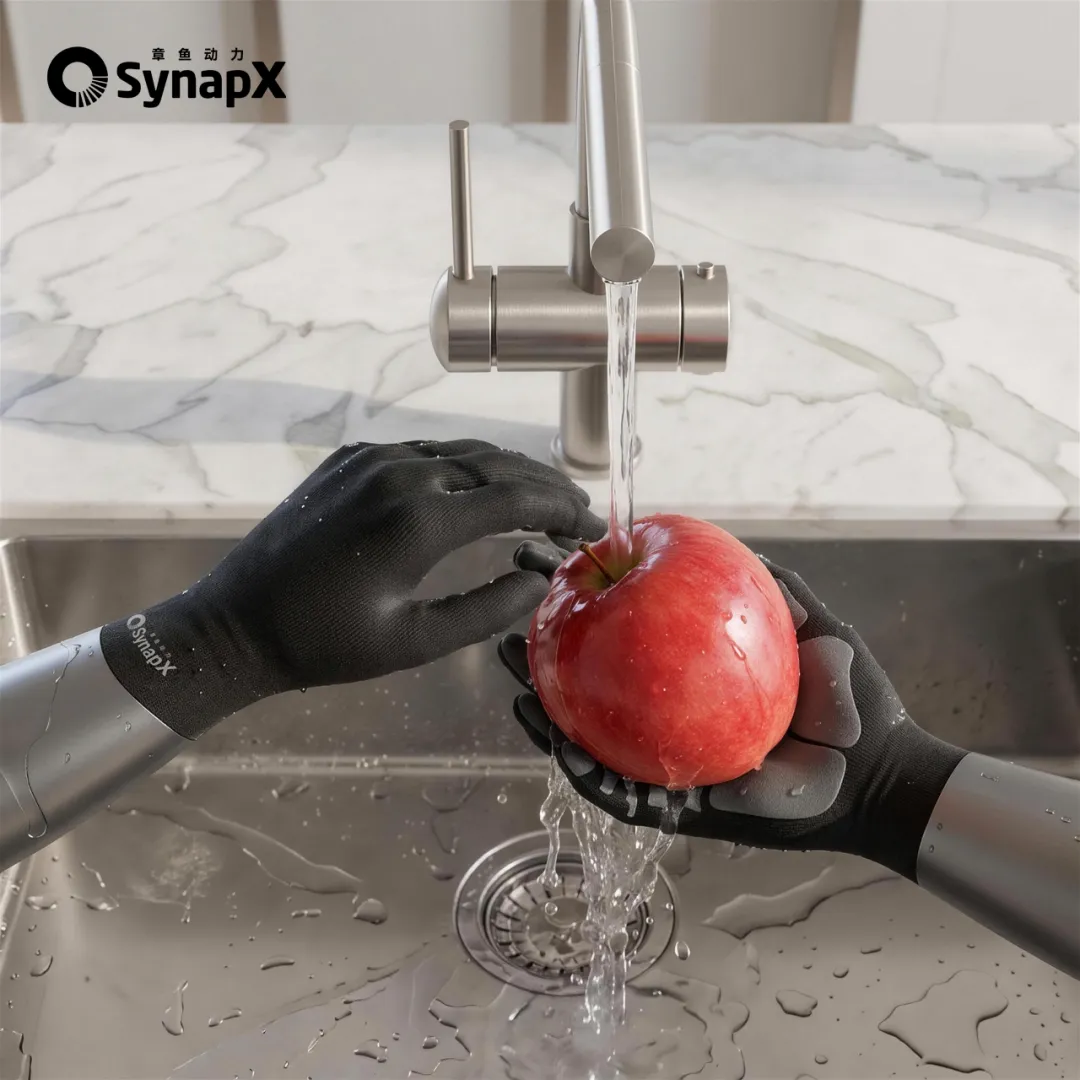
This trend has already begun to be reflected in the layout of enterprises. Infrastructure companies such as China's Kohl's are positioned as global agile operators, releasing both the L1 lightweight general agility handset, the D1 general five-finger agility handset, the M1 modular scenario agility handset, and the F-series rope-imitating agility handset, which showcases data gloves and a chain of computing tools.
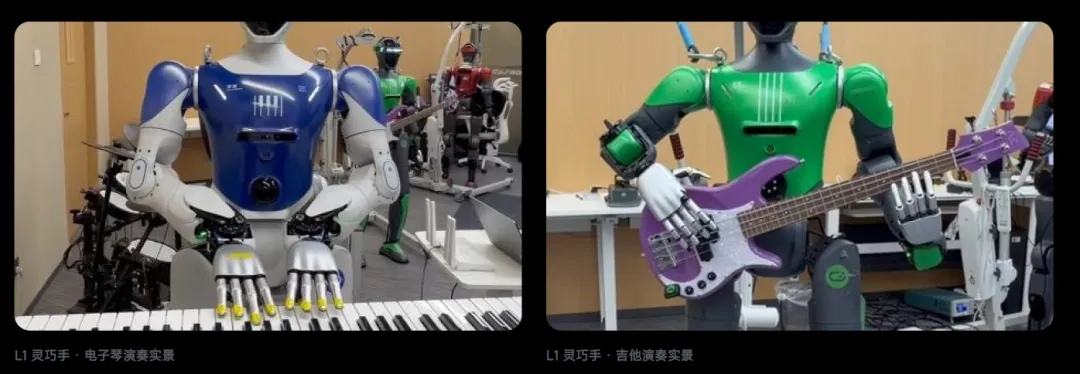
The future of agile competition may gradually extend to hardware design, engineering manufacturing, data acquisition, algorithmic iteration, plus scenario verification, etc. Whether these capabilities can be linked together to form a continuous iterative loop will be a challenge for agile operations to move further to scale applications.