He summed up the drivers behind it: the robotics industry gradually moved from concept verification to the engineering landscape. Manufacturers no longer pursued single performance indicators, but began to consider mass production costs, reliability and consistency, which directly led to a shift in the structure of upstream component demand.
For example, traditional consumer electronics customer product definitions are mature, BOM fixed, focused on large quantities, cost control and stable turnaround; traditional industrial customer product lifecycle is long, focuses on long-term supply stability and maintenance of specifications; while robot customer is in a period of rapid turnaround, BOM is repeatedly adjusted, in order to quickly verify, multi-program contrast, small batch fast test production.
The requirements at the technical level are also high for watercraft, especially focusing on the core unit of the executor. The need for robotic clients to support the components of the joint executor has shifted from the separate purchase of motor drives, power chips, to the verification of integrated joint system schemes. For example, requiring the drive chips to be coupled with power supplies, position sensors, protective circuits to be tuned, and began to pay attention to the overall performance of low noise, high torque, density, thermal management and safety diagnostics.
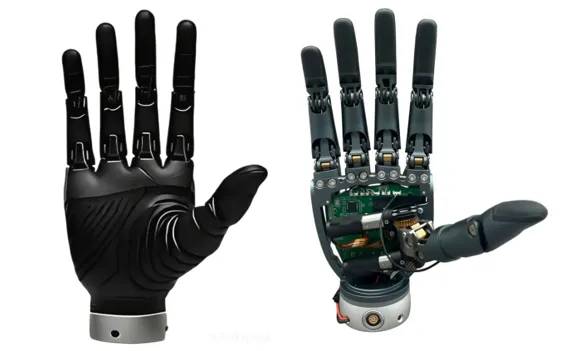
Scenario application of the 11 degrees of freedom schemes at the core of the NXP product
At the same time, as a number of automotive and intelligent driving practitioners are transforming the trajectory, many automakers are beginning to refer to vehicle regulations AEC-Q standard screening devices, which is not difficult to understand: human robots have to work in unstructured human environments, joints are often reversed, withstand shock loads, requirements for component stability and failure protection mechanisms, and even higher than traditional industrial mechanical arms.
From consumer electronics, automotive electronics to today's AI servers, the company has been deeply involved in many industries for decades, and the demands of these customers for human robots are significantly different.
Lin Ming, Deputy General Manager, Customer Marketing S Group, China, said: "In the past, distributors were a mix of supply and demand, and today customers need a full-chain collaboration that ranges from brain computing to limb-to- limb execution". Lin Ming, Senior Vice President, China Operating Area, said: "Liang is making a comprehensive shift from traditional distributors to human-machine industrial ecosystem services, with a 1+4+2+2+2+2+2+2+2+2+2+2+2+2+2+2+2+2+2+2+2+2+2+2+2+2+2+2+2+2+2+2+2+2+2+2+2+2+2+2+2+2+2+2+2+2+2+2+2+2+2+2+2+2+2+2+2+2+2+2+2+2+2+2+2+2+2+2+2+2+2+2+2+2+2+2+2+2+2+2+2+2+2+2+2+2+2+2+2+2+2+2+2+2+2+2+2+2+2+2+2+2+2+2+2+2+2+2+2+2+2+2+2+2+2+2+2+2+2+2+2+2+2+2+2+2+2+2+2+2+2+2+2+2+2+2+2+2+2+2+2+2+2+2+2+2+2+2+2+2+2+2+2+2+2+2+2+2+2+2+2+2+2+2+2+2+2+2+2+2+2+2+2+2+2+2+2+2+2+2+2+2+2+2+2+2+2+2+2+2+2+2+2++2+2+2+2+2+2+2+2+2+2+2+2+2+
From Passive Delivery to Priority Collaborative R&D
Customers have changed, and the way distributors serve has changed, first and foremost is the time when they intervene. Zhenping believes that the past habit of following a customer's designated BOM to make supplies is a passive delivery chain; nowadays, robot customers need to be involved in R&D, actively providing system solution suggestions, and transitioning from mere component suppliers to R&D partners.
As an example, one of China's humanoid robotics startup teams worked early on arm joints' chip combinations, motor-driven algorithms and sensor matching, and Liu brought in the original factory technicians to help customers complete BOM optimization, circuit parameter tuning and system testing, and finally successfully enter small batch testing.
Chang Han, director of the Land Commercial and Industrial Marketing Group at JCPOA, divided JCPOA's role in the robotics industry into three phases: semiconductor traders→ technology value-added distributors→ human robot industrial chain ecological service providers. He pointed out that to achieve such a transformation, the core competitive forces are no longer commodities and prices, but process understanding, mechanical verification, project collaboration capabilities and ecological operational capabilities.
It's not an easy road, but, frankly, whether it's the strong industrial characteristics of software-hardware, the demand for customers to buy landed effects, or the intrinsic pressure of traditional trading models, distributors are pushing forward. After more than a year and a half of cultivation, teams like the world-class have just crossed the threshold of the first stage, but there has been a significant improvement in the choice and pioneering capabilities of homogenized components.
Shen Wei, president of China's Guangdong region, said that China continues to invest more resources in production lines, technology, application of three dimensions, across single sales roles of distributors, providing customers with a range of services from product development, testing, trial production, modeling to mass production, assisting R&D and procurement personnel in solving the problems of material selection, inquiry, procurement, and supply.
According to Shen Wei's introduction, Seppin focused on the technical framework of the pump integrator + control + sensing + energy pump, whereas the pump is arranged in the direction of GaN power supply, gentle hand-microscopy and so on.
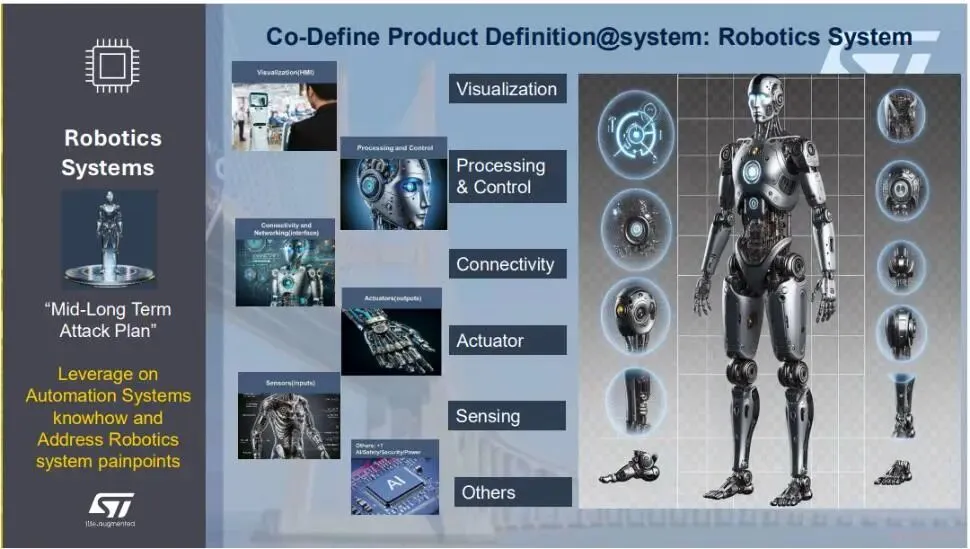
The company has launched a human-robot system-level technical layout framework/image source: Big Bang Group
In addition to the high-precision biomechanical handling, Seppin and Liu have recently introduced a corresponding solution, such as Seppin's 11 degrees of flexibility with the NXP i.MX RT1189 at its core, which achieves high-precision biomechanical handling, but also senses the size of the grip force; Seppin's semiconductor with the idea method introduced the human-robot executor full-chain solution, which is applicable to multiple connections such as joint drive, power control, signal sensing edge computation.
From running sample verification to picking up mass production slopes
How many component resources can be allocated to a single-customer runway that is still in its early stages and is not large enough to lift the human-robot industry's volume crunch?
Changhan informed that high-tech robots, the robotics business is not only the strategic priority for the industrial intelligentization sector of the PRC, but also its entire WPG 2.0 transformation as a benchmark business.
Over the next three to five years, Henhan expects the business to achieve synchronous growth performance with the industry, with a year-on-year growth of 300% and 500% respectively. But he is more concerned about not being able to take a position, to make Big Bang a downward-linking hub in the domestic robotics industry, to build complete local technology and verification capabilities around individual dominant brands, and to output direct-handed subsystems.
Since this year, AI-driven demand has allowed many components to enter the price cycle, and the chip cycle at major international factories has been extended to decades, overlapping with geopolitical variables. For the currently underutilized robotics industry, bids and locks are likely to be a problem, which is a concern for most corporations.
ShenVie's response was to integrate supply chain security into a set of more than 250 product lines, covering human-robot decision-making control, intelligent perception, agility, linear connectivity, rotational connectivity, power duration, and supply chain management mechanisms based on demand forecasting, spare cycles, and inventory forecasts. ShenVie's goal is to provide a stable supply chain security during the mass production phase.
In addition, in the face of geopolitical uncertainty, the company has also introduced more than 100 domestic semiconductor production lines. Domestic products and two international supply chains are in parallel, and it is also written in the plan for the next three years. The senior deputy head of the China Operating Zone of the Daifeng Group said that in the next three years, the company will focus on the B-end scenario landing, promoting domestic and international dual supply chain cooperation, and helping the Chinese robotics industry achieve the transition from prototype verification to mass production.
Returning to the industry's point of view, the competitive mass-production competition is far more than just a competition between factories, component selection, system integration and supply chain synergies, which also determine who can lower costs and stabilize deliveries.
For industrial chain service providers like Big Brother, the logic of this business has also shifted, not to sell out the goods in hand, but to solve the customer's problems. Whoever completes this transformation will be the first to take the lead on this unbroken track.
* Cover for AI mapping