The machine-armed man was about to grab the coffee bag, and the man next to him suddenly reached out his hand and removed the bag.
When people turn the lights on while operating the coffee machine, the light around the button changes.
Before reaching the microwave oven, the person next to it would intentionally put a can of beverage in a plate that was supposed to be packed with cake... and wait until it was ready to close the door, with one hand reaching the door...
In a seven-minute video, we see all sorts of unexpected interferences, but what's even more surprising is that these interferences have been solved by robots.
From the video, it can be seen that the moment the coffee bag was removed, the machine arm no longer turned to its original position, but in the direction of the bag being removed, re-adjusted its trajectory, and grabbed again. When the lights came on, the movement of the button was not half-deformed; the drink bowl in the plate, it did not ignore, but instead took the first step and put it aside, confirming that what was left could be safely heated, to continue the movement in the hand; the most surprising thing was that the machine closed the door, the hand just searched the door, and the machine arm immediately shrank back, quietly at the side. People removed the hand, and it closed the front door again.
These episodes are exactly where this presentation is worth seeing. Robots enter the physical world and can never escape being in the same space with humans, and there are many unforeseen situations. To get things done, robots must always notice: will the present situation allow themselves to continue as they have just planned?
This is exactly where Aether AI is good at this release of CRIS-0. It is a cause-driven robotic intelligent system. Every time the robot is disturbed, it can detect and adjust the strategy in time, and the shutdown is particularly noticeable, with a response rate of 0.1s.
This is because, in essence, it is designed to better adapt to changes in the real world. In the face of every "accident", it has to find out exactly what happened, what has changed, what the effects of these changes on subsequent actions are, whether to take a step backwards... and this understanding of change, the effect, and the ability to adjust actions accordingly, is what is called "causal intelligence".
Think carefully, this pattern of side-by-side observation is already very close to humans. This is why CRIS-0 is not only more resistant to interference, but also more capable of completing long-range tasks and personalized tasks.
Furthermore, in the field of action and decision-making in a dynamic world, which can theoretically benefit from this path, robots are only the most typical scenario and Aether AI's causal intelligence is the first step into the real world.
As for how causal intelligence solves these problems, we'll talk about it later.
Why is it not enough to just "predict the next step"?
Over the past few years, LLM has been a huge success in the digital world, with "looking for rules from large amounts of data and then predicting the next step". But it seems to have a certain peculiarity to Aether AI founder and CEO Yellow Rose.

Language is a rather special formulation: it is a discrete, human-made law that has been summarized for thousands of years, written on the surface of the text, and models can be learned well based on correlation. The physical world is quite another thing. The laws of gravity are not written on the surface, and many of the conditions affecting the results only appear in interaction.
In a world where statistical rules alone "predict the next step" are linked to several problems, such as not knowing which variables really determine the outcome, which are just background noise, being very easily disturbed when performing tasks; encountering unproven interventions in training, not knowing how to push them out; not knowing where to turn after a task fails; changing environments, not knowing which relationships have been previously learned.
Causal intelligence is complemented by this layer of "causal". It first presents the world as a variable of causation related to the task, then finds out who influences who among the variables, and finally sees the actions of the robot as an intervention to model "how the world would change if I did this".
Causal intelligence, therefore, is expected to tackle some tricky problems: out-of-distributed generalization, long-tail scenarios, cross-bodies migration, error recovery in long-range tasks, and more proactive data collection. Robots are the most typical scenario, because every robot's action is an intervention, and the boundaries of relevance adaptation are immediately apparent. However, any area that needs to make decisions in a changing world actually has the same needs. Its fundamental problem is not to "predict more accurately", but to "identify what really changes the outcome, and to act through and against the facts in a changing environment". This is why it is not only suitable for robots, but can also expand to other areas.
CRIS-0 is causally driven.
How does it work?
The CRIS-0 approach is not to have a big model do everything from start to finish, but to divide the intelligence of robots into two levels: the upper level is responsible for understanding tasks, reasoning and planning "what to do next"; the lower level is responsible for understanding specific physical changes and predicting "what this action will change the world".
The two levels correspond to the two core components of CRIS-0: the Causality-guided Robot Agent and the Causal World Model.
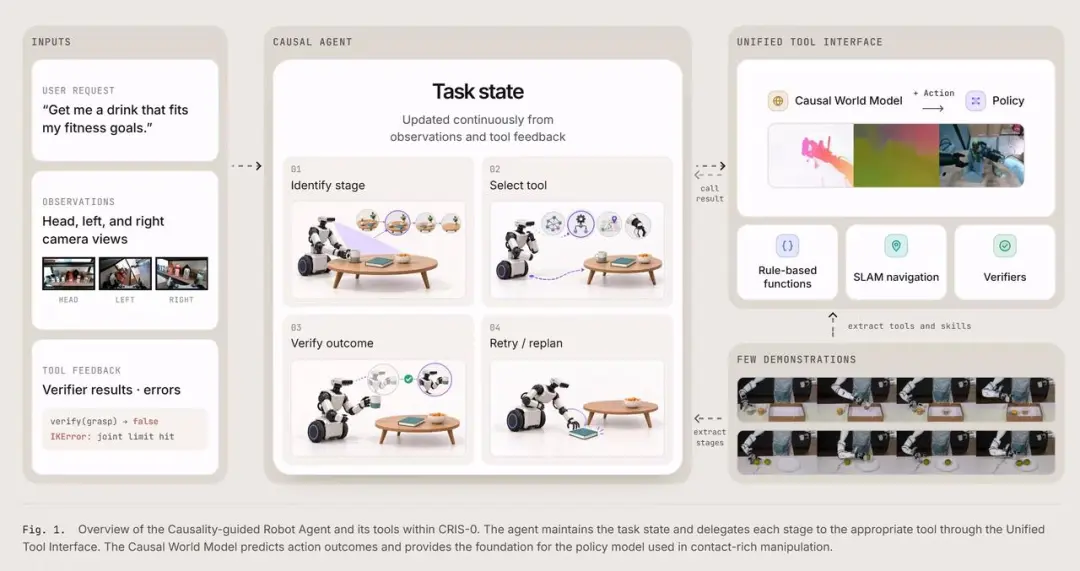
The agent organizes tasks around "causal state transfers". It is able to detect important variables related to tasks from new environments, break down tasks into phases, define verification standards for each phase, and prepare corresponding execution tools.
When it is executed, it continuously updates the status, verifies the intermediate results, decides whether to continue, retest, or go back to the next step. For example, the aligned edge of the tabletop does not look at the whole picture, but at whether the tabletop has been captured, how far away from the target, whether it has slipped. Only the variables that really affect the task will enter its decision.
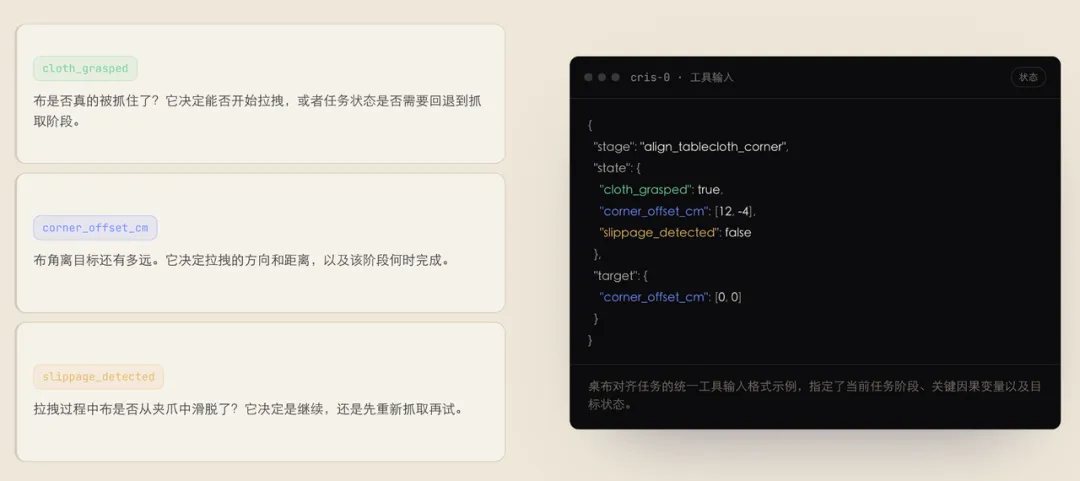
These capabilities are organized through unified tool interfaces. The rule functions, learned strategies, SLAM navigation, world models, verifiers, are all packaged as programmable tools. Free-space mobility can modify rules functions, access to rich crawling strategies, need to judge future world models, need to confirm results.
The execution process is a "structured state transfer cycle": evaluating the state, executing tools, verifying the results, and updating the task graph according to feedback. In the task bar, the node is the verifiable phase and the transition condition between the phases.
If the problem arises in the tool itself, CRIS-0 is stored on the basis of the error feedback correction tool and after successful execution. Thus local errors do not accumulate and difficult tasks are also broken down into subproblems that are more suitable for the corresponding tool.
The Causal World Model is responsible for predicting the physical consequences of the action. It does not directly predict the next picture, but first looks at what current observation and candidate actions will cause the changes to occur, and then uses these changes to chart the future. Thus, the intelligent body not only knows "what the picture will turn out to be" but can also judge "is this action pushing me to the desired state". On this basis, CRIS-0 also adds an action module that allows the world model to directly generate robotic movements from the predictor into a strategic model.
We're going to see how these designs work on real robots, and then we're going to see the experiment.
It's not just robots that are intelligent, but robots that are intelligent.
What are the advantages?
Aether AI puts CRIS-0 and end-to-end models in the same set of tasks: the same robots, the same scenes, the same people messing around.
Experiments have found that in the face of all sorts of sudden interference, CRIS-0 is obviously more robust and reacts faster. Because it fundamentally understands which variables and tasks are relevant, what changes will affect the results, and always tracks the stages of the task, so it can quickly return to the affected stage after disruption.
But interference is only the first step, and the longer task is to see the truth.
In another demonstration, the user gave only two rather vague instructions: "Help me find the blue little bag". "It's too messed up, help me sort it out". The robot had to undo the words: first find the little bag, then start packing.
This long task is precisely where the end-to-end model is most easily planted: errors accumulate between steps, often until the last step is discovered, but it is not clear which step is wrong and why. CRIS-0's approach is to verify a state at each completed stage, and not adjust the scale at this stage, so that local failures are stopped on the spot and do not explode until the end.
Blurring requests are another way of thinking about it. "Give me a bottle of drinks" requires that the model first understands the user's intentions and then complete a precise grip control. It is difficult for a single model to do both at the same time. CRIS-0 divides them into different levels: the planner is responsible for selecting targets, such as combining situations after a morning run and fitness habits, to select functional drinks; the rule function is responsible for putting the claws in place; the strategy model is only responsible for the final step of the precise operation.
Several rounds of comparison showed that the value of CRIS-0 was specific: the task was half-executed, the conditions changed, a step didn't work well, the system had the opportunity to be detected in time and adjusted to the corresponding linkage. The real environment is difficult to always support a pre-arranged plan, and whether robots can get things done depends on these judgments and corrections along the way. This gives Aether AI's causal intelligence route a landing point to observe.
Robots are just getting started.
Prior to this demonstration, Aether AI had tried two things separately: allowing the AI to perceive an unfamiliar environment on its own, and allowing it to simulate the changes it would make.
The first clue comes from RSIAgent. After entering unfamiliar software, the smartphone actively tries to operate, checks which practices work, under what conditions fail, and then stores the verified experience into memory for subsequent tasks. It explores a method of accumulating experience through interaction with the environment without updating the model parameters.
Another work, CausalWM, focuses on how physical changes occur. For example, the mechanical arm pushes the cup, and the model predicts the motion, then the changes in three-dimensional geometry, and then generates a future image. The first step involves the results of the next step prediction, which the team calls the "causal chain of thought".
CRIS-0 continues these two research ideas, combining task-level planning, verification and recovery, with prediction of physical change and control of movement. The ability to study separately to get into practical operations and accept execution results checks.
Behind this work, Aether AI planned a gradual technological route into the model.
One layer closest to the task is the Cause-Driven Intelligent Body, which uses the key conditions for planning, attribution and recovery. What steps can be followed, where failure may occur, and how to repeat the verified experience the next time.
In addition, the team also hopes to continue advancing within the model, including a modular neural architecture to realize the organization of contact, friction, and other factors into replicable modules, and a more underlying Causation Transformer to directly involve causal effects between variables in model computation. However, both layers are still being advanced and validated.
Yellow Rose's "smart brain capable of reversing and adapting to the real world" is the target along this path, and robots are the most honest and direct testing ground.
In fact, biopharmaceuticals and the development of new materials have similar needs: how to change into components or conditions can affect performance, whether interventions in a biological process can lead to expected changes. Causal methods can help researchers to come up with more reliable assumptions, choose verifiable conditions, and then experimentally modify them. These areas cannot illuminate the capabilities of robots, but the idea of "finding the conditions that affect the results, intervene, and then test the consequences" can be extended.
Aether AI itself has plans to explore in these directions, so we'll see how far it goes.