
It's the first time in the history of the world.
OpenAI's annual revenue is $20 billion.
On 8 October, the Financial Times revealed that OpenAI provided documents to investors showing:
By the end of September, the company had annual revenues of nearly $50 billion.
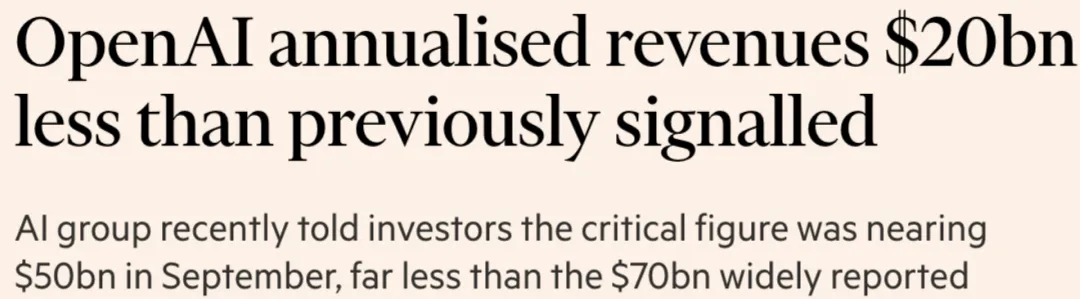
The Financial Times reported that OpenAI had annual revenues of nearly $50 billion as of the end of September, down from the previously widely reported $70 billion.
At the end of September, the figure in the media was close to $70 billion.
The report adds to the market's concerns about AI growth.
At the close of trading on the day, the British dollar fell by about 2.9%, the Oracle fell by about 5.5%, and the Nasdaq Comprehensive Index fell by 1.25%.
Less than a month ago, Anthropic reported profitable progress.
On September 13, Reuters, citing the Financial Times, reported that Anthropic told shareholders that the adjusted operating profit was expected to be positive for the second consecutive quarter.
Today, OpenAI's two groups have annual revenues of about $20 billion.
While the market is questioning whether AI can make money, a more basic question needs to be addressed: how do these revenue figures come about?
Is OpenAI really making less than $20 billion?I can't understand that.
On September 29, Reuters quoted people with knowledge as reporting that OpenAI's annual revenue was close to $70 billion; on October 8, FT disclosed documents showing that the figure was close to $50 billion.
The difference relates to the way a revenue is calculated: how to calculate the cost of paying when customers use an AI model via a cloud platform?
This type of revenue could involve a split between cloud platforms and model companies.
CNN quoted a source as saying that the previous $70 billion figure did not come from OpenAI, but may have been the result of an outside world comparison and adjustment of statistics with Anthropic.
According to the source, for the related cloud platform collaboration sales revenue, Anthropic uses the total quantity and OpenAI uses the net quantity.
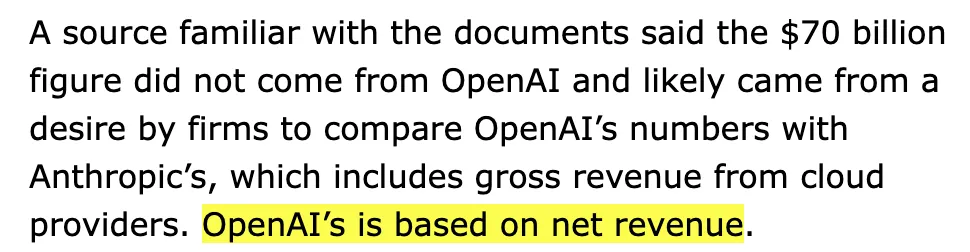
Let's give an example: customers pay 100 yuan, cloud platforms pay 20 yuan, and model companies leave 80 yuan.
According to the total calculation, the revenue was 100 yuan, divided by the platform's additional cost of 20 yuan; according to the net amount, the revenue was 80 yuan directly.
In the same business, the money paid by customers has not changed, but the calculation is different and the revenue figures on the accounts may be different.
The dividend here is just an example, not the actual situation of the two companies. The remaining 80 yuan is not profit, and other costs such as providing services are deducted.
Therefore, the $20 billion gap cannot be directly counted as revenue lost by OpenAI, nor can it be fully counted as a split taken away by cloud platforms.
However, this also means that when comparing the revenue scale of OpenAI with that of Anthropic, statistical time and computational quality must be aligned.
50 billion a yearIt's less than $50 billion a year.There is also a word that is easily overlooked: ageing.
Annual revenue is typically calculated by subtracting recent income from the size of the entire year.
A common algorithm is to multiply monthly income by 12.
If a company earns 1 billion yuan a month at this rate, the annual revenue is 12 billion yuan.
But this does not mean that it has earned 12 billion yuan in revenue in the past year, nor does it guarantee that it will reach this figure in the next year.
For fast-growing companies, the ageing indicator shows the recent size of the business; for a full year's performance, the actual revenue for the full year remains to be seen.
Why did Ingredients and Oracle also go down?OpenAI has not been publicly traded yet, but the market's judgement on its revenue has already affected the share prices of other companies.
The reason is that it has been in business with these companies for a long time.
You pay for AI subscriptions, companies call for models, and the revenue goes to model companies.
In order to provide services, R&D models, companies need to buy computing power to drive demand for upstream cloud services, servers, chips and data centers.
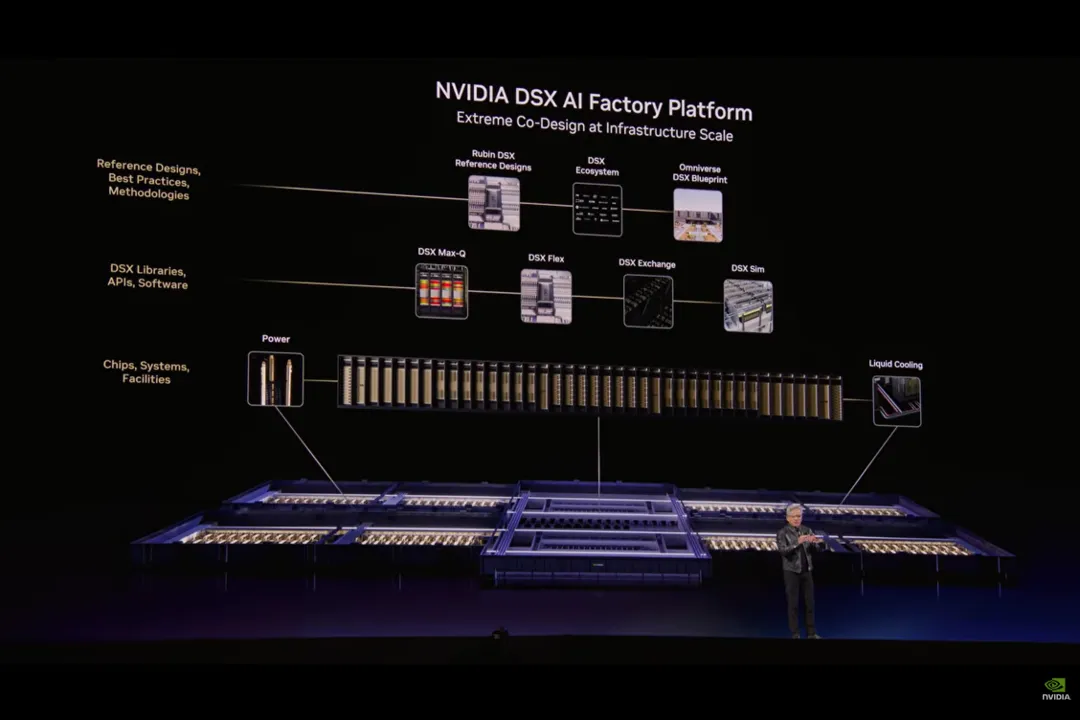
NVIDIA's AI factory platform covers data center design, computing management software, and infrastructure such as servers, networks, power and cooling.
The model companies' demand for computing power will drive the input of these links; whether they can recover costs through user payments will affect how far the next round of expansion can go.
Therefore, investors are concerned not only with how high OpenAI's revenue is, but also whether it will be able to rely on business revenue and financing in the future to pay its continuously expanding accounting bills.
According to CNN, the U.S. stock index was already down at the opening of the day, and the fall expanded further after the Financial Times reported it was on the list.
However, the revenue dispute is only one of the factors influencing the day.
Reuters' closing report also mentions the rise in oil prices and the resulting inflation and interest rate worries that the entire decline cannot be attributed to OpenAI.
Similarly, market concerns do not mean that demand for AI has weakened.
Whether the procurement is reduced, whether the contract can be fulfilled, and the subsequent disclosure of operational information are also considered.
But the growth of model companies, the expansion of suppliers and investors' expectations of returns are closely linked.
Next round of computingWho paid for it?In January, Sarah Friar, OpenAI's CFO, wrote in an official article that it took years to commit to top-notch computing, and business growth was unstable: sometimes demand came first, and sometimes demand surpassed existing computing.
While the future revenue is uncertain, computational investments need to be arranged in advance. This is also the reason for the market-tight AI revenue.
But if you look at the income figures, you'll have to ask clearly:
What period is the statistic? is it the annual scale or the actual quarterly revenue? what is the sales of the collaboration platform?
Looking back, we'll see how much money can be left after the cost of services, R&D and personnel is deducted, and when and on what future calculation bills will be paid.
Huang Rinpoche summed up the business logic of AI in one sentence: "Arithmetic is income".
In his GTC speech, Huang Yin explained that "reality is income": faster production, higher production efficiency, fewer disruptions and longer service life will affect the revenue of AI factories.
More powerful models are supported by computing, models absorb user fees, and revenue supports the next round of R&D and computing construction.
The key to sustain this cycle is whether the computation can be transformed into a service that is worth paying for and provides sufficient funds to support reinvestment.
Expansion will still require external financing if the more computing power purchases, the more demand for payments does not keep pace, or revenues do not cover costs in the long run.
As a result, OpenAI's revenue figures will shake the entire industry chain: the market needs to see that the money invested can ultimately be recovered by paying users, so that the next round of expansion is more underpinned.
To you, for me, these huge investments will ultimately be reflected in the model we use every day: it saves us the time, the work, is it not worth the subscription fee?