
It's the first time in the history of the world.
OpenAI is a day to remember!
Just recently, OpenAI "Godfather" Tibo released the Day 5 update: "24 Hours Online Agent" dots, which can now be created on mobile phones.
He's shocked that so many people have created dot on the web and on the desktop, and now it's time to scale it up!
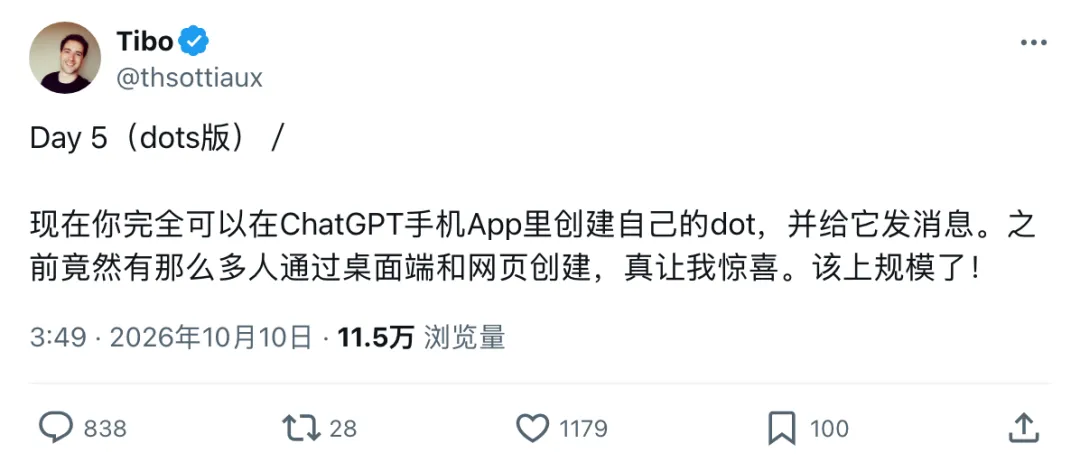
Users who have access to the dots can open the iOS or Android version of ChatGPT and create their own dots directly.
What's even more surprising is that the dots are alive and well for the Codex.
Launching new tasks, following old threads, finding relevant contexts, and managing timely tasks, this personal assistant is becoming more and more like a "living manager".
It's one of the few ways to get an agent out of your phone and let it command the codex to work.
You don't have to go through the code every time, and you can switch jobs.
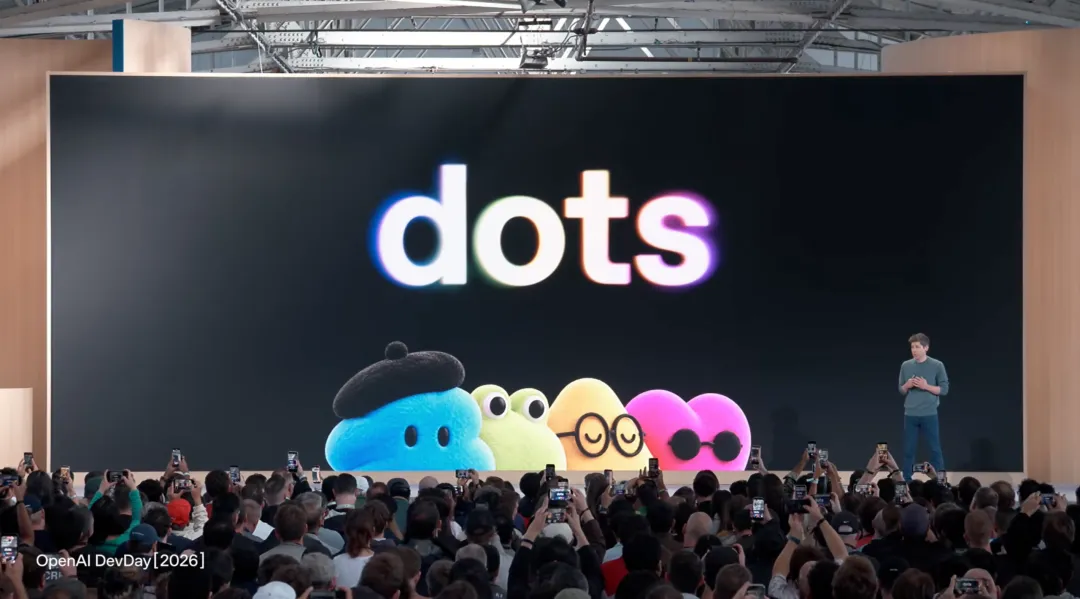
The phone pinched a dot.Open the door and you'll be alive.On September 29, OpenAI released the "All-weather individual AI smart body" dots.
The model behind it is the GPT-6 Astra.
It is not a concept at all with ordinary ChatGPT conversations.
dot has its own cloud computer and browser that connects more than 4,000 applications via plugins.
Within the scope of its mandate, it can continue to advance missions and actively report progress.
According to OpenAI, the dot can be viewed as a separate entity.
It learns how you work, discovers what you need to focus on, and promotes your project with its own computer.
But before you can create and configure a dot, you must first use a desktop app or a web page.
If you want to start from scratch, you have to sit back in front of the computer.
And this time, OpenAI directly removed the door.
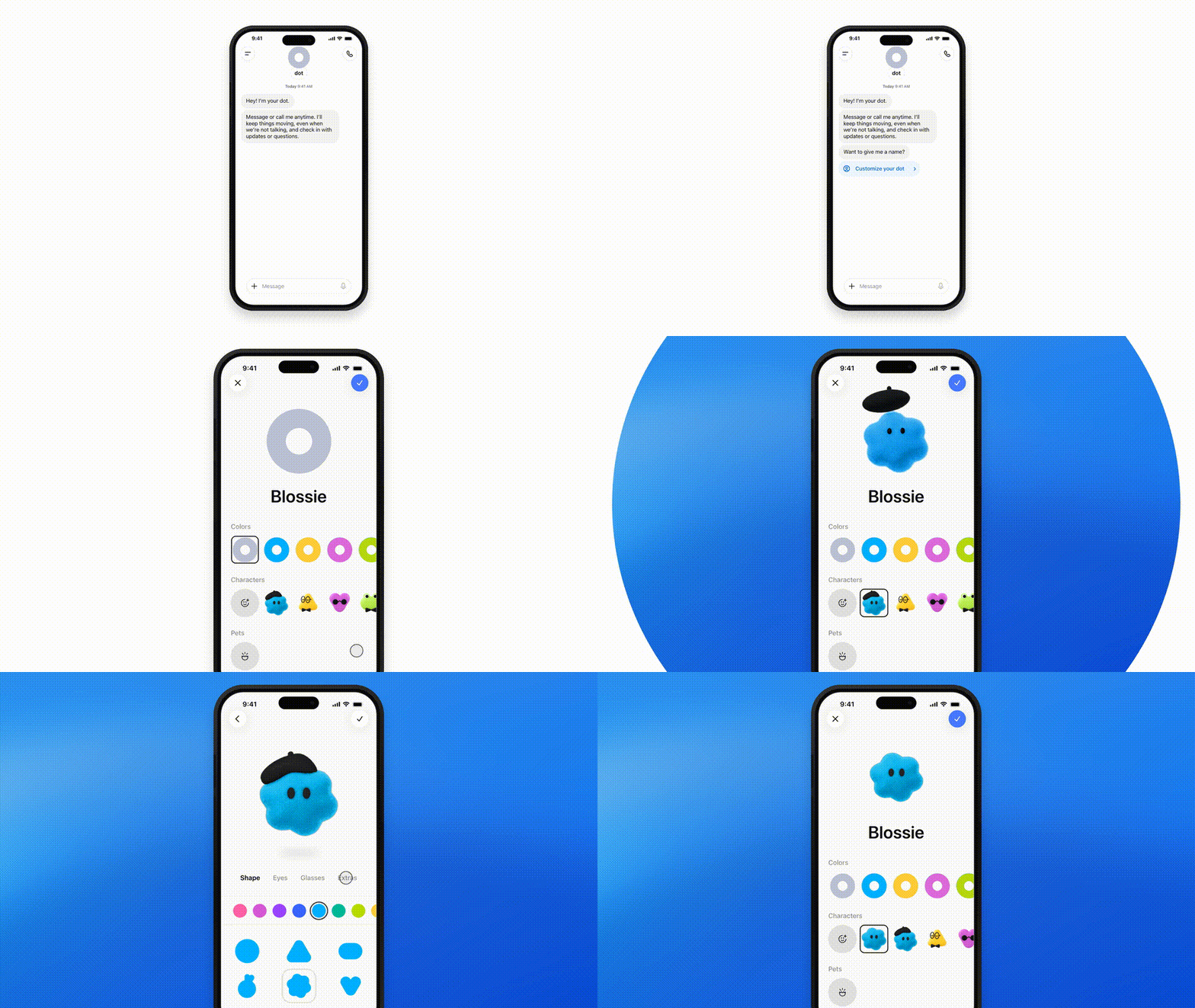
Now, when you open the ChatGPT App on your mobile phone, you can start from creation to completion of configuration.

Starting a name, choosing a shape, connecting applications, the whole process can be done on your phone.
And this is just the first step.
Dots command the codex"Send in the Chief Conductor".
The mobile device is just an input change, and more importantly, the collaboration between the dot and the codex is another step forward.
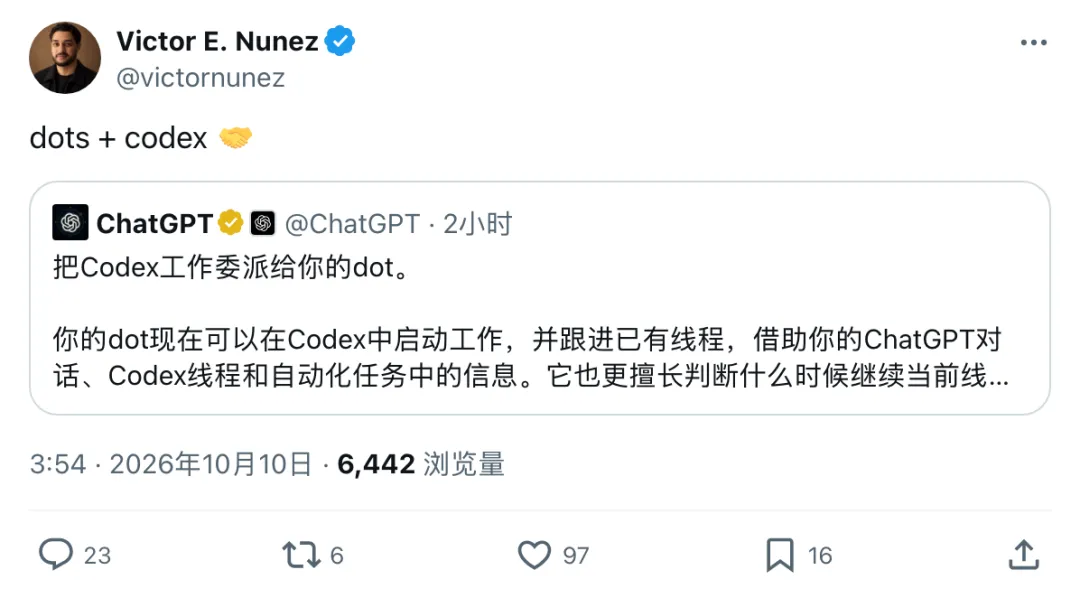
Codex is responsible for specific programming tasks, while dot is more like a personal assistant to help you organize tasks.
I've been able to live with the codex before.
This reinforcement is the bond between them.
Do you want to use the old thread or do you want to use a different one?
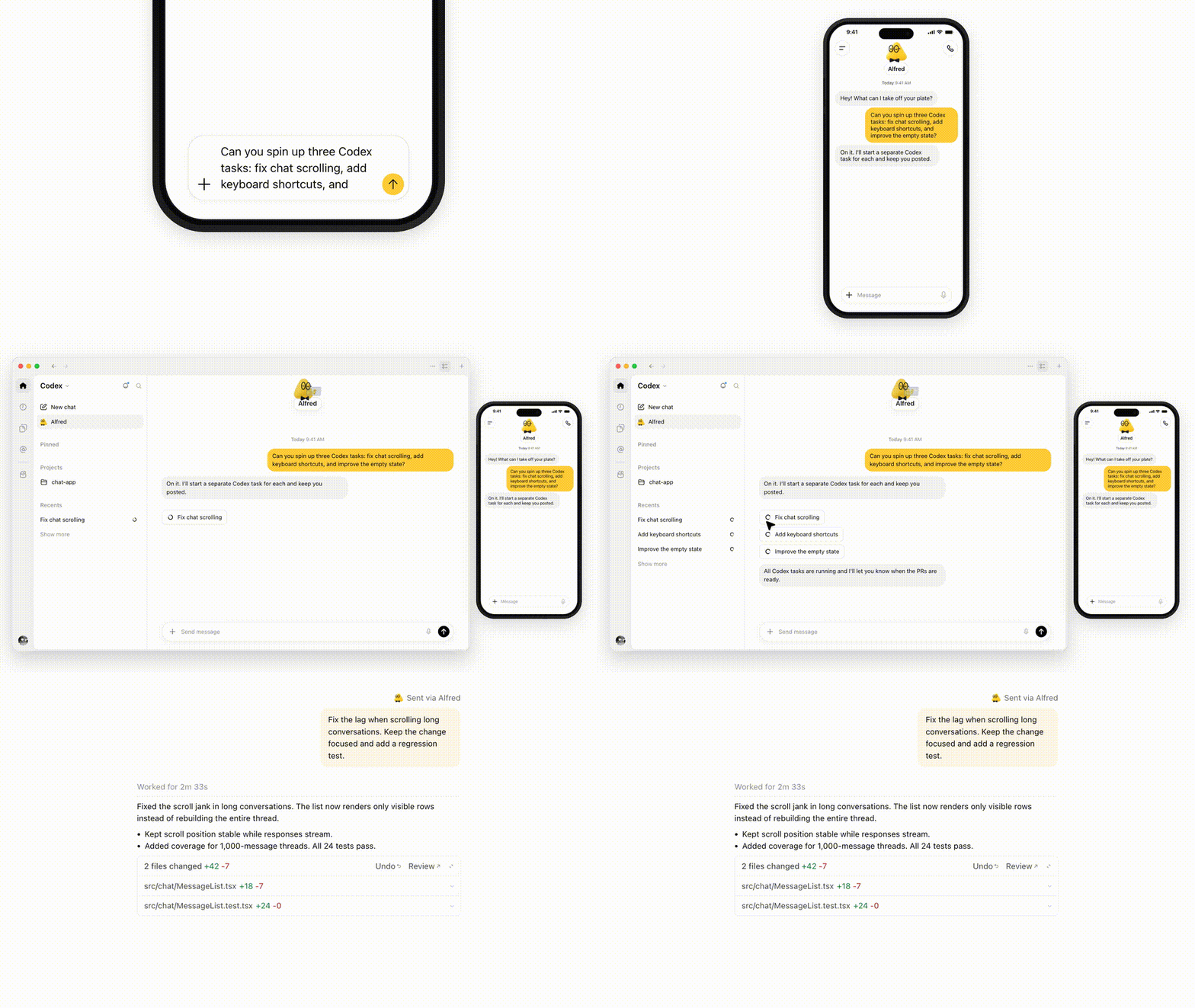
The previously discussed development needs can then be continued with existing threads, and the relevant context is easier to retrieve.
In particular, changes can be broken down into three things:
- Looking for context
dot can search ChatGPT conversations and call up the context in existing Codex threads and automation tasks.
The needs that have been discussed before, the attempts that have been made, can be followed up with less repetition of the background.
- More streamlined thread management
Another improvement is the judgement of the relationship between the new and old tasks.
It is better at deciding when to continue the old thread, when to open another, to reduce the disruption of the related work.
- Following results, managing timely tasks
In addition to following programming tasks, the dot can also view and edit timely tasks in ChatGPT Work.
In the presentation, the dot will also continue to send messages after the modification of the codex, requesting to open the PR, and then summarize the results of the review to the user.
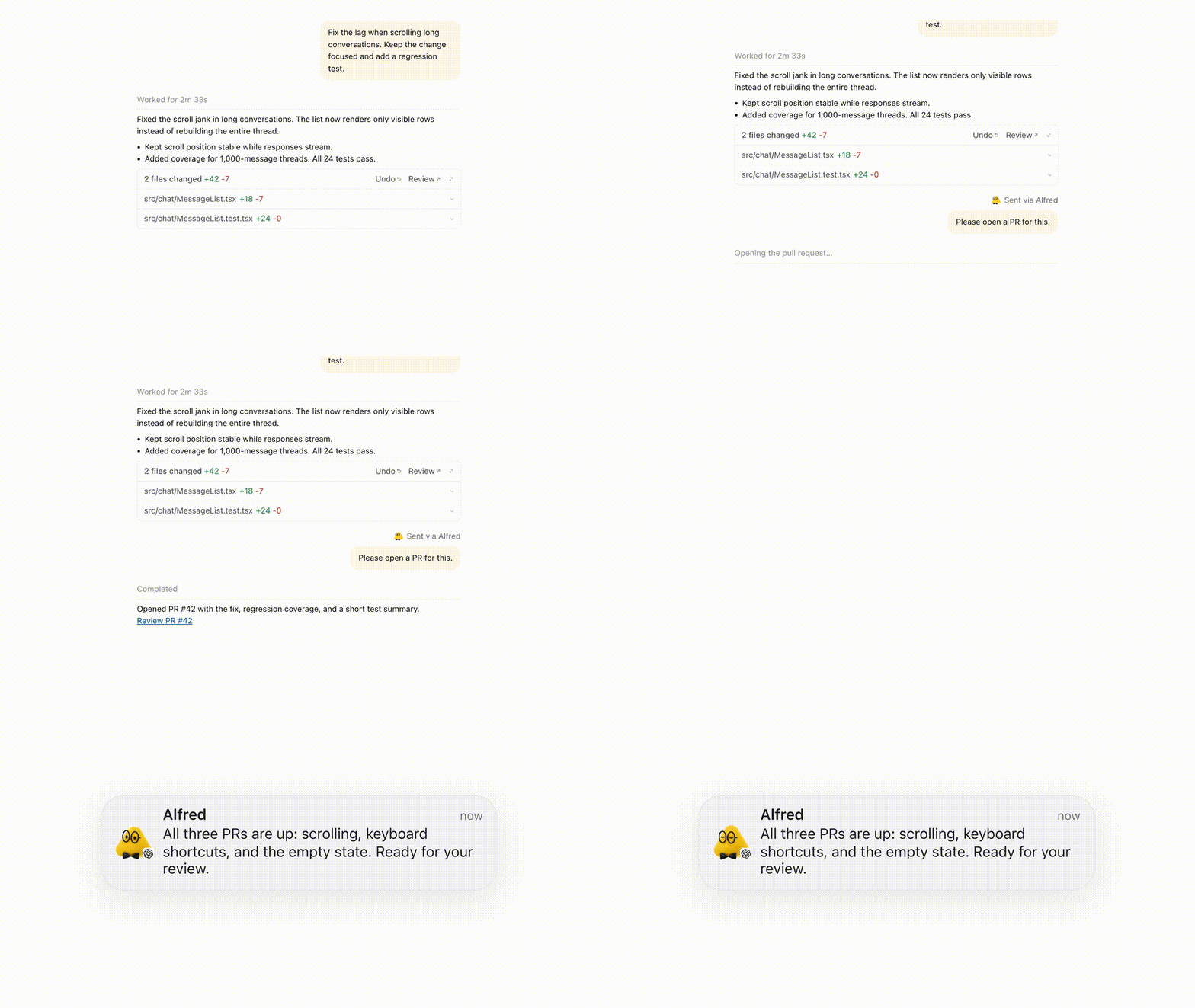
In this way, the dot is like a "project manager" who helps you organize the whole thing, while the codex is the "engineer" who is responsible for the specific programming.
And you're the CEO of the Order.
The process is also intuitive: open the ChatGPT App, create a dot, exchange targets, and then assign programming tasks to the Codex.
You can check progress on your mobile phone, process approved operations, and add requests at any time.
If you think of something to do, get your phone out, and you can switch tasks.
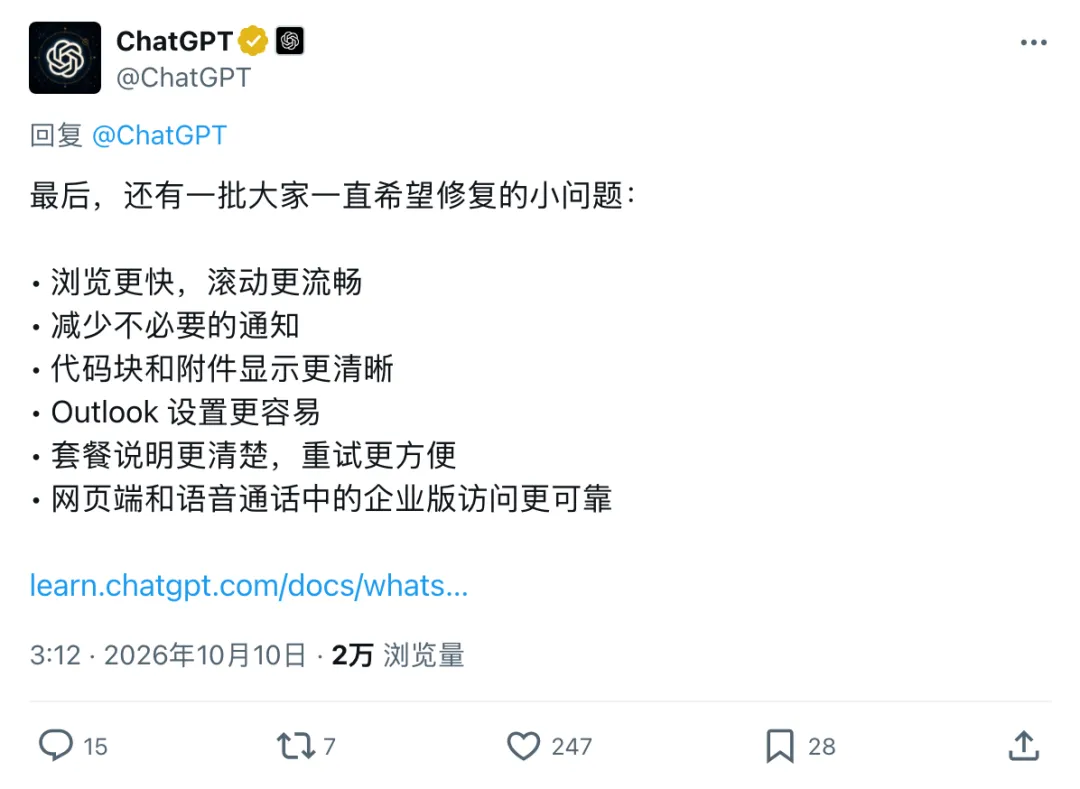
Not only that, OpenAI also threw out a series of details fixing the dots, including:
Browsing is faster, scrolling more smoothly, with fewer extra notifications; the display of blocks of code and attachments is also clearer.
Outlook settings, package descriptions, and post-failure retests have also improved access to enterprise versions in web terminals and voice calls.
Codex Second Guess What?True to heart surgery
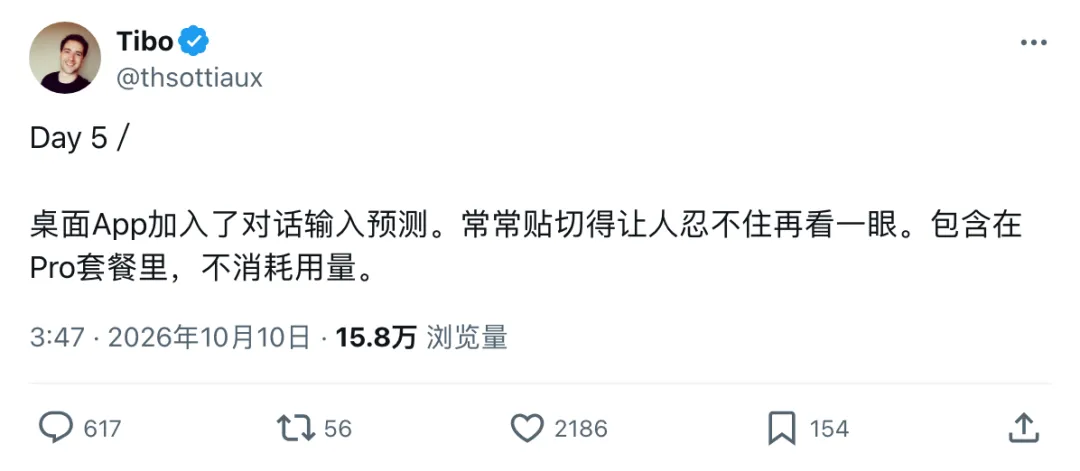
Ninety-two seconds before this tweet, Tibo released another Day 5 update: Composer Predictions.
Simply put, the codex has "read heart surgery" so you can guess what you want to say next.
OpenAI released a 15-second short film, a moment familiar to developers.
When the codex completes a game, the input box contains the following suggestion: "Install the game on my Chromatic".
Instead of adjusting the page, a large inscription "CENTER THE DIV" appears, which is to put the div inside.
There are also closing moves that developers are familiar with: "Well, clean it up and open a PR again". These words are prearranged by the Codex and can be used directly by coders.
There are two suggestions in the picture: keep the paper brief and general; keep the current design so that it can be used on mobile phones as well.
The next step could be to explain the material or to continue to change the product.
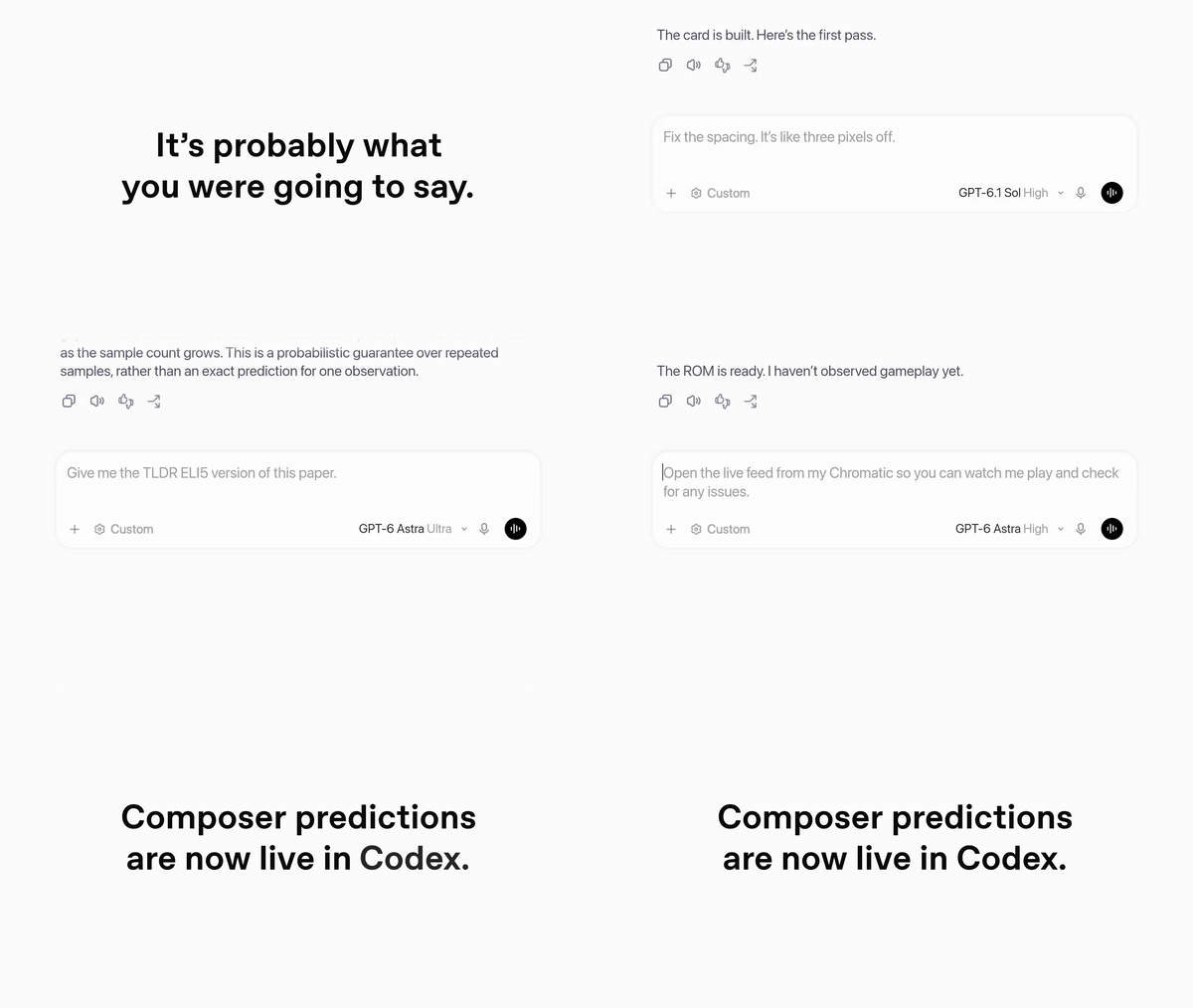 Codex pre-filled the following message according to the dialogue; the user still decides whether to send it after accepting the tab.
Or the familiar Tab key, which can now be replenished with instructions given by AI.
After completing a round of responses, Codex will guess the full message you may be sending next based on current conversations.
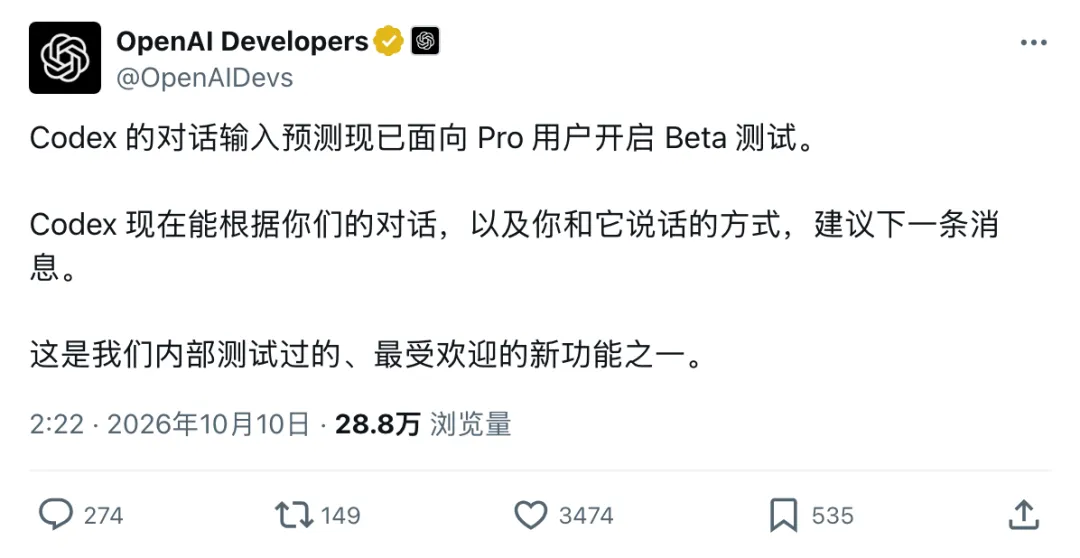
Tap on the tab, and it's suggested that you enter the edit box. You can edit it and decide whether to send it; if you don't feel right, you can enter your own words as usual.
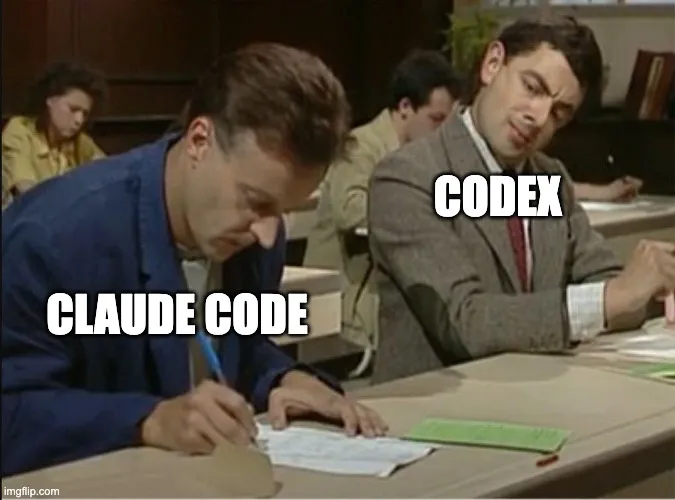 Claude Code has previously made similar suggestions.
The most interesting change here is that the input box suddenly becomes very much like a colleague taking a conversation. Where the conversation is, what the next step is usually to do, and even how you normally talk, all become its predictive clues.
OpenAI employee Sharif Shameem made a very catchy comment. According to his own use of the codex, he can guess at about a quarter of the messages he will send next.
He also quoted a collaborating researcher as saying that the prediction was "accurately frightening".

External user Ivan Ciraj also said that he had used it many times during the day and felt like he was back in the days of tab-added codes, but the experience was greatly enhanced.
The most surprising thing is that he had never thought about doing this work before, and even wanted to pay tribute to the person who offered this tip to OpenAI.
Thomas Ricouard was more direct: he probably accepted 90% of the suggestions.
Currently, this beta feature is aimed at eligible individual Pro users over the age of 18, supporting local and SSH threads at the end of the Codex desktop, as well as GPT-6 Astra, GPT-6.1 Sol.
Tibo Special emphasizes another detail: the forecast is included in the Pro package and does not consume consumption.
To be precise, it is free to generate suggestions for this step; to send out messages to keep the codex functioning and measured in a normal way.
A few words are of course comfortable. A more subtle change is that AI will also suggest what to do next. Encountering familiar end operations, one only needs to confirm; encountering directional choices, or having their own ideas.
OpenAI is the first step to getting started.
Putting the two updates together, it's clearer where OpenAI wants to take them.
The dots capture the objectives, organizational context, and task assignments; the codex, at the end of a round of work, gives advance recommendations for the next step.
OpenAI wants to take over when the user has a goal and has not yet decided which tool to open.
It was time to go back and forth between the different tools to find the background, assign the tasks, and get feedback.
If this link is able to stabilize the runway, from switching targets to checking results, people will spend less time switching back and forth between tools.
By then, the first step in starting work could be to say, "Give me a dot on this thing".
RoboInd editorial channelResearch, robotics companies and market intelligence for cross-border sourcing.Explore the channel ↗
Share this
End of editorialExplore more from Global Robotics News ↗