On September 22, Black Forest Labs, known for its FLUX image model, released the open-source 7B world action model FLUX 3 Action. According to its official blog, the model surpasses the previous strongest open-source model on the UK's RoboLab-120 list, Cosmos 3 Nano, but is less than half the size of the latter.
The so-called World-Action Model (WAM) has emerged rapidly since the term was explicitly coined by Ingrid in her DreamZero paper in February of this year. But there is an embarrassing problem behind the heat wave: these systems have almost simultaneously replaced the video backbone, training data, video-action interaction and reasoning processes, and no one knows exactly which design has led to the improvement.
This week, a team from Stanford University, led by Lee Feifei, Zhang Jun, Ehsan Adeli and others, published a paper proposing the open world action modeling framework OpenWAM, in an attempt to give a systematic answer to this question.
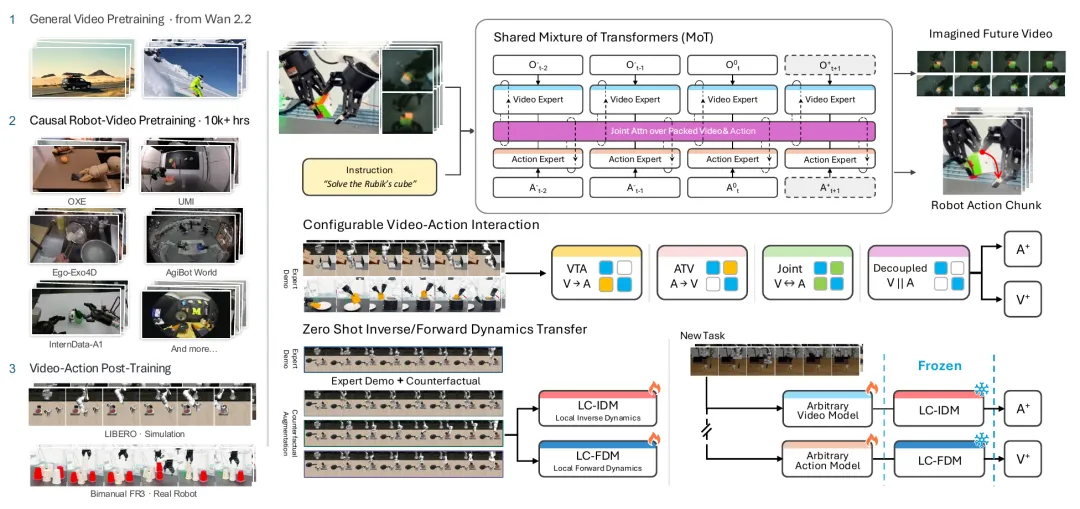
Overview of the OpenWAM framework: three stages of training, a shared MoT architecture, four configurable modes of interaction, and a locally dynamic model that can be replicated and frozen.
OpenWAM: An Open Framework for Composable World-Action Models
Address of the paper:https://arxiv.org/abs/2610.07922
The main page of the project:
The code repository:https://github.com/OpenWAM/OpenWAM
Why do we need a "unified exam"?
The traditional visual-language-action model (VLA) is like a driver driving a conditional reflection, seeing a picture, hearing instructions, and acting directly.
WAM goes one step further: "brain preview": it predicts what the next few seconds will look like and what to do about it. The video naturally records how objects fall, collide and are pushed, and models trained with mass video have their own physical precedents.
The problem is that "prediction pictures" and "generation movements" can be combined in many ways: first imagine the next move, first imagine the consequences, both generate at the same time, or at the same time.
The second problem is more subtle. Robot training data are mostly successful examples, only telling the model "how to go the right way" and hardly including "how to get two centimeters out of your hand". It's like watching an apprentice with a trainer perfectly winding the video, remembering the route but not knowing how many cars will turn the steering wheel.
OpenWAM responds to the former by sharing interchangeable underlying data, while the latter responds to large-scale "counterfactual" data.
It's the same skeleton, four "first think or move".
OpenWAM began with the Ali-based video model Wan2.2-5B and continued its training on approximately 334 million robots interacting with human video, with a nominal duration of about 146,000 hours, with no action labels, and 14 days of training on 32 B200 units.
The key change is "causal": each video block can only see the present and previous content, and can't look into the future. The original model, like taking the script repeatedly and changing the plot, now plays out in chronological order, like live streaming, which is exactly what robots need to do step by step.
Subsequently, the team used the Mixture-of-Transformers (MoT) architecture to combine 5B's video experts and 2B's action experts. They each retained the unification, projection and front-end layers, exchanging information in only one layer of shared attention.
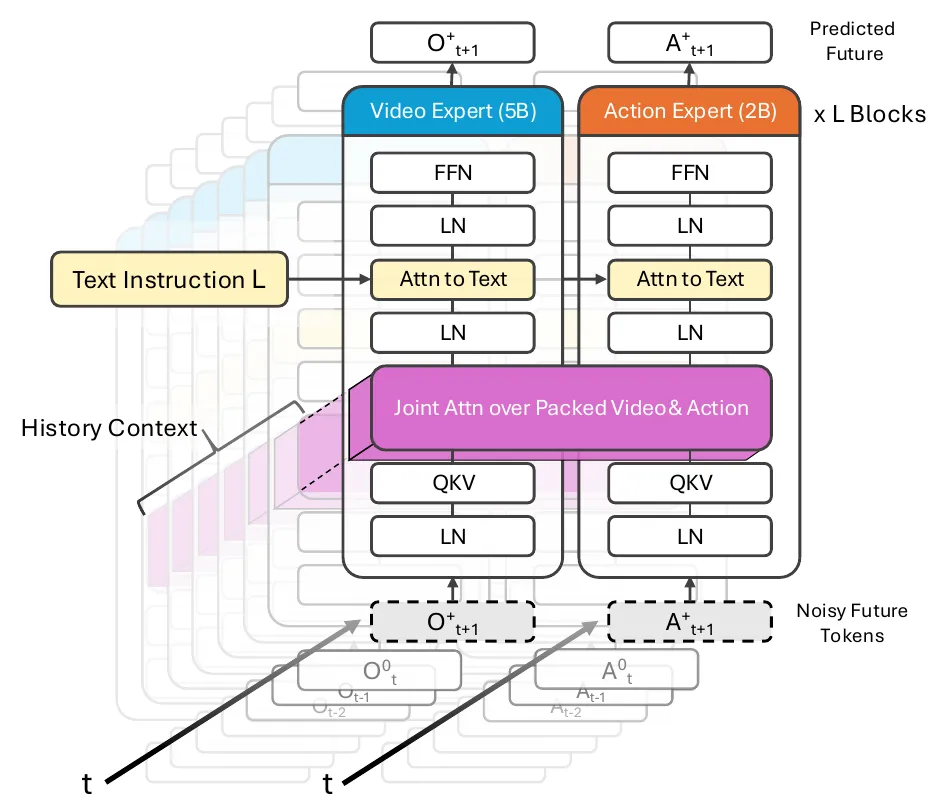
Shared MoT architecture, video experts and action experts jointly pay attention to tokens after packing.
On this skeleton, the team defined four "interaction procedures":
VTA: Imagine that the scene is in action.
ATV order is the opposite.
Joint allows both to generate and refer to each other simultaneously
Decoupled makes it impossible for the two to see each other in the future
It's like the same band playing the same song, the only difference being who plays it first, whether they can hear each other. The four share the same basic, tokenization and flow matching goals, and the only variable is to generate order and cross-modal attention, which means "control variables".
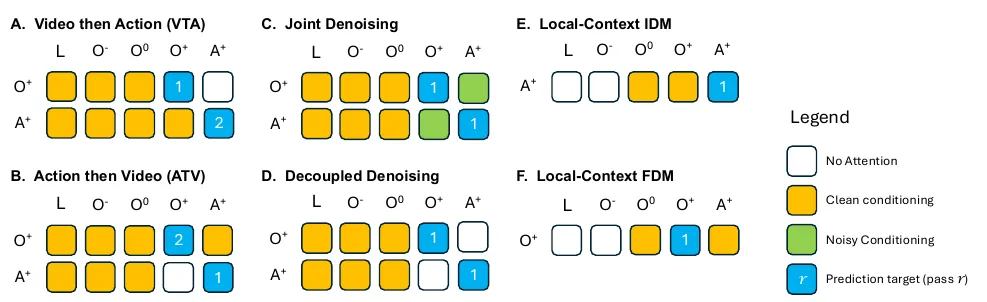
The four interaction procedures (AD) and the two local dynamic procedures (EF) mask attention.
It's hard to break down the translator and train separately.
A more novel part of the paper is the breakdown of the reverse dynamic model IDM and the vertical dynamic model FDM into components that can be independently trained.
IDM can be translated as: input the current image, the state of the robot's body, and an imagined future video, and output the specific action; FDM, in turn, predicts what the image will look like based on the action.
The key is "local": both do not receive task instructions and earlier history, and are only concerned with "what action this small image changes corresponds to". So they do not bind to specific tasks, can be spelled with any compatible video predictor, the video model decides "what should happen", and IDM is responsible for "how to do it".
But only translators who have learned the successful demonstration have narrow insights. For this reason, the team constructed a LIBERO-Long-CF dataset: restoring the simulation state in the demonstration, performing modified movements such as stopping, reversing, adding noise, changing the claw clock, etc. A total of 32,000 clips, about 410,000 control records, is 29.7 times that of the original demonstration, of which 72.3% changes the position of the object. Many branches simply do not complete the task, but that's the point.
Experiment: The bottom can hit, the translator can move
In LIBERO's four subset, the success rate of all four interaction procedures is high, with VTA averaging 98.6%, slightly higher than the LingBot-VA (~98.5%) and π0.5 (~96.9%) cited in the paper. However, LIBERO is close to zero, and the more noteworthy detail is that, in LIBERO-Long, future parts of the Invisible Decoupled (~97.0%) do not match the Joint (~96.6%) of the two-way interaction.
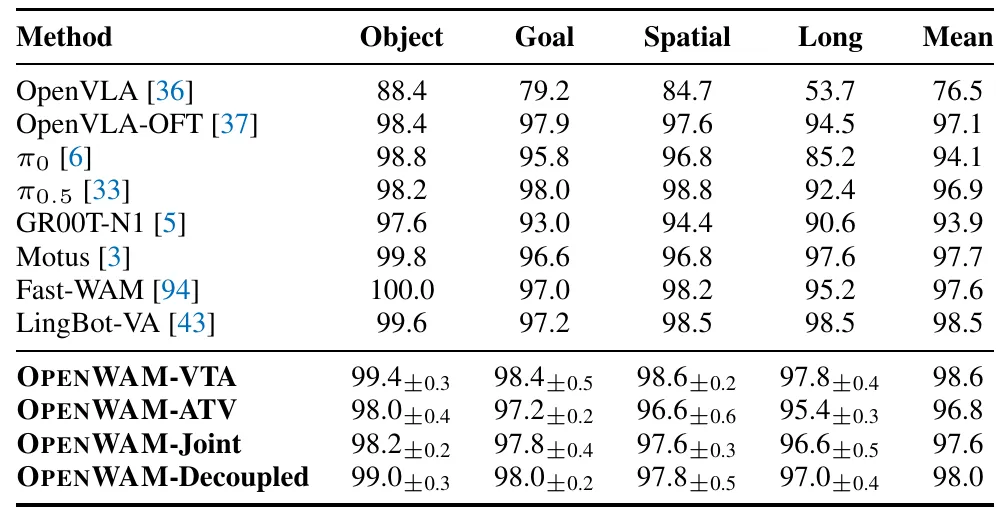
The closing circle success rate for the four LIBERO subset (%) is the reported baseline.
On the machine, the team used two Franka FR3 mechanical arms to test the toast, recover the last layer of the 2×2 square and sort cups by color, with an average success rate of 92.1% and 91.9% respectively for VTA and Joint.
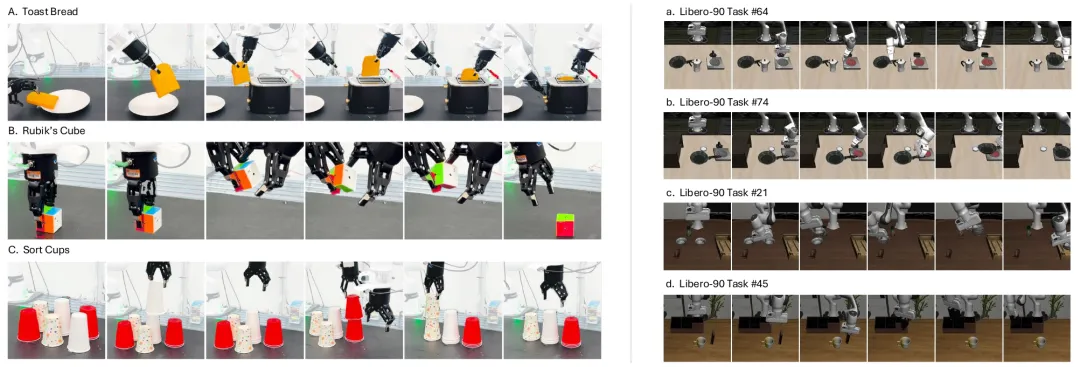
On the left are three real-machine dual-arms missions and on the right are four LIBERO-90 missions for component migration.
The dilution experiment showed the distribution of the base: other conditions remained unchanged, with VTA on LIBERO-Long at only 68.4% when the original version Wan2.2 was initialized, up to 97.8% after the causal base for robot video pre-training, an increase of 29.4 percentage points. The authors emphasize that this is a common effect of data and causal modification.
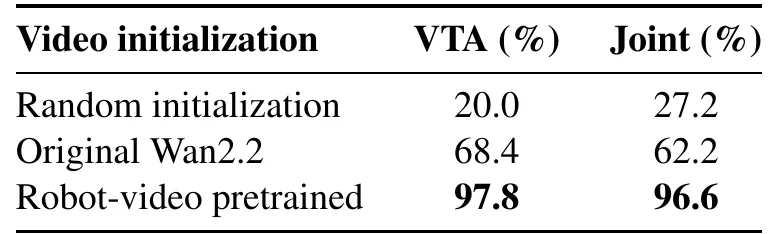
The impact of video backbone initialization on LIBERO-Long success rates.
The most critical was the component migration experiment. The team froze the IDM trained on LIBERO-Long with video predictors tailored to four new LIBERO-90 missions.
As a result, the average success rate of local IDM with demonstration and counterfactual data training was 84.0%, compared to 47.0% for IDM with full context, and 21.5% for local IDM with demonstration training alone.
"Only look locally" and "I've seen enough of the consequences" are missing, and the combination of the two makes for a moving motion translator. It should be noted that the video predictor on the target mission has been modeled using demonstrations containing motion tags, which is not a zero-sample migration, and the authors make this clear.
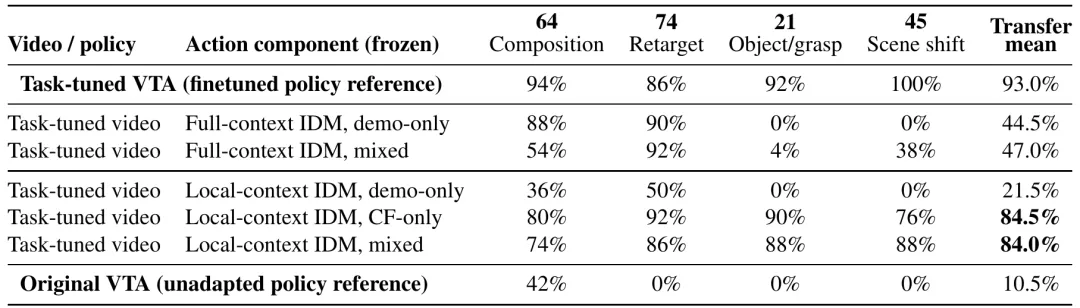
The success rate of freezing the IDM migration to four LIBERO-90 missions.
The FDM consists of 16 different movements from the same state, allowing the model to predict which real outcome the image corresponds to, with a random guess of about 6%, a FDM of only 21.1% with sample training, and an increase of 71.3% after adding counterfactual data, the model is finally able to distinguish between "so push" and "so push".
Local FDM's predictive performance on counterfactual displacement.
What is the meaning of this verse?
The authors also acknowledge the limitations: component replication is mostly verified in simulation, and the cost of "intentionally making mistakes" on real machines is much higher; FDM also covers only short-term forecasting. But the value of OpenWAM is not more than a few percentage points. At the time of the weekly emergence of the WAM paper, a fixed underpinning, simply changing a variable public testing platform, could help the field shift from "who scores higher" to "why higher".
Currently, the team has open-source training, evaluation and combination code, and pre-training video model weighting.