AI video generation is entering a new competitive stage.
If the keyword DeepSeek left to the big model industry at the moment is "frontline capability parity", then video models are also approaching their own similar nodes:
Performance, efficiency and availability thresholds begin to explore the extreme simultaneously.
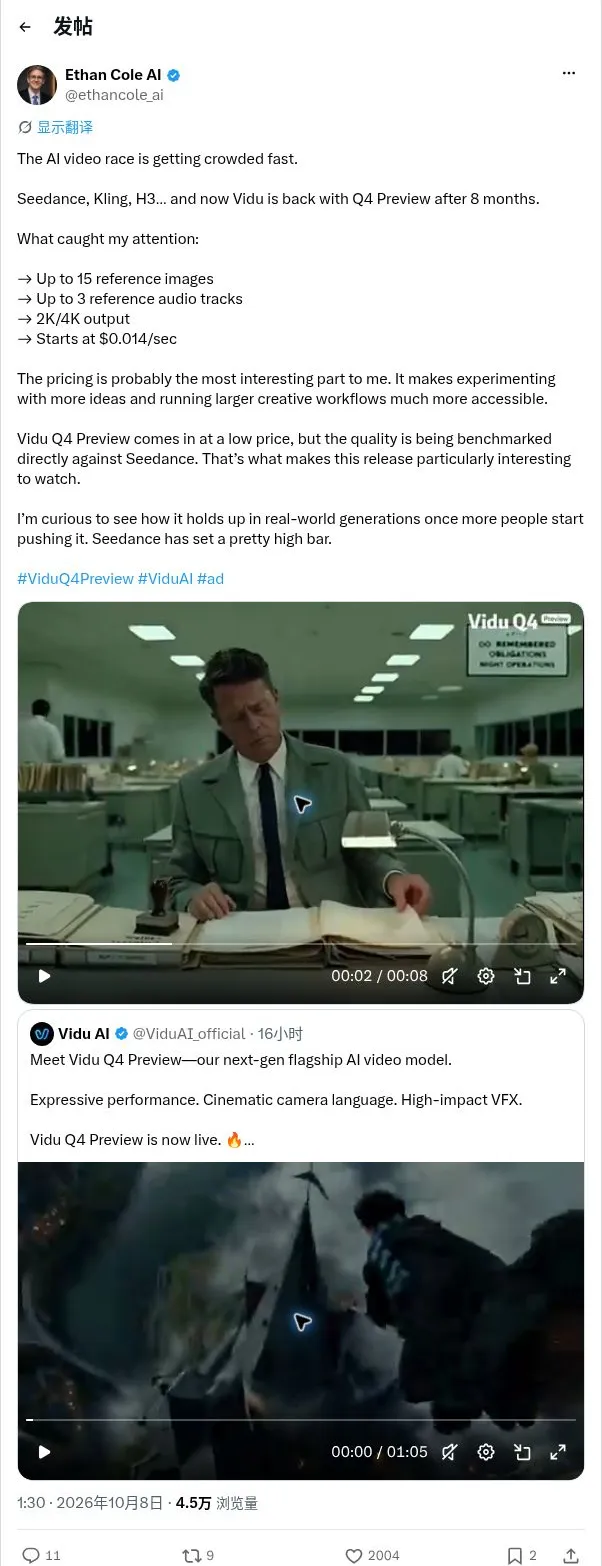
The Vidu Q4 Preview, the latest release from Digital Science, is a step-by-step result. As the first preview version of Vidu Q4 aimed at creators, it will focus on three capabilities: finer character presentation, more intense lens language, and more impactful complex visual effects.
The real price of 0.09 yuan per second is shocking, but what really needs to be explained is why a video model can simultaneously move forward with character performance, camera timing, complex features and reference material controls, while squeezing the cost of production to an area where creators are more willing to repeat the shot.
This is the DeepSeek problem with video models: when performance, efficiency and availability change at the same time, the coordinates of industry competition are recalibrated.
Over the past year, China's video model has been described as "far ahead".
Seedance is at the forefront of integrated power; Kool-Aid has built a strong public awareness with its image quality and consumer-grade dissemination capabilities; Vidu is unique in its strong technical base dividend, and its position as the world's leading model research player. Especially the increasingly apparent trend is that top AGI teams such as OpenAI will not only stay on this layer of video production, but will continue to advance into the physical world.
Let's see how many "firsts" in the field of video came out of Vidu's hands:
2022: pioneering the U-ViT architecture
2024: The release of China's first full-featured Sora video model; the launch of "Reference Live Video" and multi-subject consistency after global launch
Vidu 2.0 will compress the generation time to less than 10 seconds, proving universal is a long-term technology route.
The Q series continues to reinforce consistency, dynamism, narrative and performance, with Q3 achieving a 16-second soundtrack for drama; Q4 enabling flagship models to use...
If you're in the heat of the moment, try a few cases and taste the sweetness.
The sky was "awakened" in the Dunmow murals, the fingers touching the strings, the spirals dancing, and every detail pressing against the rhythm.
In just five seconds, the footage is continuously switched over and over, side shots, facial expressions and body scenes, the person and clothing are always stable, and there is a trendy advertisement texture.
The details of the animation are equally excellent, especially the small movements of the hands and feet when the back of the neck is pulled by a tornado.
Vidu Q4 Preview also supports up to 15 reference charts, reference audio inputs, and 2K, 4K graphics output.
The price was also the focus of the update. Q4 Preview's initial price started at 0.09 yuan/second, and the same budget could generate up to five times the amount of content. This meant that the creators could then retrieve the footage at a lower cost, change the way a camera was shown, and rearrange rhythm, cameras, and sound.
Currently, the Vidu Q4 Preview is just a preview of the official launch, and the overall performance has already been demonstrated, making the official version of the Q4 look forward to further breakthroughs in stability, control and creativity.
Where did "Vidu" come from?
Vidu's work has always had a distinct style of mind. High-dynamic movements, fast-paced mirrors, strong emotional performances and complex visual effects appear more frequently, especially the good effects of anime, which are also referred to by users as "Vidu Taste".
The video comes from Vidu's super-creation of "The South Wall".
In the overseas creator community, this "Vidu flavor" has formed a fairly clear mouthpiece. Some CPP users who originally worked in an abstract art style will hear about Vidu's great animation abilities and start experimenting with animation that they are not very good at; Japanese AI creators have repeatedly acknowledged Vidu, even having hundreds of thousands of views on YouTube of all Vidu-produced AI animations. In some side-by-side contrasting videos, users also mention Vidu's performance in spin-offs, spin-offs, and coin-particle effects.
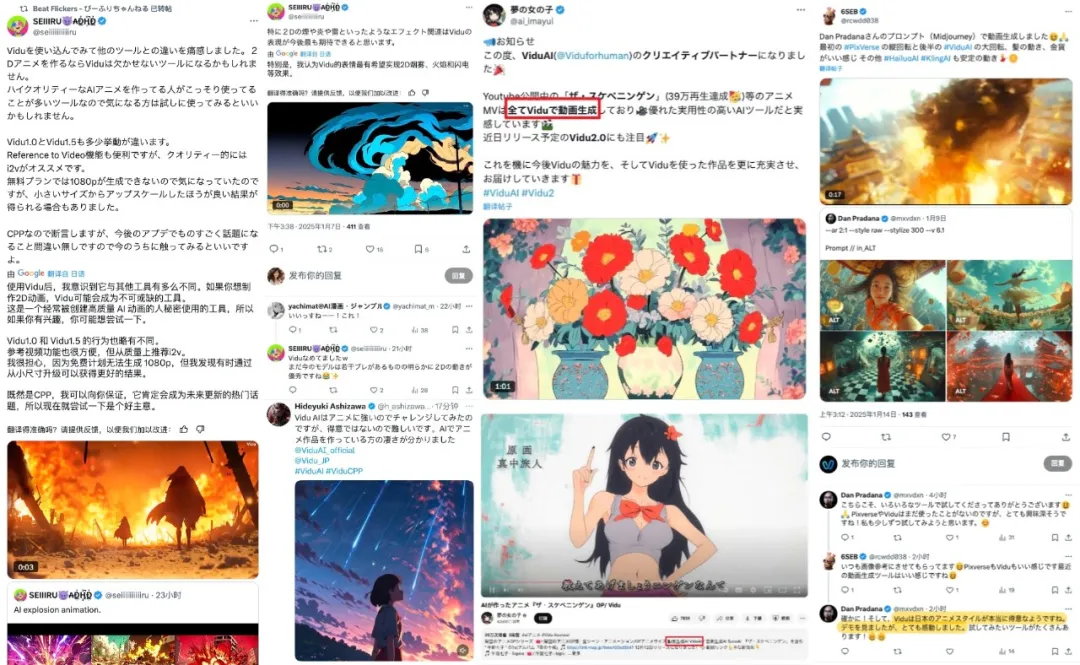
Vidu has created a recognizable style tag in the minds of creators: better suited for high-dynamic footage, better able to express strong emotions, and easier to make animated images with a sense of flames, speed and dramatic tension.
An anime is not a "simpler" video-generation scene, on the contrary, it has high demands on the model's motion consistency, camera timing, character consistency, transmitter and clothing, detail dynamics, particle characteristics, and emotional bursts. If a model is able to steadily produce high-intensity animation, it often means that it not only paints beautiful images, but also has stronger control over time, action, and spatial relationships.
It was here that Vidu's world model path of product style and vividness began to intersect: what users saw was "animation is burning, action is smooth, footage is touching", and what technically corresponded was the model's ability to model a dynamic world.
In the fifth stage of the path proposed by Biomics, Vidu primarily responds to the first stage of "creating the world" and is responsible for learning about people, objects, movement, spatial relationships and scenic dynamics. The Vidu S series further incorporates real-time interaction, while Motos and Motubrain extend predictive power to physical action.
In this direction, video is not just a series of images, but also a continuously evolving world trajectory, where video consistency and physical rationality are more important.
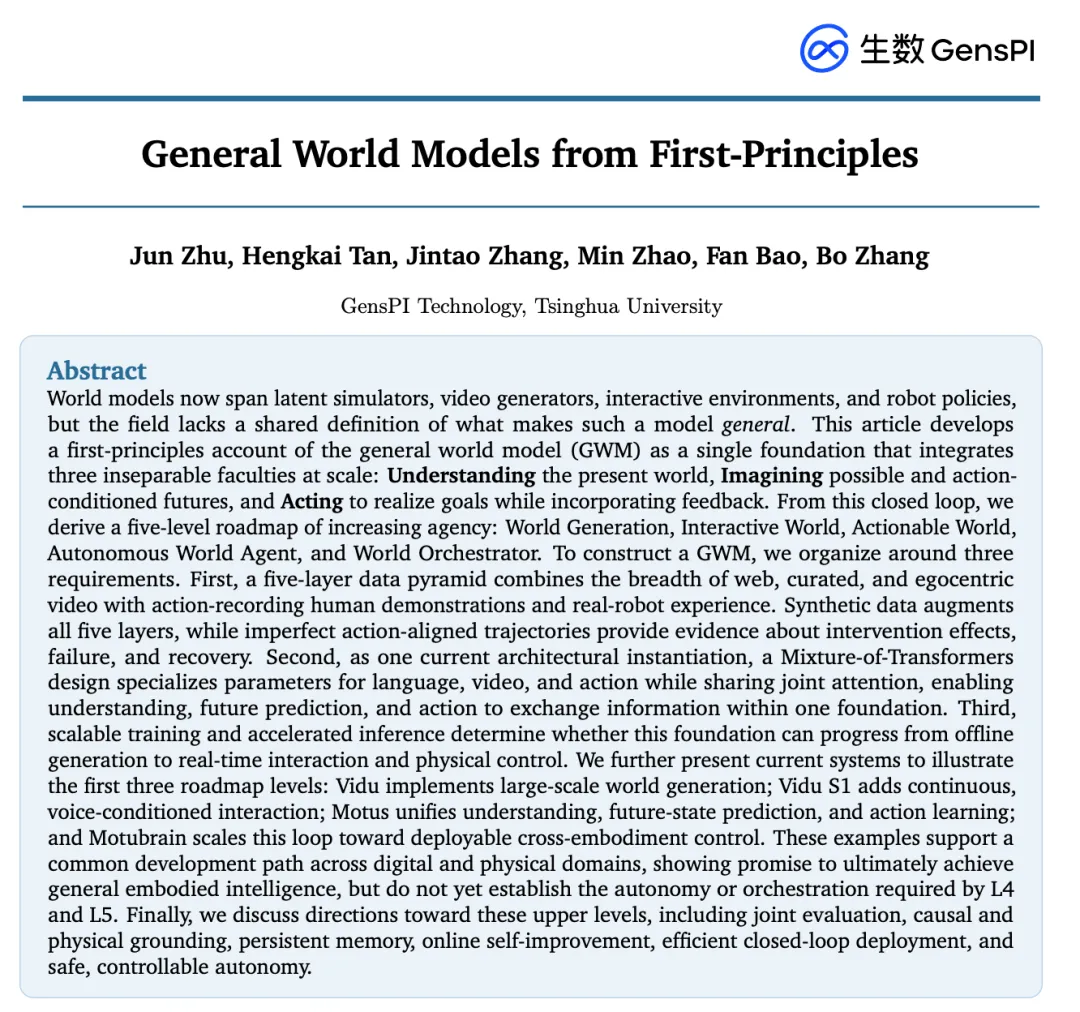
Video prediction is a basic form of world modeling in which models need to simulate a sequence of events based on people, scenarios, and actions that have already occurred. The longer the video, the more complex the movement, the easier the accumulation of errors over time, and the higher the requirements for long sequence modeling and state memory.
In the technological path of Vidu, the world model and multi-mode capabilities form a bi-directional promotion.
Why is it so cheap to model?
Vidu Q4 Preview starts at $0.09 per second, but is the low price all-inclusive?
For some time now, China's AI teams have been reducing the use of cutting edge models through architectural optimization, engineering transformation and scale-up services, and the field of video generation is particularly sensitive to this change because of its long-term double constraints on computational costs and "drag card generation".
If models continue to generate identity drift, disruption, or commodity distortion, once the price is lower, the creator will still have to pay a lot of screening, return to work, and waiting costs.
Therefore, discussing the pricing advantages of the Vidu Q4 Preview and whether it can reduce the number of attempts required to obtain the available lens. Q4 Preview emphasizes that the performance of the transmitter is to reduce the total return of character drift, movement rupture, camera disorder and feature disconnection.
A maximum of 15 reference charts, 3 paragraphs of reference audio, and 2K and 4K outputs further cover real-world aspects such as role control, audio continuation, and delivery of image quality.
However, to make these capabilities available to users at a lower price, the problem of computational efficiency must also be addressed.
Video generation is a computationally intensive task. The longer the time, the model needs to maintain a longer state chain; the higher the resolution, the faster the visual information involved in the computation. For the Transformer-based scattering model, attention in long sequences is particularly expensive, and the speed of reasoning directly determines the computational consumption of a single generation.
In the past few years, a considerable portion of the work has been done on efficiency. SageAttention attempted to accelerate attention with low-bit computation; subsequent SLA combined sparse attention with linear attention, further compressing the computation of long sequences; TurboDiffusion combined attention acceleration, step-by-step, quantum generation and engineering optimization to achieve a hundred-fold acceleration under specific open-source video models and hardware conditions.
The results of these experiments at least show that the optimization of the efficiency of video production in real numbers has been taken into account in several areas, such as sampling steps, numerical accuracy and reasoning systems, and related technologies have also been product-oriented in the real-time video production of the Vidu S1.
Data shows that Vidu Q4 Preview is about twice as fast as similar models, and 5 seconds of video takes about 110 seconds to complete. Increased speed reduces waiting time and increases unit computing task throughput.
For creators, what is more important is the "cost of available footage". One-time production is cheaper, and the model's control over the characters, lenses and reference materials is more stable, reducing the number of attempts required to obtain a available material. Performance and efficiency progress at the same time, in order to truly transform the price advantage into the actual savings in the workflow.
Therefore, the value of this round of price reductions should not be limited to short-term promotional understandings, where initial offers provide input, and the long-term meaning depends on whether technological efficiency continues to translate into lower production costs. For advertising, short films, anime and e-commerce content teams, this will affect whether AI video can be mass-produced and whether it can be entered into the formal budget.
What is it about acting, footage and special effects, and AI videos?
In the end, the technical route will be back to the drawing board. Next, we'll do a hand test.
Try an emotional one-act play with no lyrics and test the "acting technique" of the Vidu Q4 Preview.
We set up a short film that turned from restraint to explosion: fierce complacency, drowsiness, laughter in the kitchen, banging the table, slow calm, five emotional changes in a row. The reference material is only a female figure and a wood kitchen environment map.
It's a very close-up view, without cutting the mirror.

The difficulty of this test is that the lens is always fixed to the person's close-up, and with continuous lengths, the model is unable to hide faces, movements, or identity drift through the lens.
People need to complete many emotional changes in a short period of time, such as suppression, drowning, laughter, bursts and release, and eyebrows, eyebrows, mouth corners, scars and body postures must form a continuous response.
At the same time, the lights must increase as the mood moves from the positive heat to the side light, the reverse light, when it bursts, and finally fall back to the twilight, and the person's face must remain stable in the dramatic bright and dark changes.
Vidu Q4 Preview has a high completeness, with no apparent sudden "face change" in mood swings. Even after experiencing significant facial expressions and multi-dimensional changes, the five senses, short hair and clothing of the characters have not shifted significantly.
We'll take a look at the camera editing capabilities of the Vidu Q4 Preview.
In the following advertisement, Vidu completed a 16-second round-the-clock push of the desktop, a person gesture perspective shadowing, a red-circle turnaround, a product puncture matching take-up, a group shot, a low-position person, an arcade group shot, and a final product classification in 16 seconds, with a wide range of scenes but no scattered rhythms.
The product always maintains a high resolution in close-up lenses and multi-person interaction, with pink packaging, white suction tubes and cherry patterns throughout the film.
The cutter has a commitment, the cameras have a purpose, and the product remains stable in high-speed images, "standing at C-point", which is already a more complete advertising narrative logic.
The Vidu Q4 Preview was created by Vidu's super-creative "Halloween Culture" to advertise a snake skin, which was quite creative.
Vidu's hand-held skills are also useful.
A static home map was made into an 8-second "space assembly show" by Vidu Q4 Preview.

Tip: Starting with only the floor and walls, all kinds of furniture jump into the scene in a dynamic manner of lovely apples, respectively, from the surroundings, finally forming a quiet final image, Figure 1 as the end of the 5s; 5s-8s: afterwards, the environment gets darker, the light of the landing lights gradually lights up, which is important in the apples-like dynamic jump into.
Sofas, landing lights, edges, hanging paint, greenery and pillows jump in and out, with each piece of furniture squeezing, bouncing back and shaking slightly when it lands.
After multiple objects entered continuously, the shape, size and landing point remained stable, with no apparent intersection or location confusion. The second half of the environment gradually darkened, the landing lights slowly lit up, the warm light spread to the sofa and the ground, and the atmosphere changed naturally.
This shows the model's comprehensive control of multi-object motion, elastic transformation and dynamic lighting.
Around the same time, the Vidu Q4 Preview demonstrated higher overall reliability in situations where the model needed to "take the whole picture".
"DeepSeek Moments" from the video model
AI video really enters the production chain and needs to cross three barriers.
The first is the limitations of the model's capabilities. The characters must perform, the footage must be able to drive the narrative, the special effects must interact with the natural environment, and the reference material must also be consistent in the continuous images.
The second way is system efficiency. Only if the generation speed is fast enough, the unit calculation output is high enough, the creative team can simultaneously test multiple versions, spending more time adjusting performance, footage and rhythm.
The third is the creation threshold. Once costs drop, advertising, e-commerce, short films, anime and video teams can put AI video into their normal budgets.
Therefore, the "DeepSeek moment" of the video model, the lack of front-end performance, system efficiency and public availability, front-end performance is responsible for opening up creative space, system efficiency is responsible for reducing marginal costs, and universal pricing gives more people the opportunity to continue experimenting.
The Vidu Q4 Preview is a step-by-step answer to this question. It is still in the preview phase, and the official version will push the limits of video generation capabilities further.
JIQIQ4, login to Vidu.cn and get 500 points for registering a new user.
I'm going to try it again.