Anthropic is competing for Agent Cost.
Comrades, Anthropic has come up with another price. This time it's the cheapest Haiku in the Claude family.
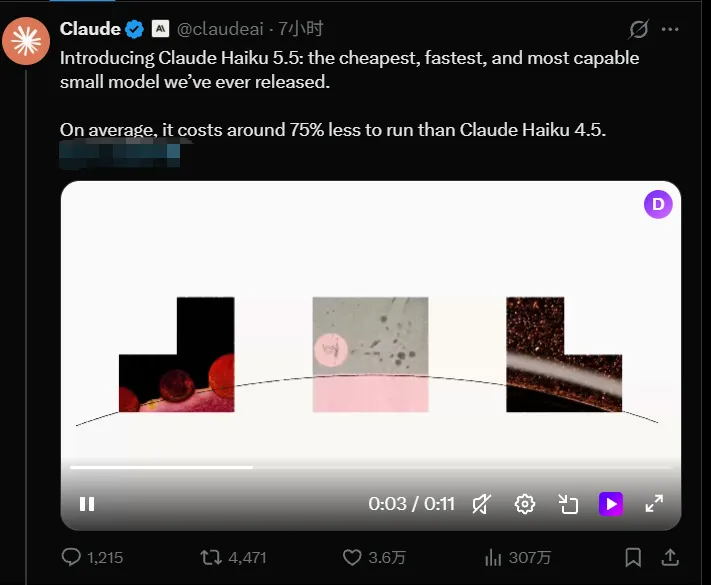
On October 7, Anthropic officially released Claude Haiku 5.5 as the fastest, most capable, and least expensive small model ever made.
The most exaggerated is the price.At least $0.1 per million of tokens entered, a 90% direct discount from the previous one.
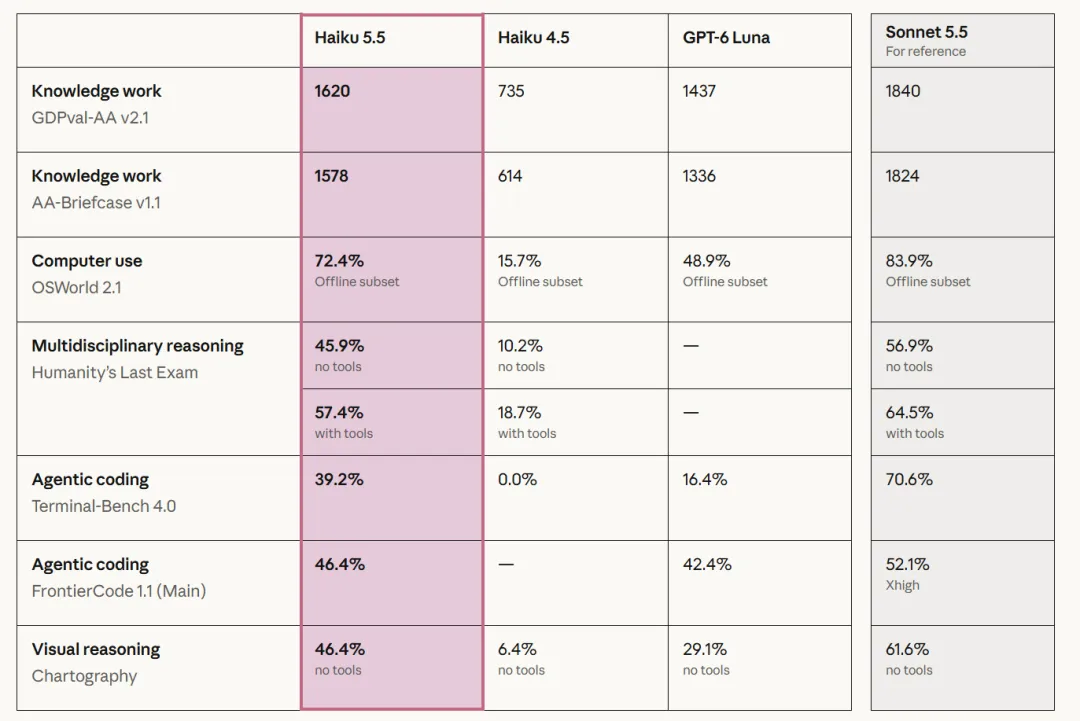
According to the results of tests published by Anthropic, Haiku 5.5 outperformed OpenAI's GPT-6 Luna on several benchmarks such as computer operation, knowledge work, and agent programming, with some results even bridging the gap.
In addition, Haiku 5.5 also introduces adjustable reasoning intensity, supporting 1 million tokens in the context window and up to 128,000 tokens output.
In the meantime, Anthropic has completed an update of the entire barrel of Claude 5.5 in just 15 days. On September 22nd, Opus 5.5 launched Sonnet 5.5 on September 28th, and now Haiku 5.5 is officially added.
This time around, Anthropic is focusing on AI missions that are extremely cost-sensitive, with huge amounts of calls.
Multiple scores exceed GPT-6 Luna, with a computer operation success rate of 72.4%.
According to the Benchmark score published by Anthropic, the Haiku 5.5 has achieved a significant improvement over the previous generation and has performed better than the GPT-6 Luna in some tests.
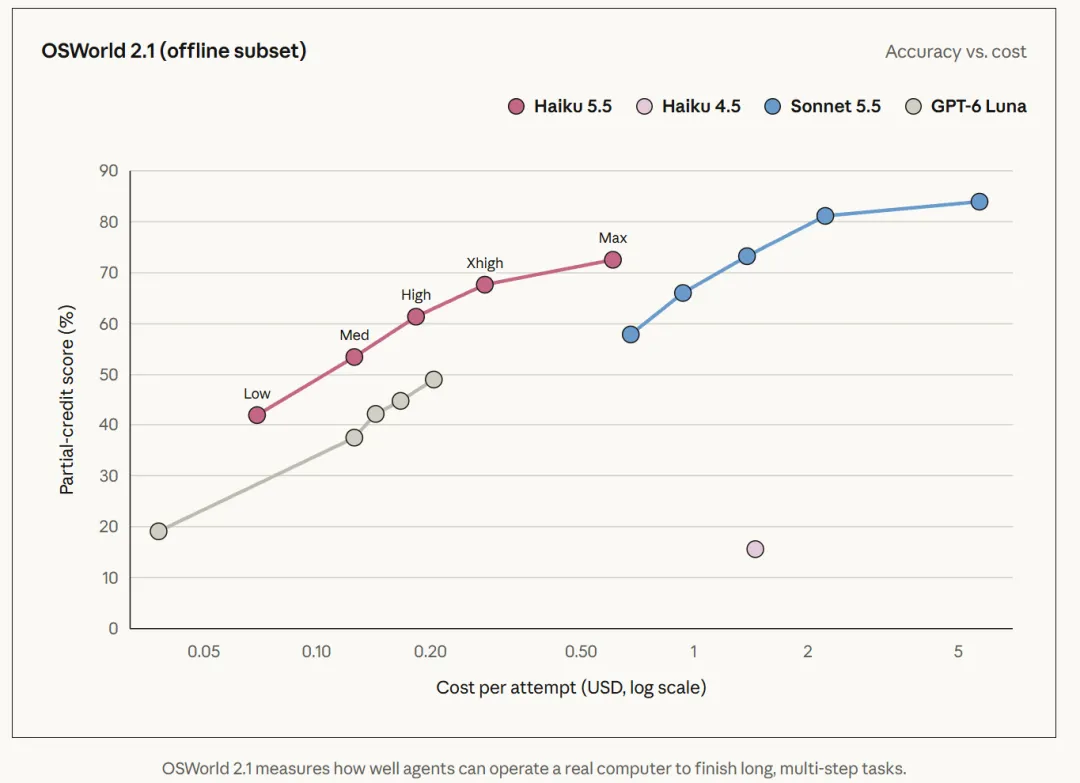
The most prominent of these results came from OSWorld. It was a test that measured the real computing ability of an AI Agent to operate, requiring the model to complete multi-step, multi-application operations.
In the OSWorld 2.1 offline mission subset, Haiku 5.5 achieved a success rate of 72.4%, compared to the previous generation Haiku 4.5 at 15.7% and GPT-6 Luna at 48.9%.
In terms of knowledge work, Haiku 5.5 scored 1620 points in GDPval-AA v2.1, up from 1437 points in GPT-6 Luna. In the Terminal-Bench 4.0 Agent Programming Test, both scored 39.2% and 16.4%, respectively.
However, there is also an important detail in the data.The highest Benchmark score of Haiku 5.5 often requires more rational calculations.
For the first time in the Haiku series, the Haiku 5.5 introduces an adjustable reasoning intensity that allows developers to control how much computational resources the model uses through effort parameters.
VentureBeat noted that in the Terminal-Bench test published by Anthropic, a score of 39.2% corresponded to the maximum reasoning intensity. After switching to the moderate reasoning intensity, the score dropped to about 20%, whereas the moderate intensity was the default setting of Haiku 5.5.
Artificial Analysis, a third-party rating agency, observed a similar phenomenon. In its Intelligence Index rating, Haiku 5.5 has a maximum reasoning strength of 43 points and a mean reasoning strength of 34 points. Under the same rating, the average cost per mission is about $0.21 and $0.05, respectively.
In other words, the model can perform better in return for a better task by increasing the reasoning budget, but the actual cost may also increase significantly.
Artificial Analysis, in its own Terminal-Bench 4.0 test, measured a score of 33% of maximum reasoning intensity and 15% of average intensity. Due to different rating settings, this group of figures differed from the official results of Anthropic.
This is why it is important to consider the intensity, completion rate and actual costs of small models when considering performance.
In the more complex Agent programming tasks, Sonnet 5.5 still has a clear advantage: a terminal-Bench 4.0 score of 70.6%.
It is also clear from Anthropic:While Sonnet and Opus are still better suited for complex Agent programming tasks, Haiku's advantages are concentrated in high-frequency, range-specific work.
The GPT-6 Luna is directly competing with the GPT-6 Luna.
If the performance improvement makes the Haiku 5.5 more competitive, then the price is probably the most important point of view for this release.
For token requests of no more than 100,000 tokens, Haiku 5.5's entry/exit single price is 90% lower than the previous generation.
According to Anthropic, about 90% of requests from the previous generation of Haiku were within 100,000 tokens. Combined with different request lengths and changes in Token consumption, the company expects Haiku 5.5 to be complete.Average cost of similar tasksIt's down about 75%.
There is also an easily overlooked detail where Haiku 5.5 replaces the new Tokenizer. According to the official developer documentation, the number of tokens generated in the same text in the new model may be about 30% higher than Haiku 4.5, depending on the content.
Another notable competitor is the GPT-6 Luna. The base price of the Luna, given by OpenAI, is also $0.1 per million for Token input and $0.5 for output, and the caching read price is also consistent with the low price of the Haiku 5.5.
However, there are significant differences between the two companies in terms of billing thresholds.
Haiku 5.5 enters a higher price range after prompting more than 100,000 tokens; GPT-6 Luna only triggers a higher price after input of more than 272,000 tokens.This means that Luna's unit Token price has an advantage over requests between 100,000 and 272,000 tokens.
It is also necessary to combine the actual Token usage, budgeting and task success rates to determine which model will save more money in completing a task.
For the market as a whole, Anthropic is also putting pressure on other low-cost models.
The concurrent API prices listed by VentureBeat show that Google Gemini 3.5 Flash-Lite is priced at $0.3 per million of Token inputs and outputs; Gemini 3.8 Flash is priced at $0.75 and $3.75 respectively.
Of course, the positioning capabilities, caching strategies, and task performance of different models vary, and these figures are primarily reflective of API price competition.
Small model price battles are being upgraded further.
Eight million calls a week, and companies are starting to get smaller models to work bigger ones.
What is Haiku 5.5 for?
The scenes given by Anthropic include document summaries, information classification, database queries, context compression, and as Subagent in the complex Agent workflow.
There is a very realistic problem behind this: today's Agent is increasingly complex, with a task often requiring multiple model calls.
Financial AI company Rogo provides an example. In its workflow, a more capable model is responsible for producing financial presentation documents. While processing one of these slides, Haiku 5.5 Subagent accesses the enterprise's 10-K annual report, finds the required business revenue data, and delivers the results to the main model.
For this task, the model needs to find and extract information quickly and accurately. Rogo believes that the Haiku 5.5 achieves a balance between accuracy, speed and price that is suitable for a large number of repeat calls.
Box, an enterprise content management platform, also gave early test results compared to Haiku 4.5.Haiku 5.5's internal ratings improved by 11 points, with delays dropping by about 50%.
According to Box, this makes the new model suitable for large-scale operational analytical work such as synthesis of book reports, financial summaries, and periodic reviews. However, Box does not disclose a complete assessment standard.
Asana's testing covers Agent tasks such as bug classification, project building, large-scale project combination searches. According to its disclosures, Haiku 5.5 reduced the latency of tasks by more than 30% compared to current models and improved the single-wheeled Agent's maximum logical speed by 2.5 times.
Another more cost-effective example comes from AlphaSense. The company's Ask in Document feature processes about 8 million calls a week, primarily to answer specific questions about one or more documents.
In 400 test queries, Haiku 5.5 has an internal rating of 0.84, while Haiku 4.5 has a rating of 0.76.
If a model is called millions of times a week, the long-term accumulated cost changes can be quite noticeable even if they save a small amount of money each time.
The data comes from early customer feedback disclosed by Anthropic, specific workloads, controlling models and rating standards are not entirely consistent, and more independent testing is needed.
Sonnet followed the price drop, Claude 5.5 and the whole barrel started costing.
In addition to the Haiku 5.5, Anthropic has also synchronized the pricing of Sonnet 5.5. As of October 7, the caching reading fee for Sonnet 5.5 has been reduced by 50% from $0.2 per million tokens to $0.1 per million.
Anthropic expects that this adjustment will reduce the cost of most Agent workloads by about 20%, depending on the extent to which the application repeatedly uses caching in context.
For Agents who need to repeatedly read the history of long conversations, tool descriptions and contexts on tasks, the cost of caching directly affects the long-term running costs of the system.
At the same time, Anthropic is launching monthly APIs for Claude Max and Team subscribers: $100 for Max 5x users, $200 for Max 20x users, and $500 for Team users.
These limits can be used for model calls on the Claude platform, encouraging more subscribers to try to build their own agents and apps.
For developers, Haiku 5.5 is available on platforms such as the Anthropic API, Amazon Bedrock, Google Cloud, and Microsoft Azure.claude-haiku-5-5。
Anthropic also updated the Python and TypeScript SDKs, adding support for browser operations and computer operations in the Beta phase.
By this point, the product division of the Claude 5.5 series has become quite clear.
The Opus 5.5 is responsible for high difficulty, complex reasoning tasks, the Sonnet 5.5 covers everyday complex tasks and programming, and the Haiku 5.5 focuses on high-volume, cost-sensitive, and fast-response tasks.
From September 22 to October 7, Anthropic took 15 days to complete this round of product updates, with all three models emphasizing performance and cost effectiveness.
The release of Haiku 5.5 also makes a trend even more apparent. As Agent moves from demonstration to practical application, developers must consider the cost of calling the entire system. Which steps require a stronger model at a time, which can be assigned to smaller models, and how work is allocated between different models will affect the final commercial feasibility.
For Anthropic, perhaps the most attractive part of Haiku 5.5 is this:It makes more tasks that were previously difficult to scale because of the cost of calling too high, economically viable.
The competition for small models has begun to delve deep into every execution link in the Agent system.