“ The sense of speed is borrowed from elsewhere.
The brake is a robot with wheels on it.
The phrase has been quoted extensively over the past two years, and the reason for that sounds good: perception, decision-making, control, three things are one thing; simulation, data pipelines, chips, all of which can be moved together.
Zhang Zhang, CEO of Optical Technology, gave a percentage at WAIC 2026. He has been working for a long time as an unmanned aerial vehicle and is now a physically intelligent person, judging that about 50% of the infrastructure of autonomous driving technology has been transferred. Data collection, data set cleaning processing, end-to-end model training, simulation verification, machine testing, these processes can be run over and over again.
Zhang added the other half. For autonomous driving, contact means a collision accident; for robots, these core tasks of seizure and assembly are accomplished entirely by contact.
Autonomous driving is a set of methodologies that should not be taken together, such as the timeline.
01.
50% is in the process.
In the last two years, media statistics have shown that nearly 40 core executives and technicians in the field of intelligent driving in the country have moved into physical intelligence. The list has been drawn up, ranging from the number one position of intelligent driving in automotive companies to the top scientists in AI, and mostly to entrepreneurs.
These people's choices have a proven track record. This self-driving system has been running for nearly a decade, collecting hardware, cleaning labeling pipelines, training scripts for end-to-end models, verification processes in simulation, and finally the test racks of real machines, each of which has been trampled through craters.
Capital market judgments also point to the same point. Capital market confidence in physical intelligence, part of which comes from data-gathering sensors that have passed vehicle standard verification. A hundred years of supply chain in the automotive industry has a strict set of parts verification standards that can be passed in autonomous driving scenarios and are usually more reliable in physical scenarios.
The differences are not only one-sided. The complexity, diversity, and higher demands for physical intelligence of scenarios and tasks; the safety and stability standards for long-term operation of products, and the requirements for autonomous driving are more stringent.
What can be moved is the process, the standard and the method of verification. What cannot be moved is the ability that has already been practiced, which is to re-grow into a whole new body.
The difference between the two sides can be broken down into three parts, which are multiplication relationships.
In the perception model, cars rely on four sensors: cameras, laser radars, millimeter waves, ultrasound waves, electromagnetic waves concentrated near visible light, and a bit of infrared and 24G, 77G.
In the scene, cars run on public roads, objects interact about the types of vehicles, pedestrians, transportation facilities.
In terms of precision of movement, the control movements of the car are brake, acceleration, rotation, precision to the degree of centimeters.
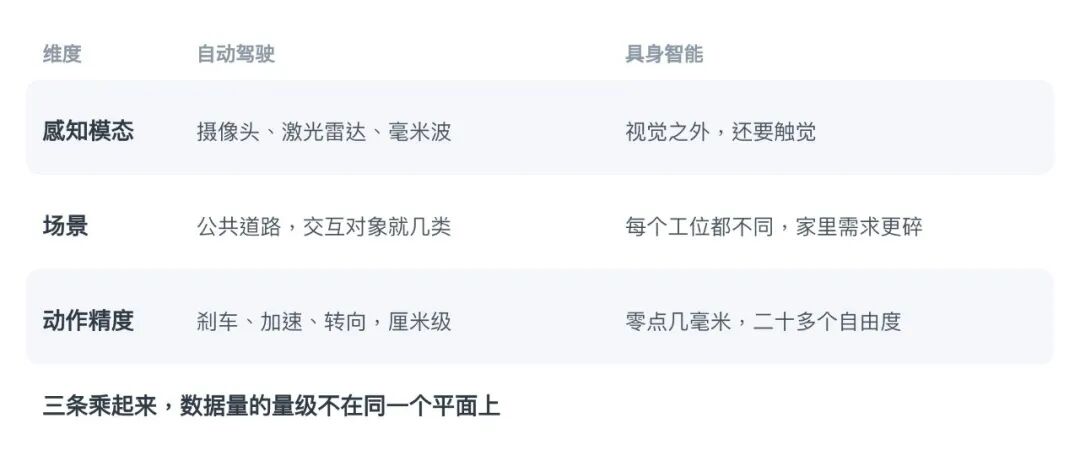
He believes that autonomous models cannot move directly to robots because the difficulty points on both sides are not in the same place. Autonomous driving focuses on navigation and movement, while robotics focuses on operation. He breaks down the general capabilities of the robot into movement, navigation, interaction, and operation, in which the operation determines whether it can enter the factory or not.
Running, jumping, and fighting movements can be quickly reversed based on body structure, motor power and balance control. Hand operation involves tactile feedback, force control accuracy, and multi-finger coordination, with greater engineering difficulty at each step.
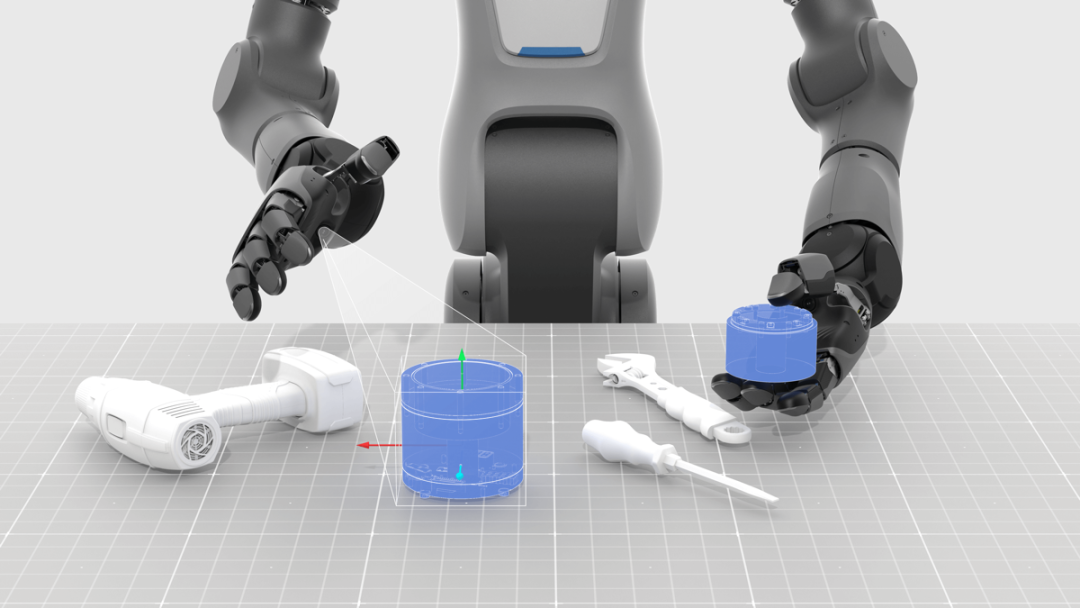
Notes: Hands on the stage to grab an electric toothbrush, a type of brush tool. The gap between the two industries is concentrated in the hands.
This is backed by an old and often quoted conclusion, the Moravian paradox, which makes it easy for machines to reason at a higher level and makes it difficult for them to master basic human perception and motor skills.
The two systems are in opposite directions when it comes to this matter. One is learning how not to, and the other is learning how to. This difference is not eliminated by adding data.
02.
The only thing missing from the simulation is the sense of hand.
In the last decade, automakers have used the practice of allowing cars to run tens of millions or even hundreds of millions of kilometers in virtual environments to repeat long-tail scenarios that are difficult to replicate in reality.
The problem arises in the precision of the physical engine. The realisticity of the picture is long enough, and the friction and shape change are both approximate values. The static friction coefficient at one point of contact is a fixed number in most engines. In reality, the same thing, the friction changes with the pressure, speed, surface humidity.
The simulation strategy is to learn the contact model of the simulator, not the real one.
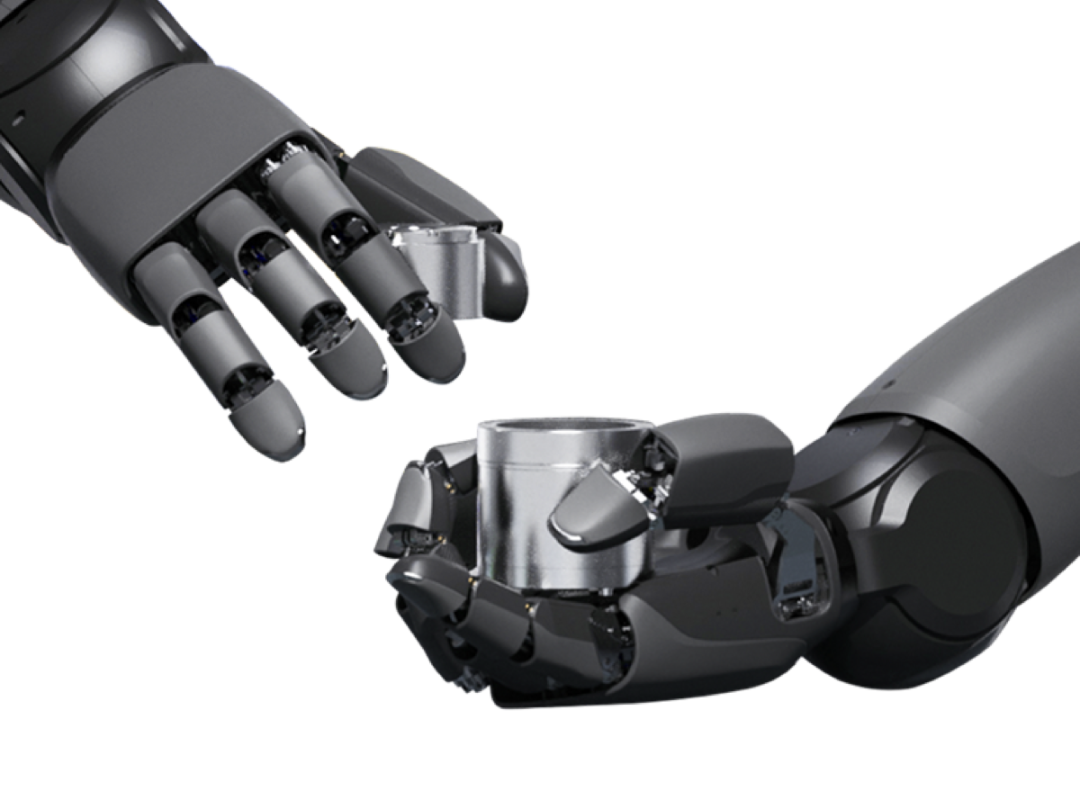
Robot hands grab a metallic vessel. How the contact force changes with the force is not allowed in simulation.
A Stanford paper this year gave a set of comparisons.
One Demonstration, Many Objects, as a conventional baseline approach to simulation, has a success rate of 80% to 96%, with the same strategy shifting to the real five fingers, falling to 3% to 38%.
The paper's contact center rewards program, which incorporates real contact feedback into the training cycle, brings the average success rate of single strategies on 16 objects, four classes of tasks, and two handheld machines to 71 percent.
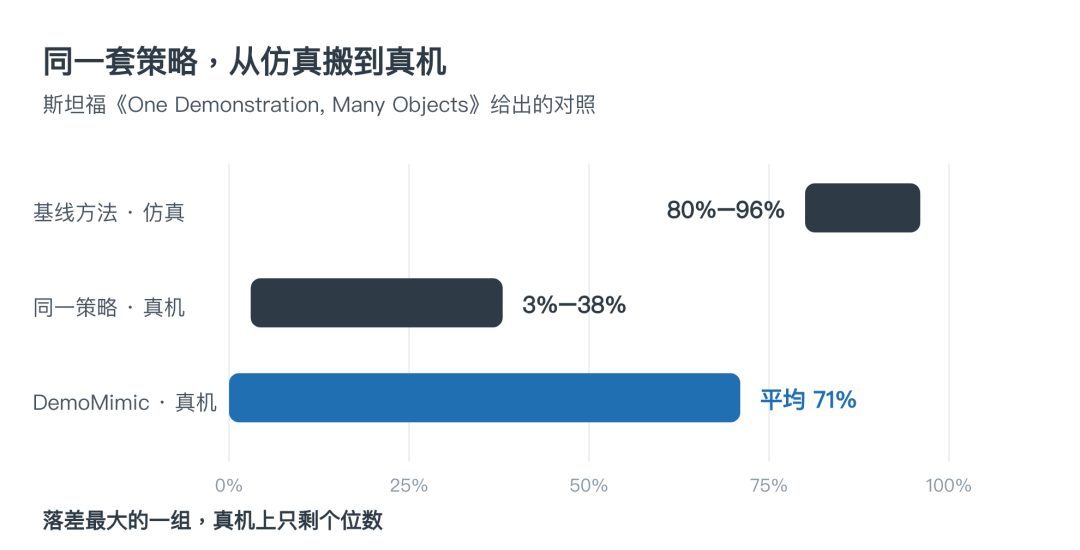
Notes: The same set of strategies, with a high success rate in simulation, actually dropped to hundreds of points. Image source: Public data mapping based on paper
This is the specific shape of the simulation of the chasm to the real machine. The closer the mission is to contact, the less help simulation can provide. The grip, insertion, and handling of flexible objects belong to this category, relying on the senses of the hands, which are precisely the ones that robots most want to do alive.
03.
It's a good copy, but not a bad one.
The part that can't be picked up in the simulation can only be picked up from real equipment. On this line of data, there is a run-of-the-mill method of autonomous driving. The car runs along the road, the model follows the backstage, and as long as its judgement and human operation are wrong, this part is picked up and passed on.
This method is based on the number of cars. There are millions of Tesla hardware-supported data collection vehicles that run on the road every day, and the data is self-generated without the need for additional organizers to collect it.
There is no such number on the robot side. The total shipment of the current robot is 100,000 units, and 80 million cars a year worldwide. A significant part of the 100,000 units are still in the laboratory and development platform, not working on the jobsite every day.
Chart: Quantitative contrast between total robot shipments and annual production of cars, horizontal axis in pairs. Image source: Drawing based on public data
This is why the intelligent industry is now talking about data, how to convert human-operated video into training data, how to remotely operate a receiver, and rarely how to automatically recover it from running devices.
The anticipated gap will finally fall in time. Technology has not been able to skip past stages, engineering products are all done a little bit upwards, solving one problem after another.
The phrase applies to self-driving cars, but it's more relevant to physical intelligence: chips, motors, sensors, data pipelines, measurement methods, and everything in between.
At the World Robot Congress this year, Wang said that the general intelligence of the physical world will not need another five or ten years. He estimated that the data collection of robots will be 1000 times greater in five years. Two phrases are not the same thing: one is a landing node, one is the size of the data and the direction is consistent.
It's not a question of direction. It's a question of where the progression chart assigned to this direction comes from.
Autonomous driving took decades to scale from its earliest public demonstrations to today's deployment, the most skilled thing in the midst of which was moving the timetable backwards. The difficulty structure of physical intelligence is different from it, and the two things do not have to repeat the same curve.
The next time you see a robot coming into a factory, the next time you see a time forecast, you can see where its progress is coming from. In the industry, most of it is self-driving.