It's the first time in the history of the world.
How should the price of computing be re-priced when AI entities are approaching and even replacing human knowledge labor?
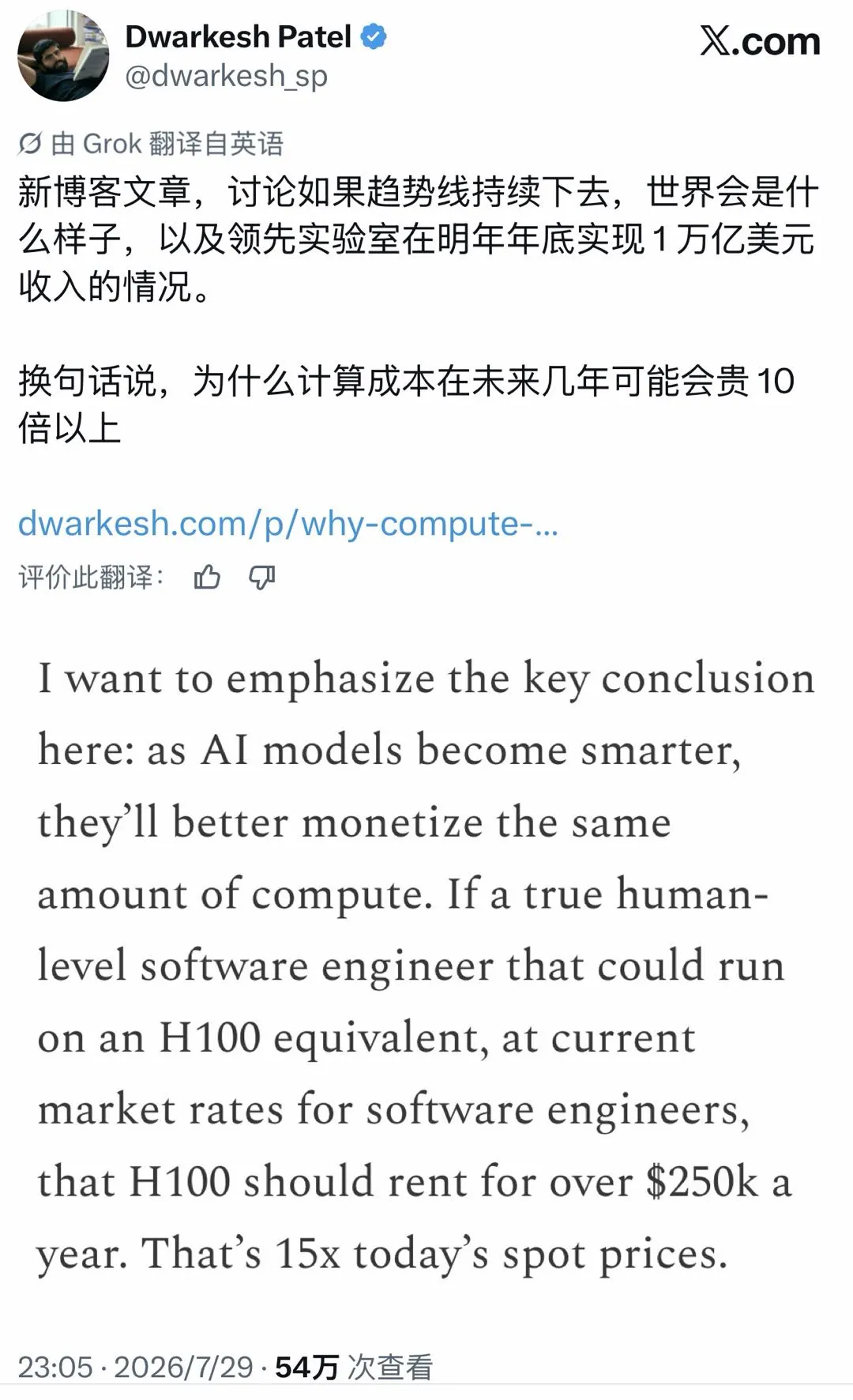
In a recent blog post, well-known tech podcaster Dwarkesh Patel made a bold suggestion: if AI labs continue to grow rapidly (like Anthropic to $1 trillion by the end of next year) and the supply of computing only increases about three times a year, the price of computing might increase by more than 10 times.
In recent decades, computing has been seen as a "tool". Computers are faster, more servers, and cloud computing is cheaper.
But the era of AI is undergoing a paradigm shift:The GPU is no longer just a piece of machinery, but could be a carrier of digital workforce.
If an H100 can carry an AI Agent that is close to the level of top programmers, its value should no longer be calculated according to the "server hourly price" but should be calculated according to the value of human labor that replaces it.
Imagine if there was a sleepless, responsive, technically capable "digital software engineer" at the top of the human ladder, how many years would you be willing to pay for it?
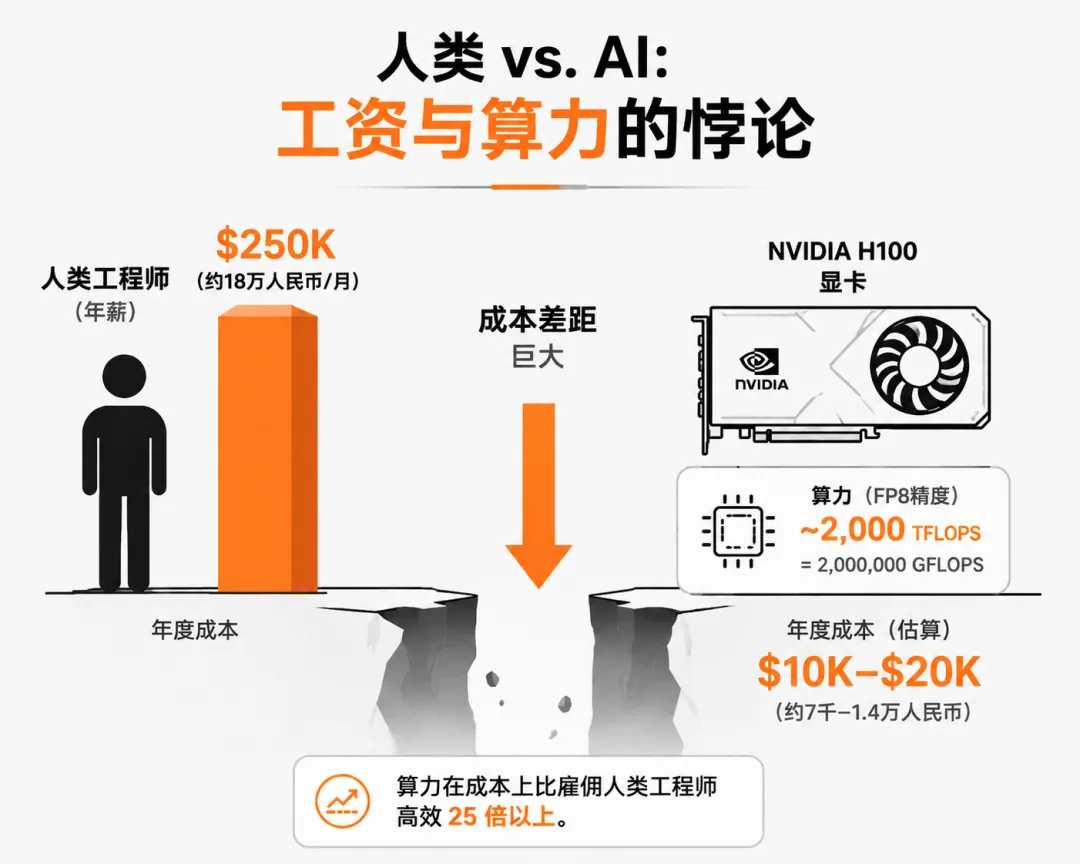
In Silicon Valley, the average market salary for software engineers is more than $250,000 a year. However, carrying such an equivalent level of intelligence (Agent) could only require the computing power of a single H100 graphics card.
Now, let's make a note:
If the H100 could perfectly replace a $250,000-a-year human programmer, the theoretical annual rent for the H100, purely from business and economic logic, would have to be set at $250,000 per year.$250,000That's it.
But at this point, the current rental price of the H100 on the market is only about $160,000 a year.
This is what we are going to face, the biggest "black hole" in the history of humanity.
When the intellectual proliferation of the virtual world is far beyond the limits of the physical world, contradictions arise:
The growth in value of digital intelligence is far exceeding the expansion of physical computing infrastructure.
This 15-fold decline in valuation will generate strong feedback:In the coming years, the real price of computing could face a round of 10 times or even higher hyperinflation.
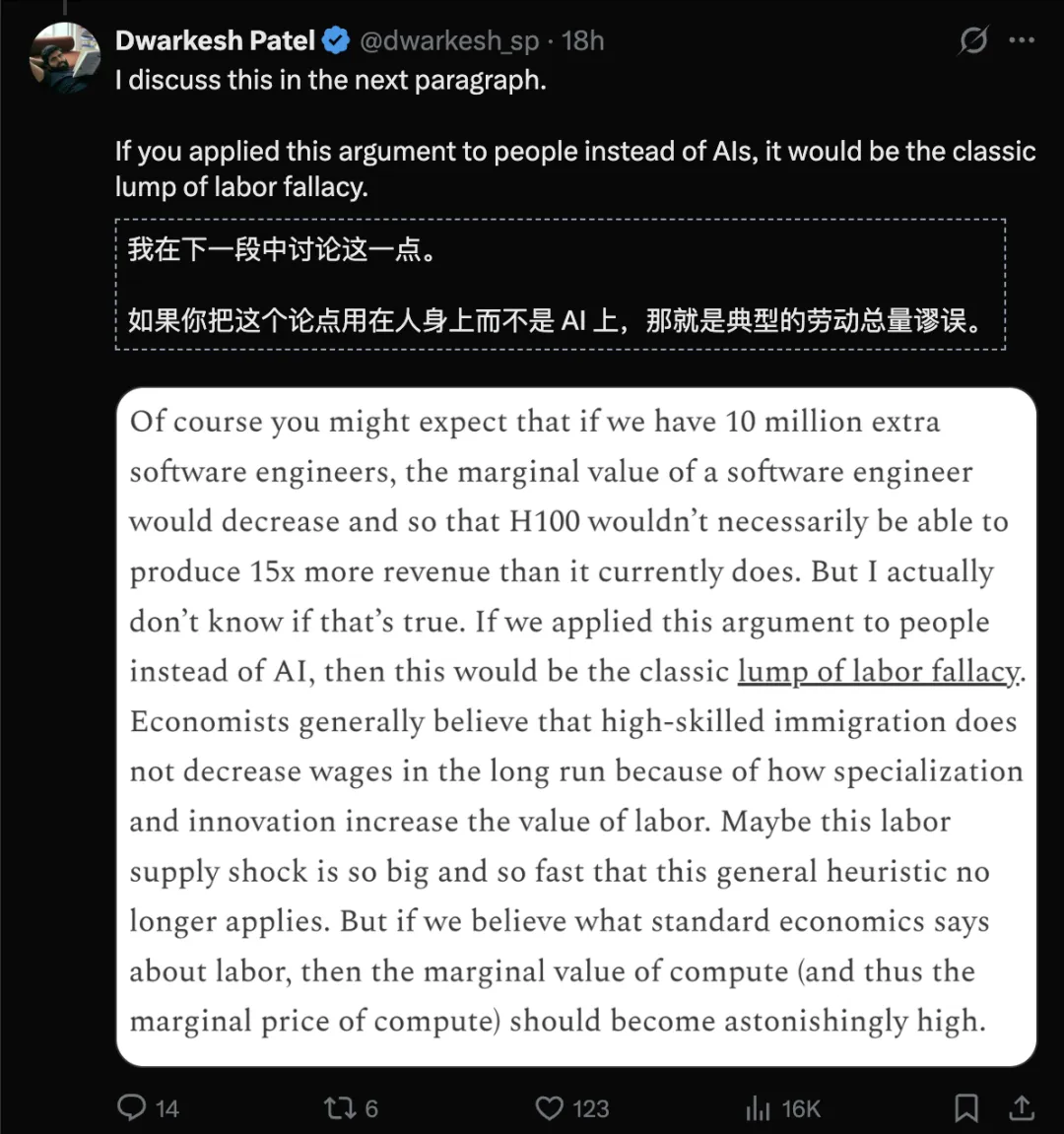
Naturally, there is a question: will the salary of software engineers decrease significantly in the future?
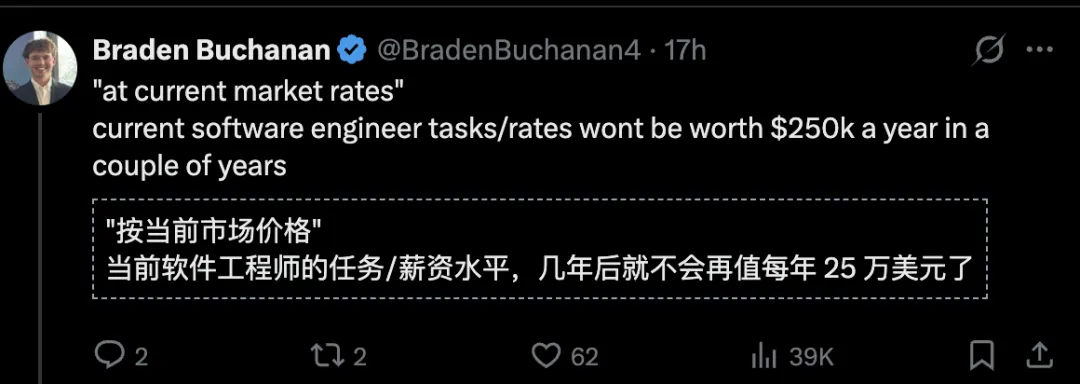
This question was also considered by Dwarkesh Patel:
But if we believe in the theory of standard economics about the labor force, then the marginal value of arithmetic -- rather than the marginal price of arithmetic -- should become extremely high.
Over the past few years, the AI industry has followed a simple logic: bigger models, more data, more GPUs, stronger capabilities.
But now a new contradiction is emerging:AI is growing at a faster pace than the growth of computing power supply.
Take Anthropic, for example. In the past year, its business revenue has grown by about 10 times.
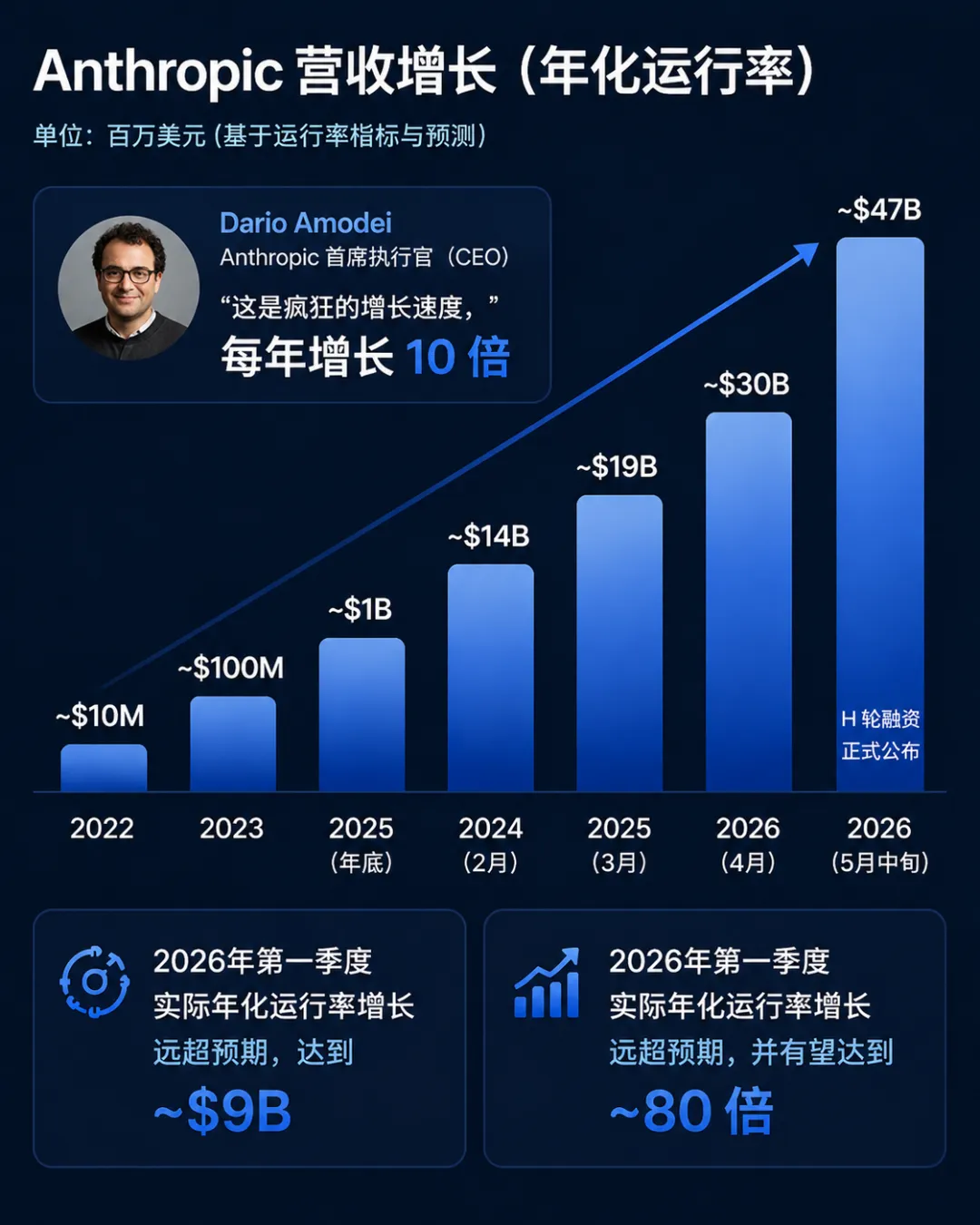
At this rate of growth, its annual revenues could reach between $100 billion and $150 billion by the end of the year. If this trend continues, next year it will have to face a crazy question: how to support the trillion-dollar "money landscape"?
The answer is only one: more intelligence. And more intelligence means more training, more reasoning, more GPUs.
However, the problem is that the supply of computing power is not growing at the same rate.
Currently, the expansion of physical computing in industry-leading laboratories can only sustain roughly three-fold annual growth.
And then there's a big mistake:
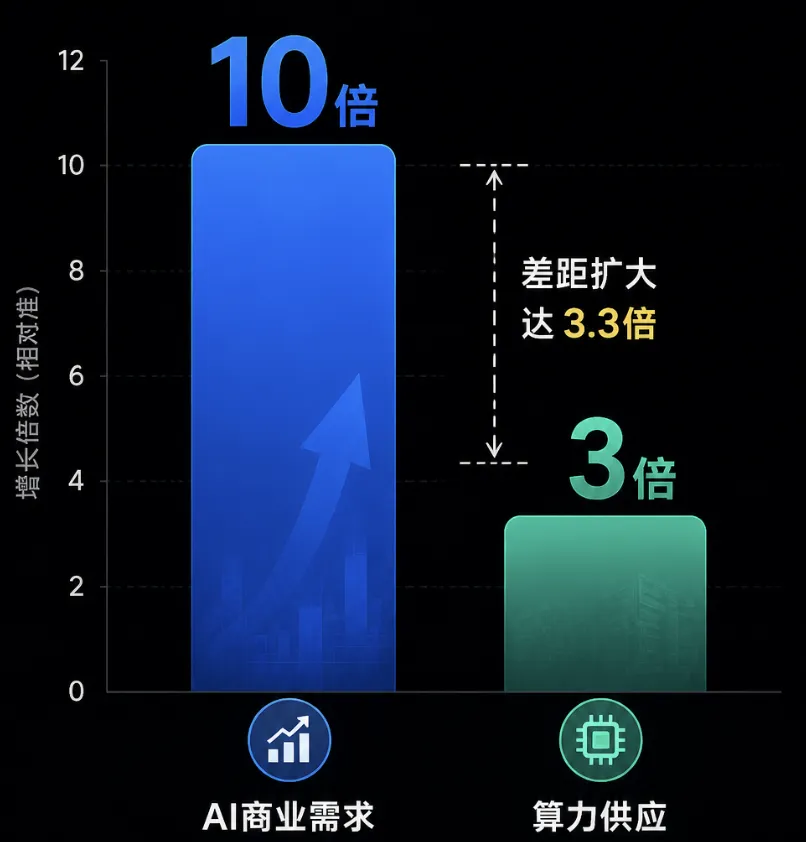
The digital world wants to run 10 kilometers, but the physical world only offers 3 kilometers of road.
There are only three options:First, to increase the rate of profit. Second, to increase the price of computing. Third, to put more computing into reasoning business.
The third path is actually the one that many AI labs are most reluctant to see.
Because reasoning to make money is essentially just to prove that "the AI business model is in place".
Then continue to finance, continue to buy more GPUs, and continue to train the next generation of models.
The real cycle of Silicon Valley is:

Making money is not the end, it's just to buy more computing power.
Because what all the labs really believe is that today's most advanced model, a year from now, might be just like yesterday's phone, powerful, but outdated.
This would push back the first two options:Rising interest ratesOrThe rise in the single price of computing。
By the end of next year, if the profitability gap is to be digested entirely by the profit rate, the profitability rate in the frontier laboratories will have to be in the mid-to-high range of around 95%.
In the history of business, this is almost a fantasy, except for a few absolutely technological monopoly nodes.
So all the clues and logic are finally coming together in one export:The single price of computing power is about to usher in an unprecedented storm.
GPUs are changing from servers to factories in a new era.Many people don't realize that AI competition is entering the age of infrastructure.
In the past, Internet wars have been fought over: users, traffic, inputs, while the AI era has been fought over: power, chips, data centers, supercomputer clusters.
Why? Because top AI labs can't rely on regular cloud servers.
They require: proprietary GPU clusters; stable network structures; extremely high utilization rates; data and model security.
It's no longer about renting a regular server, it's about renting a future smart production line.
A typical example is Google and Anthropic leasing large-scale GPU resources to SpaceX.
Google reportedly has about 110,000 GPU clusters and a monthly rental of $900 million.
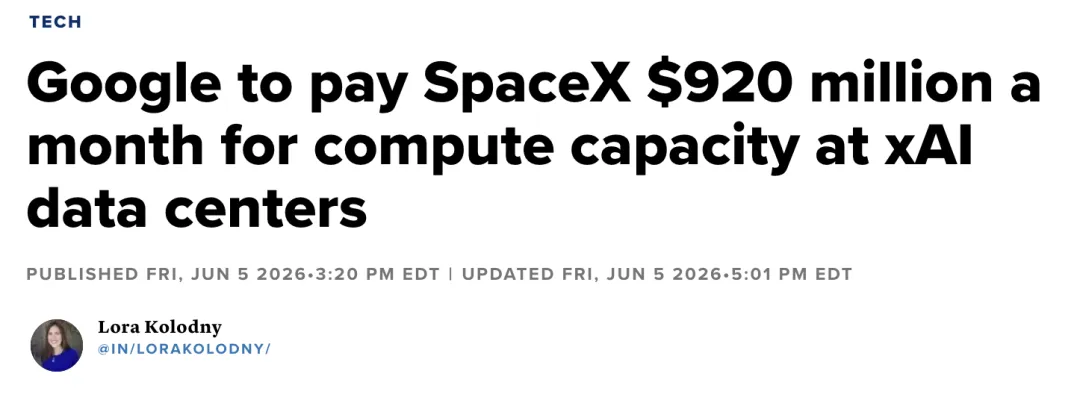
In the meantime, we're going to have to pay the rent of a single GPU per hour, and we're going to have to pay the rent.This is almost twice the single price of the current cash lease on the market.And don't forget, the current cash price itself is already 40% higher than the lows at the beginning of this year.
Why not?
Because top computing is increasingly becoming a strategic resource like energy, power grids, and so on.
Imagine an industrial revolution where one factory has a steam engine and another one doesn't.
The difference is not 10 percent, but the difference in the whole way of production.
The GPUs of the AI era are also becoming this new "steam engine".
Why are calculation prices so out of control?
The answer lies in the physical formula on the supply side, which has been sealed off by the physical limits of the giants of accumulation electricity and light engraving.
Within the industry, the myth of "calculation is growing 3 times a year" is broken down, but the three multiples are barely spotted at the edge of the limit:
3x) ≈ 1.4x (More's Law) x 1.2x (New Wave Factory Construction) x 1.8x (Advanced Processing Capacity)
And these three multiples, each approaching the ceiling.
Moore's Law: Each step is more difficult to minimize than the previous one, and leakage and atomic limitations make it as hard as ice.
The construction cycle of the new wavelength plant is long, and the delivery speed of high-NA EUV light engines is stuck throughout the chain, unresolved until at least 2030.
In the last two years, the only engine for the growth of computing power has been to extract AI chips from mobile phones, PCs, and advanced systems.
By the end of 2027, AI chips will consume 86% of N3's electrical capacity, from 60% to 86% of lithium is not growth, it is absolute lithium in the physical sense, and there is no more room.
Three multiples, two have been seen, the last one is about to hit the wall. The story of the power supply has been told.
The more expensive the calculation, the less expensive the model.
Intuition says: It's expensive to calculate, so you should use a lightweight model, open-source cutting edge, and save a little money.
But AI economics is the other way around.
The core logic is:The Algerian-Alan effectWhen all commodities are added to a fixed additional cost, the price is more economical.
In AI, this "additional cost" is the cost of computational depreciation, regardless of the model.
H100: $20 an hour.
- The best model: 1 hour of work, 25 dollars, 20 calculations + 5 premiums.
- Penguin Model: License fee 0, but IQ is not enough, repeated trials and mistakes delayed 2 hours, $40.
Conclusion: It is more expensive to use a plane model instead. It burns computational power and more valuable resource time in inefficient experiments.
Therefore, the more expensive the calculation, the stronger the model, the lower the price premium. Since Yokohama has to pay for the calculation, the more money you spend with the smartest, the more money you really save.
There's no way to live.
Eventually, the capital of society as a whole will be like a black hole, drawn to a very small minority of trillionaire oligarchs who can create the absolute most powerful model.
Computing is also a resource, without having to raise prices.Of course, there are some who oppose it.
In the comments section, Eric Xu makes an interesting rebuttal: The $250,000-a-year rental logic is only in the purely digital realm. When it comes to the physical world, such as the approval cycle of clinical trials, the decision-making process of government procurement, AI's turnaround ceiling may be as low as $250,000 and closer to $50,000.
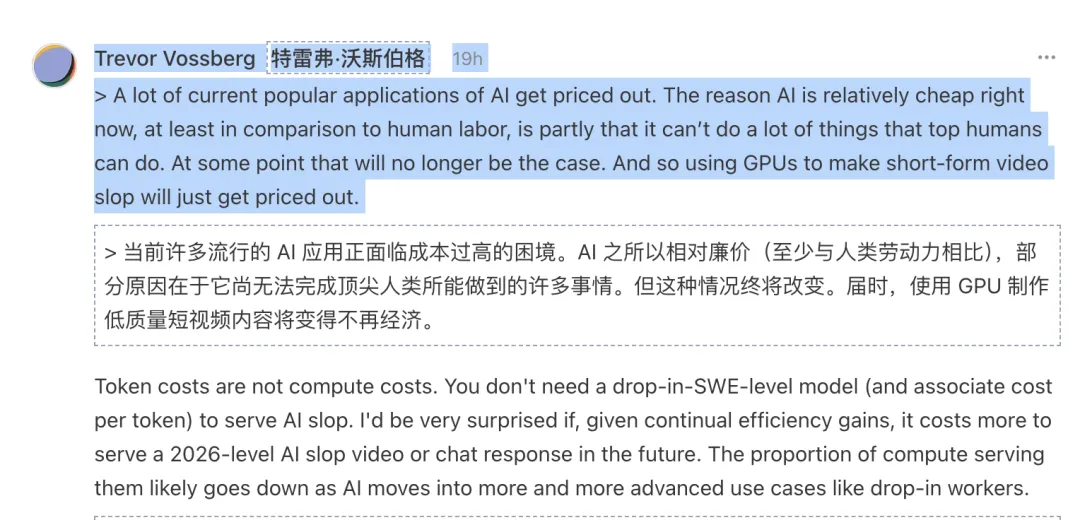
Trevor, a senior software engineer, points out that low-quality content simply doesn't use top models, and they tend to move to cheaper alternatives rather than disappear directly. In other words, what is being cleaned up may be the price, not the content itself.
In 1980, Stanford biologist Paul Ehrlich and economist Julian Simon gambled that five metals would rise in price a decade later.

After a decade, five companies collapsed and Erlich admitted to losing money. "Resources will go up in price", and most of the richest people in history have lost.
Dwarkesh's response was: the resilience of the computational supply, much smaller than commodities. Copper mining can increase production under high price stimulation, and the EUV light engraving machine itself does not have the spare capacity to be released. In these years of supply of only three times tonnes per year, there is no alternative.
Interestingly, Dwarkesh himself admits that this prophecy is almost entirely false.
Perhaps one day computing will be as cheap as the sand, but before that day comes, we will have to go through one of the most brutal mathematical arms races and mathematical inflation.