It's the first time in the history of the world.
DeepSeek-V4-Flash's official version has just blown up the global general model circle, followed by the Chinese life sciences edition of Deepseek.
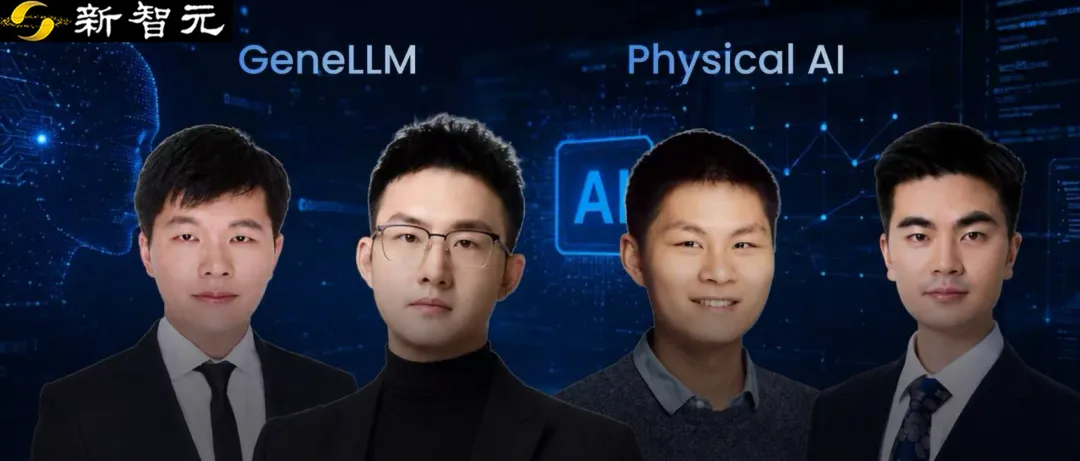
Recently, the GeneLLM multidisciplinary model of life sciences (founded by four Oxford University home scholarships) has been independently developed and published in the leading international academic journals Nature Communications and Advanced Science.
As the world's first multidisciplinary model to be pre-trained using primitive genomic data directly, GeneLLM is the world's first multidisciplinary model to use primitive genomic data directly.Another groundbreaking model after Google's AlphaFold and Stanford University's EVO 2 fills the gap in the basic model of life sciences in China.,Let's see.AII started to understand the multiple "languages" of life and the whole "system".
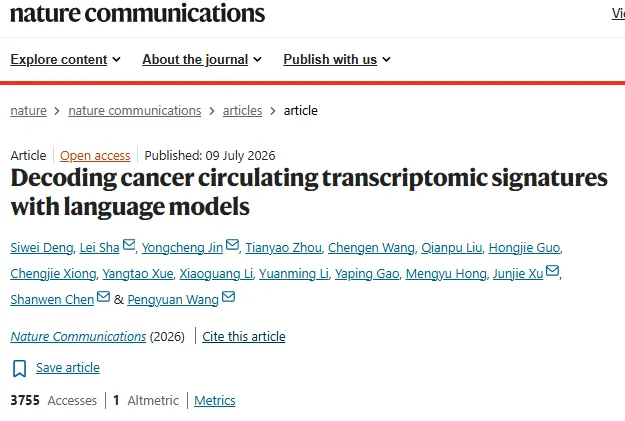
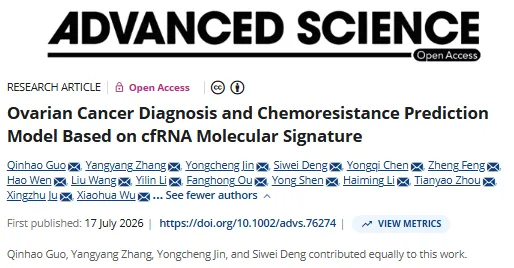
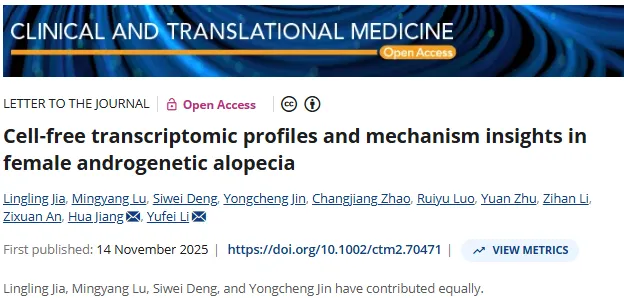

Slide to the left and look at the picture
 It's like predicting the next token.Predicting the Next Life Message
Disease recognition is just one of the application scenarios of GeneLLM, and what Zinedine Zidane really wants to do is create the "Claude Code" in the field of life sciences.
At the heart of big language models like ChatGPT, Claude, DeepSeek, is the next token prediction.
GeneLLM's thinking is similar, but it predicts not words, but life messages.
The four amino acids in the RNA sequence, A, U, Bird, G, Cell, and C, are the basic tokens used by GeneLLM to understand the language of life.
Traditional bioinformatics analysis typically relies on gene annotation, sequence pairing, and artificial definition labeling. This method, while accurate, limits the cognitive range of the model in advance and may lose a large amount of unknown biological signals hidden in the raw data.
GeneLLM, on the other hand, offers an alternative pathway to study life-forms directly from raw sequence data that has not been processed.
It uses multivariate raw data such as RNA, protein, and metabolic groups as training data to allow models to independently detect disease-related patterns.
Currently, GeneLLM has completed model pre-training of 1.5 billion parameters and 3.5 trillion base sequences, and the XLarge version achieves 30 billion parameters model pre-training, continuing to expand technical barriers.
As the world's first multidisciplinary model based on primitive sequencing data pre-training, GeneLLM includes two major phases:
(1) Unsupervised pre-training and prototype mining
(2) The patient level of the disease is mitigated
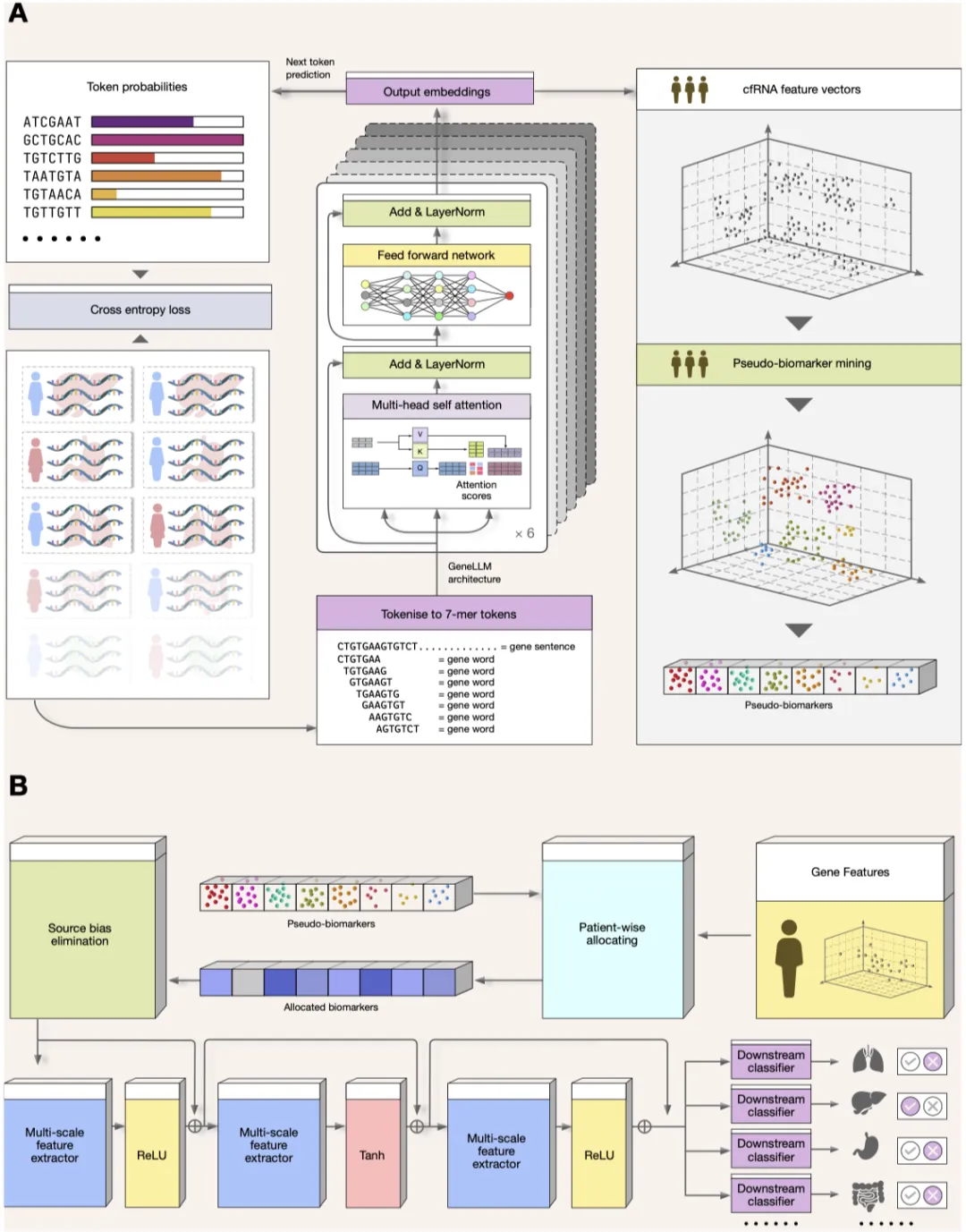
GeneLLM first needs to solve a problem:
How can we turn complex life data into an AI-comprehensible language?
In natural language processing, the BPE algorithm cuts sentences into tokens; while GeneLLM cuts RNA sequence segments of about 150 bp in length into life tokens through a sliding window consisting of 7 bases.
Subsequently, the model used the Transformer architecture to directly predict the next colony without genetic annotation and labeling.
This means that AI is not looking at the "dictionaries" that humans have compiled, but learning directly from the primordial signals of life.
In the course of the training, GeneLLM processed about trillions of RNA readings, training on the NVIDIA A100 GPU of the Baccarat cluster.
At this point, capabilities such as GeneLLM generalization began to "emerge".
As a major breakthrough in the field of biology, GeneLLM has produced a scientific model that can be applied to new drug research, precision medicine, synthetic biology, environmental monitoring, microbiology and biological agriculture, protein and molecular design, and is one of the few real-world models.
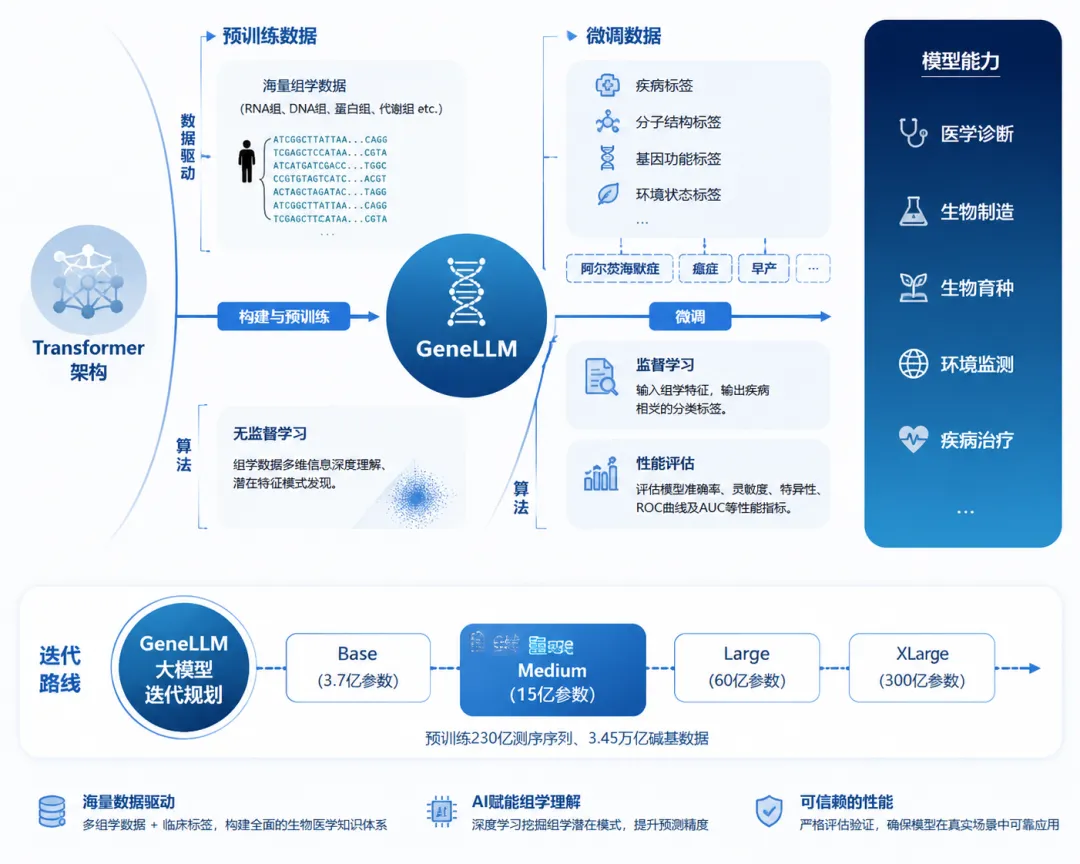
When we look at GeneLLM's underlying innovations such as "data, architecture, training", we can really understand why it represents China's "biological version of DeepSeek".
Silicon Valley stacks trillions of parameters with tens of thousands of H100s, while DeepSeek improves computational efficiency with algorithmic innovation, and GeneLLM, which shakes billions of life science data.
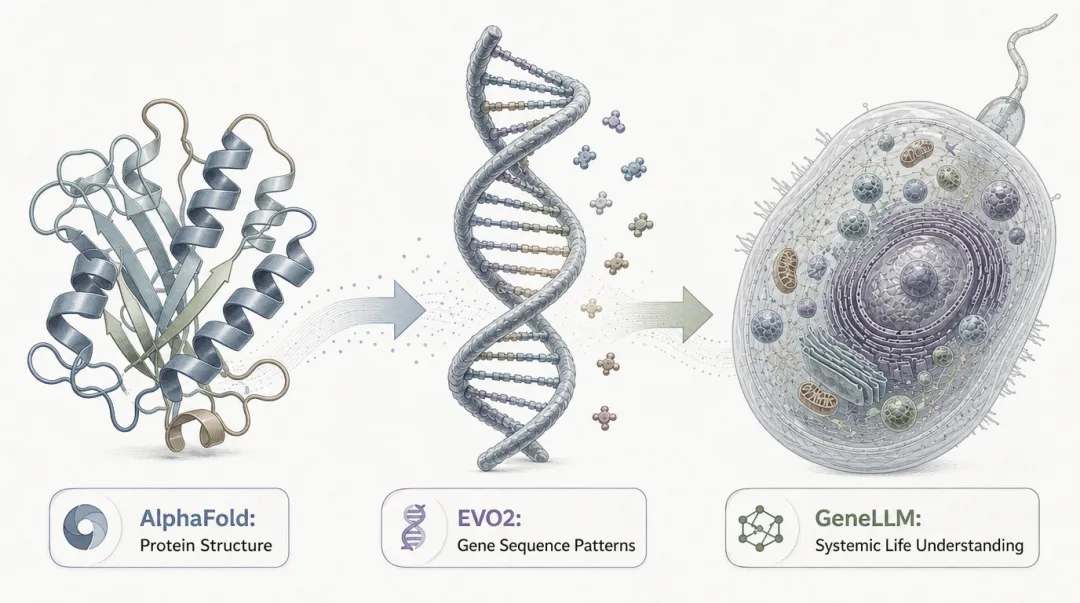
If AlphaFold makes AI understand the "structure" of life for the first time, and EVO2 makes AI understand the "code" of life for the first time, then GeneLLM tries to understand the "system" of life further.
The traditional method relies on 6Gb depth sequencing, high cost and difficult to land. GeneLLM remains AUC > 0.8 at extremely low depths of 1Gb (cost reduction 83%).
This means that there is a real hope that universal accurate healthcare will become a reality.
A new scientific paradigm is emerging: allowing AI to learn from life data, allowing life science to enter a new phase of predictable, computable, and scalable exploration.
It's not just the model, it's the smart infrastructure of the "last mile".However, the layout of Zinedine Zidane Biology is more than just a basic model.
Using the GeneLLM multidisciplinary model as the foundation for life-cognition, Zhengfu Bioscience further constructed an execution system connecting AI intelligence to the physical world, completing the AI for Science closure from the understanding of the laws of life, the generation of scientific hypotheses, to automated experimental verification and continuous iterative optimization through Harness Intelligent Experiment Execution Layer and DBTL (Design-Build-Test-Learn).
As Liam Fedus, former OpenAI VP, post-training head, said, the current LLM has exhausted limited text and code on the Internet, and the next major advance in scientific discovery must depend on experimental iteration.
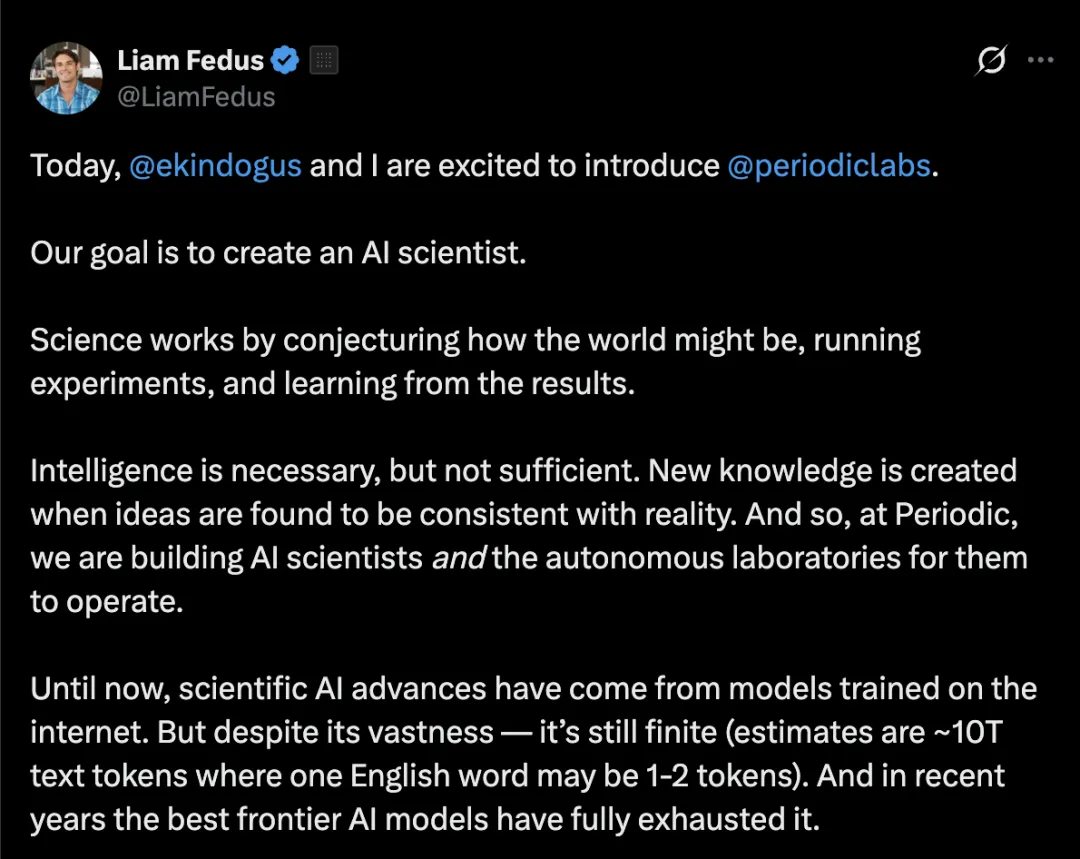
In other words, AI cannot find new knowledge just by reading what has been written by humans, it must experiment itself.
But there's a problem.
Internet services are born with APIs, web information is born with digital, but research equipment comes from different manufacturers, protocols are different, both complex and expensive, and no one can overturn the reconstruction in a few months.
Most laboratories today are designed specifically for humans: instrument panels, fluid movement, sample status, on-site judgement, the vast majority of which do not turn into machine-readable signals.
AI is entering the laboratory, and it's not just a question of model ability, it's a question of a new set of infrastructures.
So AI is entering the lab, and it's not just a question of modeling ability, it's also a question of physical harness: transforming the lab into a compilable, programmable, observable, traceable system.
This is the last mile of the real AI4S.
BioFord Harness to get the lab started on its own.To this end, Zinedine Zidane developed a system called BioFord Harness.
It is a set of infrastructure that connects AI and physical laboratories.
They didn't make the mechanical arm imitate the human hand, but they turned the lab into a system that could be compiled, programmed, observed and traced.
In this process, Physical Harness must accomplish at least three things:
1. Compile scientific intent or experimental DSL into instructions that can be executed by different devices;
2. Complete scheduling, resource and security constraint management and handling of abnormalities between multiple devices;
3. Turn experimental results, device logs and environmental parameters into inputs for the next round of models and experimental design.
Scientific questions→ AI understanding→ experimental programming→ device scheduling→ execution→ data flow→ model optimization→ next round→
This is the launch of a set of scientific experimental data.
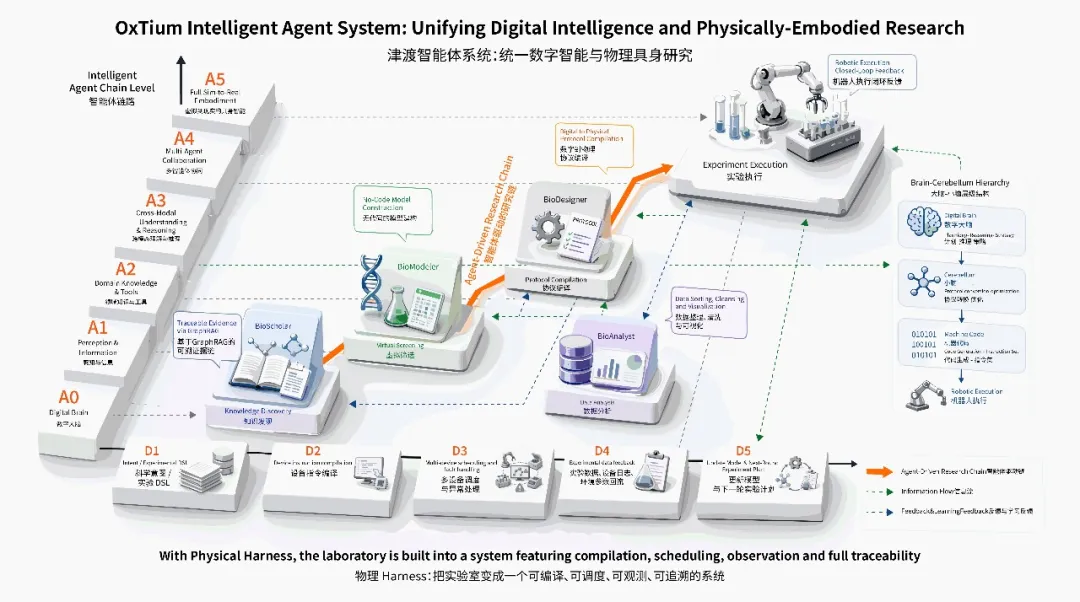 The five smart entities are turning the scientific process into a "curve"
The BioFord Agent is a physically intelligent scientific research platform that connects the physical layers of the laboratory downwards, the cognitive layers of scientists upwards, and the breakdown of reasoning and execution using physical AI in the middle.
At the cognitive level, the BioFord Agent is a collaborative network of five intelligent agents that open up the entire process of life sciences research, which can increase scientific research efficiency several times.
Literature retrieving intelligent agents
Experimental design of intelligent agents
Science and intelligence
Experimental modulation of the intelligent body
Intelligence in data analytics
For example, a literature retriever can quickly help you retrieve and read bulk literature, complete a literature review, and help you make assumptions.

Experimental design of intelligent agentsThe research team shortened the experimental design cycle from a few months to a week.

The experimental modulation of intelligent objects, based on the Universal Instrument Abstraction Layer, introduced by Tsinghua Bioscience, breaks down the protocol barriers between many types of heterogeneous devices.
Both PCR, enzyme meters, flow cell meters, and automated fluid transfer workstations can achieve unified piping and unified scheduling. System-built dynamic scheduling algorithms allow for automatic batch sequencing, real-time conflict avoidance, and complete recording of experimental parameters, forming traceable audit chains.
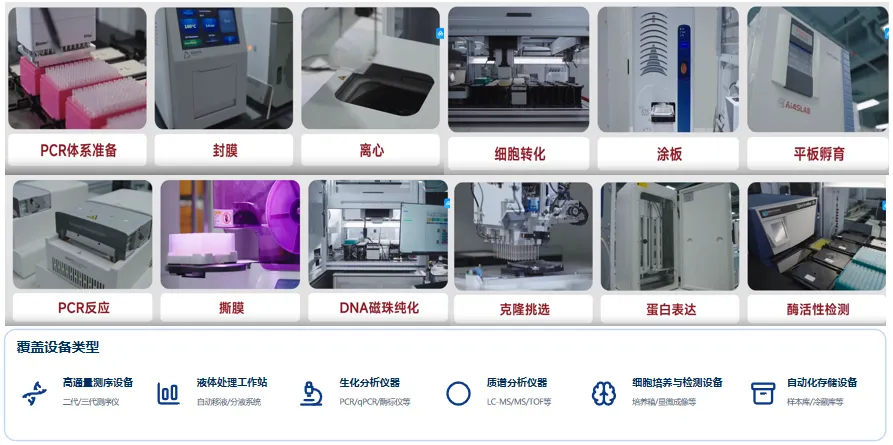
This means that AI is no longer staying in the "planning" phase, but actually entering the lab, manipulating equipment, executing tasks, and becoming a trusted "research assistant".
Failed data, perhaps more valuable than successful dataThe deeper value of this system solution is that every experimental puzzle, whether successful or unsuccessful, can be transformed into digestible data.
In traditional laboratories, a failed record may be just a line of "outcomes that don't live up to expectations", and experience exists in people's minds, people walk away, and experience is gone.
And in the BioFord system, every failure is the logical recording of valuable training data, the selection of parameters, the recording of environmental conditions, the proof of wrong paths... all sinking down and becoming part of the "experience" of the system.
Next time, AI will know: this is not the way.
What the patient is looking for is that in this race, it is not the strongest mathematical win, nor the biggest win of the model.
You can buy math, but you can't buy scientific data.
In a statement, the founder and CEO of Tsinghua Bioscience, Kim Su-shi, said:In the course of our research and development, we have gradually discoveredAIFor BioScience, it's not just a stack of models, a stack of data. For people who do experiments, the ultimate solution is still the problem of not being done, not being done, not being done".
This is the most important and the most difficult to replicate A.I.4S. track.
The four Oxfords,One of them was Rofolie's classmate.In 2022, the moment she receives her PhD in Bioengineering from the University of Oxford, she faces a choice.
He was mentored by Hagan Bayley, a Fellow of the Royal Society, founder of the three-generation sequencing giant Oxford Nanopore, who had a deep tradition of "outcome landing" in the lab.
But he chose another route to pack a "prototype technology" in the lab and bring it home. Along with his colleagues, three other Oxford graduates: Ph.D. in Biology, Ph.D. in Biology, Ph.D. in Computer Science, Ph.D. in Computer Science, Ph.D. in Computer Science, Ph.D. in Computer Science, Ph.D. in Computer Science, Ph.D. in Computer Science, Ph.D. in Computer Science, Ph.D. in Computer Science, Ph.D. in Computer Science, Ph.D. in Computer Science, Ph.D. in Computer Science, Ph.D. in Computer Science, Ph.D. in Computer Science, Ph.D. in Computer Science, Ph.D. in Computer Science, Ph.D. in Computer Science, Ph.D. in Computer Science, Ph.D. in Computer Science, Ph.D. in Computer Science, Ph.D. in Computer Science, Ph.D. in Computer Science, Ph.D.D. in Computer Science, and other fields. The team has been working on a collaborative research project to achieve disease predictive detection by combining AI and transcription technology.
The company's name, "ZinFud Biology" and "Zin" are derived from Oxford, implying that they originated from academic heights such as top laboratories in Oxford, and "Fud" refers to humans, which they believe AI for Science should reach.
Currently, the BioFord Agent Physical AI research platform has been deployed in some well-known universities in the country, with significant success, shortening the research cycle from the original number of months to a week.
The wind blows: Four rounds of financing, capital "Vin Shan" siteHowever, following the path of "the former without ancestors" will inevitably lead to loneliness.
In the early days, it was difficult. At the time, AI was like a fire, but in the field of biological sciences, "AI+" tried a lot. "I don't necessarily understand biological sciences, and most people don't understand AI".
"Investors can't understand what we're doing".
The team chose one of the "hardest routes": cutting from a large bio-based model to a global index of companies doing this.
In 2025, the transition came about.
At the time, the State Department issued a press release on the in-depth implementation of the AI+ initiative, which included AI for Science.
The company's main financing timeline is the industry benchmark.
Angel + Wheel:The Chinese Seed Fund (CCF) is the leading seed company in China.
Pre-A+ Wheel:To create a ten-million-dollar eastern investment;
Pre-A+ Wheel:In the case of the war in Nanchang, a new investment of ten million dollars was made.
Round A:The company has invested nearly a billion yuan in the acquisition.
In a statement, senior investment partner Xi Jinping said: "Zinfu Bioscience has transformed basic life science research into a subscribing, scalable 'calculation+experiment' infrastructure".
"We are not satisfied with selling software to build intelligent operating systems in the life sciences field. Just as Intel defined computing in the PC era, we want to define new paradigms for life sciences research and development in the AI era".
From the Oxford Laboratory to Shenzhen, from no one's understanding to the first line of capital focus, the story of four Oxford men is not just a business legend, but also a torture of the soul about "what we can do for humanity".
When AI learns its own "overnight" research, science discovers that it may no longer rely on incidental inspiration from genius, but becomes a predictable inevitability.
Industry map: Zinedine Zidane steps out of the path of lightweight physical AIOn the larger AI for BioScience map, Zinedine Zidane is not alone, but the starting point is quite different.
The first is the digital edge.AIScientists.
Stanford-based Biomni, which has been commercialized as Phylo, has more than 150 professional tools to automate document review, assumptive generation, and bioinformational analysis.
FutureHouse, supported by Eric Schmidt, is dedicated to building AI scientists who can independently generate hypotheses and write papers.
However, while they are powerful, they are still limited to the digital world.
The second category is fully autonomous routes.
With the help of AI+ robots, Chinthai Technologies has deployed over 300 production sites around the world.
Flagship Pioneering is a $550 million project funded by Lila Sciences that seeks to allow AI to fully take over the design, execution and redesign of experiments, with the goal of "scientific superintelligence".
But that's too much money.
The third category is:End to endThe pipeline.
The first AI drugs have entered Phase III clinical trials, but they are "car makers" rather than "road repairers".
Zinedine Zidane's choice was to focus on building the physical Harness, modeling the infrastructure of the "last mile" between physical experimental systems.
Don't do the bottom race, don't do itEnd to endPipelines, not a digital worldAIScientists -- just doing that one kilometer is undoubtedly a more lightweight attempt.
In the words of Goldsmith, the verdict is clear:AIThe real watershed for Science is not whether the model answers much like the scientist, but whether the laboratory can start as a continuous learning system".
Furthermore, in the global AI for Science space, Zinedine Zidane is not simply "doing the last mile".
To be more precise, it is the last kilometre of the entrance, and it competes for the right to organize the entire scientific workflow.
Compared to pure-digital AI scientists, it has the ability to touch the physical world; compared to a self-built bio-asset science factory, it has the opportunity to take over the laboratories of existing customers; compared to end-to-end AI pharmaceutical companies, it doesn't have to put its destiny in a certain line of clinical pipeline.
It will not be a parameter, but an accumulation of experimental trajectories, device interfaces, failed experiences and cross-laboratory execution networks.
As Goldsmith says, the tens of thousands of signal pathways and unknown reaction mechanisms within the organism are fascinating. "The richness of biology, the beauty of the prospect of AI for Science".
With AI's intelligent exploration of life's tangles, the stellar oceans of Oxford scientists have just begun.