A team of researchers from Virginia Tech, the University of Wisconsin-Madison, and Dartmouth College proposed SAGE in their paper NeurIPS 2026: use symbol-closed analysis to explain the biases and cumulative biases in long-range reasoning exploration, and then turn this diagnosis into a structural guide when training. In the evaluation of 12 benchmarks across seven model families, SAGE performed better overall than comparative post-training methods; in the Andrews Curtis-AC experiment, the Lean Qwen3 test approached the baseline model by 8 times.
Sage: Mitigating Long-Horizon ReasoningBiases via Topological Guidance
Meeting: NeurIPS 2026
It was written by XinyueZeng, JiaweiZhang, YujunYan, DaweiZhou.
Unit: Virginia Tech, the University of Wisconsin-Madison, and Dartmouth College
Link to the paper:https://arxiv.org/abs/2609.30192
The code link:https://github.com/Susan571/SAGE-NeurIPS2026
A: The difficulty of reasoning: there is a prize at the end, but there are more and more obstacles.
Post-training that relies on the ultimate answers to the rewards has significantly improved the model's mathematical reasoning ability; however, rewards on long tasks are often rare and lagging behind. A solution path may be changed dozens or even hundreds of times, but the training process only knows the end result and it is difficult to determine from which step to start to deviate.
One way is to allow human or process reward models to be graded gradually at the cost of obtaining reliable process labels or verifiers; another way is to transform exploration and reward without having to sketch the structure of the task itself. SAGE therefore asks: Why is it easier for the model to go to a branch that looks like a matrix?
The paper uses Andrews' Curtis ((AC) task as a stress test. Given a group composed of generators and relational representations, the model must successively perform the permissible AC transformation and attempt to reach the ordinary representation. Whether each step is legitimate can be checked, but legitimate operations are not the same as finding a path to the target; true success signals must be confirmed by the end of the entire sequence.
The experiment solved 1,190 examples of paper-based constructed ACs. This task magnified the contradictions of local legitimacy and global complexity, and suited to testing long-range reasoning on whether to continue to advance toward the goal.
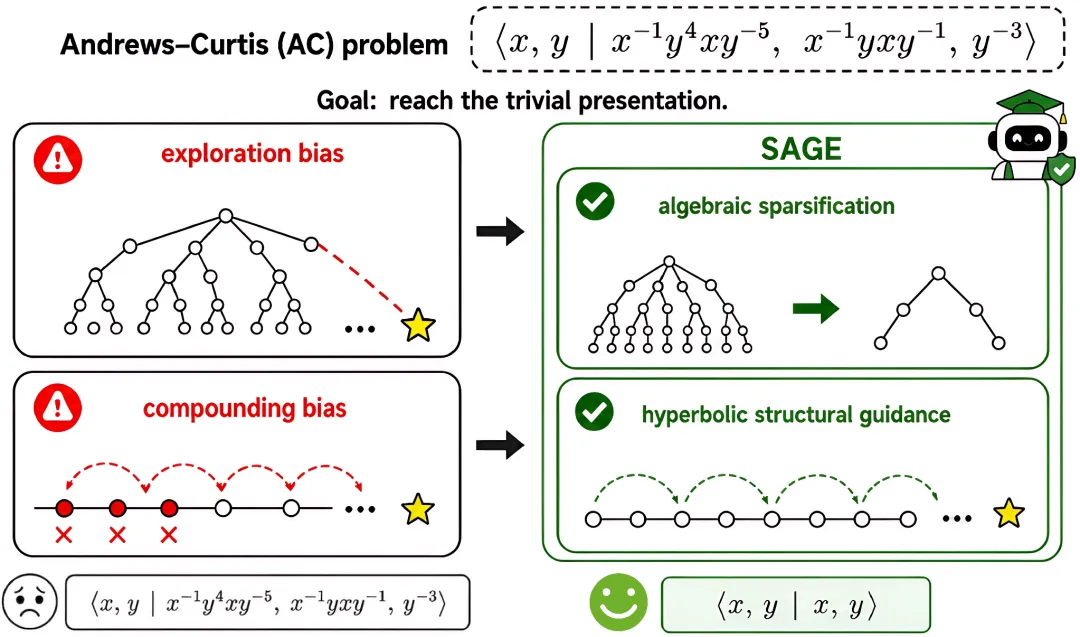
Figure 1: In the example of AC tasks, SAGE guides the two types of deviations by using algebraic dilution and binary structure, respectively.
Second, SCA: Put the two strings on the same structural map.
SCA (Symbolic Closure Analysis, symbol-closure analysis) defines the path of a loop as follows: Starting from the starting point, as long as each step conforms to the task's local operation, it belongs to the local loop domain F. It has a loop front closure characteristic. Once a step is unlawful, subsequent continuation cannot turn the loop back to the legal path.
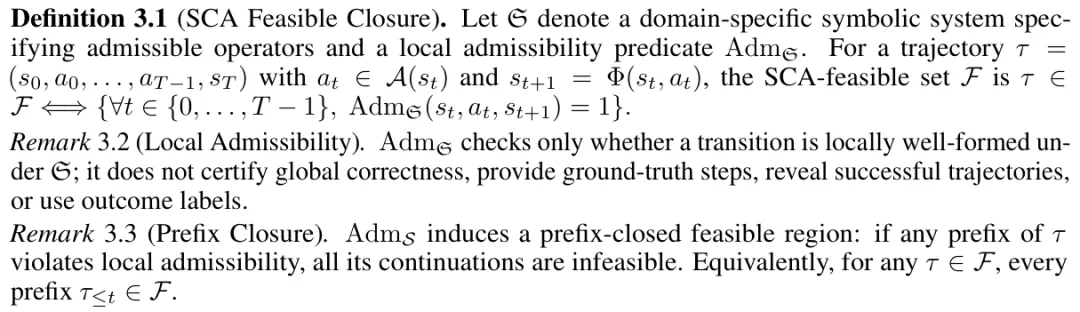
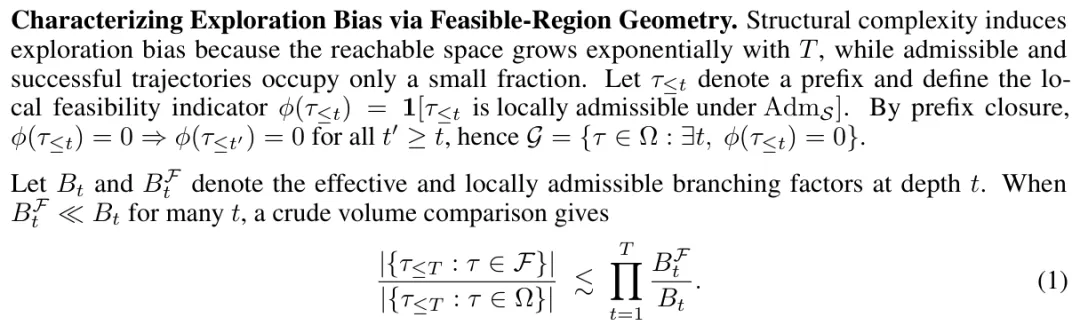
The first major difficulty is to explore the bias. The number of effective branches of the second layer of t is Bt, where the number of locally viable branches is Btf. The geometrical intuition given by the paper is that the proportion of viable fronts of depth T is roughly limited by the Btf/Bt connectivity of the layers. If many layers have only a small number of viable branches, this proportion shrinks rapidly with depth; when the final rewards are limited, it is more difficult to randomly pick up useful trajectories.
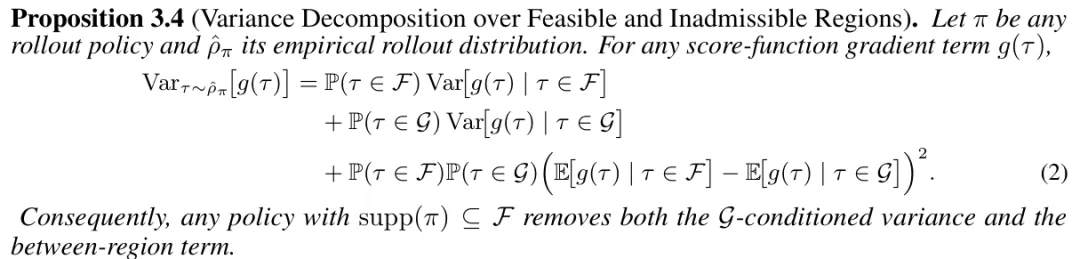
The paper further divides the volatility of the strategic gradient into three parts: the variance within the available range, the variance within the inaccessible range, and the variance between the two types of trajectory mean signals. If the sample is really concentrated in F, the latter two disappear. This breakdown explains why increasing the budget in which branches will affect the quality of the learning signal; it does not mean that local law can guarantee the solution of the topic.
The second difficulty is cumulative bias. Early decisions lack direct correction only when the endpoints are awarded. The paper considers the optimization of the KL rule: if the probability of a reference strategy finding a successful trajectory is p, the endpoints are bounded by Rmax, and the KL penalty intensity is λ, the total variation between the optimal strategy and the reference strategy is as follows:
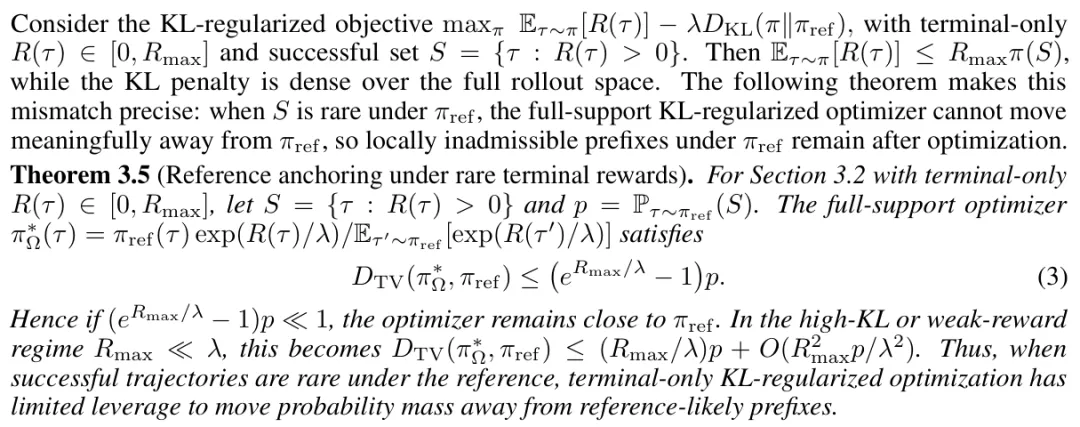
When successful trajectories are rare and rewards are not strong relative to KL constraints, this upper boundary is small; training is difficult to significantly get rid of the initial selection of the original reference model, and small deviations can therefore continue along the long chain.
The SCA thus gives two clear design goals: one is to concentrate sampling probabilities into more hopeful local feasibility branches; the other is to get feedback on the target structure before the forecast reaches the end. Symbolic tasks such as AC can pinpoint the locality legitimacy of the definitions; and natural language tasks require estimating gaps and target focal points, which theoretically ensure cannot be moved past as before.
Sage 3: Let theoretical diagnostics be involved in training
SAGE (Structural Admissibility-Guided Exploration, Structural Admissibility Guided Exploration) writes the above two goals as complementary structural momentum functions. They do not directly give a standard solution, but evaluate candidate reasoning steps during training: which operations are more compatible with unresolved structures and which advance closer to the task goal.
Algebraic dilution is aimed at exploring biases. The system represents the currently unresolved structure as a graph of the graph of the graph of the graph of the graph of the graph of the graph of the graph of the graph of the graph of the graph of the graph of the graph of the graph of the graph of the graph of the graph of the graph of the graph of the graph of the graph of the graph of the graph of the graph.
The system maps the current state with the target structure into a binary space that is suitable for representing the level relationship, with the distance between the two forming a gradual feedback loop: no endpoint reward is needed, training can distinguish candidate frontrunners that are closer or more distant to the target. Here, the approach to the target is a structural signal constructed during training, not proof of final correctness.
In the implementation, the old strategy first proposed a set of candidate reasoning steps, which SAGE sampled when training with two dynamic functions; at the end of the trajectory, it combined the end reward with the average structural score to calculate the relative advantage of the group, updating the strategy. The paper also gave a conditional concentric conclusion: if the dynamic function can pull out all local possible and impossible trajectories in positive interval Δ, the probability of the two types of trajectories after overweighting is multiplied by exp (−λΔ).
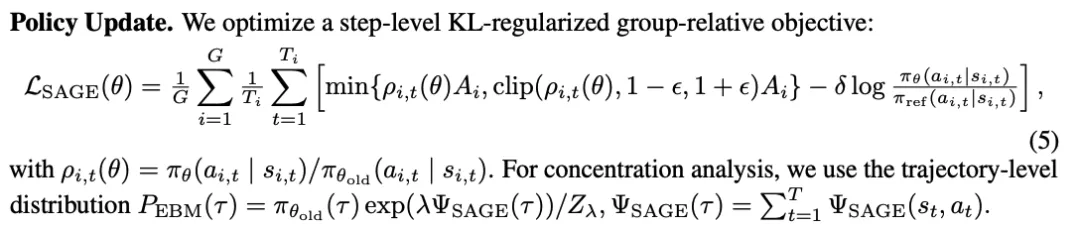
These structural modules increase the candidate scores for the training phase and the distance computing costs. After the training is completed, reasoning directly uses the learned strategies, and no longer runs this set of scores or additional searches; therefore, the paper says that the no additional reasoning expense gap refers to the no longer introduction of structure-guiding modules in online computing.
Results: From average accuracy to verifiable long chain success
Assessment covers 7 closed mathematics, 4 free text reasoning and 1 AC longitude symbol task, a total of 12 benchmarks, 7 model families. The comparison objects include SFT, GRPO, EMPO, and GRPO-PRM for process feedback. The paper reports methods using comparable rollout budgets, generating length and decoding constraints.
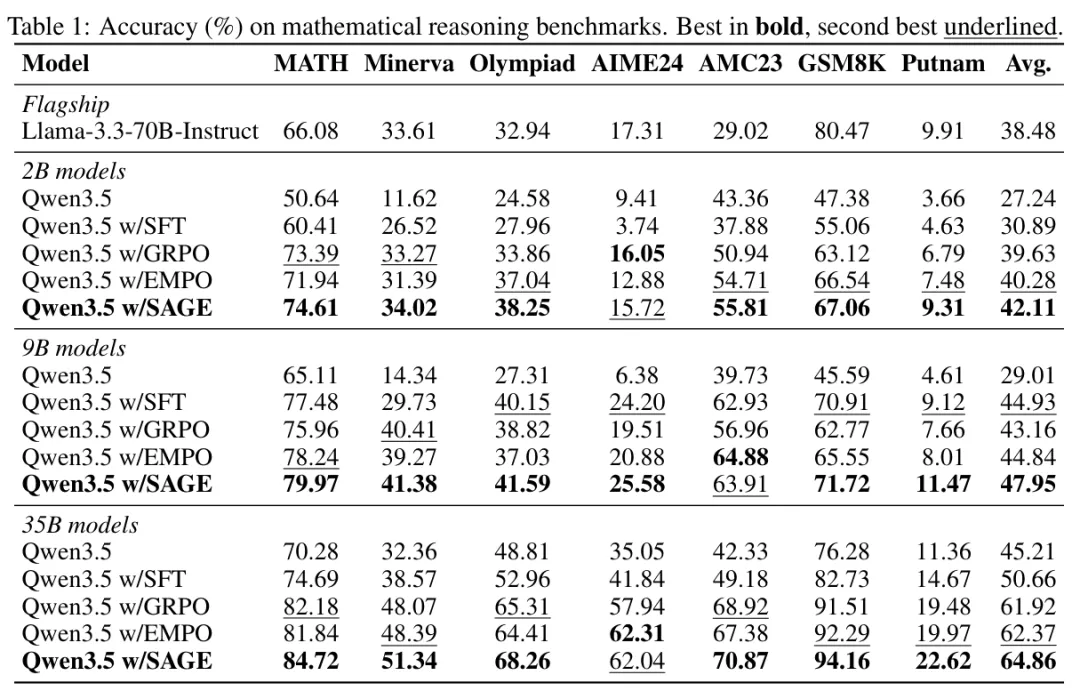
1. Closed mathematical reasoning: The SAGE averages of Qwen 3.5-2B, 9B, 35B are 42.11%, 47.95% and 64.86% respectively; the training baseline is 1.83%, 3.02 and 2.49 percentage points higher after the strongest of the same scale. The unit is not a complete winner, e.g. 35B's AIME is 62.04% and slightly lower than EMPO's 62.31%.
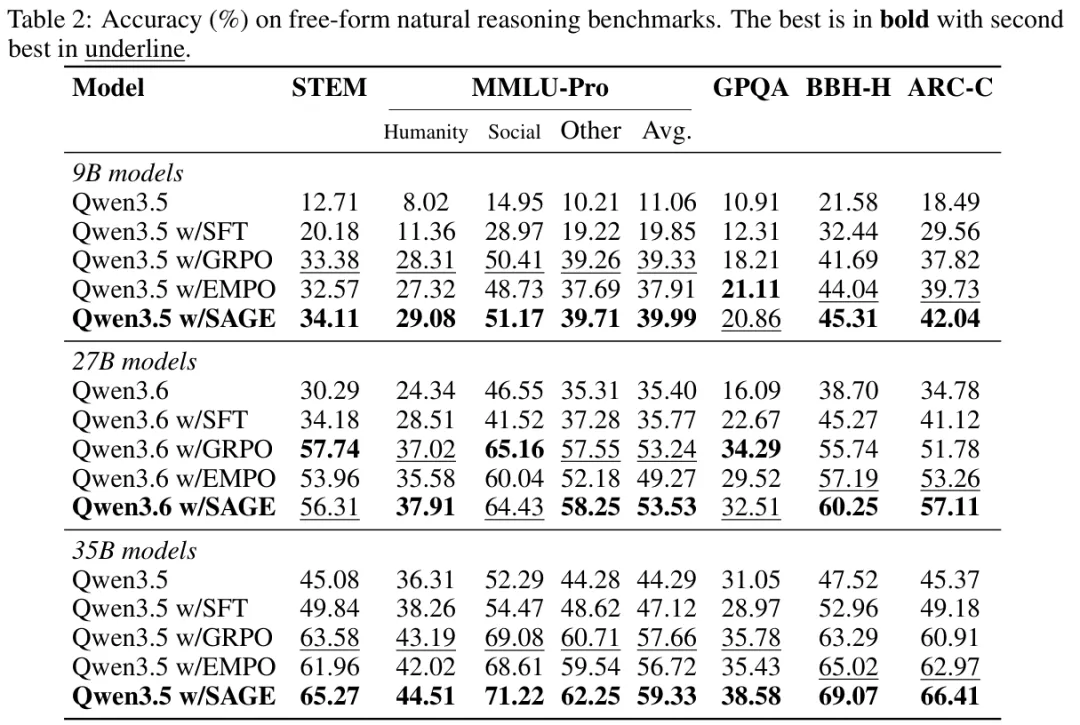
2. Free text reasoning: On the 9B model, the MMLU-Pro average accuracy increased from EMPO's 37.91% to SAGE's 39.99%; BBH-H increased from 44.04% to 45.31%, and ARC-C increased from 39.73% to 42.04%. But on the GPQA SAGE's 20.86% was slightly lower than EMPO's 21.11%. At the 35B scale, SAGE ranked first in all four indicators, with BBH-H at 69.07%, and ARC at 66.41%.
3. AC long-range tasks: paper-specific measurement of AC conversion efficiency (whether local steps meet the rules) ACPathSolving (whether the entire path reaches the goal) and Lean verification pass rate (whether final verification is through formalized checks) Comparison of the baseline version of six base models with the SAGE version in the diagram: the previous version of AC conversion efficiency increased by 19.2 tonnes by 26.0 percentage points; Lean verification increased by 13.2 tonnes by 20.8 percentage points. Lean verification in the Qwen3 version of SAGE approached the baseline version by 8 times.
For example, in the Qwen 3.5-35B AC experiment, GRPO's fluid transformation efficiency/path resolution rate/Lean through rate gradient was 54.28%/23.05%/14.64%; SAGE reached 59.83%/31.76%/23.69%. The GRPO-PRM rewarded using a learning process was 17.36% on the Lean indicator, still below SAGE's 23.69%.
Conclusion 5: From final rewards to structural guidance
As larger language models generate longer and longer chains of reasoning, a problem arises: multiple steps do not necessarily mean that the model is always on the path to an answer. The end reward can tell if the model is ultimately correct, but it is difficult to identify the first step. Long-range reasoning requires that the structure of the path itself be used earlier in training.
Starting from local viability, SCA explains how viable branches become scarce with depth, and why rare terminal rewards are difficult to correct for early selection. Based on this analysis, SAGE proposed a set of structure-guided post-training methods: algebraic dilution based on a sample of candidate steps to adjust for unresolved residues, binary structure guidance based on state-to-goal distances to provide feedback for forefront reasoning, and use of two signals for strategy updates.
The results of the mathematical, free text and AC examples show that this method greatly improves the accuracy of answers. It provides a new training path: allowing the model to learn not only from the final success, but also from the structure of the reasoning process to learn how to choose the next step.
In the future, how to construct reliable structural signals in tasks such as defining rules such as AC will still need to be tested. However, this work shows that improving long-range reasoning can also be done from the point of view of making models more efficient in choosing routes.
When training allows the model to avoid the seemingly logical but difficult paths to the goal, long-term reasoning has the opportunity to go further.
Information from the author
A Ph.D. student in Computer Science at Virginia Tech, whose research areas include the stability and reliability of big-language model reasoning, has been published at top international conferences such as ICML, ICLR, NeurIPS, and others.
This is the first time I've seen this.
The main page of the lab: