This morning, OpenAI uploaded 722 mathematical manuscripts of a previously unpublished internal model to GitHub. The release of its own spin-offs, the model's background and the controversy in the mathematical community, which we covered in the previous report.
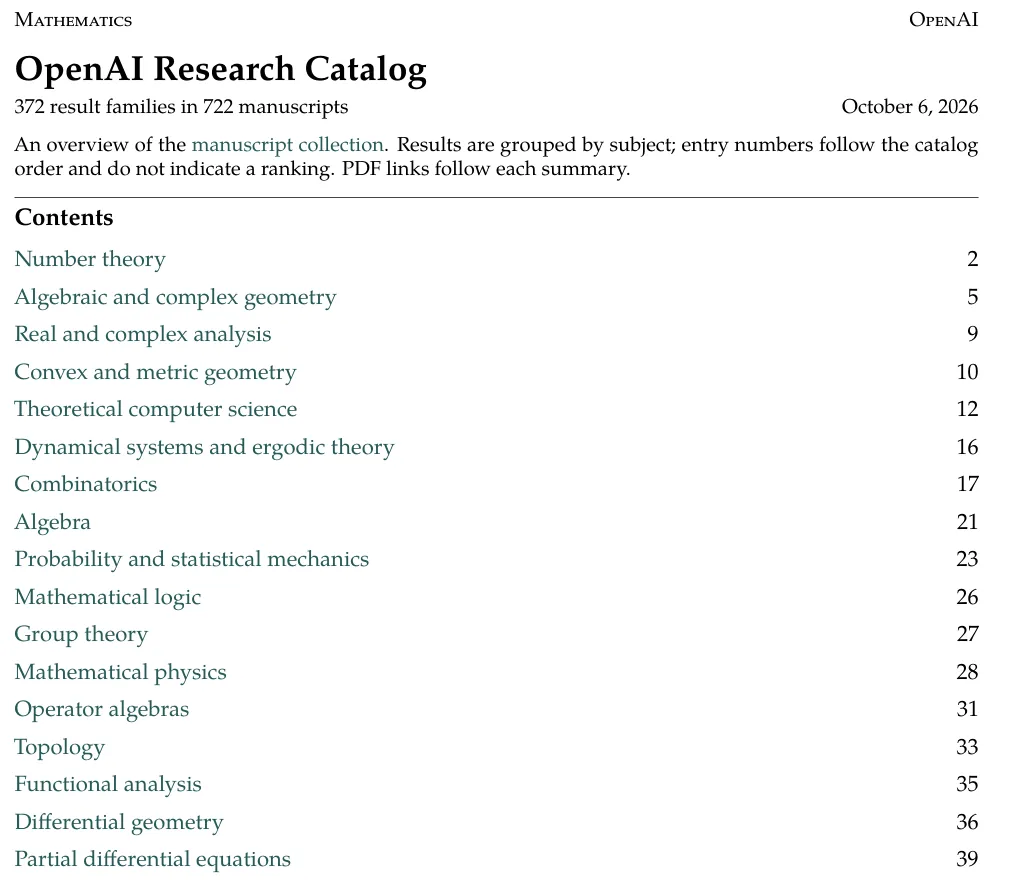
Address of the warehouse:
First, it is necessary to make some clarifications:
First, the 722 manuscripts are classified into 372 "outcomes", covering 17 areas of mathematics, geometry, theoretical computing, mathematical physics, and others, and this article lists the most famous and oldest of these areas.
Second, the list contains both "proof" and "falsification", and according to our rough search, there are about 50 outcomes of the word "falsification" in the abstract, some of which have been circulating for more than half a century, and some of which have been overturned rather than proven.
Third, and most importantly, all the "proving" and "solving" in the context are OpenAI's own statements, the vast majority of which have not been peer-reviewed. About 60% of the outcome families have Lean formalization, which is a proof checked by a computer step by step, which we note when referring to; no formalized results can currently only be counted as "statements".
Numerology: from Lyman to Hilbert
Numerology is the most surprising part of this list, with several of the 31 outcomes directly linked to the most famous names in history.
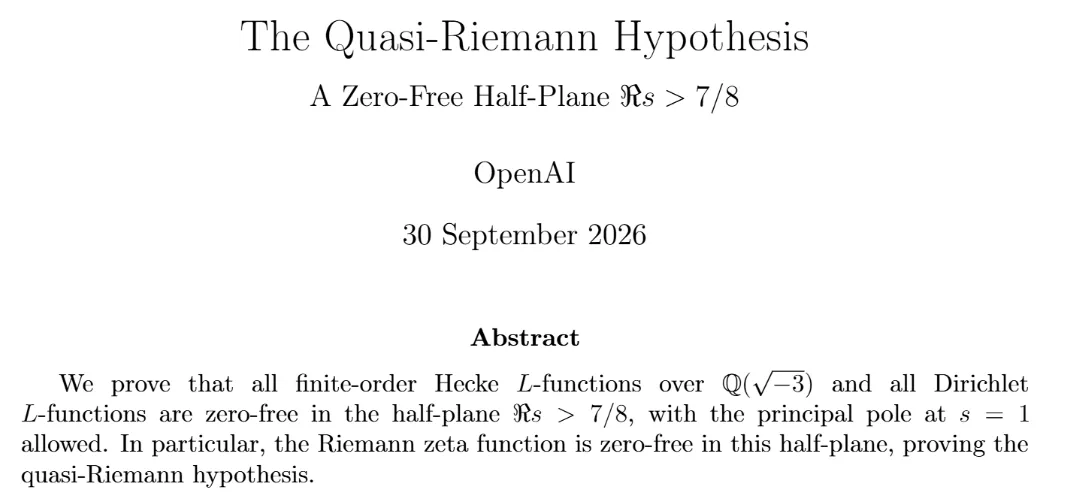
Freeman's conjecture in Warehouse No. 003 is one of the most widely circulated. Freeman proposed in 1859 that the unusual zeros of the zeta function all fall on a line; this ultimate goal was too far off, and mathematicians retreated to the next, hoping to at least prove that a line on the right was clean and zero. This never happened for over a hundred years. OpenAI claimed to have drawn the line at 7/8, forming the zeta function and all the dictionary L functions simultaneously, and attached Lean formalization.
It's just a matter of time.
The BSD conjecture, which accompanies Lyman's conjecture on the Millennium Grand Prize puzzle, is also on the list. It discusses how many points are logical on the elliptical curve, and the precise correspondence between the behavior of a parsing function at some point. OpenAI's 002 and 006 outcomes combine to claim that for each logical elliptical curve, the complete BSD formula is proved by "almost all of its two distortions"; 006 also goes along with the Goldfeld conjecture proposed by mathematician Dorian Goldfeld in 1979.
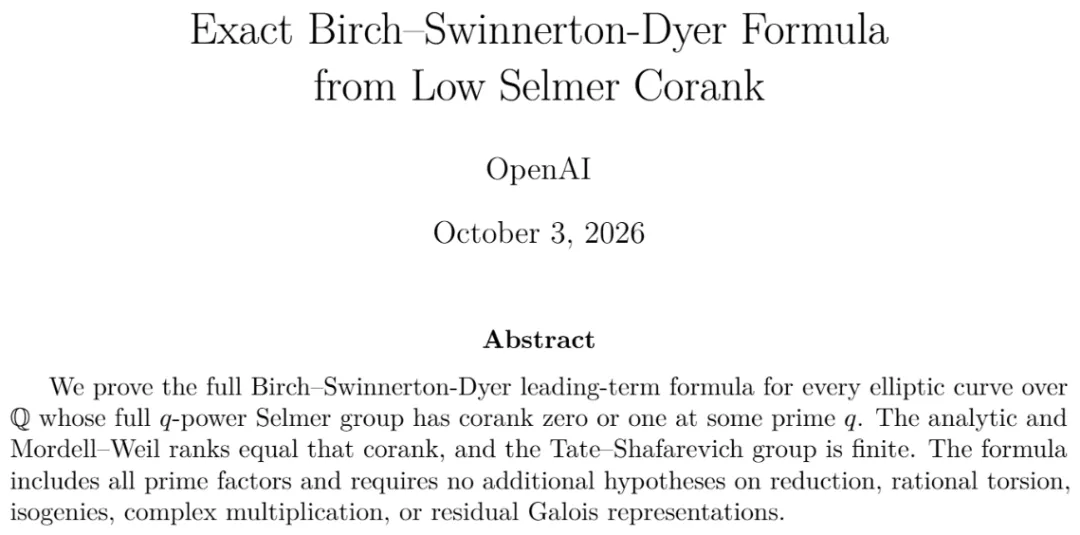
The BSD formula
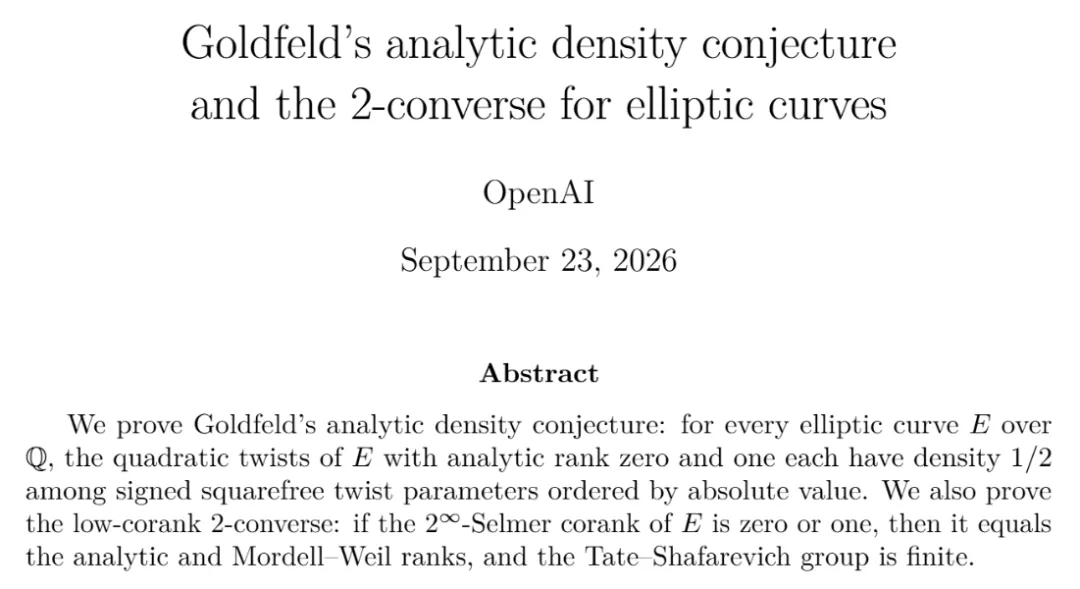
Goldfeld speculates
The number 004 refers to the tenth of the 23 questions presented by Hilbert in 1900. The original question was: Is there a general algorithm for determining whether any integro-coordinate equation has an integer solution? In 1970, Yuri Matiyasevich gave a negative answer based on the work of his predecessor.
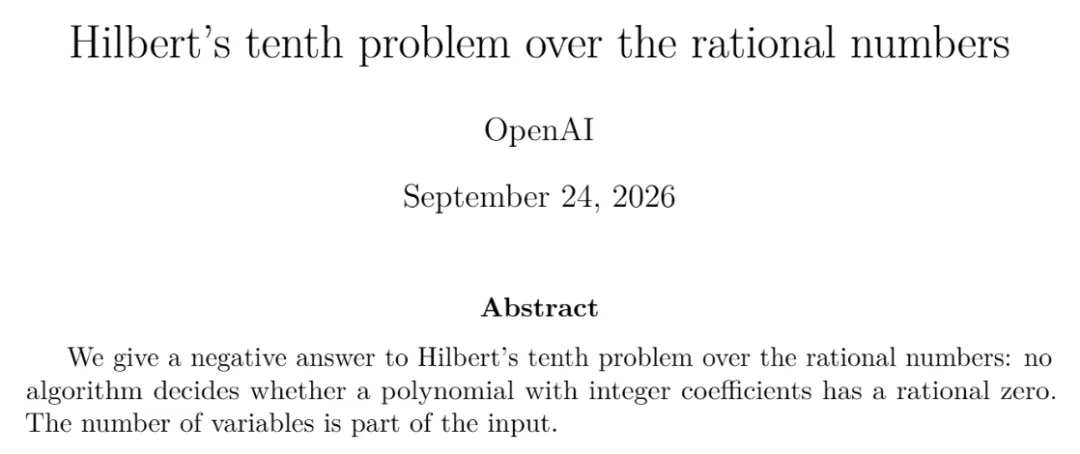
Hilbert's 10th question (which is a rational field)
There are also two results that the average reader can get a glimpse of.
One is the Catalan constant, i.e. 1 minus 1/9 plus 1/25 minus 1/49, which alternates so that no one knows if it is an irrational number; OpenAI claims it is.
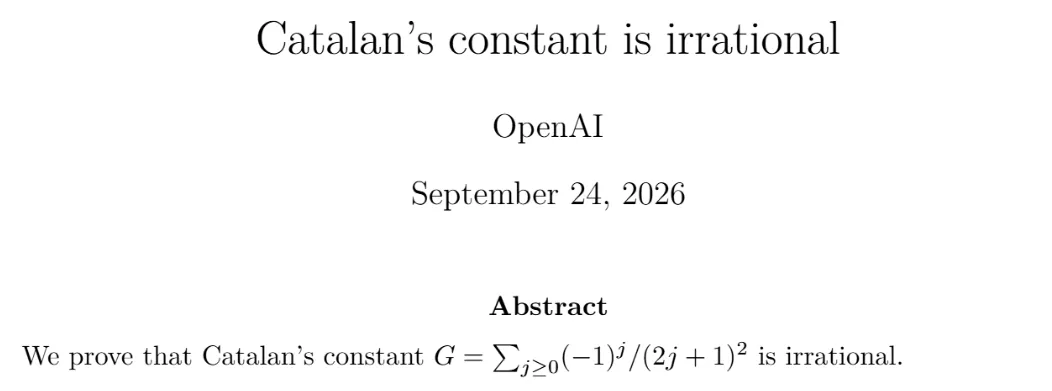
Catalan frequencies
The second is the circular rate π: "How hard it is to get close to scores": the upper limit previous mathematicians can prove is about 7.1, and OpenAI claims that the optimum value is exactly 2, i.e. π is as common in this matter as the "overwhelming majority" of irrational numbers.
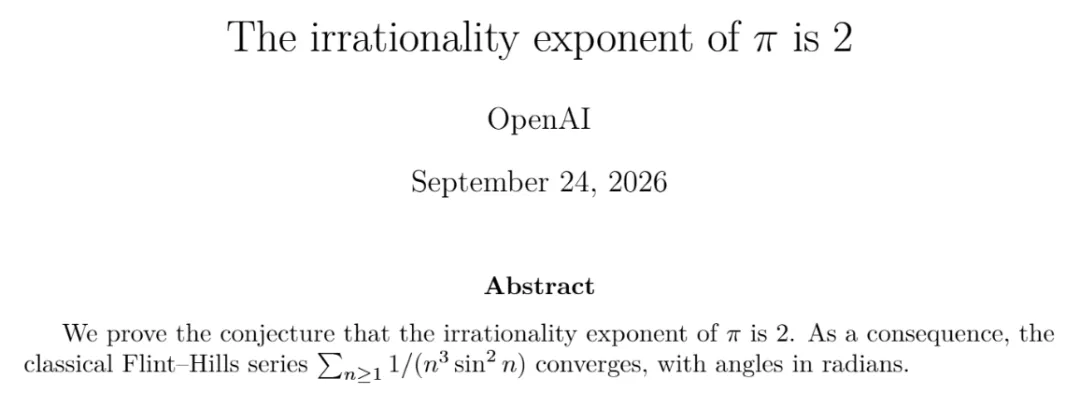
rational measure of π
Algebraic geometry: a corner of Hodgkin's conjecture with a rational relationship
Algebra and replication geometry come in third in a family of 36 outcomes. The most notable of these is #032: for all the replication of CM Abel's conjectures, the Hodges conjecture is one of the Millennium Prize puzzles, meaning that something that "looks like a geometric object to the topography" must actually be cut out of the algebraic equation. CM Abel's conjecture is a type of special object of extreme symmetry, not all of which is the case, but OpenAI claims that, based on James Milne's previous hypothesis, the result can also be derived from Tate's conjecture on all the Abel's conjectures.
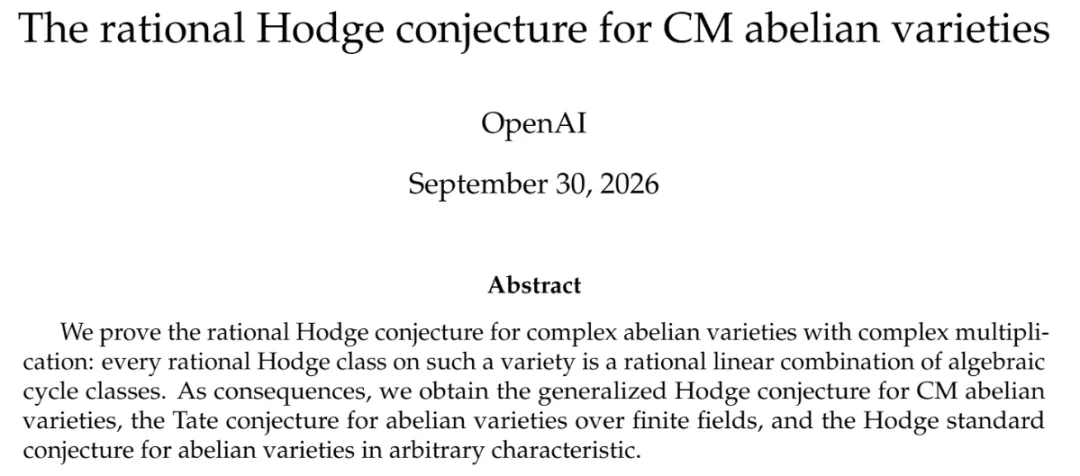
CM Abel Zhenhof speculates
Another noteworthy question is #054. The question of whether three-dimensional quadrants can be logically parameterized is a famous problem in algebraic geometry, which Alexander Kuznetsov has proposed using a conjecture of "paradigm" language. OpenAI claims to have constructed examples that satisfy this conjecture, but still cannot be logically parameterized, thus overturning the conjecture.
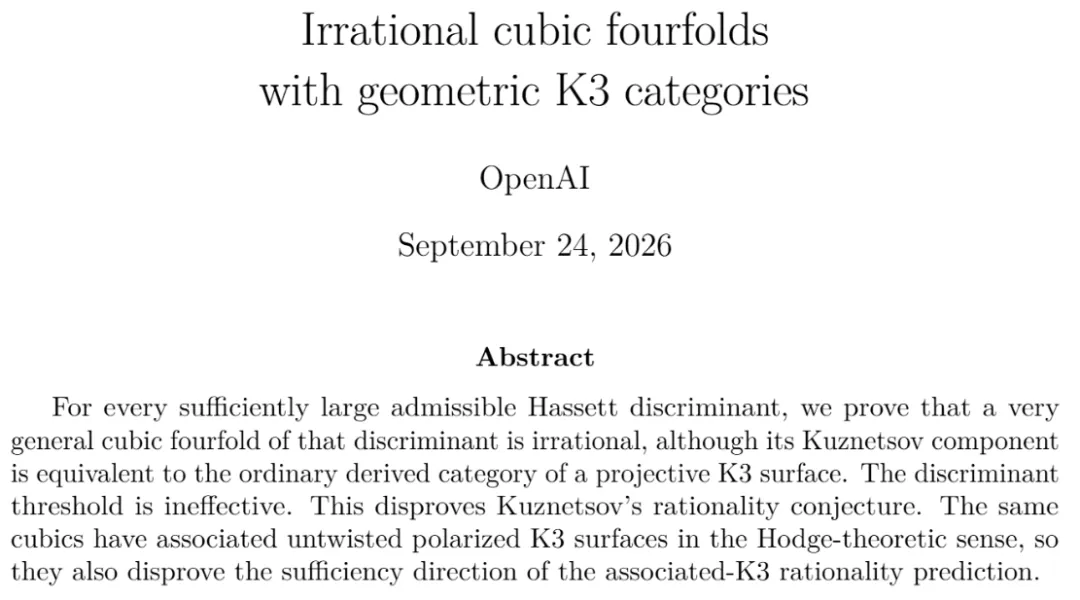
It's the first time I've ever been in a relationship with a woman who's been in a relationship with me.
Back to the abstract, the quantum geometry Rowland correspondence No. 069 is on the list. In 2024, Dennis Gaitsgory and others proved Rowland's conjecture with a series of nearly 1,000 pages of papers, and OpenAI claimed to have made its "quantum" version of it with irrational parameters.
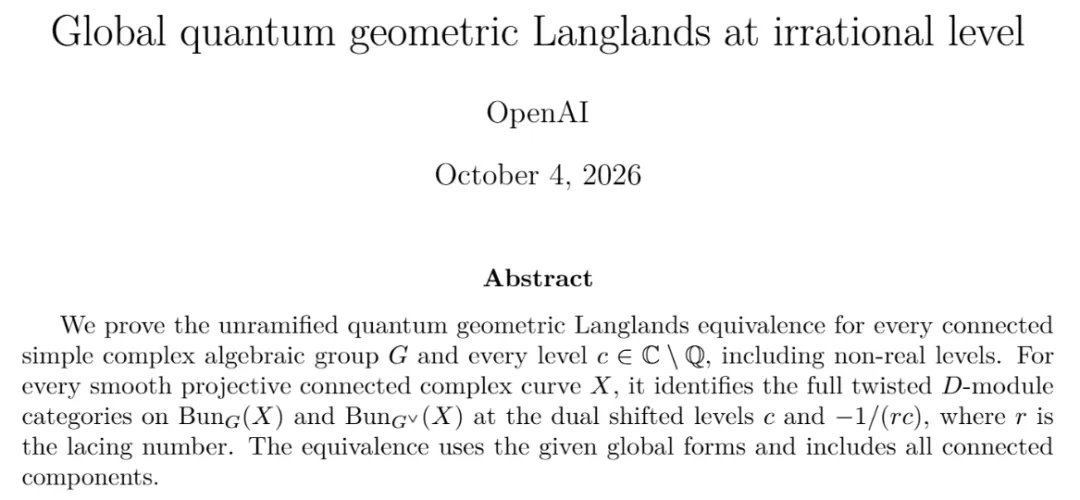
The quantum geometry of Langlands
No. 008 claims to have solved the issue of Groth.