Where the smart connection comes from has become a topic that we need to explore together.
The industrial chain silicon system has evolved into silicon.The market enters the expressway
In my view, the progress of smart welding has never been accomplished by a single technology, a single component manufacturer, but by the evolution of silicon systems down the entire industrial chain.
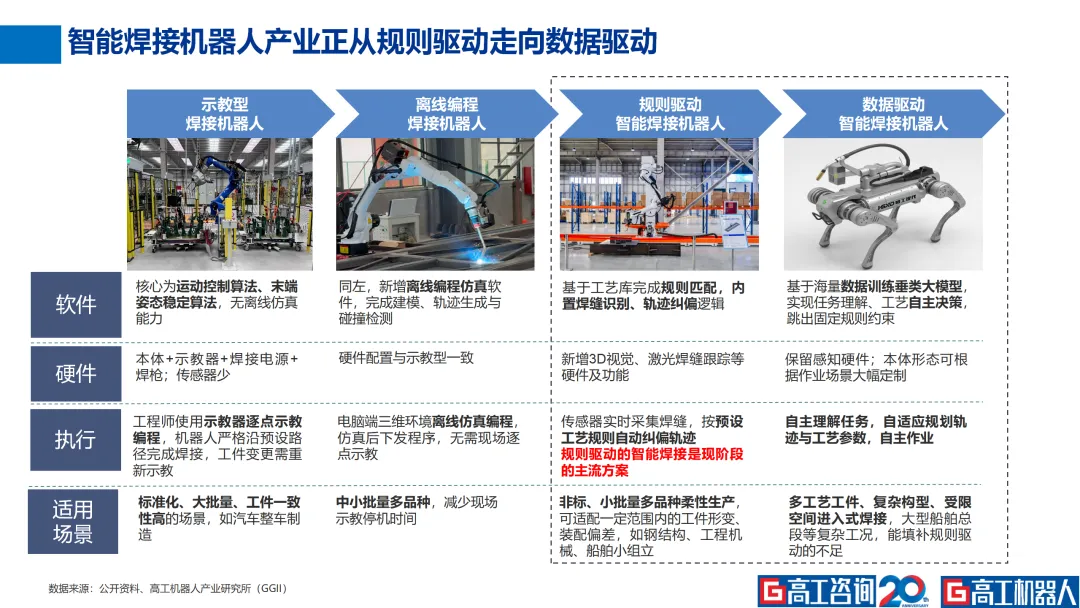
The process of modeling upstream, perception, decision-making, and execution links has accelerated significantly, and technologies such as simulation are constantly evolving, especially in perception and reverse modeling.
In addition to traditional industrial robots and collaborative robots, four-legged robots and humanoid robots have also entered the market in succession. At the same time, multi-machine collaboration has become a trend: collaborative welding applications for 2 to 4 robots are relatively mature, and some welding sites have achieved collaborative work for up to 8 robots.
From the earliest steel structures, to vessels of current size, to active attempts in industries such as metalworking, heavy machinery, new scenarios, new industries are constantly being opened.
The mature, most intuitive manifestation of an industrial chain is market data.
GGII data shows that in 2025, sales of smart welding robots in China amounted to 0.69 million units, accounting for 11.6% of total sales of welding robots, and the penetration rate of smart welding robots was 8.2% and doubled compared to 2022.
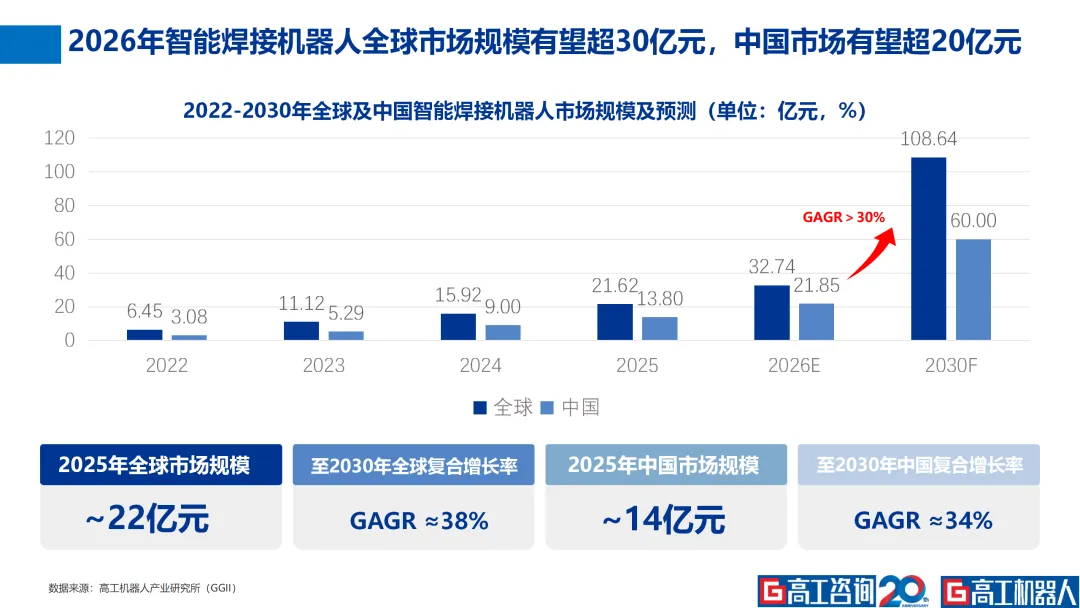
In terms of market size, the global market for smart welding robots is expected to reach about 2.2 billion yuan in 2025, and the Chinese market is expected to reach about 1.4 billion yuan; GGIII expects the combined annual growth rate of the global and Chinese markets to reach about 34% and 38%, respectively, by 2030, and the global market size is expected to exceed 3 billion yuan in 2026, and the Chinese market is expected to exceed 2 billion yuan.
The dismantling value comprises 3D vision/laser chip tracking systems, smart chip control systems and offline programming software, which together account for about 40% of the value of smart chip robots. Liu stressed that these three large chip technology barriers are high and will continue to be a core value in future industrial development.
In terms of process, arc welding is the fastest-growing plate among welding robots. In 2025, China saw sales of 595,000 welding robots, an increase of about 13.3%; of these, 4,160,000 arc welding robots, an increase of 18.5%. Compared to slow-growing point welding, arc welding for various materials such as carbon steel, stainless steel, aluminium and aluminium alloys, as well as different thicknesses of plates such as thin, medium and thick plates, the growth of arc welding plates will be further accelerated with the new working conditions and expansion of new industries.
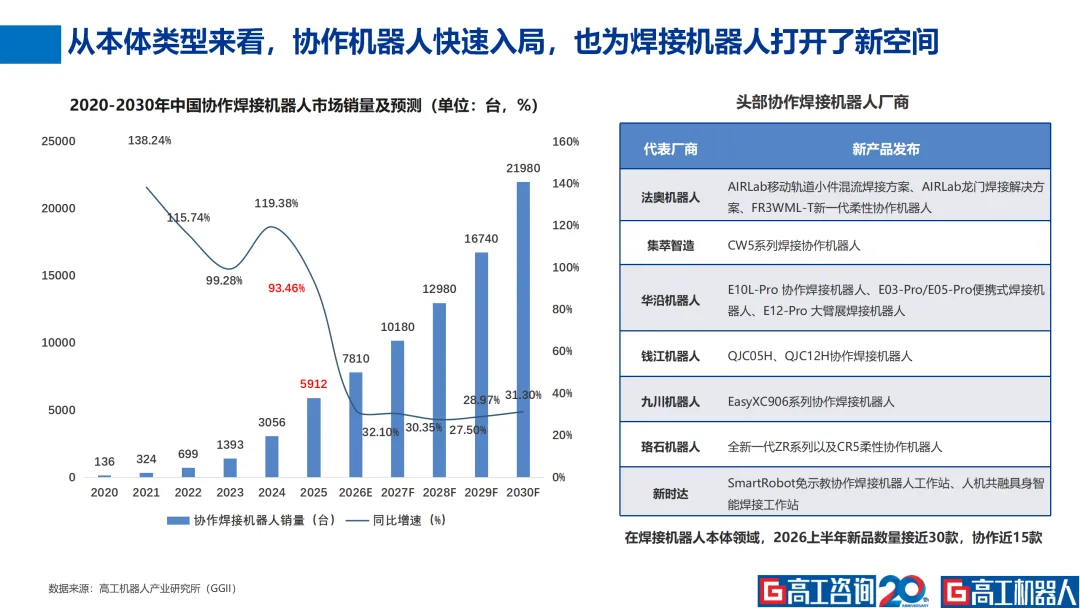
In the first half of 2026, there were nearly 30 new welding robots, including 15 collaborative robots, 15 humanoid robots and 7 quadruped robots combined. In 2025, the shipment of collaborative welding robots in China reached 5912 units, thanks to the deployment of flexibility, lower thresholds, and the addition of mobile external axes to adapt to various working conditions, the growth of collaborative welding robots is expected to continue to lead.
Steel structure powered by twin engines for shipbuilding, market space from 2 tonnes to N tonnes
In terms of downstream applications, steel structure and shipbuilding are the two main markets for smart welding today. Both of these markets have clear non-standard attributes. The cost of welding is high.
Among them, the steel industry has entered a period of stock optimisation, with overall growth slowing, but the penetration rate of smart welding is still low, and the expansion space is still considerable; the shipbuilding industry is in an upward cycle, and the GGIII expects this cycle to last until 2032, with the expansion of the downstream market driving the same frequency to release demand for smart welding.
Outside of Z2Z, Z2Z describes a leap path to Z2Z: metal processing is a typical long-tail market, sensitive to price, and the market space will open up as the cost of intelligent welding robots drops further; more heavy machinery thickening plates, super-thickening plates scenarios; welding requirements are high, and the need for intelligent welding has begun to emerge, and once technology breaks, the penetration rate will increase further; personalization of automotive parts and non-part parts is increasing, and there is also considerable penetration space.
Opportunities in the 3 million jobs gap with four problems to solve
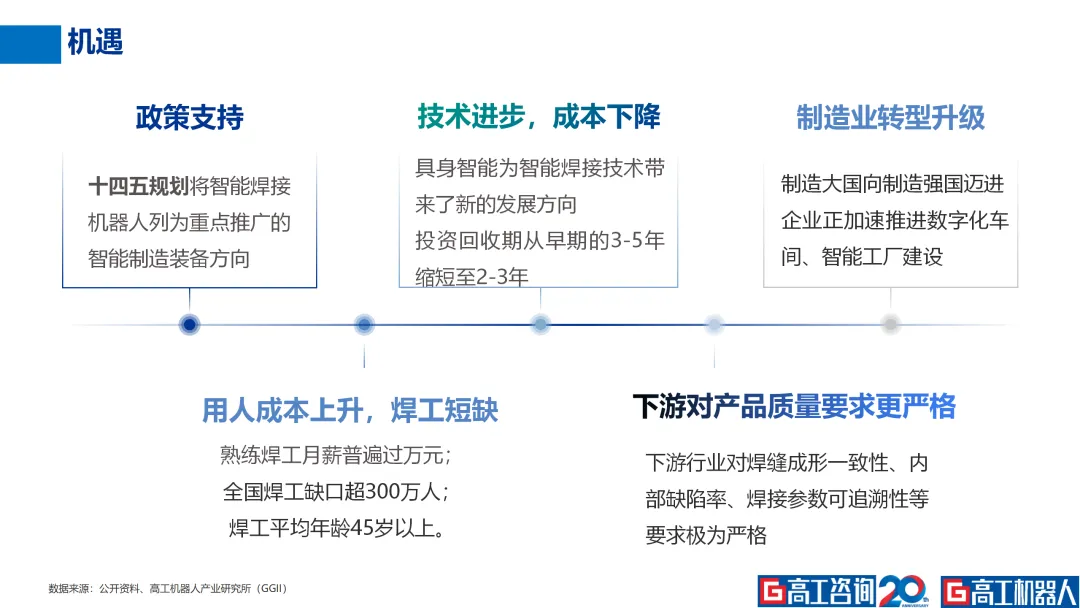
The logic of the growth of smart welding, on the one hand, depends on the rigidity gap on the demand side and on the technical progress on the supply side. In the current market situation of the shortage of workers and rising costs for users, the policy side is also accelerating the pace, such as the 14th and 15th plans to list smart welding robots as the main promotion of smart manufacturing equipment directions.
At the same time, there are four major challenges facing smart welding:
One is that the core algorithms and process accumulation are insufficient. Low accumulation of welding process data, insufficient effective sampling of complex process scenarios, and thus limited parametric recommendation accuracy for intelligent matching.
The second is the difficulty of adapting to complex working conditions. Large deviations in the size of non-specific workpieces, large errors in the positioning of the cylinders, arcuate light, strong electromagnetic interference and changes in temperature and humidity affect the stability of the sensors, and the combination of welding in different materials, plate thickness and slope form varies even more. Although the level of sensors and data has improved significantly, there is still a lot of complex working conditions to be tackled.
The third is on-line monitoring and quality control. Current online monitoring focuses heavily on location tracking and surface defect identification, real-time perception of internal quality and precise control are still in the exploration stage, and it is extremely difficult to establish an accurate quality control model.
The fourth is the shortage of top talent. Human robots, large-scale general-purpose model circuits are hotter, and the appeal for top model algorithm talent is far beyond smart welding enterprises. However, Liu also said that technology related to smart welding is penetrating into traditional industrial manufacturing, and more top talent will enter the welding field in the future, bringing new changes to the industry.
Short-term three-point drop, long-term sword fingers for the AGI
Looking to the future, Liu gives two roadmaps for the short- and long-term leaps in smart welding technology.
There are three short-term priorities.
One is multi-machine synchronous coupling: based on the relative maturity of two to four synchronous clusters, further solving the scheduling complexity of four or more clusters of machines, avoiding collision difficulties and efficiency optimization problems, and achieving multi-axis linking control of the robot's body with the external axes such as the variable machine, ground track, and lift axis.
The second is free of demonstration of autonomous welding: with the continuous breakthrough of reverse modeling technology without drawings, complete automatic scanning, welding identification, path planning and welding of workpieces in an orderly manner, without the need for any artificial intervention, the whole process can be truly welded; at the same time, improving the ability of the system to adapt to the bias, promoting complex welding, such as multilayer multilayer welding, towards autonomy.
The third is mobile welding: in the case of fixed workplaces, such as large workpieces, on-site construction, especially in the shipbuilding sector, continuous improvement of the autonomous operation of mobile intelligent welding robots, reducing the difficulty of welding implementation.
The long-term strategy also has three main lines.
Data-driven intelligent welding: combining physical mechanical knowledge such as welding fluid mechanics with mass welding data, building a large welding vertical model of welding mechanics + data welding dual-driven, getting rid of the reliance on rules of artificial prediction, and balancing AI decision-making ability with real-time control accuracy of equipment.
Multimodal integration of perception and quality-wide chain intelligent control: achieving precise time and space synchronization and characteristic-level integration of multimodal data such as voltage, current, flow, speed, temperature, sound patterns, spectrum, and so on, promoting the extension of quality detection from surface defects to internal mass, allowing perception data to be deeply connected to intelligent control systems.
Digital synthesis with virtual reality: achieving 1:1 synchronous mapping of physical output lines with virtual models, generating welding samples and fault data in bulk in a simulated environment, and training of replicative models.
The end point of this long-term strategic route is the AGI for welding.
Written at the end
From demonstration to offline programming, from rule-driven to data-driven, every leap of intelligent connecting robots is the result of technological evolution and downstream demand dual-wheel drive: advances in technologies such as point-cloud modeling, trajectory planning continue to drive higher ROI, shorten investment recycling cycles, while downstream rigorous demands on quality and flexibility continue to raise the demand for intelligent silicon and linearity.
Standing at the beginning of a rapidly climbing penetration rate, the expansion of the market for intelligent welding has just begun. From steel structures, shipbuilding to metal processing, heavy machinery, automotive parts, from single-engine to multi-machine collaboration, from hydrogen to silicon, this technological leap is without an observer.
* Cover for AI mapping