At the beginning of October, OpenAI's Tibo set up a pressurized Flag. For the next 28 days, each day, OpenAI will bring a clear enough improvement to Codex/Work users.
The first day's updates were straightforward: GPT-6 Astra and GPT-6.1 Sol increased the default speed under the subscription system by about 50%.
The next day, the pace suddenly accelerated. In addition to delivering one update, Tibo released four updates: Auto-review free, API grading simplified, Meetings plug-in session access records, and Decisions API open to more developers.
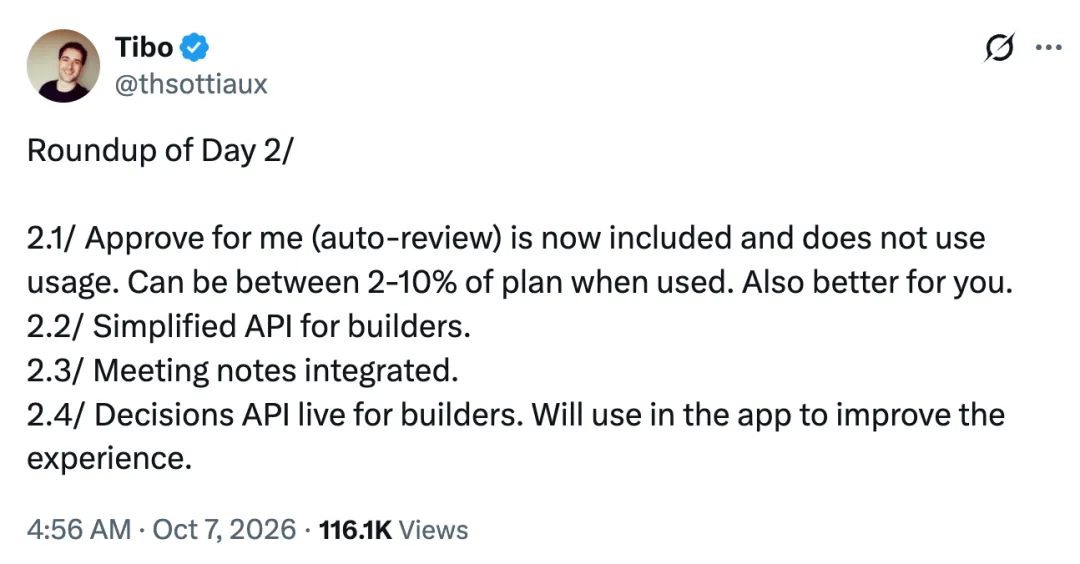
Four updates across the Codex, ChatGPT and API.
Separately, not all of these are DevDay-grade releases; put together, they all point to the same thing: OpenAI is focused on dealing with the details that are the easiest for agents to get stuck with after they actually get into day-to-day work.
Day 2.1
Let the second agent watch the first agent for you.
The first thing to do the next day was to confirm the authorization.
OpenAI announces that Auto-review is now free to all users who log in through their ChatGPT account, and will no longer consume the amount of user packages.
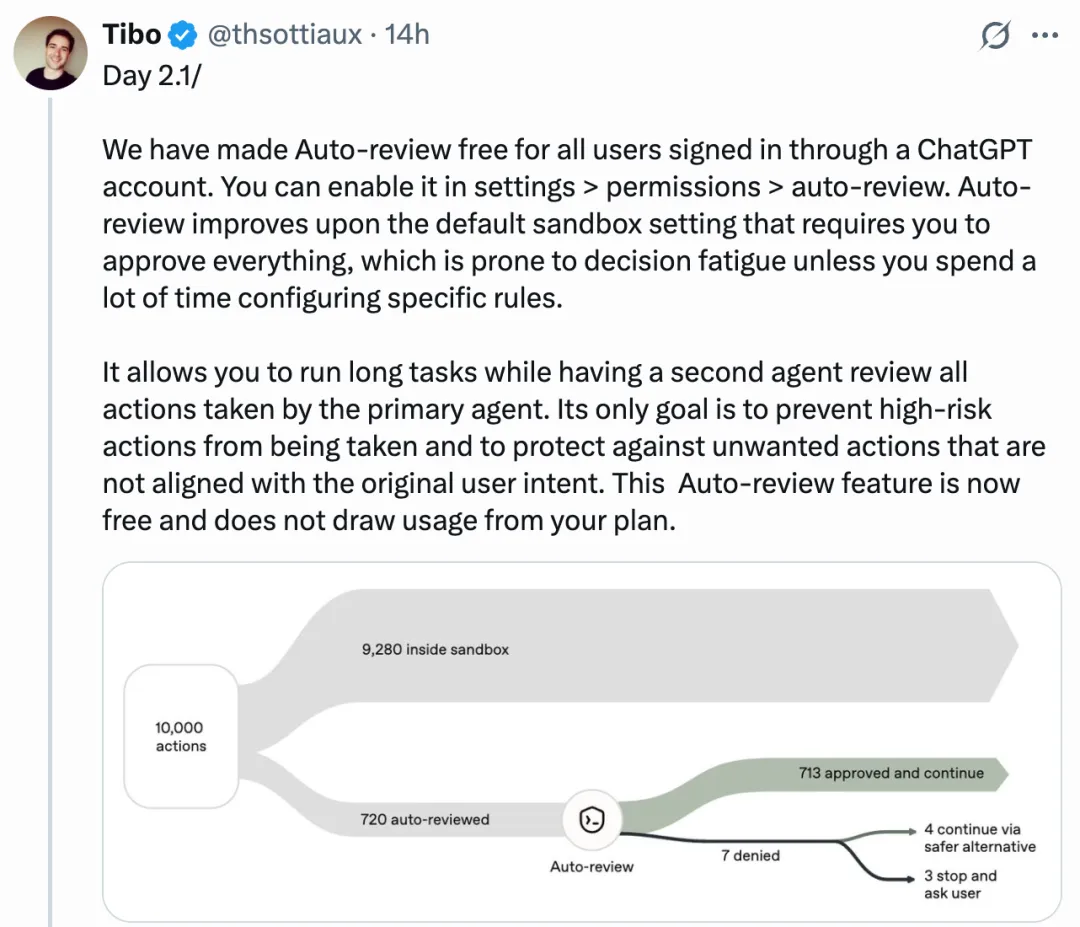
In the default sandbox authorization mode, users often require manual confirmation when the Agent is ready to perform operations that may have external implications. When the task is short, the mechanism is not problematic. Once the Agent starts working continuously for decades or longer, frequent clicking on approval itself becomes a burden.
The solution given by Auto-review is to reintroduce one Agent. The main Agent continues the task, while the other Agent checks the operations it is prepared to take. Its responsibilities are narrow, focusing mainly on high-risk behaviour and actions that deviate significantly from the original intent of the user. Tibo also acknowledges that Auto-review is the previous "Approve for me" mode.
It's not the two words "free" that are really worth paying attention to.
When the agent gradually enters a real task that runs for a long time from a few minutes of code generation, authorization management becomes increasingly difficult to rely on the user's step-by-step clicking confirmation. A complete release of authorization also carries a significant risk. Auto-review is equivalent to adding a layer of automatic review between the two, allowing the agent to continue to run while maintaining a check for high-risk behavior.
It is not equivalent to absolute security, but for long-range tasks, this authorization model is closer to the actual available Agent workflow.
Day 2.2
API five grades to three grades, top-level thresholds directly halved
This time it's for developers.
OpenAI has simplified the previous five paid API Usage Tier into three: Build, Launch and Grow. Among them, the cumulative fee threshold for Build is $5, the launch is $100, and the highest level of Grow is $500.
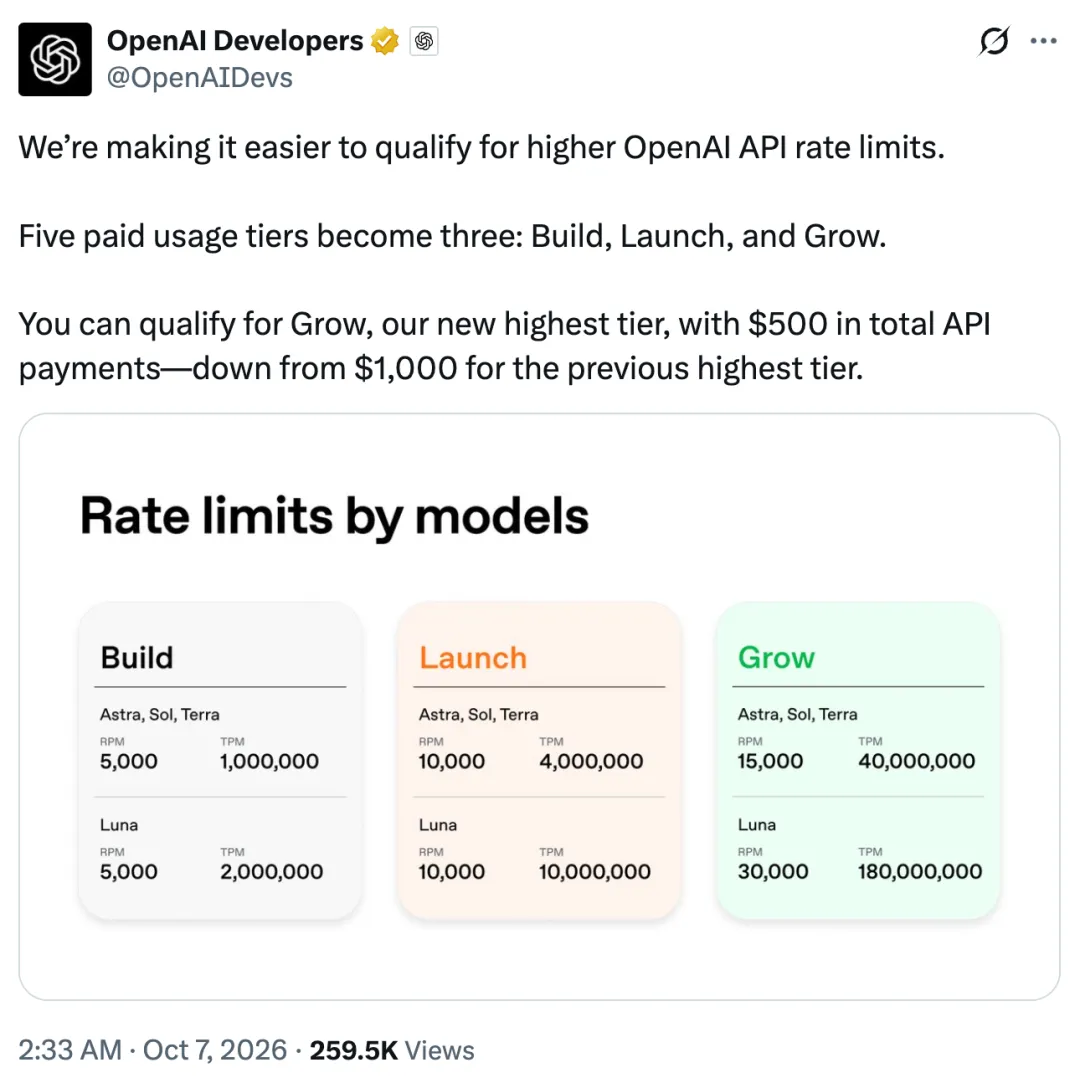
Prior to entering the highest pay grade, a cumulative payment of $1,000 was required, and now the threshold has been reduced by half. Once the conditions are met, the organization will be upgraded automatically without the need to apply manually.
The adjustment itself does not change the model's capabilities, nor can it simply be understood as API pricing. It solves the friction in the expansion process.
For developers who are pushing applications from testing to formal production, the API Rate Limit can easily be transformed from a background parameter into a real bottleneck. Once the number of requests grows rapidly, whether higher RPMs, TPMs and overall usage ratios can be achieved in a timely manner will have a direct impact on whether the service can continue to expand.
Compressing the five layers into three while lowering the entry thresholds of the highest level is equivalent to shortening the path of developers from small-scale trials to larger-scale calls.
Instead of continuing to add new levels and rules, OpenAI chose to simplify the rules themselves.
Day 2.3
At the end of the meeting, ChatGPT got the context.
Day 2.3 returns to a more everyday workplace: meetings.
OpenAI officially brings the Meetings plugin to ChatGPT. It can record content during meetings and then save personalized summaries and tasks to ChatGPT Space. Users can keep records private or share them with the team, and ChatGPT can continue to update project plans, organize action items or follow up after a draft meeting based on this content.
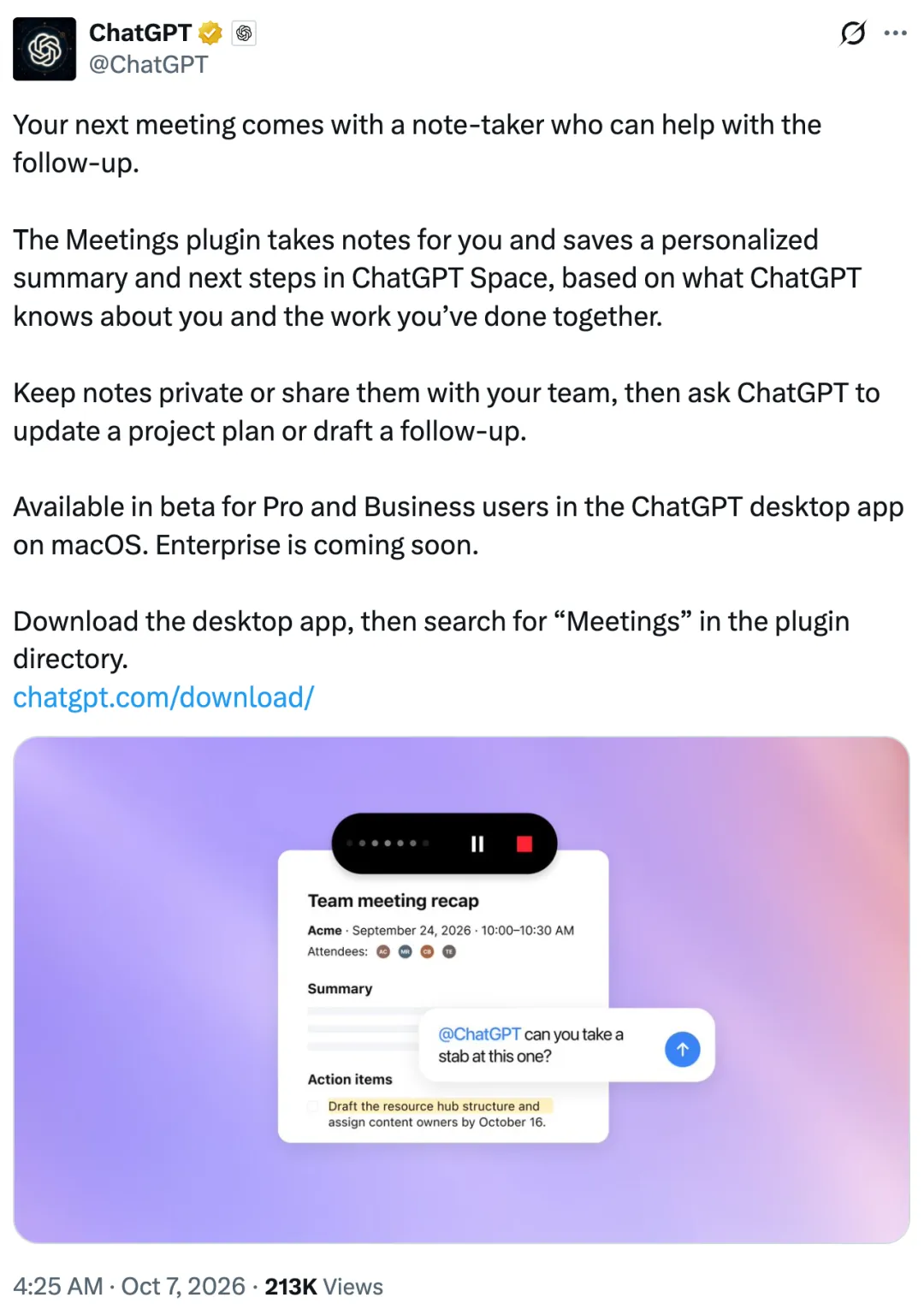
Currently, Meetings is open Beta for Pro and Business users in the MacOS version of the ChatGPT desktop application. Enterprise is not yet widely available. OpenAI's help documentation shows that only a small percentage of Enterprise customers are currently participating in Alpha testing.
What's interesting about this feature is that it further bridges the gap between "work happens" and "AI accesses context".
In the past, meeting content was handed over to AI, often requiring recording, rewriting, uploading documents, or copying the minutes of the meeting. Now the meeting itself has become the context input to ChatGPT. More importantly, the meeting record does not stop at "summarize what you just said".
The decisions, tasks and contexts generated at the end of the meeting can continue into Space and then become the input of project plans, documents and the next round of tasks.
This is another piece of the puzzle that OpenAI has been working on since the launch of ChatGPT Space: allowing agents to more and more automatically access their workplace context.
Day 2.4
Let the model write fewer answers and make decisions directly.
The next day, the last update was in the Decisions API.
The API was first unveiled on OpenAI DevDay 2026 on September 29th. It was still in limited preview. Now, according to OpenAI's latest release, the Decisions API is in public beta and open to developers.
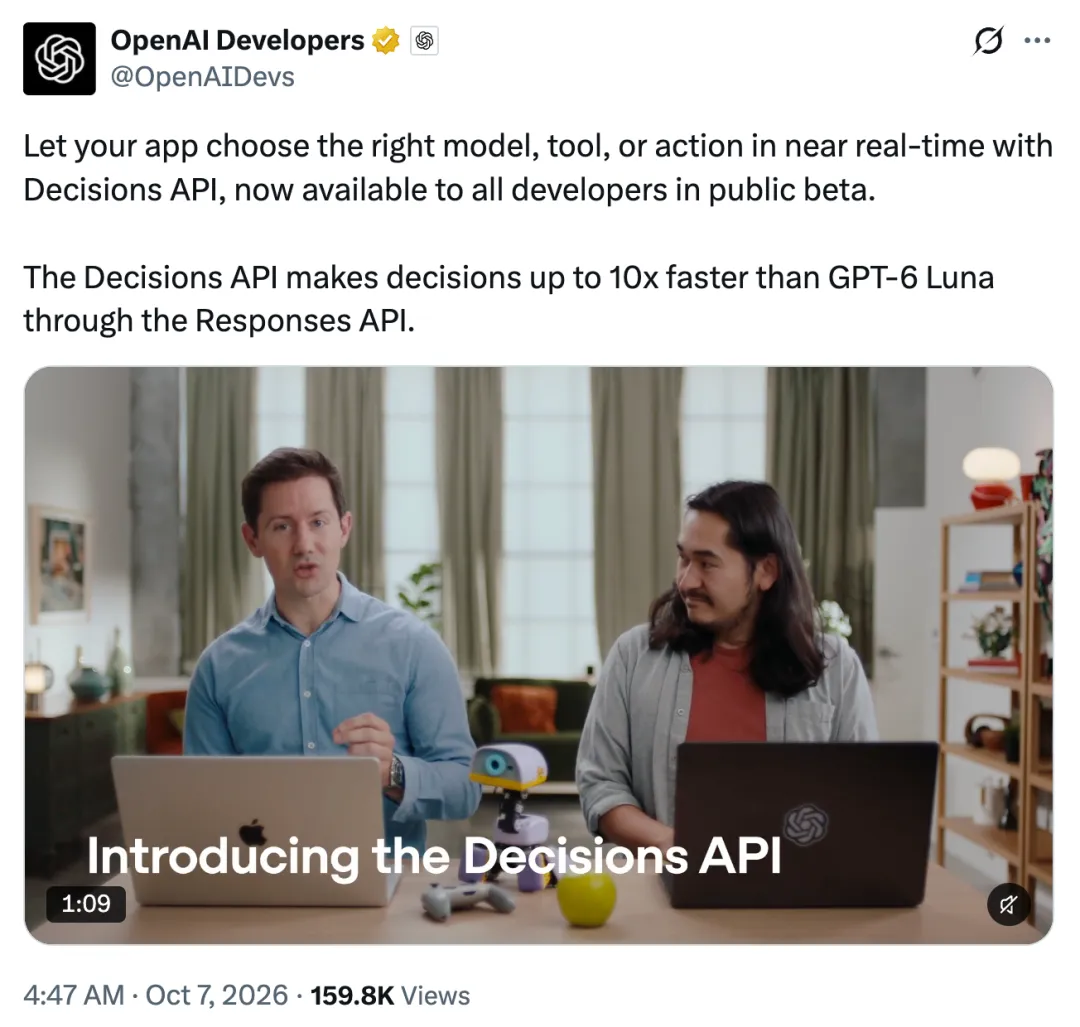
It solves problems that are somewhat different from ordinary generated APIs.
Many applications call large models, not to get a long text. For example, a request should be given to which model, a task should use which tools, what action an agent should take next, whether a tool calls are risky. These questions often require only a clear judgment.
The Decisions API is designed for this type of task. It is powered by GPT-6 Luna, which accepts text and image input and currently supports three types of output formats. Predicates is used to judge a statement as a true probability; Choices is used to select from predefined options and return confidence; Scores maps the input into a numeric range.

The data provided by OpenAI is that the maximum decision-making speed of the Decisions API can be reached at about 10 times the speed of GPT-6 Luna through the Responses API. The data previously shown by DevDay is about 150 milliseconds to 1.6 seconds, although this figure comes from OpenAI's own demonstration that actual delays will still be affected by specific tasks and input sizes.
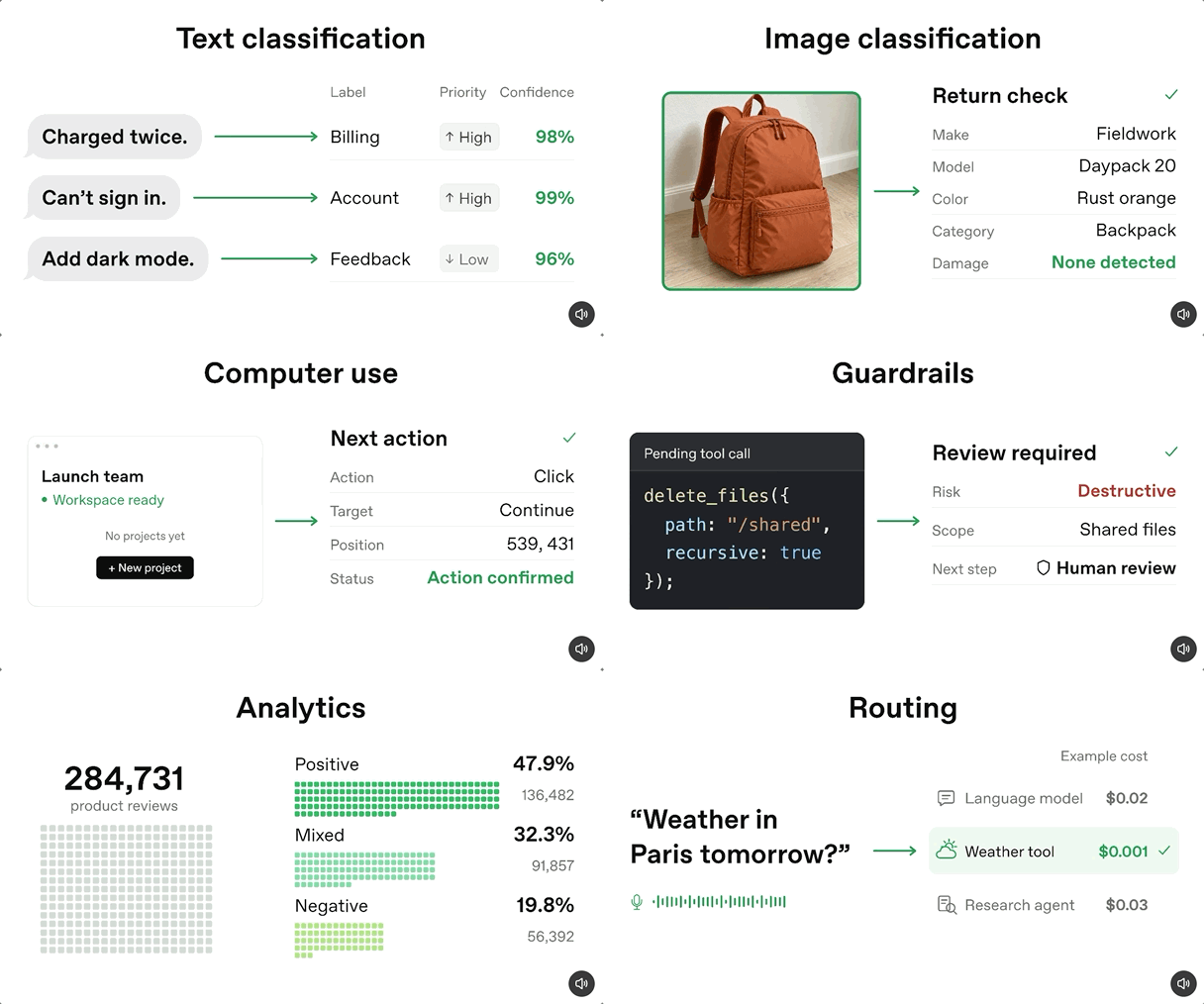
It can be used for request routing, model and tool selection, content classification, image comparison, and risk assessment before Agent tools are called. This is why the Decisions API is worth continuing to observe.
As the workflow of the Agent becomes more complex, a large number of model calls actually take on the role of "judging what to do next". In the past, developers often had general models generate structured results, then parse JSON, or respond to a limited model from several options through Prompt. Now OpenAI has started to extract these tasks separately into a low-delay decision interface.
If this interface can be further matured in terms of stability, cost and confidence calibration, the model calls for "responsible generation" and "responsible judgment" in the Agent system may become clearer.
From Auto-review to the Decisions API, the four updates of the next day are wide ranging. But they have one obvious thing in common: they do not continue to pursue pure model performance indicators.
After entering a truly long-term, high-frequency work environment, new problems arise: people need to continuously approve operations, API scaling rules are too complex, work contexts require repeated movements, and a lot of simple judgments and no need to call a complete generation process.
The first day, OpenAI made the model run faster. The next day, it began to clean up a series of friction left after the model actually went to work.
The link is as follows: