On September 27, the 46th Chess Olympiad concluded in Samarkand. The hosts Uzbekistan defeated Ukraine 2.5-1.5 in the final round, claiming the gold medal in the open group for the second time, while the Chinese women's team took the top spot in the women's group for the seventh time.
Anyone who has watched the live broadcasts of the top chess games in recent years is probably familiar with the evaluation rule that floats up and down the side of the screen. The engine will tell you that the white side is now leading half of the soldiers, or that a certain chess set the odds of winning, but it never explains why.
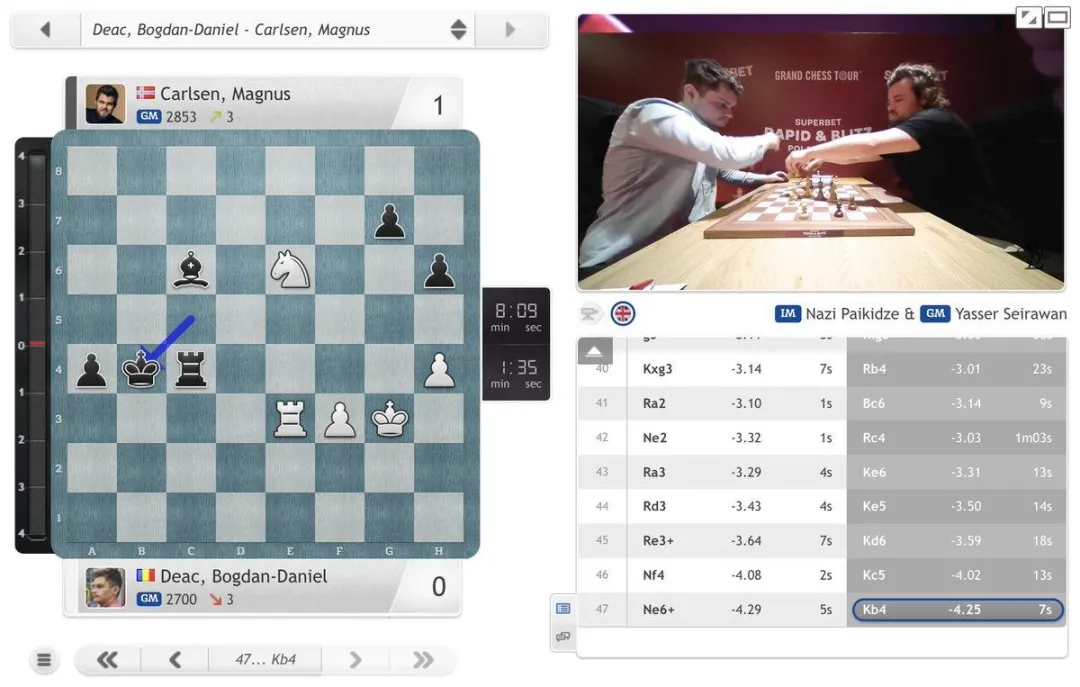
The black and white space on the left side of the board, floating up and down, is the evaluation bar.
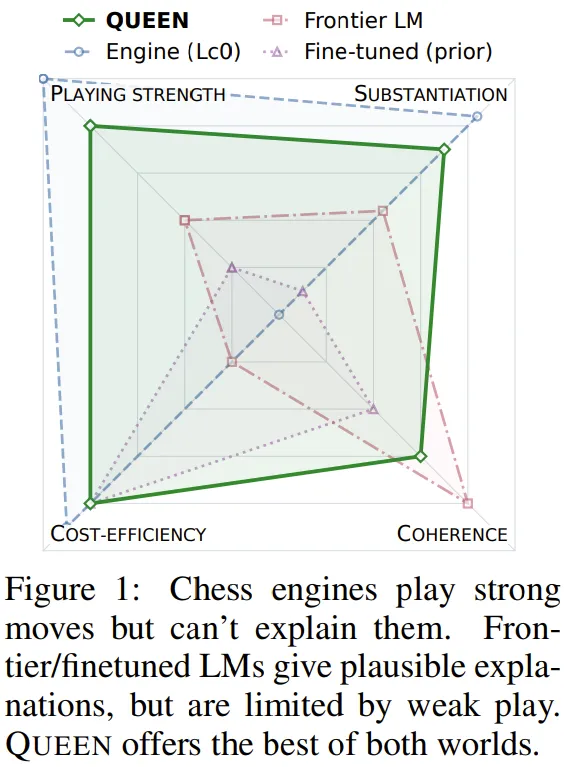
This is a summary of a general dilemma in the field of AI. The strongest expert models are often silent, while the most talked-about language models are often not strong enough in the professional field. Chess engines have long put humans far behind, but can't say a word.
Recently, a team at Princeton University published a result on arXiv in an attempt to connect the two ends.
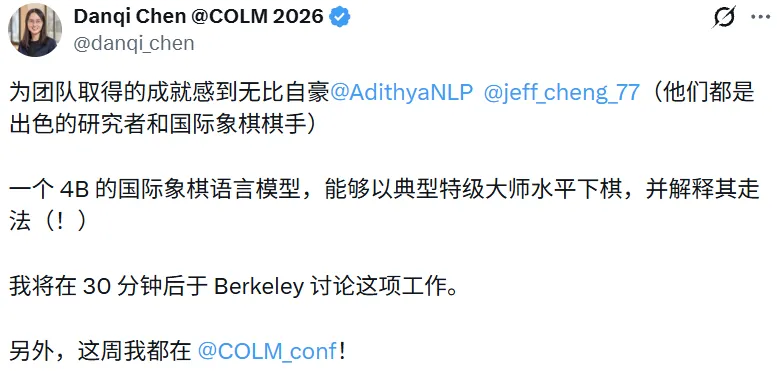
The model they trained is called QUEEN, with a total parameter of about 4B, and the chess power is close to that of a typical special master, who can explain himself in natural language why he walks this way.
Language Models that Play Chess and Explain Their Moves
Address of the paper:https://arxiv.org/abs/2610.03695v1
Model address:https://huggingface.co/collections/princeton-nlp/queen-chess-models
Open source code:https://github.com/queen-project/queen
I don't want to talk about what I'm going to say.
The origins of chess and AI date back to 1950. That year, Claude Shannon estimated the computational complexity of chess and envisioned what a chess machine would look like.
For more than seventy years, from deep blue, which relied on manual evaluation functions, to AlphaZero, which grew out of self-defense, and Leela Chess Zero, which was based on Transformer, a generation of engines outperformed each other.
The problem on this side of the language model is precisely the opposite. The paper found that chess language models, which had previously been specially fine-tuned, were mostly trained and evaluated on isolated tactical topics, and that even in these limited scenarios it was difficult to choose good chess, and the quality of the interpretation was naturally limited.
The paper states that as of 2 October, there were fewer than one-tenth of the world's 1899 Special Masters, less than one-tenth of all active online chess players. The vast majority of chess players did not wait a long time for a Special Master to sit down and talk to themselves.
A silent master, an interpreter who speaks
QUEEN's thinking can be understood by a scenario: to have a silent master who only uses his fingers on a chessboard, and an interpreter who is good at speaking but equally good at chess. The master is responsible for "seeing", the interpreter is responsible for "speaking", and the key is to make the interpreter truly understand the master's gesture.
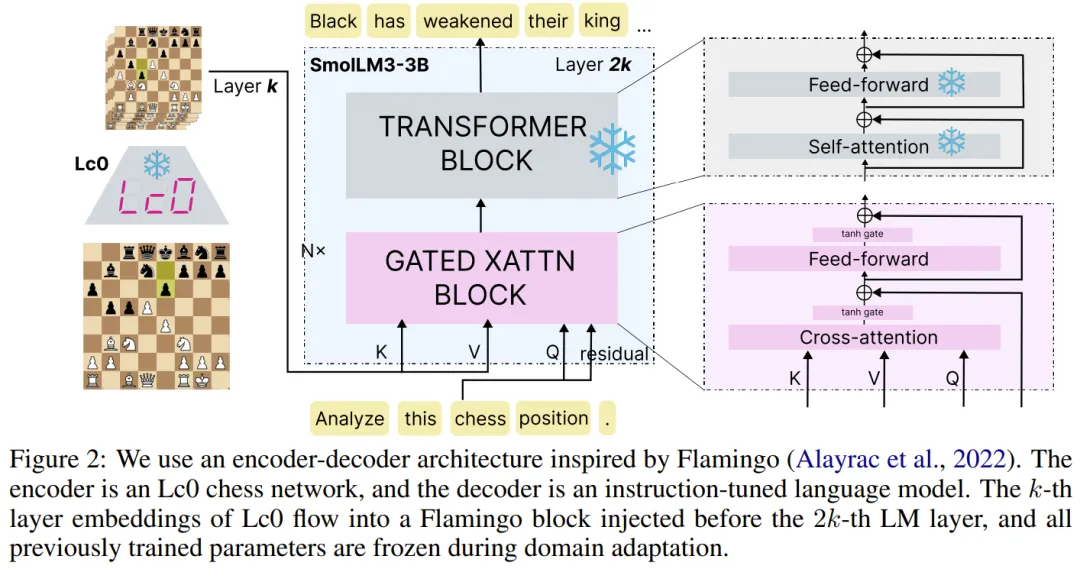
Specifically, the "Master of Silence" is a BT5 network in the Lc0 family (the paper calls it Leela), about 240M parameters, 15 layers, input fixed to 64 tokens, corresponding well to the 64 characters on the board, without searching it can fall to the level of a superhuman.
The interpreter is HuggingFace's SmolLM3-3B, a general instruction model that has hardly been trained in chess.
The bridge between the two draws on the cross-sectional attention of the gate control of the visual language model Flamingo: Leela's characterization of layer I, before entering the language model layer 2i, a total of 16 bridge modules were inserted, about 470M parameters. Different from the original Flamingo only from the final layer of the encoder, this layer-by-layer pairing allows the language model to simultaneously see the "idea" of Leela's shallow and deep.
The team designed a four-stage question-and-answer course, starting with a simple, in-depth, static question such as "what's on a board?" and then asking "where can this horse go?" and "who can be a general?" and then giving 1 to 8 steps to get the model to demonstrate the future situation. All the answers were generated and tested by the program. At this stage, Leela and the language model were frozen, training only bridge layers and new words.
After training, the models achieved accuracy rates of 99.97%, 99.97%, 98.97% and 96.07% on the four categories of problems, respectively.
Self-evolution with the "Belmann Update" in the natural language version
After learning to read the chess, the model would not write the analysis. The team first used the low reasoning file of GPT-5.6-Sol to generate a demonstration explanation for 15000 situations, at a cost of $652.35, and after filtering out the remaining 8602 items containing unlawful or erroneous samples, it was used for the first round of supervised fine tuning, which resulted in a model Elo of 1782. The explanation was written smoothly, but the recommended chess is often unreliable.
It was inspired by AlphaZero: to make better judgments with searches, to put "press" judgments back into the network, so that the next time the network doesn't search, it can also think directly.
It's like a chess player's repetitive habit. In the face of a situation, the model writes three candidate rules first; then steps apart and re-analyses each of the three new situations; if the analysis of a particular situation itself is wrong, continue to drill until you find the model "just not good enough".
Subsequently, Qwen 3.8-27B combined the three-part analysis into a complete explanation of the original situation, explaining why this step was chosen, where the other two steps differed, and explicitly requesting that no new content be added. Only when the conclusion of the merger was better judged than the original model would the data be retained for the training of the next round.
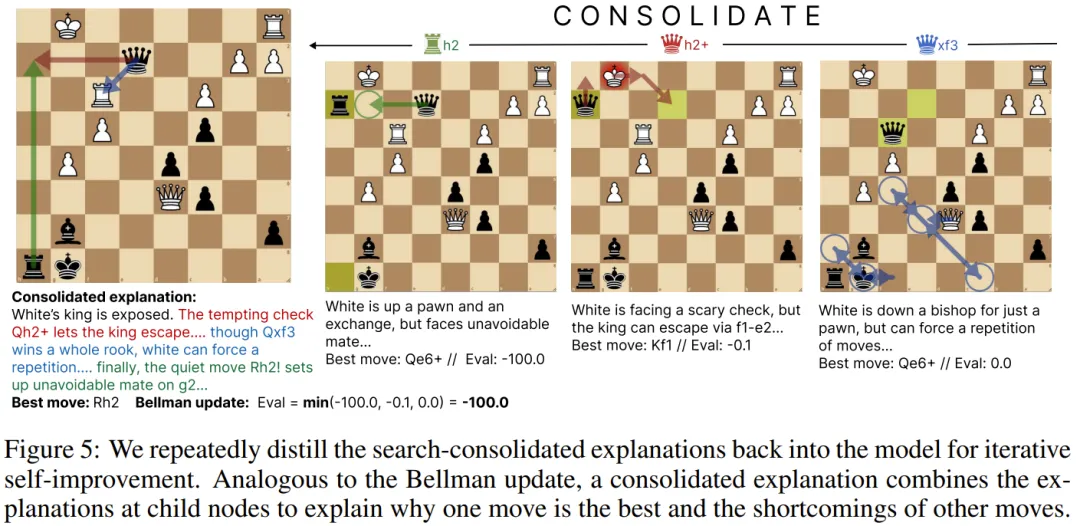
The paper gives some examples. The white side examines three candidates: Rh2, Qh2+ and Qxf3. From the opponent's point of view, the evaluation of the three sub-situations is that they must be killed, respectively, -0.1 and 0.0, taking the most disadvantageous opponent, concluding that the apparently quiet Rh2 is the killer, while the seductive general Qh2+ will let go of the other king. Each round starts from about 400,000 positions and ultimately produces 150,000 to 280,000 training data.
The results of the experiment
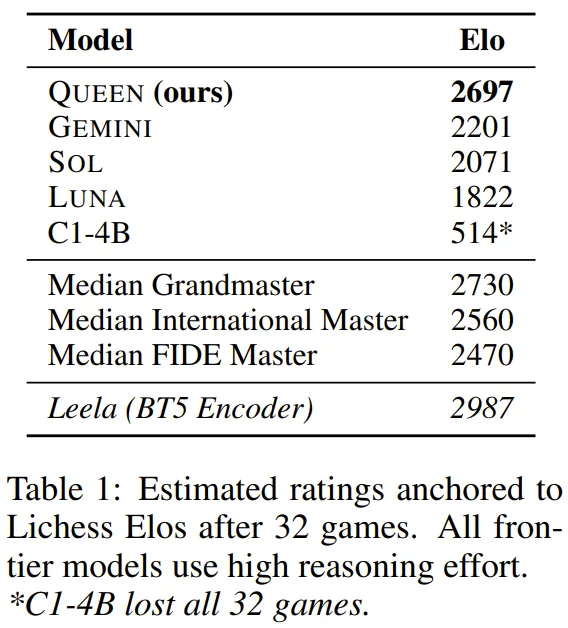
In terms of chess power, each model with eight different intensity engines matched the Lichess grading system by 32 discs. QUEEN eventually scored 2697 points, with Gemini-3.1-Pro for 2201, GPT-5.6-Sol for 2071, and the predecessor C1-4B for 4B. As a reference, the average score for the Lichess Advanced Master Fast Chess rating was 2730. In seven rounds, QUEEN's score rose from 1782 to 2697, a cumulative increase of 915 points, with the fifth to sixth rounds in the middle briefly falling by about 100 points.
In terms of argumentation, the team examined whether the main variation given by the model in 1000 tactical questions and 1000 real-world situations was wrong. In tactical questions, Queen's initial error rate was 91.6%, 9 percentage points higher than the second Gemini; this figure was 97.1% in real-world situations.
However, the paper also frankly demonstrates the shortcut. In the GPT-5.6-Sol score as a judge, the structural consistency of Queen is 3.51, evenly matched with Sol, but the conceptual consistency is only 2.76, significantly lower than Sol's 3.61, and the language fluency is slightly lower than that of the front-end model.
In other words, the changes it found were correct, but it was easier to describe the situation with the term "hardened outpost". The authors analyze that self-distillation can gradually push the search tree into weight, but teaches the model to describe a type of chess it has not seen, and the wrong concepts can still be passed along layeredly in the process of merger.
The dissolution experiment yielded two conclusions:
Leela's encoder and the four-stage course are missing, and if you remove any of them, the model's chess power drops to 514 points.
QUEEN is not a simple recitation of Leela: in more than five justifiable legal situations, it has chosen 53.8% of the different chess variants from Leela.
The team also experimented with versions that did not rely entirely on front-end models, using Stockfish manual evaluation features and modeling to generate an initial explanation, resulting in higher chess power for the first four rounds, with the first round reaching 2115 points.
What is the meaning of this verse?
The value of QUEEN is not just in chess. It really offers a set of formulae: in a field that already has a "silent expert", cross-referencing expert models to language models, first reading expert expressions using language models in the classroom, and then using search-and-distillation to make interpretations better written.
According to the authors, this approach could be transferred to areas such as gaming, robotics and computer operations, where there is no shortage of powerful but non-speaking dedicated models.
More than a month later, in the live broadcast of the World Championships in Geneva, the rating bar will still only give numbers, and the AI that makes the numbers sound is probably not far away.