Recently, there has been an interesting platform, with 440,000 people using it to teach robots "life experiences".
They capture videos of their daily activities and upload them to robots to learn.
In the last four months, users from 108 countries have uploaded more than 16 million real-world mission videos, and the platform receives 30 minutes of new content per second, equivalent to recording 4.9 years of human work per day.

Sources are as follows:
Figure has paid $15 million to these "teachers" and is set to spend more than $1 billion on data and computing over the next 12 months.
After all, language models can "read" the Internet directly, but the "life experience" of learning robots is not so good.
A few days ago, at the 2026 World Robotics Congress, Wang Xing, the founder of Yuke's technology, also spoke about the "ChatGPT moment" in the robotics industry. According to his estimate, the real breakthrough will still have to wait two or three years; if it doesn't go well, it could take another five to ten years.
With bodies that can be turned upside down, 16 million human videos, and billions of dollars in investments, what else do robots need to really move from demonstration to scale?
Sergey Levine, co-founder of Physical Intelligence and host of The Peterman Pod, one of the world's most influential robotic learning scholars, recently gave a good answer.
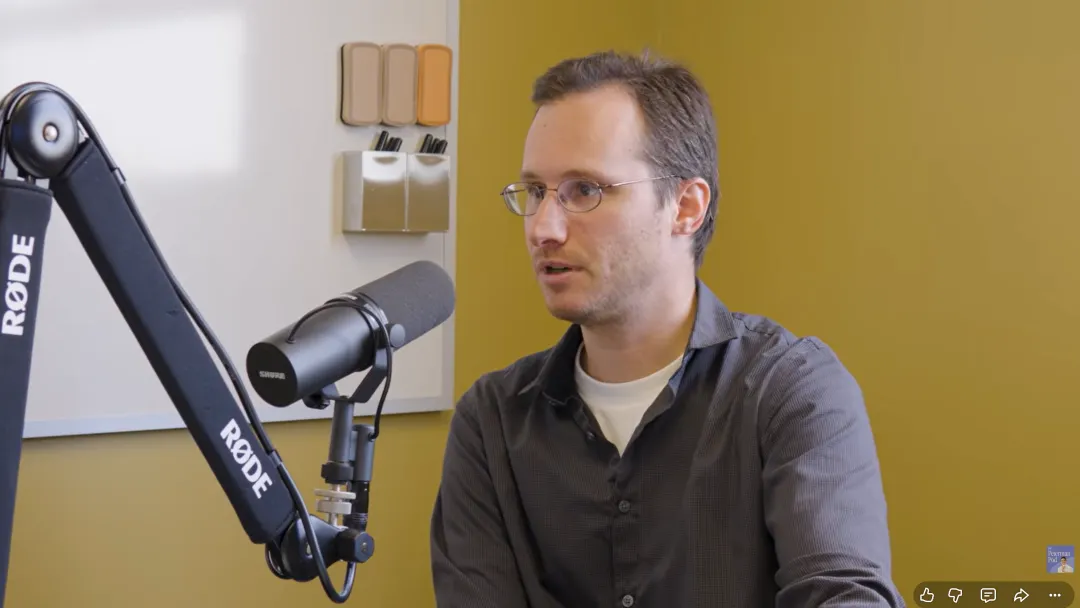
The video link is as follows:
In his view, the robotics industry is going through a transition of problems.
In the past, the task was to control the body of the robot, and now the difficulty is that the church robots themselves make their own decisions, and if they want to move into the future, they must find something truly scalable.
The body of a robot matures before the brain.
Before large-scale model-dominated robotics, Boston Dynamics was almost synonymous with advanced robotics. Flashback, running cool, jumping videos used to be a one-time browsing experience. In recent years, it has no longer occupied the center of opinion as it did in the past.
Sergey Levine: I'll explain it this way: In a way, robotics is about how to build complex systems.
It is easy to divide AI into several distinct areas, such as big language models, computer vision, and robotics. But one of the three is not exactly the same as the other two.
Manufacturing robots will need to handle all the components of the entire system: how to connect lines, what energy to use, how the executors should be designed, until the robot makes high-level planning, decides what the next step is to do. When we see different videos and presentations released by different companies, we may think that they all belong to "robots".
Many of Boston Dynamics' classic achievements showcase highly advanced, well-designed hardware, and traditional control methods. They have excellent control engineers responsible for designing and configuring the entire system, but with relatively little emphasis on the decision-making capabilities of robots. At a particular stage of development, this path makes sense.
Robot technology has now entered another stage. Hardware, of course, still has room for improvement, but in many ways, existing hardware is already "good enough". The biggest challenge at the moment is to create a truly effective decision-making cycle that enables robots to respond intelligently to everything in the environment.
The "decision cycle" here does not necessarily refer to high-level decisions at the symbolic level, but may also include very low-level decisions. The real question is: Do robots need to consider their surroundings, or do they just need to control their bodies?
If a robot is to roll over on a flat surface, it primarily has to deal with its own body. But if it is to pick up a cup of coffee from the table, although the move is simpler than rolling over in some ways, the robot must truly understand what is happening in the outside world and not just focus on itself.
In terms of technological developments, I think it's a fine line between AI and control systems: control systems are responsible for controlling the body of a robot; AI needs to consider the world outside of a robot.
A: What would you say if you could go back to when you were just entering the industry, based on all the knowledge you have now, and give yourself a suggestion at the time?
Sergey Levine: Over the last few years, I've learned something that's not much different from what I thought earlier: to solve robotic problems effectively, you have to use a very broad set of prior knowledge. Many people in the field of robotic learning have had an idea that I initially agreed with: since humans can learn from scratch, robots might as well start from scratch.
Earlier in the year, when we were doing a large-scale robot learning study at Google, we did a project called the "mechanical arm farm". We put a lot of mechanical arms in a conference room.
Our idea is that if they can grab millions of objects, they should be able to learn a very general grabbing tactic. This method works. Robots have actually learned to grab objects. But going forward makes it very difficult. Well, now robots can pick up anything, but then what?
I think it's partly because we were using the "whiteboard" idea at the time: starting from scratch to see if robots could gradually learn all kinds of behaviors without any prior knowledge. But the whole problem could be solved much easier and more realistically if we could combine the personal experience of robots with knowledge from other sources.
It is not the language that is really important, but whether people can acquire prior knowledge and use this knowledge to build a framework for the learning process. Prior knowledge can be gained in a variety of ways.
Therefore, prior knowledge has many different sources. The key is that you have to figure out how to introduce this knowledge into a robotic system. Otherwise, you are actually asking robots to solve a problem that is more difficult than that faced by humans and animals.
Imagine: having someone assemble IKEA furniture, but he's never seen any in his life. Of course, this can be very difficult, because he doesn't even know why he's assembling these things or what the final product should look like.
So, prior knowledge is very important. I'm still very much in favor of robots learning through personal experience. But if I were to advise myself as a young person, I would say: take prior knowledge more seriously.
Robots don't have data mines, and they don't have "return keys".
According to the 2026 Human Robot Industry Development Report, in the first half of this year, Chinese human robots have shipped more than 40,000 units, accounting for 97% of global shipments. Another number given by the CEO of ACE Robotics Wang Xiaogang at the same time: Over the past few years, the total amount of physical data accumulated by the entire industry was about 100,000 hours, which is not enough to train basic robot models.
Sergey Levine noted that much of the hardware currently used in robotics research comes from China. They are of good quality, relatively inexpensive, and can meet the standards required by the institute. However, worldwide, the scale of software and data is still incomplete.
Since machine learning has entered the physical world, it has lost both the direct download of Internet data and its recurring low-cost environment.
Host: What do you think the impact will be on the industry if OpenAI or Anthropic starts investing heavily in robots, and will other competitors worry about that?
Sergey Levine: To be fair, the robotics ecosystem may not be as healthy as other branches of machine learning.
Computer vision and natural language processing are naturally adapted to form an ecosystem centered on machine learning because they have freely accessible data and are widely accepted in the industry.
In addition, the security concerns faced in these areas are not as serious as those faced by robots - at least not at the level of physical security. Of course, people have reason to worry about AI security, but this is still not the same thing as a physical device that could directly cause physical harm.
Therefore, in the field of computer vision and natural language processing, it is relatively easier to build serious large-scale machine learning projects.
Traditionally, robotics is not a discipline that is particularly willing to share data. So I think that the more activities that are carried out around robot learning, the more likely it is that people will think of a future where robots will be controlled by models that are learned, rather than by controllers that are designed by humans.
Because it's impossible for any organization to build a true basic model on its own in a single vertical space. The entire robotics industry needs to move from traditional factory automation to the way we look at computer vision and natural language processing. In this sense, while I'm proud of what Physical Intelligence is doing, it's not enough to rely on one company to push everyone in this direction.
A: Currently, robots can use different types of data, such as simulation data, and they can also collect physical interaction data from the real world. Which data is better and which is worse, and what are the advantages and disadvantages of each?
Sergey Levine: There is a lot of debate in the robotics community about this issue, and different researchers sometimes have the exact opposite view. My own view is that if the model has a full understanding of the physical world, it will be easier to absorb data from different sources.
If you want to learn how to fly an airplane, you will probably use a flight simulator, at least for part of the training. You can understand the simulator because before you start training, you already have a lot of knowledge about the world that can be used to understand what is happening in the simulator. You know that you learn to fly an airplane using a flight simulator, not just by playing video games. You are gaining some knowledge that can be applied to real airplanes and you understand that there is a layer of abstract relationship between the simulator and reality.
The same is true of watching others do things.
Suppose you're watching someone cook -- even if you can't personally feel every move they make -- you can still use your own experience. You'll think, "I saw him pick up a salt bottle. I've been salting food before, so I pretty much know what he's doing". So you can abstract this behavior into "salting" without having to analyze each muscle movement of the other.
What I want to say is that once you understand how to use your body and how you experience the physical world, knowledge from other sources can be connected to this understanding.
This suggests that a basic robot model may be better able to absorb knowledge from other sources if it is trained with a large amount of real physical data and thereby gains a basic understanding of the physical world. This view is the exact opposite of what some people think.
After seeing the success of Internet data as a big language model, it's easy to think that robots should follow the opposite path.
But I think that the right order might be right. As long as we build a solid foundation of robot experience, we can continue to add all the other data to it, and the model will be better able to absorb that knowledge instead.
Host: If a humanoid robot doesn't succeed in a few years, what do you think is the most likely cause of its failure?
Sergey Levine: For a robot to really function, it has to have a high level of reliability, robustness and generalization.
Because these generative AI tools often need to interact with humans. When you let a big language model complete a task, its first response may not be completely satisfactory. So you modify the cue word and continue to interact with it repeatedly.
This is why even early language modeling tools, such as the first version of ChatGPT, are not as powerful as today's models, but already have practical value. Users can keep trying and adjusting until the model fundamentally solves the problem. This is similar to using a search engine. You enter a query, and you don't get the desired result, you change a query, you search again, and you can always find the information you need.
But the full value of a robot will only be released when it is able to perform its tasks autonomously.
If every task requires repeated adjustment and guidance, it is almost against the original intent of using a robot. So the biggest risk is whether the robot can successfully achieve the reliability and robustness required by the actual application.
I personally have a great appreciation for technologies like reinforcement learning. They can leverage the experience of autonomous robotics to continue to refine the last few percentage points and really move the system from a 95% success rate to 100%.
PRESIDENT: As a bystander, I often see demonstrations posted on Twitter by the Chinese robotics team, and the results are amazing. In some ways, they seem to be moving ahead. But I don't have a deep professional background, so I'm curious about your opinion: How do you rate the Chinese robotics industry?
Sergey Levine: One of the most valuable and constructive things for those of us who work related jobs in the United States and Europe is to think: What can we learn from this?
In my opinion, one of the most important experiences is that a healthy ecosystem must be built.
So-called ecosystems, of course, include excellent researchers and engineers, as well as healthy open source ecosystems. But this also means that all industries that support the robotics industry must be healthy in themselves. These industries include not only computer science, machine learning and model research, but also supply chain, manufacturing and hardware research.
In some respects, the U.S. is doing pretty well; but in others, the U.S. has been letting them down quite a bit over the years. We should look at what is happening around the world, pay attention to the excellent results of Chinese and other national labs, and learn a lesson: we need to work hard to build a healthier ecosystem and invest resources in all the links that support the development of robots.
I'm not good at business or investing, so I can't claim to know exactly what to do. But I think we have to fully realize that this is a system that needs to be developed as a whole.
PRESIDENT: Of these components of the ecosystem as a whole, which, from the perspective of an American robotics researcher, would have the greatest impact on robotic advances if improved?
Sergey Levine: I think that getting reliable, low-cost hardware is definitely a very important issue.
Currently, much of the hardware used in robotics research is indeed from China. The hardware is of good quality, relatively inexpensive, and can meet the standards that researchers usually need. However, if we can get the hardware in the United States, of course, it would be great.
I don't think there is any insurmountable difficulty in this. The key is to accept the fact that the whole ecosystem needs support, not just one link.
Find something that's really worth scaling.
The robotics industry has offered three ways to collect experience.
Figure mobilizes ordinary users in 108 countries to record real-world tasks in homes, restaurants, offices and factories. ACE prepares production line workers to wear sensors and collect tens of millions of hours of motion data in two years.
But more data doesn't necessarily mean stronger capabilities. Levine has repeatedly stressed that machine learning can be scaled before the right technologies and the right data can be found. Robots are not yet in a stable scaling phase similar to GPT-4 to GPT-5, and the entire industry is still looking for leverage that can truly be scaled up.
Host: The big language model has had an unprecedented impact and has attracted huge investments. The potential market size of physical AI and humanoid robots may be even greater. What stage is humanoid robots currently at? How do you expect this technology to actually enter the real world?
Sergey Levine: In the last few years, and more accurately, in the last decade, one of the important experiences that machine learning has given us is that it works as long as we scale it.
But there's a premise here: you have to find something that's scalable.
For example, when people first started studying language models, the mainstream architecture was LSTM. LSTM performed well and far better than its predecessors, but its scalability was not good. What really matters is not how mathematically elegant it is but how easily it can be expanded.
Therefore, the development of a technology is usually divided into several stages.
First, you have to figure out what can be scaled up, which is to find scalable technologies. Then you have to put in industrial resources: increasing the amount of data, expanding the scale of the model.
So when you do more basic technological research and development, the key is to find the levers that can leverage the scale: identify the right architecture, find the right combination of elements. When you do these things, you might have some cool results in your own right, but it's not enough to really change the world.
To get back to your question, I don't think that robots are in a stage like GPT-4 to GPT-5 yet, which is to put in industrial resources, scale up models, and improve capabilities with it.
Robots are still in the early stages of establishing basic technologies.
So we shouldn't expect the robot model to get bigger and stronger every month and continue to progress along a predictable scaling curve. In fact, as the right technology is gradually being developed, the scaling laws of the robot model themselves are changing.
But for this reason, it is still difficult to predict where the technology will go next. It has not yet entered a stage where it can make stable predictions by scaling rules, but is in the process of finding and combining key puzzles.
PRESIDENT: The first thing to do is scale up the lab, and maybe breakthroughs first. Perhaps there will be an exponential growth effect here: the more robots deployed, the faster the development; the faster the development, the easier it is to scale deployments, creating an ever-accelerating data fleet. Do you think this will happen in the robotics industry?
Sergey Levine: It's true that much of this is true, but there's one important detail that you have to keep in mind: you need to scale up the right thing.
The real key is to build an efficient linear feedback loop. The more robots deployed, the stronger the modeling capabilities. This logic is perfectly correct. The difficulty is that people can easily build so-called data planes in the wrong way.
Suppose I run an automobile company that has a mechanical arm on the production line that is responsible for welding cars. It performs welding tasks every day and can do millions of welds per month. If I just use these operations records as data planes, then what I end up getting is probably still just a robot that is better at welding cars. But this robot is already deployed on the production line and is able to weld cars.
That's why we have to scale up the right thing.
Data is not a completely replaceable standardized commodity. It's not like electricity or oil, it's not just that the more you buy, the better.
So the basic direction of the data plane is not wrong, but you need to use the right technology, expand the right objects, and access data sources that can support a variety of chemistry learning. For robots, data is more like an educational course than a standardized commodity that can be bought and accumulated.
If you were asked to come up with a roadmap that doesn't have to be very specific, what key milestones would you have to go through between now and the ultimate goal of "robots come into my home and work for me?"
Sergey Levine: The most difficult part of a robot is always its ability to generalize.
When a company presents its own robotic system, it is often difficult to judge from a single presentation how much generalization it exhibits. For example, the demonstration of robots performing high-difficulty tricks looks exciting, of course. But this type of content often involves a certain degree of organization. It and a robot in any family can perform tasks reliably each time, not the same thing.
If viewed separately, the ability to generalize is usually not so surprising. Because generalization is a characteristic that can be demonstrated through many experiments and cannot be fully demonstrated through a single demonstration. What you see is probably just a robot doing something very ordinary, unremarkable. What is really exciting is that it uses an object that has never been seen before and is in an environment that has never been tested before. In fact, this is much more difficult than completing a set of tricks that have been practiced millions of times.
At the heart of this roadmap is, first, a stronger generalization capability; second, a secondary effect: the better the robot is generalized, the greater the potential for further generalization. A key milestone in this pathway is a very clear demonstration: robots are able to make continuous advances using the experience of self-collection after entering an environment in which they have never been exposed at a stage of training.
For example, I finish the back-end work in the lab, get a model and a set of adaptive algorithms, and then deploy it to a new environment. This environment can be a home, or it can be a factory. Wherever it is, it needs to perform real tasks.
This means that the whole process has been truly automated: robots collect useful experiences while continuously improving themselves.
Next, I could deploy it in many different areas, allow it to perform the tasks people really need, gather valuable experience, and continue to improve models with that experience.
Another important milestone was to find a clear and practical way to migrate knowledge and common sense across different scenarios to improve the reliability of the system.
For example, if you drive on a road and suddenly see a fire truck and a lot of traffic jams. Even if you've never been in this situation before, common sense will tell you: "I should slow down". You may not know how to handle it, but at least you won't rush through traffic jams and interfere with firefighters' work.
If a robot can use common sense to recover from an unexpected situation, it would be very important. For example, a robot puts coal into an oven. It should know that this is not the way coal should be collected, so it reopens the oven and extracts coal. If it can do this, it shows that we can use common sense to correct errors.
I think this will be another important step forward.
PRESIDENT: So let's look at a more optimistic path. Assuming everything goes well, in a decade's time we will have models and robots with great capabilities. Will the end goal be to end human labor?
Sergey Levine: I think it's a mistake to think of robots as "machine humans".
On some level, computers are a bit like a "mechanical brain". But when personal computers really took off in the 1990s and early 2000s, the first thing that happened wasn't that people replaced their brains with computers.
What we're seeing is a huge surge of computers of all shapes and sizes, which is called universal computing. You have a computer on your desk, you might have one in your pocket, you might have one in your refrigerator, you might have one in your car. Because computing has become so easy to access, you can add a little bit of computing power to anything.
I think it's hard for people who first thought of computers in the 1940s and 1950s to imagine a future like this. They might imagine a giant computer occupying an entire room, responsible for formulating or controlling the policies of a country, without thinking that everyone's refrigerator has some kind of computing ability.
With this kind of push, the future may be "a little physical execution in everything". Many of the everyday tasks that must be done personally now may be helped with some automation in the future.
Another notable example is the modern programming intelligence body. Of course, there is still no definite idea where the programming intelligence body will eventually go. However, from the actual experience of today's software engineers, most people seem more inclined to believe that the programming intelligence body enhances its capabilities rather than letting itself panic.
Of course, there will be people who will panic. But at least from the software engineers I've worked with and from my own experience, using AI tools to expand the amount of work an individual can do is more of a capacity building.
This analogy may be fairly straightforward, because software engineering is indeed a real-life job, and AI has entered the profession and provides greater leverage for practitioners.
So this is another example that we can refer to.
However, it will take time to prove exactly what the real outcome will be.
The link is as follows: