It's the first time in the history of the world.
Two AI's were bred and allowed to play chess themselves, resulting in two completely opposite curves.
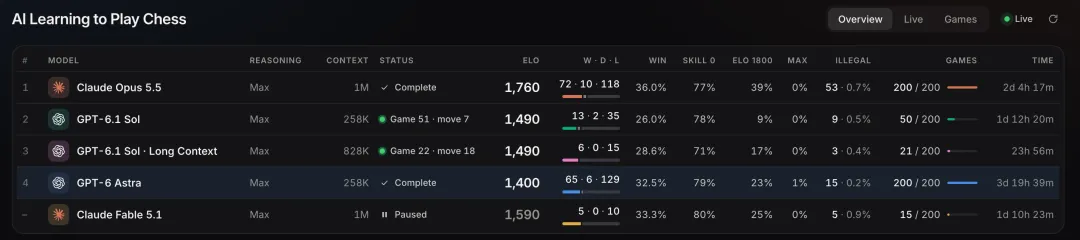
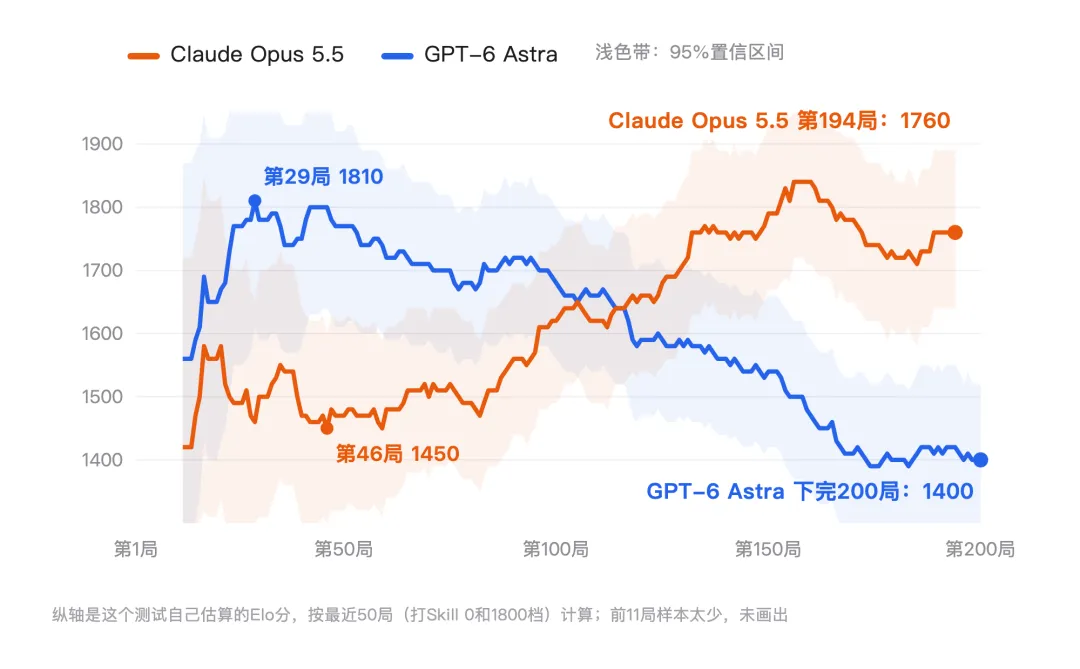
Claude Opus 5.5's first 75 discs were also played below 1500 points, but 200 discs were completed, and the score had risen to 1760.
On the same list, the GPT-6 Astra is a bit miserable.
On the 29th, there were 1810 points left, down from 200, but only 1,400 points left.
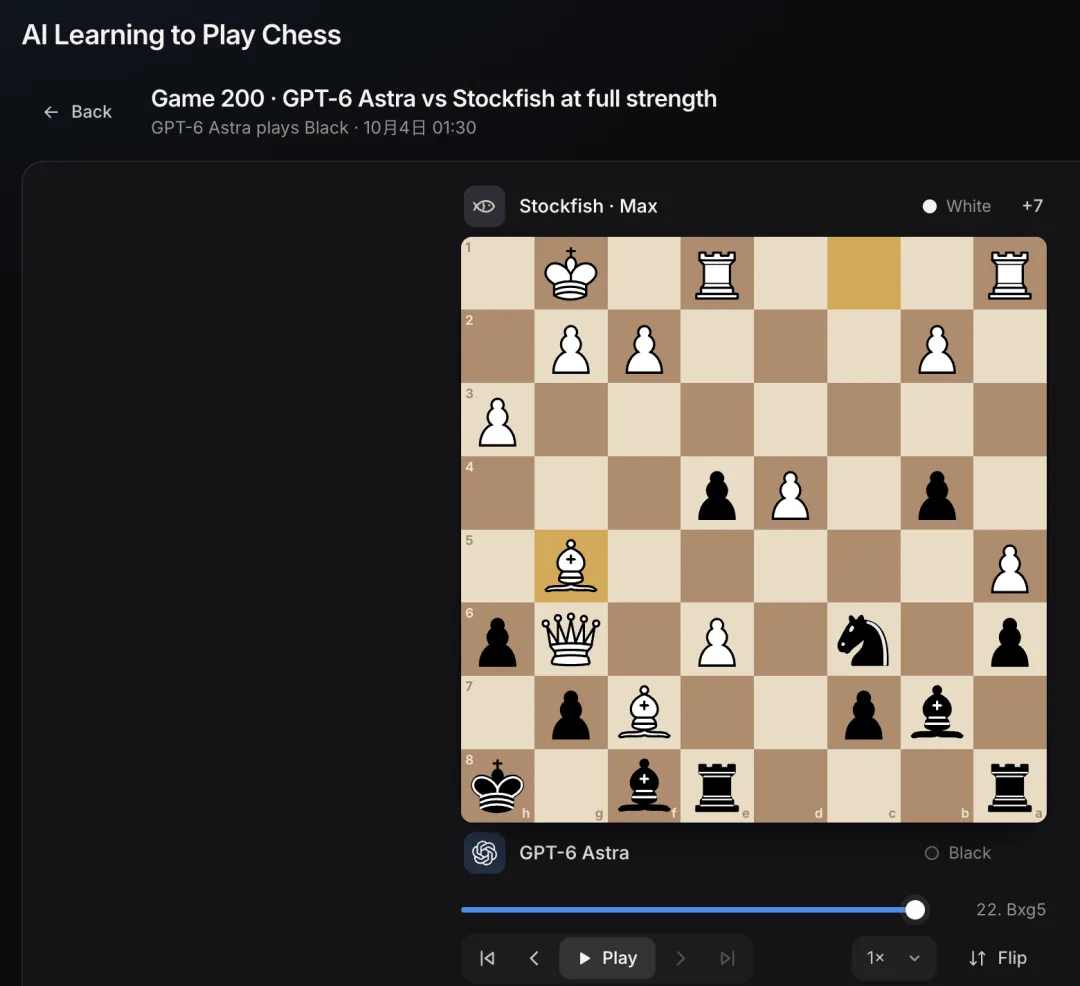
Against the bloodthirsty Stockfish, it dropped 68 sets and didn't win a single set.
In this round of experiments, no one designed chess lessons for them, nor did they update the model parameters.
The more Opus exercises, the more Astra exercises, the more she returns.
This "AI self-learning chess" experiment, from the hands of Peter Gostev, the head of AI capabilities at Arena's large model arena, exploded on X as soon as it was released.
And some netizens have noticed, isn't that the old "Time Cycle" theme on Reddit three years ago?
However, this time, the protagonist was locked in the loop and replaced by AI.
AI thrown into the cycle of timeThe original theme of the "Time Cycle" is a dead cycle for an ordinary person:
He only knows the rules, he has never played chess, but he must defeat the legendary chess player, former world champion Kasparov, in order to escape.
Every time you lose a set, the time is set again.
Kasparov does not remember the previous match, but he remembers clearly and can return to the game with his previous experience.

"Time Cycle" on Reddit: How many dice does it take for the average person to win Casparov, to escape the cycle?
At the time, netizens were brainwashed, and some calculated that violence would take longer than the life of the universe, and others came up with an accidental way to get Kasparov on one set, move the next one around, and play the master's chess.
Now, Gostev has really thrown AI into this cycle.
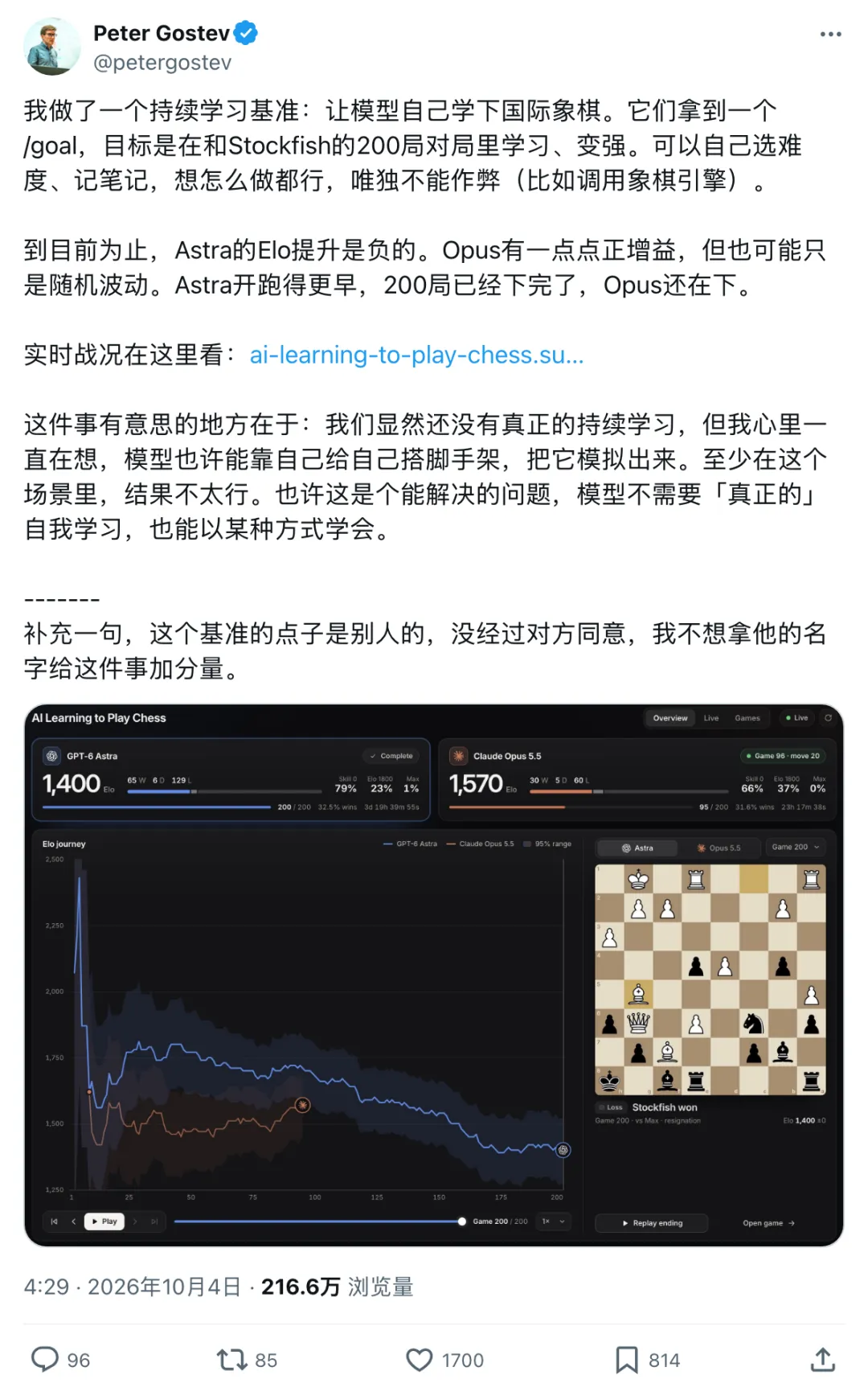
The rules are simple, with each model achieving the same goal, and Stockfish's 200 chess pieces to learn and strengthen themselves in the game.
Stockfish is currently the most powerful open-source chess engine in the world, and the human world championship is still in full swing.
In the experiments, it was divided into three grades, the weakest being Skill 0, limited to a moderate grade of 1,800 and filled with blood.
The model can choose the difficulty of the opponent.
Gostev also responded that models can win about a third of matches on average, and not every set challenges the full strength of Stockfish.
GPT runs through the Codex, Claude runs through the Claude Code. Choose what difficulty, remember what notes, try to decide as much as possible by the model itself, and minimize the author's interference.
The only prohibition: not to use a chess engine to play chess.
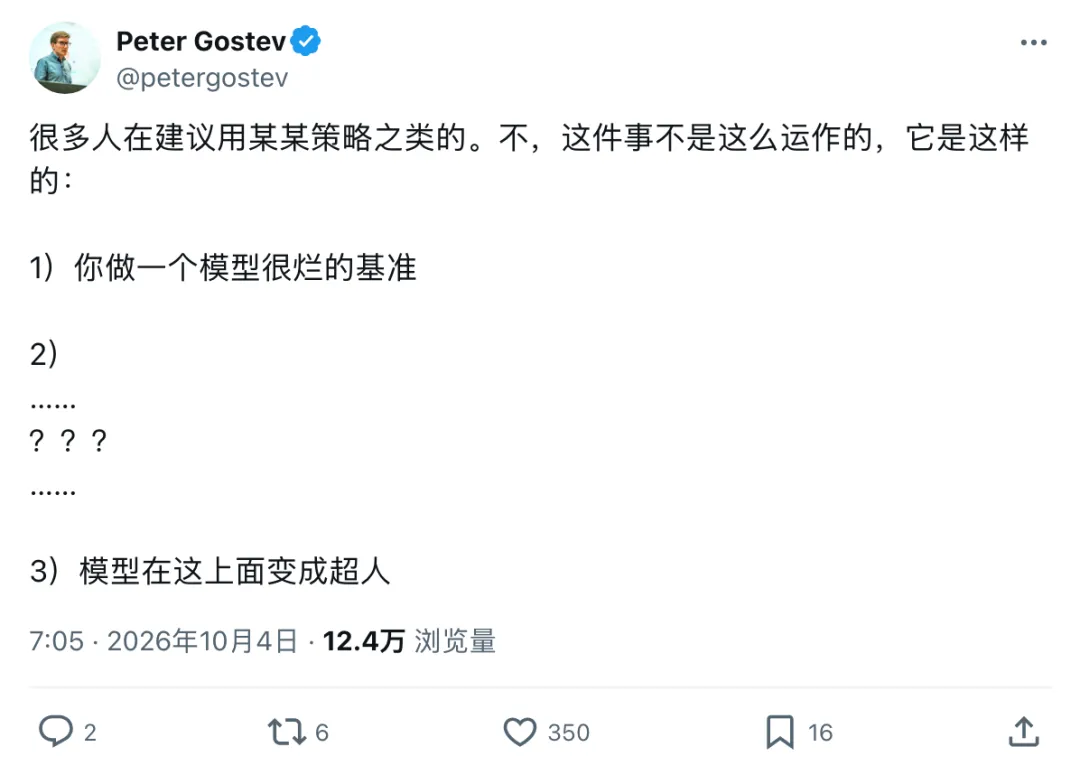
In the comments section, it was suggested to teach the model specific strategies, specific beginnings, which Gostev disregarded. He wanted to observe that it was the model that could not find its own way forward.
A notebook is the memory of an AI crossing a disc of counterparts.
Stockfish won't learn anything new from the previous record, but the AI can go through its own records and bring the previous experience to the next record.
However, the score should be clear first.
According to the page's statistical caliber, Elo is based on a performance estimate against Skill 0 and 1800 grades from the last 50 discs, and the full intensity grades are not involved in the calculations.
A score of 1760 here does not mean that AI has reached the level of a human chess player's 1760 points, but there is still some reference value to observe its lack of progress in experiments.
Opus: The lower the higherThe opening of Opus 5.5 is not a great song.
The first 75 came back and forth between 1450 and 1550, and the 46th came down to 1450.
In the middle, the wind began to mutate: the 100th disc 1620, the 150th disc 1790s, and the highest blow to 1840.
As of the morning of October 5, the score dropped to 1760 at number 194.
The results are not intuitive enough to see the score.
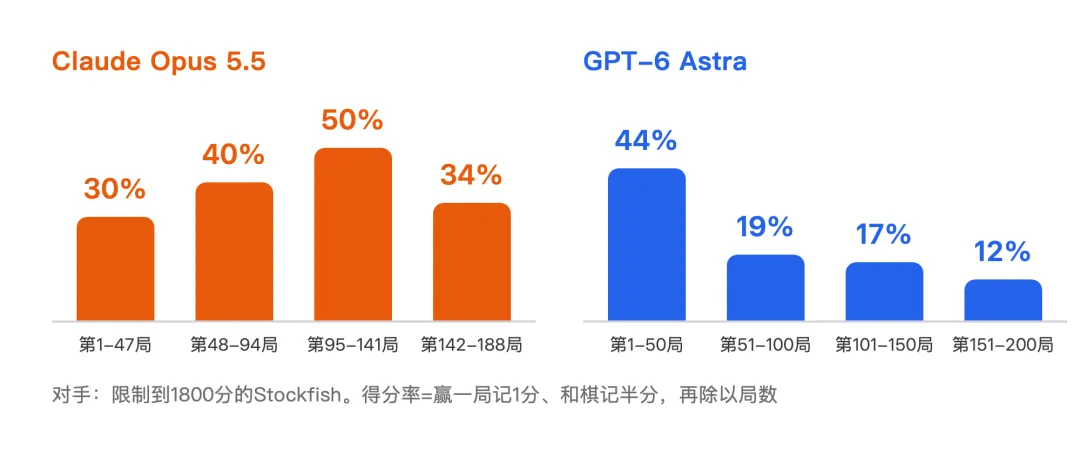
For stockfish in the top 1,800 grades, Opus's four-step score ranges from 30 percent to 40 percent and back to 50 percent.
The most recent segment, although it fell to 34%, is still higher than the start.
The weakest Skill 0 was practiced from more than 50% to 90%.
Gostev's own judgments have also changed as progress has been made.
In his original post, he also said that Opus "is gaining a little bit, but it may also be just a random fluctuation".
After ten hours, he changed his mind:
Opus, from about 1500 to about 1750, was a remarkable performance.
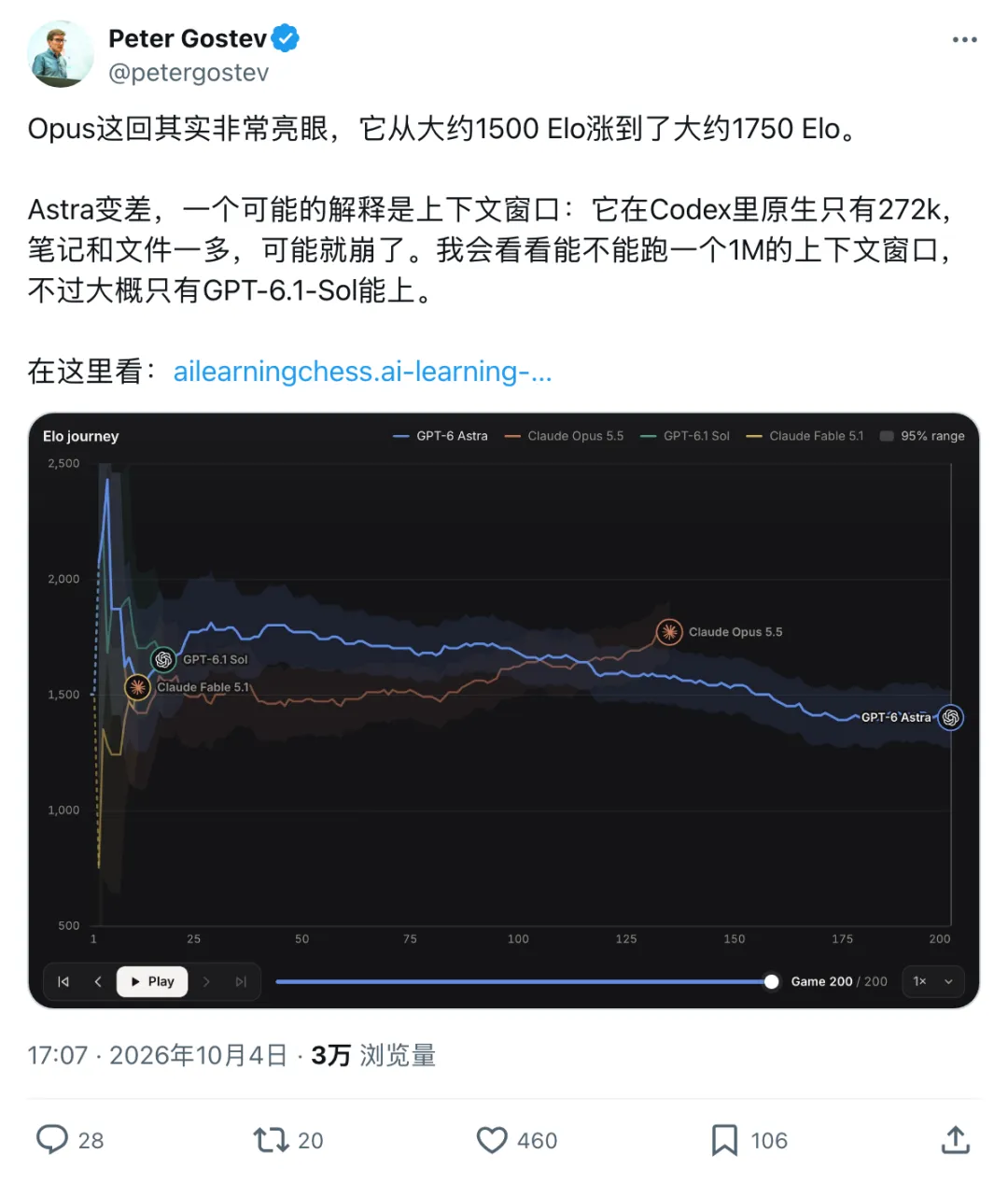
So much so, that the comment section questioned whether the model would stealthily write itself a chess engine.
Gostev replied that the results of the engine had been directly scrapped, and that he had personally checked that the Opus 5.5 was in fair play.

Of course, Opus wasn't wrong either.
The site is dedicated to statistics of chess models that want to go, but are not conforming to the rules. Opus has tried 52 times before and after, 37 of which were to have the chess player directly pass through the other chess players on the way...
The scores are stagnant, but the mistakes in the basic rules have not disappeared.
In Opus's notes, he wrote about how to arrange for himself to practice chess, which Gostev did not disclose.
What is certain is that it did not change the model or update the parameters, but instead raised the score in a set of matches.
Astra: The more you practice, the more you go back.The more trained the Astra is, the brighter the start.
On the 29th disc, it reached 1810 points. But then it began to lose points: the 100th disc 1680; the 150th disc 1540; the 200th disc stopped at 1400.
For the top 1,800 grades, it also dropped its scores in four phases from 44% to 19%, 17% and 12% respectively.
Even the weakest Skill 0 is fast moving, with the first 100 cards winning more than 90%, and the last 100 cards remaining only about 60%.
Although the same can be said of Opus, the result is: the longer you practice, the lower you get.
Gostev offers an explanation: the problem may appear in the above context window.
He said that Astra's native context window in this Codex configuration is 272k. As notes and files increase, there may be a slowdown in how the model handles these contents.
This conjecture is easily associated with the everyday experience of using AI: the more information is packed, the older the conclusions, the new requirements, the overturned judgments are mixed together, and the models begin to get the wrong focus instead.
However, the exact reason for Astra's fall cannot be directly attributed to the context. Contrasting experiments are needed to make this assumption a reality.
Gostev is also an activist.
On October 4, he posted that he was going to give the GPT-6.1 Sol test 1M in context.
Two minutes later, a SOL-specific runway was added to the website using the 828K context window.
GPT-6.1 Sol and Claude Fable 5.1 have been added, and there are now between ten and thirty discs, scored between 1500 and 1610, and nowhere to be seen.
Fable 5.1 has been discontinued after 15 discs.
 AI can't really get out of failure
Gostev is actually trying to figure something out.
He wanted to see if the model could not change the weight, only take notes, replicate, and become stronger in real warfare.
At least in this round of experiments, Opus 5.5 demonstrated this possibility.
Oriol Vinyals, former vice president of Google DeepMind, head of technology at Gemini 1.0 to 4.0, also commented:
In literary studies, the model is immobile weight, and you can only learn something new by plugging into the information in the context.
It's time to get back to the "time cycle" on Reddit.
If a challenger wants to escape the cycle by continuously practicing chess, he has to turn every set he loses into the next one.
The performance of Opus 5.5 shows this possibility.
If AI can accumulate experience and improve performance in a single attempt, it may not have to rely entirely on human retraining models.
The door to self-evolution may have been opened as a result.