The first co-author of the paper is Dai Meipo, Zhang Yuejiang, Xu Huiyang, and the author of the communication paper, Liu Xiaobo, a young professor at Southeastern University, whose research focuses on physical intelligence, computer vision and machine learning. The study revolves around robotic simulation of learning and generative action strategies, exploring the role of the distribution of learning resources on robotic operations.
In robotic simulation learning, scattering models and flow matching models are used to generate motion models as conditional samples, learn motion distributions from expert demonstrations, and generate motion sequences by iteration. These strategies have been used to clutter placement, tool use, and two-arm synchronous operations.
Generative robot strategies typically start from standard Gaussian distributions unrelated to current observation. Methods such as A2A, VITA, and others begin to use this body perception or visual information structure to generate start points, but mainly consider the start points to be estimates of certainty, not yet explicitly modeling its uncertainty. This raises a question: should the start point of motion generation be a deterministic value, or a distribution?
In response to this question, a team from Southeastern University's Honors Program raised the question:LeaP(Learnable source Prior)Leap combined predicted the mean and variance of the initial Gaussian distribution to provide state-related random initialization for motion generation. In 15 RoboTwin simulation operations, the average success rate was reached.81.6%The standard Gaussian line, which uses the same encoder and generator, is up 25.5 percentage points.
The relevant papers have been published by the International Conference on Robotics Studies.CoRL 2026Received, code is open source.
Where Should Action Generation Begin? A Learnable Source Prior for Generative Robot Policies
Link to the paper:https://arxiv.org/abs/2606.17408
Project warehouse:
The main page of the project:https://daimeipo.github.io/LeaP/
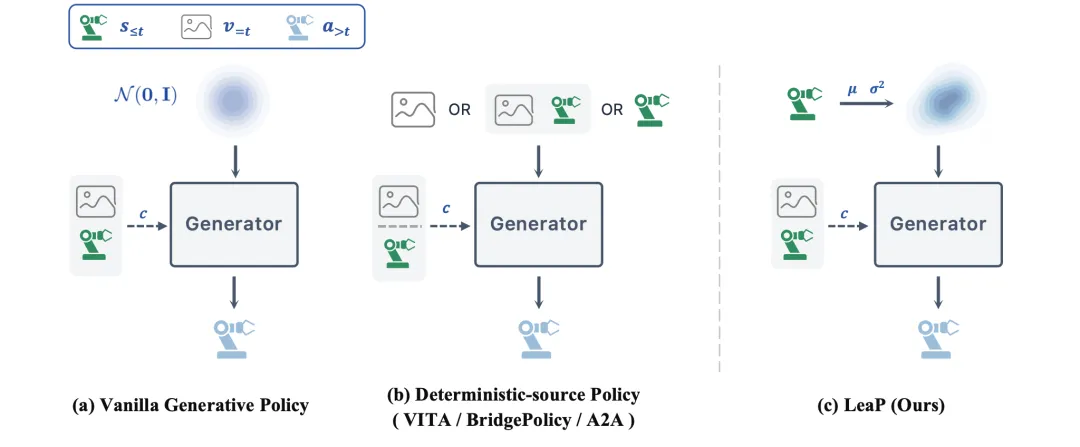
Figure 1: Three movements generate starting points: standard Gaussian noise, starting points determined by observations, and the probability distribution of LeaP learning conditions.
LeaP: A learning resource for action-generated pioneers
The core design of LeaP was to replace the fixed standard Gaussian source distribution with the opposite Gaussian distribution under the conditions of physical perception, jointly learning its mean and variance. The predecessor provided random initialization related to the state of the robot, with the generator further combining visual and physical perception to fine-tune the information.
Specifically, Leap inputs the body's sensing characteristics into two layers of MLP precursors, the output mean and the variance of the parameters, constructing the opposite-angle Gaussian distribution. The mean determines the distribution center of the initial sample, and the variance controls the degree of dispersion of the sample in each of the dimensions of the movement, both of which together adjust the state of the robot.
In actual sampling, the model scales the standard Gaussian noise step-by-step, plus the predicted mean, to generate a starting point. Both training and reasoning retain this random sampling process.
The precursor receives only in-body perceptual information, while the generator receives both visual and in-body perceptual characteristics. Both undertake initial distribution modeling and action refinement, respectively, to allow LeaP to access existing generators, keeping their architecture and reasoning unchanged.
Training uses three common objectives: flow matching loss learning from the source sample to the change of the expert action; negative-to-number loss supervision of the precedent's conditional probability distribution; and the correlation between the source sample and the paired expert action in the characteristic space in contrast to the aligned loss. The precedent and the generator are optimized end-to-end through these three losses.
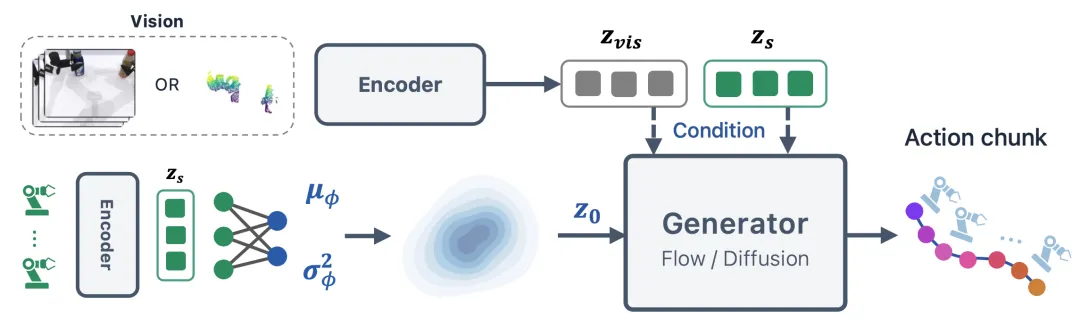
Figure 2 of the Leap Framework: The perception determines the prior distribution, and the vision and the perception co-direct the generation of action.
Test results and analysis
The team tested the design on 15 RoboTwin dual-arm operations, including crawling, placement, tool use and dual-arm collaboration. Each task used 50 expert demonstrations, each random seed evaluated 100 times, and ultimately reported the results of three seeds. All methods used the same DP3 PointNet dot cloud encoder.
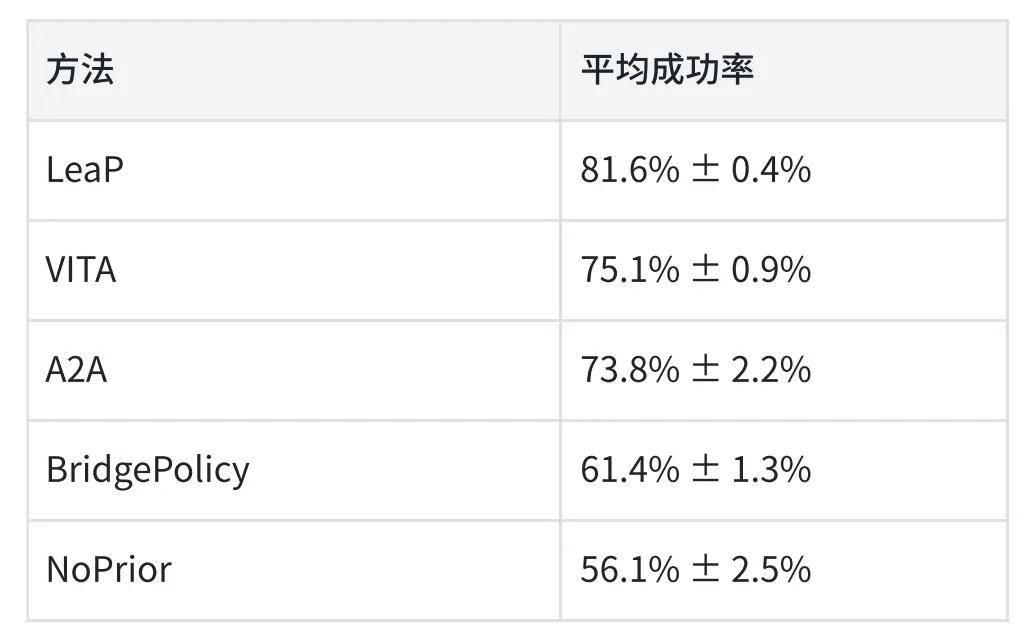
Table 1 shows the average success rate of 15 missions, reporting the mean and standard deviation of 3 random seeds. BridgePolicy is a version of the research team based on the original paper.
The most direct control comes from NoPrior: it shares coders, generators, and flow matching processes with LeaP, starting with Standard Gaussian.A gap of 25.5 percentage pointsLeap also outperforms VITA and A2A, which use determination starting points, by 6.5 and 7.8 percentage points, respectively.
In terms of model size and training efficiency, the total parameter of LeaP was 13.22M, of which the predecessor was about 0.21M, accounting for about 1.6% of the total. In experiments with laptop tasks, the LeaP training 1000 rounds achieved a 91% success rate, demonstrating the potential to improve sewing efficiency after 3000 rounds of performance over four main baseline training rounds.
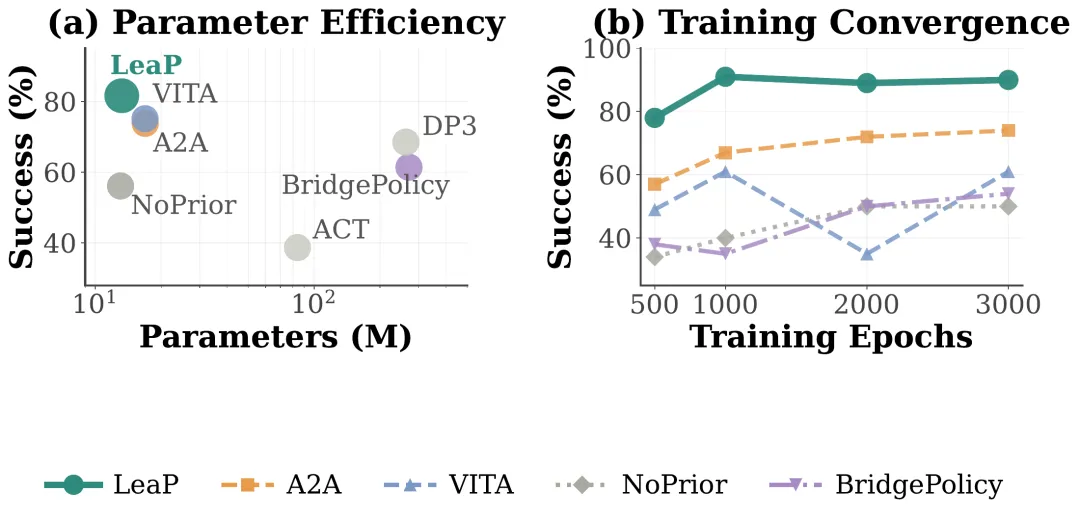
Figure 3 Model size and training matching contrast. Left: The parameters of each method are equal to the average success rate of 15 tasks, including methods such as ACT, DP3; right: in laptop tasks, the success rate of each method varies with the number of training rounds.
This trend is also seen in real-world mechanical arms. In the three tasks of grabbing squares, closing boxes, grabbing and placing sandbags in Franka Research 3, 100 remote-operation demonstrations were used and 20 random object position tests were performed.80.0%This was higher than A2A's 68.3%, VITA's 56.7% and NoPrior's 46.7%, up 33.3 percentage points from NoPrior.
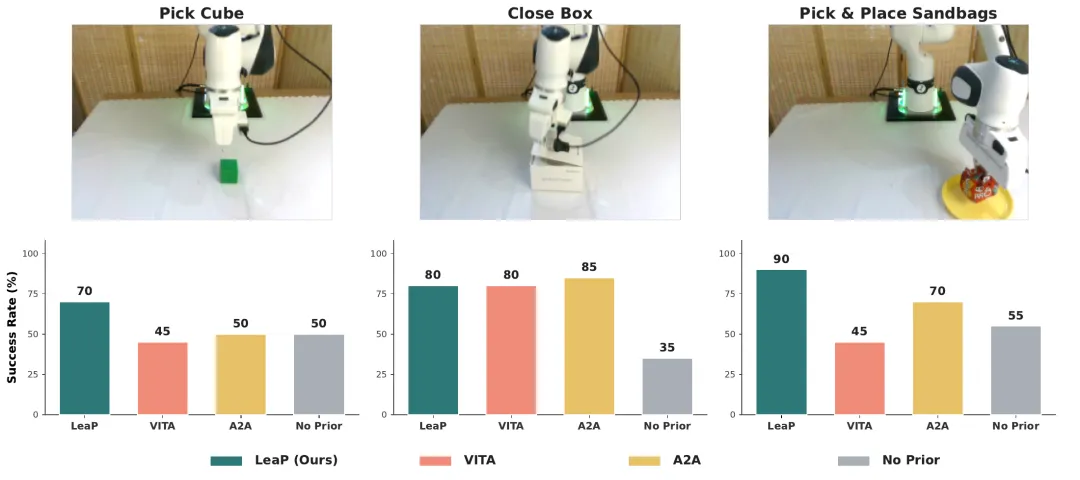
Figure 4 shows three operational missions and the success rate of each method on the real mechanical arm.
Dissolving experiments: prior input, distribution form and training objectives
The study examined prior inputs, distributions, and monitoring objectives through a fusion experiment. The experiments were conducted on three RoboTwin missions: grabbing different bottles, opening laptops, and connecting blocks, each evaluated 100 times.
What information should be conditional on prophecy?Keeping the information received by the generator unchanged, only adjusting the input of priorities. The average success rate of the LeaP sensed only with this body was 85.3%, while the visual and three vision and state convergence schemes were 59.3% and 70.3% respectively. Neither of the three convergence methods led to an improvement, indicating that the decline was not a specific phenomenon of some convergence method. Source distribution visualization further shows that the body sensing priorities are similarly placed near the target movement, while the variables that introduce visual characteristics are easily deviated from the target. These results support the work in the paper: the priorities determine the starting points associated with the movement based on the state of the robot, and the generators then combine visual information processing operations.
What form should prophecy take?All learned precedents are superior to standard Gaussian lines, but in this group of experiments, the stronger all-coordinate Gaussian and Gaussian hybrid models do not exceed the LeaP counterpart Gaussian. More important is a set of three-way controls: the success rate is 78.0% when the predicted mean is used alone; it drops to 62.7% after adding a fixed standard Gaussian noise of 1; the combined learning mean and state adaptation ratio is 85.3%. This suggests that randomness alone is not enough; learning with uncertainty about the current state is more effective than directly adding a fixed amplitude noise.
What supervision should a prophet receive?The average success rate was 59.7%, higher than the unprecedented baseline of 47.7%, but still lower than the 85.3% of the complete model. The learning predecessor itself had gains, while explicit supervision further improved its effectiveness: removing parallel or similar supervision, the success rate dropped to 74.7% and 74.3% respectively.
Universality of cross-generator.The same predecessor increased the average success rate of flow matching from 47.7% to 85.3%; in the diffusion bridge, the complete LeaP distribution increased the success rate from 68.7% to 76.7% compared to the predecessor average determination starting point. The former showed the overall benefits of replacing the standard Gaussian source, which suggests that the learning state adaptability gap can still lead to improvement on the basis of existing state-related averages. This supports the source distribution as a replicable design module, complementing with generator design.
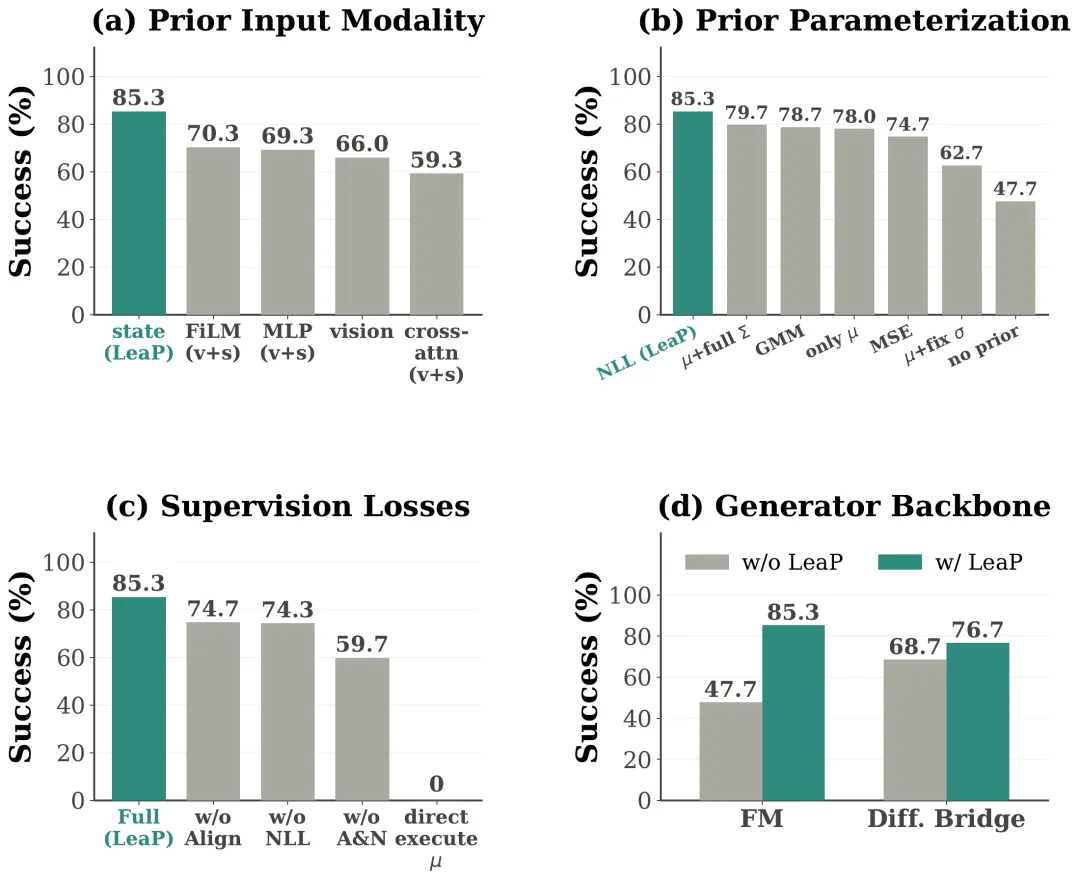
Figure 5 provides preliminary input, distribution formats, training oversight and generator type dissolution results, reporting the average success rate for the three tasks.
Summary
LeaP incorporated the source distribution into the design of generative robotics strategies, providing learning randomized initialization for action generation through the use of mediums and squares associated with light network combined learning states. Simulation, real-world mechanical arm and cross-generator experiments have confirmed the effectiveness of this design. Current testing focuses on desktop operations, with no apparent correlation between the dimensions of the action modeled by Cygus; more complex precursor forms and robotic forms are still to be explored.